“Oh, That My Words Were Recorded” (Job 19:23-27a)

“Oh, that my words were recorded,
    that they were written on a scroll,
that they were inscribed with an iron tool on lead,
    or engraved in rock forever!
I know that my redeemer lives,
    and that in the end he will stand on the earth.
And after my skin has been destroyed,
    yet in my flesh I will see God;
I myself will see him
    with my own eyes—I, and not another. (New International Version)

The biblical character Job expressed a feeling that all of us, at one time or another, have likely felt: Longing for someone to actually hear our voice, our words of grief, listen to them, and not let them fall into oblivion as if we were alone on this earth.

Job was hurting like no one before or after him. His grief was palpable. His pain was deep and intense. Not knowing what the heck was going on, he had zero understanding of why complete calamity came upon him.

Job’s family was killed, all but his wife. He lost all his earthly possessions to either theft or disaster. And his body was wracked with painful sores that covered his entire body. He was as miserable as one person could be. It was grief stacked upon grief.

In that misery and pain, after losing everything, Job didn’t want his words to be lost. He wanted them to be heard and remembered. Job needed to know that his voice was real, that he was not just speaking into the air.

This gets to the heart of what every grieving person likely wants: For someone to listen to their story of loss – for that story to be heard, listened to, and taken seriously.

I know the feeling. And I know it a bit more intimately than I would like to.

In this past year I was diagnosed with a health disorder that prevented me from continuing to work in a job I absolutely loved. This precipitated a move to another state to be near family. And there are many more losses and griefs to go along with all the changes in my life.

Going through circumstances that we neither asked for nor wanted is hard, especially when it involves significant losses. Without facing our grief, like Job did, we may end up losing ourselves and becoming lost or stuck in that grief.

Rather than me blithering on about the need for vulnerability, I myself will be vulnerable. One of the ways I accept, cope, and transcend hard stuff is through journaling. Here is a portion of my journal from today, unedited:

“I can feel myself sinking down toward the abyss. The darkness is beginning to overwhelm me. Everything – the changes, the transitions, the grief, the state of all things – is too much.

“Lord, have mercy.

“And so, I write, in the hope that my grief and big feelings of loss and of lostness will somehow fade into the background – not the foreground – of my life. Yes, it’s all a part of me. A very important part. And I never want to disavow it. Yet, it is only a part, and not the whole of me.

“Maybe that’s the thing I need to know and remember this day – that grief is not all of me; doesn’t define me as a person; and need not rule my life. There is some sort of ‘sweet spot’ in all this, in which I vulnerably and forthrightly acknowledge and talk about my grief without stuffing it away into an internal junk closet. But also, I do not necessarily focus on it as if grief is all that I am.

“Rather, I’m (like all other people) a complicated soul made up of many moving spiritual and emotional parts.

“It is ironic that a guy who once talked to grieving people on a daily basis is now grieving the loss of no longer talking to grieving people on a daily basis. Yet, here I am.

“One of the reasons I derived so much fulfillment from doing grief work with others is that it is so very much needed! I live in a society where everyone wants you to be okay, likely because they themselves are so very uncomfortable with grief and don’t know what to do with it. So, many people simply want everyone to be ‘normal,’ whatever the heck that actually means.

“Loss is painful, and no one (including me) wants to hurt. But the pain won’t go away magically. I (and everyone) must face the hurt, walk into and through the pain in order to feel better.

“To open-up to the unique pain of loss is the only way to realize emotional healing. In order to move on, we’ve got to stop trying to move on. Instead, let it out.

“In writing this I’m reminding myself what I’ve told hundreds of patients and parishioners who were going through their own unique circumstances of painful loss. Strength is found in embracing weakness, and not by trying to soldier on as if loss doesn’t bother me. It’s okay to grieve. And it’s okay to grieve any sort of loss. It’s more than okay; it’s absolutely needed.”

Eternally righteous God, merciful judge of all the living: In your love you called us to share the glory of Christ. Strengthen our hearts in every good work and word, so that we may be steadfast in your ways and always believe your truth. Amen.

Feeling the Pain (Job 23:1-9, 16-17)

Then Job answered:

“Today also my complaint is bitter;
    his hand is heavy despite my groaning.
Oh, that I knew where I might find him,
    that I might come even to his dwelling!
I would lay my case before him
    and fill my mouth with arguments.
I would learn what he would answer me
    and understand what he would say to me.
Would he contend with me in the greatness of his power?
    No, but he would give heed to me.
There the upright could reason with him,
    and I should be acquitted forever by my judge.

“If I go forward, he is not there;
    or backward, I cannot perceive him;
on the left he hides, and I cannot behold him;
    I turn to the right, but I cannot see him….

God has made my heart faint;
    the Almighty has terrified me.
If only I could vanish in darkness,
    and thick darkness would cover my face. (New Revised Standard Version)

Here is Job, sitting on an ash heap, of all things, and feeling like an ash. His children are gone, all killed by tragic circumstances. His wealth is no more. And now he is lamenting, because he can do nothing else; he has painful nasty sores covering his body that won’t let him do anything.

Job and his friends, by Ilya Repin (1844-1930)

And if that isn’t enough, Job’s “friends” come and end up giving him unhelpful speeches about how all this suffering is really his fault. They reasoned (wrongly) that there must be loads of sin in Job’s life for him to be going through such horror. God is punishing him, they insist.

Job’s companions had initially started out well. For seven days they sat with him in silence (Job 2:13). But then, after a week had passed, they just couldn’t take it anymore. They had the compulsion to speak. And when they opened their mouths, it was merely a bunch of ignorant gobbledygook.  

The friends, the companions, were themselves having an existential theological crisis. Their worldview was being challenged and threatened. So, rather than be open-minded and consider that their views may need to be altered, the friends acted like enemies, accusing Job of sin.

At issue was their clear and clean theology of believing that good guys are blessed with wealth, health, and happiness; and bad guys are cursed with poverty, illness, and misery – like Job.

They could not imagine or entertain the thought that God would let a good person suffer like Job was suffering. Therefore, Job must be bad, and they tried to find that hidden sin within him  to which he must repent of.

Yet, in truth, not all suffering – even terrible grinding suffering – is the result of personal sin or bad decision-making. Sometimes, good people suffer horribly, too.

Times may change, but people throughout the ages don’t. Today, we still think along the same lines as the companions of Job. There is far too much blaming of victims for their victimization; and way too many flippant beliefs which say to others in a terrible situation things like, “You reap what you sow.”

Job, through all of the loss, tragedy, and then suffering from his friends, held onto his integrity. Even though Job knew his situation was undeserved, he did not curse God, nor his friends.

Job made the incredible claim that suffering is not always the result of one’s personal sin – something he himself might not have said before his tragic experiences.

But just because Job did not curse, does not mean he was nice and okay with what unfolded in his life. He wished he was never born. He felt like death would be preferable to living. He contended with God, and longed for justice. His ultimate wish was that God would just speak and say something, anything.

Job was hurting so terribly, that he had bitter words of despair for God. He could make absolutely no sense of what was happening. He could not understand why he was the brunt of so much suffering. It felt like God was attacking him, and he said so.

The silence and absence of God were palpable for Job. He longed to speak with God. And his greatest lament – out of all the reasons to lament – was the horrible feeling of being alone without God’s presence and consolation.

It is interesting that we have no mention in the story about Job’s friends speaking directly to God, or praying to God, or addressing God in any way.

They certainly felt free to tell Job who God is, and how God operates in the world. But there was never any intercession for their friend, and no words of crying out to God on behalf of Job. There was only words of rebuke and chastisement, words of hurt that were as painful as the physical sores on his body

The phrase I hear most often from people speaking to the person in grief and pain is, “You just need to be strong.” And a close second is, “Everything happens for a reason.” The latter phrase is simply unhelpful, and the former phrase is actually hurtful.

It is not a sin to be weak. Just in case you read that sentence too quickly, I will say it again: It. Is. Not. A. Sin. To. Be. Weak!

We understand that when someone breaks a bone, they’ll be limited with weakness for a while. And we make helpful accommodations to that effect. But when someone’s heart is broken, and their life emotionally shredded, we expect them to be strong for everyone else around them.

It may be true that everything happens for a reason, yet most of the time, none of us knows the reason why we’re going through what we’re going through. And we probably won’t, this side of heaven.

If we try to have explanations for everything, then we join the company of Job’s companions who had to try and understand what was happening. And their conclusions were very wrong.

However, there is nothing wrong with weeping with those who weep; and expressing pain, grief, and even anger – both for the one who laments, and those who lament with them.

Pain cannot be relieved unless it is acknowledged, affirmed, and addressed by both the one who suffers and the community who surrounds them.

Where there is lament, there are loud words and expressions of grief. When lament is said to God, then God can hold that person, and rock them in the arms of mercy.

But silence is agonizing. We need friends who will listen and grieve with us. It is vital to have companions who voice to God what we cannot voice in our weakness. All of us, together, must hold onto God, and trust that the Lord hears, and will answer.

As Jesus cried out on the cross, I cry out to you in pain, O God my Creator. Do not forsake me. Grant me relief from this suffering and preserve me in peace; through Jesus Christ my Savior, in the power of the Holy Spirit. Amen.

How To Handle the One Who Grieves (Job 37:1-13)

The Wrath of Elihu, by William Blake, 1805

“At this my heart pounds
    and leaps from its place.
Listen! Listen to the roar of his voice,
    to the rumbling that comes from his mouth.
He unleashes his lightning beneath the whole heaven
    and sends it to the ends of the earth.
After that comes the sound of his roar;
    he thunders with his majestic voice.
When his voice resounds,
    he holds nothing back.
God’s voice thunders in marvelous ways;
    he does great things beyond our understanding.
He says to the snow, ‘Fall on the earth,’
    and to the rain shower, ‘Be a mighty downpour.’
So that everyone he has made may know his work,
    he stops all people from their labor.
The animals take cover;
    they remain in their dens.
The tempest comes out from its chamber,
    the cold from the driving winds.
The breath of God produces ice,
    and the broad waters become frozen.
He loads the clouds with moisture;
    he scatters his lightning through them.
At his direction they swirl around
    over the face of the whole earth
    to do whatever he commands them.
He brings the clouds to punish people,
    or to water his earth and show his love.” (New International Version)

Job’s Despair, by William Blake, 1821

On the one hand, the biblical book of Job needs little introduction. Many people know it has to do with a man’s innocent suffering and tenacious faith. Most folks are familiar with how it feels to suffer for no apparent reason. And everyone understands the struggle when life is broken by pain and loss.

Yet, on the other hand, the book of Job defies simple anecdotes about suffering. And the relationship between Job and God has a lot of complexity to it. Add in Job’s friends with their wordy offerings into his situation, and there becomes a fuller picture of the true wrestling of faith and patience that occurs.

Elihu was a young person who was with the three friends of Job. After listening to everyone speak, he himself went on a long speech, stretching six chapters from Job 32-37. He was angry with Job, and with Job’s three friends.

The young Elihu had picked up that Job thought of himself more righteous than God. And he was also upset that the “friends” offered nothing helpful, and could provide no convincing answers to Job – thus making it appear that God was guilty of Job’s intense suffering and grief.

Job, by French painter Léon Bonnat, 1880

In today’s Old Testament lesson, we are getting an end part of Elihu’s speech in which he sought to defend God’s justice through observing the majesty and order of creation.

The testimony of God’s sovereign governance of the world is found in the rain, the thunder, and the lightning; through the winter storms and the frost. The Lord uses the created order to both judge and sustain people. And through the ecological systems we can see that God is at work, regulating it all, and using it for divine purposes, Elihu points out.

What strikes me about Elihu’s words is that he is not wrong, he’s just not very helpful. As a believer, I look at his speech as more of a Captain Obvious moment; yes, he is stating theological reality, but no, he’s not really breaking any new ground or giving any great insight here.

Both Job and Job’s friends had already expressed a theological perspective in kind. Which makes me curious as to why Elihu felt so compelled to even talk at all. I think he would have been better remembered, and maybe even hailed as spiritual beyond his years, if he would have just kept silent.

I realize not everyone is going to go with me on that observation, and that’s fine. Yet it seems to me that a good many people lob too many words toward the suffering among us, when what is actually needed is a compassionate presence that has learned to be comfortable with the uncomfortable.

There are times when words are not needed, when the situation is so incredibly unique and/or difficult that to offer a speech is like yelling in the woods with no one around; it might make the one yelling feel better but that’s about it.

If anyone needed to feel better it wasn’t Elihu. What’s more, a perceived need of defending God’s reputation or honor perhaps betrays a shortsighted theology to begin with. The Lord is quite big enough to handle any rebuffs or misunderstandings from mouthy humans. God isn’t in Junior High School, requiring a mouthpiece to help him out in a scuffle.

I would personally rather give comfort to a hurting person, instead of theological exhortations and speeches about how we ought to talk to, and about, God. That’s because I observe Jesus bringing genuine comfort and help. And I would much rather take my cues for dealing with grieving people from Christ than from Elihu, or anybody else for that matter.

“God blesses those people who grieve. They will find comfort!” (Matthew 5:4, CEV) Jesus said this in his Sermon on the Mount, as a beatitude of all who desire God’s kingdom. Christ understood well the psalmist’s understanding of God’s role and stance concerning people’s grief: “The Lord is close to the brokenhearted; he saves those whose spirits are crushed.” (Psalm 34:18, CEB)

The Apostle Paul, taking a lesson from both his Jewish learning and his encounter with Christ said, “mourn with those who mourn.” (Romans 12:15, NIV) Comfort because of grief and suffering will be built into the end of time. Methinks, then, that this is important…

“Look! God’s dwelling place is now among the people, and he will dwell with them. They will be his people, and God himself will be with them and be their God. ‘He will wipe every tear from their eyes. There will be no more death’ or mourning or crying or pain, for the old order of things has passed away.” (Revelation 21:3-4, NIV)

In whatever way you choose to look at the book of Job, please don’t miss what is to be our response to another’s pain. There is a time for theological education, and there is a time to put a robust theology into practice through a very real comforting presence of another who is in terrible suffering.

God, the strength of the weak and the comfort of those who suffer: Hear my prayers and grant those who suffer in body, mind, or spirit the power of your grace, that affliction may be turned into health, and sorrow into joy. Amen.

Pay Attention to Grief (Genesis 49:29-50:14)

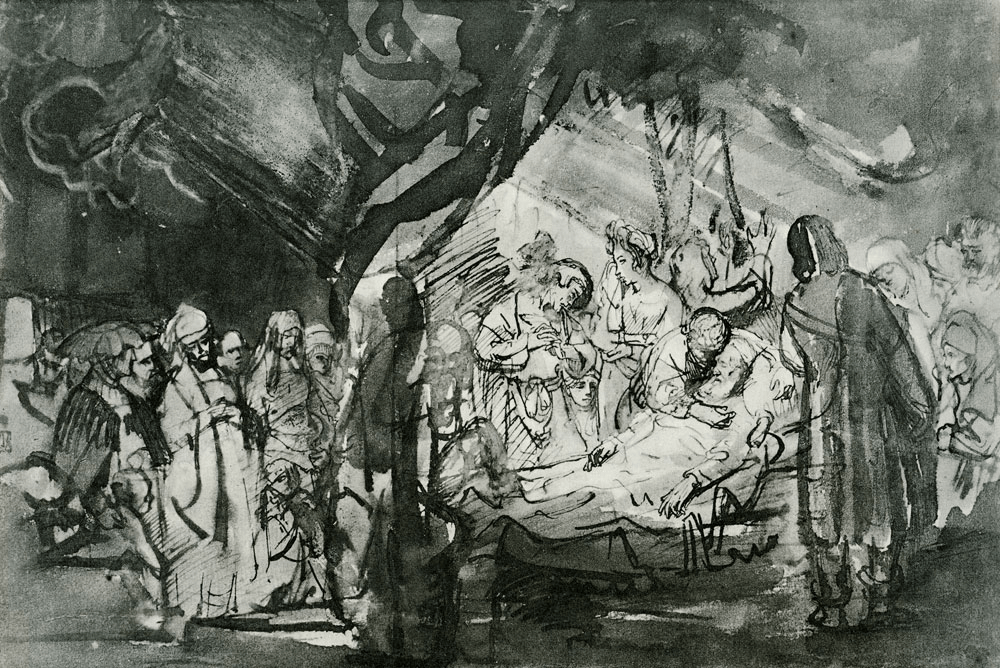
The Death of Jacob, by Rembrandt, c.1640

Jacob told his sons:

Soon I will die, and I want you to bury me in Machpelah Cave. Abraham bought this cave as a burial place from Ephron the Hittite, and it is near the town of Mamre in Canaan. Abraham and Sarah are buried there, and so are Isaac and Rebekah. I buried Leah there too. Both the cave and the land that goes with it were bought from the Hittites.

When Jacob had finished giving these instructions to his sons, he lay down on his bed and died. Joseph started crying, then leaned over to hug and kiss his father.

Joseph gave orders for Jacob’s body to be embalmed, and it took the usual 40 days.

The Egyptians mourned 70 days for Jacob. When the time of mourning was over, Joseph said to the Egyptian leaders, “If you consider me your friend, please speak to the king for me. Just before my father died, he made me promise to bury him in his burial cave in Canaan. If the king will give me permission to go, I will come back here.”

The king answered, “Go to Canaan and keep your promise to your father.”

When Joseph left Goshen with his brothers, his relatives, and his father’s relatives to bury Jacob, many of the king’s highest officials and even his military chariots and cavalry went along. The Israelites left behind only their children, their cattle, and their sheep and goats.

After crossing the Jordan River, Joseph stopped at Atad’s threshing place, where they all mourned and wept seven days for Jacob. The Canaanites saw this and said, “The Egyptians are in great sorrow.” Then they named the place “Egypt in Sorrow.”

So Jacob’s sons did just as their father had instructed. They took him to Mamre in Canaan and buried him in Machpelah Cave, the burial place Abraham had bought from Ephron the Hittite.

After the funeral, Joseph, his brothers, and everyone else returned to Egypt. (Contemporary English Version)

117 days. That’s how long Jacob’s family, along with the people of Egypt, mourned for him after his death. Yes, he was a patriarch. And yes, Joseph was the administrator of an entire nation. Yet this was not unusual behavior; it was normal.

When my mother-in-law was tragically and suddenly killed in a car accident, 30 years ago, I could not take any bereavement time off, because according to company policy, it was not my mother. So, since she lived a thousand miles from us, I had to use vacation time and take a week away. Then, when I returned to work, I was expected to pick up where I left off, as if nothing had happened.

Although I work under better conditions today, and workplaces are getting better at acknowledging the importance of tragic events in the life of employees, we still have a long way to go in dealing with grief, bereavement, mourning, and lament.

The modern funeral industry is a rather recent phenomenon in history. Beginning with, and then following, the American Civil War, death was a prominent specter, affecting every community and nearly every home. People like my second great grandfather became part of a growing business of handling the dead and providing services for grieving families. He became a coffin maker and a chief supplier for the burgeoning funeral parlor (which later morphed into a furniture business which lasted a hundred years).

Even though families needed help after a devastating war, over time, the unintended effect is that we became detached from death. Others could handle bodies and arrangements. We could choose to see or not see the dead. Folks began losing the ability to grieve and mourn their changes in life.

Grief doesn’t just go away with time. If it isn’t acknowledged, faced, accepted, and dealt with, it slowly begins to sit in the soul and rot. Eventually, it becomes spiritual gangrene; the person becomes bitter, without joy and stuck in unwanted emotions.

The point of all this is that grief and bereavement strikes us all; none of us gets off planet earth without having to deal with the loss of significant people in our lives. And when it happens, it’s imperative that individuals and societal structures allow for the time and space to mourn.

The ancients were on to something which we need to recover. They discerned the importance of allowing grief to run it’s course, instead of us trying to master grief, get over it, and move on. Grief will be dealt with when it is dealt with. Trying to tame it is like attempting to bench press 700 pounds; it’s only going to crush you if you try controlling it.

I’m not agitating for a 117 span of days for everyone’s mourning. But I am insisting that we have conversations about grief and confront it, rather than ignore it. Because grieving doesn’t mean you’re imperfect; it means you’re human.

The way we move through our grief is by telling our story – which requires someone to listen. That only happens if we have created the space for it to occur. Expectations of moving-on will leave grief where it is, poisoning us from the inside-out.

The only way to the mountain is through the valley. The only way to make the pain go away is to move through it – not by avoiding it, pretending it’s not there, or trying to go around it. Pain and suffering are inevitable; misery is optional. And letting bereavement and grief have it’s way for a while is the path away from the misery.

You will heal and you will rebuild yourself around the loss you have suffered. You will be whole again, but you will never be the same. And that’s a good thing. It gives us the ability and empathy to extend blessing to others who will eventually face their own terrible loss. They will need someone to listen. And you will be there for them.

Lord, do not abandon us in our desolation. Keep us safe in the midst of trouble, and complete your purpose for us through your steadfast love and faithfulness, in Jesus Christ our Savior. Amen.