Guilt, Grace, and Debt-Collecting: The Parable of the Unmerciful Servant

Parable of the Unforgiving Servant by Nikola Saric
Parable of the Unforgiving Servant by Serbian German painter Nikola Saric

Then Peter came to Jesus and asked, “Lord, how many times shall I forgive my brother or sister who sins against me? Up to seven times?”

Jesus answered, “I tell you, not seven times, but seventy-seven times.

“Therefore, the kingdom of heaven is like a king who wanted to settle accounts with his servants. As he began the settlement, a man who owed him ten thousand bags of gold was brought to him. Since he was not able to pay, the master ordered that he and his wife and his children and all that he had be sold to repay the debt.

“At this the servant fell on his knees before him. ‘Be patient with me,’ he begged, ‘and I will pay back everything.’ The servant’s master took pity on him, canceled the debt, and let him go.

“But when that servant went out, he found one of his fellow servants who owed him a hundred silver coins. He grabbed him and began to choke him. ‘Pay back what you owe me!’ he demanded.

“His fellow servant fell to his knees and begged him, ‘Be patient with me, and I will pay it back.’

“But he refused. Instead, he went off and had the man thrown into prison until he could pay the debt. When the other servants saw what had happened, they were outraged and went and told their master everything that had happened.

“Then the master called the servant in. ‘You wicked servant,’ he said, ‘I canceled all that debt of yours because you begged me to. Shouldn’t you have had mercy on your fellow servant just as I had on you?’ In anger his master handed him over to the jailers to be tortured, until he should pay back all he owed.

“This is how my heavenly Father will treat each of you unless you forgive your brother or sister from your heart.” (Matthew 18:21-35, NIV)

It is unfortunate that one of the few guarantees in life is that someone will hurt you, and that hurt will tear a hole in your heart and last a long time.

When the hurt comes, we all must decide how to handle the issue of forgiveness. Oh, it’s easy to talk about forgiveness when you are doing fine – its another thing when you are hurt. One man, during a conversation with his Pastor, had this story:

“Nineteen years ago, this guy stole my wife away from me. They got married and moved to Florida while my life unraveled.  After I was arrested for assaulting a police officer, this guy smirked through the entire hearing.  When I was convicted, he flipped me the finger. I’ve hated him for nineteen years. He’s coming up here next week. I have a thirty-two-caliber pistol strapped around my ankle, and when I see him, I will kill him. I’ve thought about it. I’m sixty-three years old. I’ll get a life sentence, but I’ll also get free medical, a warm bed, and three meals a day.  I’m ready to end my life this way.”

We may wonder: “Why even bother to forgive?  Why even care about that person?” Emotional pain and angry hurt can be so deep that we see no need for forgiveness. “After all,” we might reason, “look at what that person has done to me!”

Jesus does not want bitterness to be the last word; he wants it to be forgiveness. The parable of the unmerciful servant is a piece of Christ’s teaching concerning “little people,” that is, people who are, by status, lowly and unimportant to others. The heavenly Father’s heart is one that cares deeply for them. They are lost, lonely, and languishing in pain. They need help. Jesus clearly explained what to do, giving a three-step process to privately go to others who have hurt us and win them back through reconciliation (Matthew 18:15).

The disciple Peter, ever the wondering, if not wandering disciple knows that if a person hurts someone, they might do it again. So, if a lost sheep is brought back to the fold, and then is offensive again-and-again, at what point do we say enough-is-enough and stop forgiving?

We as people can often feel a keen sense of “ought to.” We feel we ought to pay the debt we owe to others, and that others must pay us the debt they owe. This works on the emotional level just as much or more than any other arena of life. If we offend someone and they become angry, we believe we ought to make them feel better.  If someone angers us, we expect them to make it right and make us feel better.

The late Methodist scholar and author, Dr. David Seamands, said the two major causes of most emotional problems among Christians are: 1) The failure to understand, receive, and live out God’s unconditional grace and forgiveness; and, 2) The failure to give that grace and forgiveness to other people. I wholeheartedly agree with Dr. Seamands.

We have grace available to us in Jesus Christ through his death and resurrection. We cannot earn forgiveness.  Grace is free.  Equally true is the fact that no one owes us anything.  Grace is free for others, as well.

The Failure to Receive Forgiveness

In the end, was the unmerciful man in Christ’s parable forgiven?… No…. Why not?… Because he failed to understand forgiveness and receive it.  It was not the master’s fault; it was the man’s own fault. So, why did he react so mercilessly to a fellow person in debt? (The man’s debt was in the billions and could not be paid off, but the other man’s debt was just a few dollars). The unmerciful guy failed to grasp the master’s grace; he didn’t get it.  He thought he could work it off, and when the debt was canceled, he could not wrap his heart around such mercy. None of us can repay grace – it is free.

The inability to know and receive grace drives many Christians to the tragic treadmill of constant striving for perfection, achievement, and recognition from others. Many people refuse grace and instead try to get rid of their guilt through endless work – fueling the workaholic, motivating the addict, and animating much of the service done in the church and the world. The problem is not a lack of understanding sin or acknowledging personal sinful actions among Christians; the problem is what to do about it. Too many believers are trying to work-off their debt.

The Unforgiving Servant by American artist James B. Jangknegt

Here is a little test: Why do you do what you do? Why do you do good and right things?  Be honest.  Is it to truly worship and celebrate the Lord who has erased such a great debt of sin in our lives? Or, are we working to pay off a debt to God?  Am I striving to assuage my guilt? Are we searching to feel better through our service to others?

We can be so accustomed to operating according to guilt instead of grace that we don’t know what to with the absence of guilt – so we just go back to guilt as our default setting, like a dog returning to its vomit. Furthermore, the tragedy is compounded by insisting that others operate out of guilt, too.

Another little test: Are we content to simply ask people to help or to serve, or do we believe that there must be arm-twisting with some guilt to motivate them? Guilt and arm-twisting are inconsistent with the gospel of grace.  If we believe we must guilt our kids, family, co-workers, neighbors, or anyone else before they will do anything, then it is us who have a spiritual problem.

Ideally, we live and work out of a sense of gratitude toward God and not by guilt. Yet, there are always folks who continue to work out their unhappiness on other people by insisting they get on the guilt train along with them. We are unable to forgive ourselves, so we live with the guilt and try to pay off our debt, making ourselves and everyone else miserable in the process.

The Failure to Give Forgiveness

The unforgiven are the unforgiving. The reason the guy in the story responded so violently to a person who only owes him a few bucks is because he never really believed he was forgiven by the master in the first place. He could not envision a world in which his debt was paid. The unmerciful man was still operating as though life were a matter of collecting debts.

At the heart of many broken relationships and emotional conflicts is an insistence on debt-collecting. We want from others something they cannot give us. God in Christ erases the great debt we have, not some other person.  Yet, we go out and seek from others what only God provides. People are good at being people – but they make lousy gods. It is God who meets the deepest needs of our hearts – your spouse, children, friends, church, and community cannot do it. That is a job for Jesus. The watershed issue is grace – whether we can receive it, or not.  We cannot give something we have not first received.

It would be weird if a marriage vow went something like this: “I have a lot of terrific inner needs and inner emptiness and debts to pay, and I’m going to give you a marvelous opportunity to fill my Grand Canyon of insecurity and take care of me!”

Sometimes people have a nasty tendency to make idols of other people and look at them as though they owe us a debt of happiness, joy, and peace. For example, the weird marriage vow, if followed through with, inevitably will result in debt-collecting. A few years down the road the spouse says, “This is not what you were like when I married you… You owe me!” Our insecurity comes from the inability to receive grace. It is all about grace. Everything is about grace, not guilt and not debt-collecting because the debt has already been paid and the guilt has been erased.

Let us draw near to God with a sincere heart in full assurance of faith, having our hearts sprinkled (with the blood of Christ) to cleanse us from a guilty conscience. (Hebrews 10:22)

Conclusion

You and I are forgiven. There is no need to collect a debt which is already paid. The cross of Jesus Christ has taken care of the sin issue once for all, and not one person reading this is an exception to grace. Here is a final exam, to determine if there is someone we need to forgive:

  1. The Resentment Test: Is there someone you resent? Is there someone who has wronged you?  When you see them or think about them, do you have resentment in your heart?
  2. The Responsibility Test: You say to yourself, “I wouldn’t have this problem if it wasn’t for ________.”  This is passing the buck and believing that my happiness is dependent on another person. The truth is that no one is responsible for your emotional well-being and happiness except you.
  3. The Reminder and Reaction Test: Is there someone who “presses your buttons?” This is when we see or talk to a person who reminds us of someone else who hurt us, and we react to that person by transferring our anger and/or pain onto them.

The Pastor responded to the man mentioned earlier who had lost his wife to another man by saying, “Well, I guess it doesn’t matter if you go to jail because you’re already in jail.  The guy who stole your wife and smirked at your hearing isn’t in jail. You are. You are a prisoner of your own hate, and you are slowly killing yourself.”  A week after that conversation the man called the Pastor and said, “You know, I get your point.  I put the gun away.  I don’t want to spend the rest of my life in jail – and I want to get rid of this bitterness.”

The way to do deal with bitterness is through forgiveness. To forgive involves a long journey, just like every other aspect of following Jesus. Hopefully, by retelling the gospel of grace to one another week after week our hearts will be soft.  We will want to begin the journey to forgive others, stumbling forward with hearts torn by hurts, yet set free by grace.

May it be so to the glory of God.

Matthew 6:7-15 – The Lord’s Prayer

The Lord's Prayer

And when you pray, do not keep on babbling like pagans, for they think they will be heard because of their many words. Do not be like them, for your Father knows what you need before you ask him.

This, then, is how you should pray:

“Our Father in heaven,
hallowed be your name,
your kingdom come,
your will be done,
    on earth as it is in heaven.
Give us today our daily bread.
And forgive us our debts,
    as we also have forgiven our debtors.
And lead us not into temptation, but deliver us from the evil one.”

For if you forgive other people when they sin against you, your heavenly Father will also forgive you. But if you do not forgive others their sins, your Father will not forgive your sins. (NIV)

God knows what we need before we even ask him, which means that the Creator of the universe has his ear inclined to listen to us. The Lord desires, even longs for us to pray to him. Since this is God’s disposition every day, Jesus communicated to us a model way of prayer. This prayer exemplifies the values of Christ’s Beatitudes and reflects the priorities of God’s kingdom. The Lord’s Prayer is meant to be prayed often, mindfully, and with flavor.

Jesus gave us six petitions to guide us in our prayers: The first three petitions are priorities of God that set the tone for the next three petitions, which are centered in our problems of living in this fallen world.

Addressing God

Jesus gave us instruction of how to address God: “Our Father in heaven.” All the pronouns in the Lord’s Prayer are plural, not singular. We are to be concerned for both our own individual issues, and for the needs of the community, of the problems and situations of the world.

“Father” is an endearing and relational word. “In heaven” balances the closeness and nearness of our heavenly Father with his sovereign and transcendent nature. Our God is both near and far – a close friend as well as a holy king.  So, we address him with a proper understanding of who he is.

Three Priorities

  1. First Petition: “Hallowed be your name.”

“Hallow” comes from the root word for holiness; it is to sanctify, to set apart. God is concerned that his creatures revere him and treat him as the Holy One.

Notice the use of the verb: not hallowed “is” your name, but hallowed, or holy “be” your name. That is, Jesus guides us to pray that God’s name would be shown as holy through us by the way we live. The world sees a holy God when his people walk in holiness, reflecting his benevolent nature.

After Christ’s resurrection and ascension, the Apostle Peter encouraged a struggling band of young Christians:

So, you must live as God’s obedient children. Don’t slip back into your old ways of living to satisfy your own desires. You didn’t know any better back then. But now you must be holy in everything you do, just as God who chose you is holy. For the Scriptures say, “You must be holy because I am holy.” And remember that the heavenly Father to whom you pray has no favorites. He will judge or reward you according to what you do. So, you must live in reverence of him during your time here as “temporary residents.” (1 Peter 1:14-17, NLT)

  1. Second Petition: “Your kingdom come.”

We live in a fallen world that has come under the domain of dark forces. The unfolding drama of Holy Scripture is that God himself is on a mission to restore his creation to a benevolent rule and gracious reign. Jesus is the King, we are the subjects, and God’s realm exists wherever his subjects go.  And where his subjects go, they are to pierce the darkness by embodying the good news that King Jesus has overcome the demonic realm and brought us into God’s kingdom. The prayer and proclamation of this good news is of utmost priority to God.

  1. Third Petition: “Your will be done on earth as it is in heaven.”

God’s ethical will has been revealed to us by Jesus in the Sermon on the Mount with the Beatitudes as the cornerstone of his teaching (Matthew 5-7). God’s will is that Christ’s followers be humble; grieve over personal and communal sin in the world; act with gentleness instead of prideful condescension toward others; hunger after true righteousness instead of legalistic self-righteousness; show mercy; be pure in heart; pursue peace; and, rejoice when persecuted. All of this results in being salt and light in this dark world.

Furthermore, we are to reconcile with others instead of hold grudges; deal with our lust through accountability instead of making excuses for our mental adultery; cherish our spouse instead of taking the easy way out when problems arise in marriage; tell the truth at all times instead of shading it; and, love, not retaliate when personally hurt or insulted. This is God’s will, and if it seems an impossible task, that is because we need divine resources to live our Christian ethic. In other words, we need to pray!

These three petitions are priorities for God. They are three ways of essentially asking the same thing – that the full manifestation of God’s reign on earth be realized.  Thus, our prayers are not primarily to receive goods and services from God, but for us to render service to God. The priority of prayer given by Jesus centers in the advancement of God’s merciful rule, and the doing of God’s will.  These prioritized prayers are a burning desire to see God honored on earth as he is already honored in heaven.

The Lord's Prayer 2

Three Problems

  1. Fourth Petition: “Give us today our daily bread.”

It is our bodies that enable us to do God’s will, and so we must be concerned for them. We must have the necessities of life and daily sustenance to carry out God’s priorities for the church and the world. This is not a prayer for long-term luxuries, but daily needs.

In the ancient world, people were paid at the end of each day. Folks also shopped every day at the marketplace for their food (no fridge!). When there was a flood or a drought, it did not just mean high grocery prices; people faced starvation and death. They needed to trust God for today, and not worry about tomorrow.  Even though we do not always readily perceive our great dependence on God, we still are in divine hands and need faith.

  1. Fifth Petition: “Forgive our debts, as we also have forgiven our debtors.”

Sin is pictured as a debt. If someone has sinned (trespassed) against us, we must forgive them, thus releasing them from their debt.  To forgive does not mean to forget. Rather, we are not to hold the debt or the sin over someone’s head for the rest of their life.

The simple truth is that the person who is forgiven by God is a forgiving person. Our own forgiveness implies that we have done the hard work of repentance through identifying our sin and renouncing it. So, if we fail to forgive, it demonstrates a lack of change on our part. We cannot, then, be forgiven if we are avail ourselves of the grace which is freely offered.

The practice of forgiveness is of utmost importance to Jesus. Living the Beatitudes of Jesus and being a peacemaker means we are to squarely face our bitterness. Simply sweeping our hurt under the rug and not extending forgiveness only gives the demonic realm a foothold into our lives – which is why we are to pray the final petition….

  1. Sixth Petition: “And lead us not into temptation but deliver us from the evil one.”

Just as we have real physical necessities we must trust God for, we also have genuine spiritual needs which hinge on the issue of forgiveness – our forgiveness from God through Christ, and the forgiveness we extend to others who have hurt or offended us.

An unforgiving heart is the primary reason for the temptation to hate, seek revenge, and retaliate. If we have spent days, weeks, months, years, or even decades harboring an unforgiving spirit through anger, bitterness, and avoidance of facing our past trauma, we have embraced the dark side and need deliverance from evil.

The path to deliverance is through acknowledging the offense, receiving grace and forgiveness from God, and passing that same forgiveness and grace to those who hurt us. This is not about whether they deserve it or not; it is a matter of what I need to do.

Conclusion

A desire to see God’s agenda accomplished through the first three petitions leads us to seek grace and forgiveness, not giving ground to the devil. The truth sets us free; telling our secrets brings freedom. Apart from naming our shame, we will remain bound and in need of liberation. Tell your secrets to God in the prayer closet, and then tell them to a trusted friend(s). We pray, and we act on what God tells us in prayer.

The Lord’s Prayer is a model prayer. That means we use the six petitions of Jesus to frame our prayers in our own words, as well as say the words in our favorite translation of the Bible.

We are to pray this prayer continually, for in doing so it will shape our everyday lives, serve as a guide for how to live, and provide discernment in making life’s many decisions.  To be the church is to pray. To be a Christian is to pray. So, let us daily and in every way make use of our Lord’s Prayer.

Our Father in heaven,

            The One who is both near and far,

May your Name be shown as holy,

            through us, your people.

May others submit to your lordship,

            and become holy, too.

Help us to know your will,

            and to do it.

We need you God,

           so, provide our necessities for today.

Forgive us of our great and many sins,

            just as we forgive those

            who have sinned egregiously against us.

Lead us in paths of righteousness,

            which will shoo the devil away.

For you are the Ruler,

the Mighty One,

full of glory and grace.

Amen!

Matthew 23:29-36 – “Woe Is Me!”

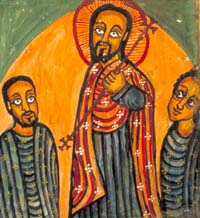
Ethiopian Jesus
Jesus, from an Ethiopian Orthodox Church, c.1750 C.E.

“Woe to you, teachers of the law and Pharisees, you hypocrites! You build tombs for the prophets and decorate the graves of the righteous. And you say, ‘If we had lived in the days of our ancestors, we would not have taken part with them in shedding the blood of the prophets.’ So, you testify against yourselves that you are the descendants of those who murdered the prophets. Go ahead, then, and complete what your ancestors started! 

“You snakes! You brood of vipers! How will you escape being condemned to hell? Therefore, I am sending you prophets and sages and teachers. Some of them you will kill and crucify; others you will flog in your synagogues and pursue from town to town. And so upon you will come all the righteous blood that has been shed on earth, from the blood of righteous Abel to the blood of Zechariah son of Berekiah, whom you murdered between the temple and the altar. Truly I tell you; all this will come on this generation. (NIV) 

I almost feel the need to place a warning label on this blog post: “The writer has determined that a careful reading of this Scripture is dangerous to those who think their current state of Christianity is just fine.”  Jesus stands in a long line of Old Testament prophets as the ultimate prophesier calling the people to see things as they really are and come back to the God of all, not the God of their own making. 

I feel yet another warning is warranted, knowing from years of experience that there is an Enemy of our souls: The dark forces of this world will try every which way to get us to believe these words of Jesus are for other people, not me or you – that you and I are okay and that this is for “those” people [probably ones we don’t like] who are clearly deluded. We, however, are simply fine.   

We all need these words from Jesus and to let them speak to us. Christ’s scathing and damning critique was leveled against a distorted spirituality, a false Christianity, a controlling leadership that stifled and snuffed-out the true worship of God. Jesus pronounced seven woes on the religiously pious spiritual brokers of his day. Today’s Gospel lectionary contains only the seventh woe. This woe, along with the rest, are not directed toward the irreligious or the spiritually lackadaisical folks among us – the woes are aimed squarely at the religiously committed. 

Ethiopian Orthodox Jesus
Ethiopian Orthodox Church depiction of Jesus

The word “woe” literally means “disaster” “calamity” and “misery.” Jesus pronounced a woe against ultra-religious persons who were obsessed with respecting the tombs and the graves of the ancient prophets. It was considered a terrible travesty to walk on such a grave, even accidentally. The concern about it would be something like today’s respect given to the American flag by many people. 

Here is what Jesus is getting at with his woe on those being so concerned with the tombs of the prophets: Honoring dead people and inanimate objects like graves while ignoring live people is not good. Respecting dead people of the past means nothing if we simultaneously ignore the live people right in front of us. For Jesus, one of the surest ways to hell is to give credence to Christian leaders long dead while flippantly disregarding the prophet or pastor presently in our lives who is taking pains to communicate God’s will and care for God’s people right now. 

Jesus knew quite well the telltale signs of hypocrisy: 1) hypocrites don’t practice what they preach; 2) hypocrites keep other people out of God’s kingdom; 3) hypocrites focus on externals; and, 4) hypocrites major on the minors. Hypocrisy, however, never has the last word – grace does. The final word to everything is God’s grace.  

For all of Christ’s severe words, his heart was filled with a love and a longing for his wayward people. Jesus died for the ungodly with deep concern, intention, and hope that everyone would come to know the true worship of God – filled with an abundance of mercy for the penitent sinner. 

When the prophet Isaiah experienced a vision of God his response was “woe is me!” (Isaiah 6:1-5). The appropriate response to today’s Gospel lesson is repentance – to see and turn from our own propensity toward spiritual and/or religious pride and the tendency to view the “other” as needing to repent, but not me.  

Let us, then, come to the cross of Jesus Christ and there find the grace which absolves us from such sin. Let us approach the empty tomb and find Christ’s resurrecting power of transformation. Let us approach the ascended Christ on the throne with both humility and confidence. Let us intercede for a world which desperately needs the peace of Christ. 

Lord Jesus Christ, you prayed that we would be one as you and your Father are one. We confess our resistance to your prayer. We have failed to maintain the unity of the Spirit. We have broken the bond of peace. For the times we have not listened to each other, when we have spoken in anger, haste, or fear, we are sorry. For the times we have not loved each other, when we have competed, or insulted or judged each other, we are sorry. For the harm that our disunity has done to our witness to the Gospel, we are sorry. Have mercy on us, we pray. Restore us to friendship with you and with one another, through the power of your Spirit. Lord, grant your grace for repentance to spiritual charlatans and victimizers; and, give your power to those distressed and victimized for forgiveness of their abusers, so that all of us together may strive to break the chains of oppression and show the peace of Christ in the world. Amen. 

Romans 12:1-8 – Healthy Group Dynamics

Transformed

Therefore, I urge you, brothers, and sisters, in view of God’s mercy, to offer your bodies as a living sacrifice, holy and pleasing to God—this is your true and proper worship. Do not conform to the pattern of this world but be transformed by the renewing of your mind. Then you will be able to test and approve what God’s will is—his good, pleasing, and perfect will. 

For by the grace given me I say to every one of you: Do not think of yourself more highly than you ought, but rather think of yourself with sober judgment, in accordance with the faith God has distributed to each of you. For just as each of us has one body with many members, and these members do not all have the same function, so in Christ we, though many, form one body, and each member belongs to all the others. We have different gifts, according to the grace given to each of us. If your gift is prophesying, then prophesy in accordance with your faith; if it is serving, then serve; if it is teaching, then teach; if it is to encourage, then give encouragement; if it is giving, then give generously; if it is to lead, do it diligently; if it is to show mercy, do it cheerfully. (NIV) 

Every person is important. Everyone is needed. Each one, according to this New Testament lesson, is to offer their entire lives to God through worship and the exercise of their spiritual giftsPeople are designed to be active in building up one another. 

When I was growing up, we had a fine china set that my parents kept in a beautiful china cabinet.  The set and the cabinet are old and were a prominent part of our living room. However, we almost never used it. I can only remember once or twice that my Mom got the china out to use. God is not looking for fine china that sits unused. He is looking for rough-and-tumble clay pots—the kind that can be used every day. God wants ordinary table-wear that can be handled in a crash-and-bang world.  

Followers of Jesus Christ were never meant to be a china cabinet, where precious pieces are safely stowed out of harm’s way. Instead, humanity is to be like a working kitchen, where well-worn pots are filled again and again to dispense their life-giving contents to a thirsty world; and, where common plates and cups are used again and again to provide a hungry population with the Bread of Life. 

Cup and Plate

Within the ancient Roman Church were both Jews and Gentiles – two groups vastly different from each other.  They tended to keep to themselves and only operate within their familiar and comfortable circles of friends and relatives.  But the Apostle Paul wanted them to be united by exercising their spiritual gifts for the benefit of the entire congregation, and not just certain persons. 

We are strongly encouraged to give ourselves in service to one another because of God’s mercy in Christ.  Since God has saved us from sin, we are to gratefully respond to him in worship that is dedicated to serving everyone.  The word “worship” in today’s text is where we get the word “liturgy.”  That is, Paul’s vision for the church was to have a daily liturgical rhythm of spiritual worship, not just on Sunday when we might pull out the fine china and impress people. 

Paul’s appeal was not to guilt people into serving but is an exhortation for all Christians to appropriately respond to God’s grace by offering their lives in sacrificial service. This is a form of saying “thanks” to God. To be oriented in a sacred liturgy that is fit for the daily will of God, our minds must be renewed. Through saturation in Scripture we discern our spiritual gifts, know what God wants us to do with those gifts, and use them effectively in the church and the world.   

Grace has been given to every believer in Jesus, not just a select few. We all have different gifts and have been graced with abilities for the benefit of others. When everyone collectively uses these spiritual gifts, there is the ability to know the will of God in any situation for any group of people. All the pronouns used in today’s verses are plural. There is to be a group dynamic which seeks to give minds and bodies completely to God in worship, using our spiritual gifts for building up one another, and discovering the will of God together. 

All believers in Jesus must share and work together by utilizing God’s grace, instead of getting burned-out because others are not serving. Grumbling about what others are not doing begs the question of whether we are over-functioning, or not. It could be that we have succumbed to the danger the Apostle Paul warned us about: thinking so highly of ourselves that we believe our gifts are superior to others, so we need to maintain our control and hegemony in the group. This is a terribly misguided notion.   

Body of Christ

We belong to one another.  Therefore, one major way of giving to God is through offering ourselves to each other with equity and without favoritism.  We must not separate Christ from his church.  To say that we need God, but do not need the church is to really say that we do not need God because the two are inseparable. Nowhere in Holy Scripture do we find individual Christians doing their own thing, isolated from a committed group of people, the church.  

When Jesus called people to follow him in service to God and a world in need, some gave him excuses that they were busy and had other pressing matters to attend to before they could follow him. Jesus simply left them and told them they were not fit for the kingdom of God. (Luke 9:57-62) 

When people were preoccupied with building wealth, or gaining power, or jockeying for influence, Jesus told them to stop it, exercise some faith, and seek first the kingdom of God.  Build your treasure in heaven, Jesus said, because it will be permanent; and, not on earth where it is temporary. (Matthew 6:19-34)  

We are graced by God with abilities which God fully expects us to use. “Cheap grace” is merely embracing Christ as a personal Savior but not welcoming him as the Lord in whom we must sacrificially give our lives to service in the church and the world. Spiritual health and vitality cannot exist apart from every person using God’s given grace to contribute to the functioning of the Body of Christ.   

spiritual gifts

The list of spiritual gifts Paul provided is not exhaustive but represents a combination of speaking and serving gifts necessary to bless humanity. Paul exhorted the church to not restrain people’s exercise of gifts but let them go at it, full bore:  

  • “Prophesying” is not foretelling the future but a word meaning “inspired speech” from God that addresses what God’s people are to do considering his Word.   
  • “Serving” is a generic word referring to all types of hands-on service.   
  • “Teaching” is needed to instruct the faithful in all the revealed will of God.   
  • “Encouraging” involves both speaking and serving, as the one gifted in encouragement comes alongside others and helps them to do something with both verbal coaching and tangible help.   
  • Giving” specifically refers to the person who lives a simple life to be able to give generously and contribute to the needs of others.   
  • “Leading” is the ability to get out in front and show the way in obtaining the will of God.   
  • “Mercy” is the much-needed ability to see down-and-out hurting people and be a conduit of God’s grace to them. 

Here is a simple observation: There is no one person who possesses all these gifts. That is why everyone must work together to have a spiritually healthy community.  A spiritually toxic community is the inevitable result of only a few people using their gifts. 

The Apostle Paul communicated some important truth about what faithful Christians must do to be transformed by a renewal of the mind: exercise godly sacrifice; commitment to worship; intentional unity; and, an awareness of our spiritual gifts. The following are some thoughts on becoming aware of our spiritual gifts:   

  1. Pay attention.  Every spiritual gift reflects God’s grace and character, and so, you will find joy and satisfaction in expressing it. Your spiritual gift will be a place of deep spiritual formation and growth in your life, as God uses it both to powerfully connect you to him and to expose areas of your soul that need his forgiveness and redemption.   
  2. Try.  Give it a whirl.  Take the step to connect with a service or ministry, or just try doing what you feel might be something God wants you to do.  Gifts are discovered more from others observing and affirming your gift and less than going through a research process.  The encouragers among us will be happy to affirm the gifts of others. 
  3. Develop.  All spiritual gifts must be cultivated and developed.  Paul told his young protégé, Timothy, to fan into flame the gift of God.  Put yourself in a position to be taught and mentored. 

We were designed by God for worship and service. We will find our greatest delight in life through engaging those two activities. The result is a spiritually healthy and thriving Christian community that loves God, loves one another, and loves the world. 

God of grace, I come before you today praying for your Holy Spirit to stir up the gifts already placed inside your people. God Almighty, I pray that whatever gifts your Holy Spirit has decided to give and put within me and those around me that those gifts be activated and used for your glory and the edification of others.  I pray for peace and joy in the community, that no one will be jealous or covetous about anyone else’s gifts. Lord God, I pray also as these gifts grow and develop that the fruit of the Spirit will be manifested, to ensure the gifts are ministered in love. May you receive all praise honor and glory from the gifts you give, through Jesus Christ, our Lord.  Amen.