The Parable of the Talents

The Parables of Jesus by Argentine artist Jorge Cocco Santiago, 2018

What would you do with a million dollars?…  Maybe you would pay off some debts, finish some work on your house, or quit your job and take a vacation. Perhaps you might invest a good portion of it. However, your investment is only as good as your level of trust.   

When I worked at a senior citizen healthcare facility, there was a resident with an apartment in independent living, but he still owned his house. During one conversation, the old man admitted to me that over the past sixty years he owned his house, he had secretly bored holes in every door jamb of the house and had stuffed away $100,000 dollars in cash!  This dear resident had personally experienced the run on banks which began the Great Depression in 1929. He had zero trust for investment banking. 

A “talent” in Christ’s day was a monetary denomination.  A talent was worth 6,000 denarii, and one denarius was worth a day’s wage.  So, in Christ’s parable of the talents, Jesus was talking about millions of dollars (in today’s money) with the master who gave his servants five talents, two talents, and one talent. (Matthew 25:14-30) 

As Jesus was telling his parable, one of his chief points was to communicate that God is gracious and generous.  The three servants responded their master’s generosity according to their view of him.  Two of the servants regarded the master as gracious and generous, and so, freely took their talents and confidently invested them to create even more money.   

The two faithful servants took risks and acted with the idea that they were secure in their relationship with their master.  However, the third servant’s perception of his master was different.  This servant discerned his master as stern, serious, and angry, so therefore, he did nothing with his talent – he was afraid. 

The man was fearful because his view of the master was off.  If we consider God as primarily an angry Being, then we will almost certainly not use the gifts he has given us, for fear of messing up and experiencing his wrath.   

However, the truth is, God is gracious and generous.  The Lord has mercifully gifted everyone and expects us to use those gifts and not hide them away in a door jamb!  God wants us to actively display grace and generosity – which will require addressing our fears. If we want to hear the Lord Jesus say, “Well done, good and faithful servant,” then taking initiative is necessary. 

Fear is perhaps the greatest block in preventing God’s people from being productive Christians in serving the church and the world.  Beneath our fears are powerful feelings of inferiority, inadequacy, and an inner conviction that we are not enough. Oftentimes, a low view of self can come from a low view of God. 

Fear paralyzes our potential to serve God’s kingdom.   

Being continually afraid, drains our energy and lessens whatever impact we could have for God in the world, diminishing our resolve to act and leaving us ineffective in service. 

Fear destroys our dreams and godly desires.   

We are meant to enjoy the gracious and generous God, and in our enjoyment of the Lord, godly dreams will be placed within us that God is pleased to fulfill: 

Take delight in the Lord, and he will give you the desires of your heart. (Psalm 37:4, NLT) 

Our enjoyment of God gives us the security and confidence to act upon godly desires and produces a generous harvest of righteousness and peace. We then can share the bounty with others, as a way of giving back to God.   

Yet, if fear gets thrown into the mix, it dilutes and destroys everything.  Fear paralyzes us, and we do nothing, like the third servant in the parable.  What is more, fear can force us into hiding, just like the servant hid and buried his talent.   

In the Old Testament book of Numbers, the Israelites were immobilized by fear.  God had a grand vision and a big dream for the people to enter the Promised Land.  But ten of the twelve spies who came back after checking out the land were paralyzed by fear.  “The land has giants, and we are like grasshoppers!” they nervously said.   

Caleb and Joshua, however, had a different view of taking the land because they had a different view of God.  They didn’t see giants – they saw a gracious and generous God who could easily take care of whoever might be in the land, and they wanted to act on the faith they had in a mighty and merciful God.  The God of the other spies wasn’t big enough to handle the giants.  Their low view of themselves as grasshoppers betrayed their low view of God. (Numbers 13:26-33) 

We might wrap a lot of our fears in morbidly sanctified self-belittling.  That is, we might feel good about feeling bad and wrap ourselves with a blanket of secret shame. As a result, those self-deprecating feelings stop us from exploring God’s dream and vision for us.   

We could use some bold God-sized dreams!  We can speak and act in the world with confidence because we serve a God who sees giants as gnats. 

Some of the greatest fears that hold back people from exploring their faith is: 

  • Fear of criticism – being afraid of what others may think or say.   
  • Fear of taking a risk – being afraid of going outside the comfort zone of how something has always been done.  
  • Fear of ourselves – being afraid to explore our vast inner world with its guilt, shame, insecurity, and mixed motives. 

Fear snatches away God’s dreams for us.  If you once had a dream and you think that dream is dead because of your sins and bad habits, you are misguided.  Dreams evaporate because of fear, by being duped into believing that we are not enough, and never will be. So, we end up doing nothing. 

Fear ruins our relationship with God and others. 

Living a spiritual life, meanwhile always looking over our shoulder to see if God is going to sneak up on us and rap our knuckles with a ruler, is no way to live.  I think the hardest people to get along with are those who have a low view themselves.  Because they do not like themselves, they do not like others. They continually wonder if God is upset with them about something.  The man in the parable blamed God for his own lack of investment.  Yet, blame shifting is really our own fear and insecurity seeping through onto others – it helps no one, especially ourselves.   

God wants us to bloom with the talents given us.  God wants us to shine and succeed. God is on our side, has our backs, and wants us to live a good life. 

Fear sabotages our service. 

“I can’t!” is the cry of the person locked in fear.  I cannot stand up in front of people, meet strangers, sing, serve like that other person can or love like Jesus did.  I cannot because I am afraid, and I only have one talent!   

Perhaps you have observed that God typically uses tongue-tied people, worriers, and those with a sordid past – and not superstars – as servants commissioned with a set of talents. The less a person has, the more God shows up and shows off with generous power and gracious ability through that person. 

Nothing sabotages serving more than being afraid, worried, and believing we have so little. Give God a chance!  Step out.  Take a risk.  Act on that dream. 

Conclusion 

Once in a small village in India, a farmer brought to the open-air market a whole covey of quail, with a string tied around a foot of each bird.  The other end of the string was tied to a ring on a central stick.  The quail were all walking in a circle because of the strings on their feet.  As the day went on no one seemed interested in buying the farmer’s quail.   

Finally, an old man came and bought every one of the quail.  After he bought the quail, the old man told the farmer to cut the strings and set all the quail free.  So, the farmer did.  But none of the quail flew away.  They kept marching around in a circle as if they were still tied to the string.  Finally, the farmer had to shoo them away to get them to move, and even then, the quail landed somewhere else and just started marching in a circle again. 

God has freed and forgiven us.  Yet, we can so easily remain tethered to imaginary strings and march around in vicious circles of fear, afraid to venture into the unexplored world God has for us, to spread our wings and be free. 

God loves you.  God has wonderful plans for you.  God created you with your unique personality, gave you unparalleled experiences, and gifted you with uncommon abilities. God wants you to tap into that passion and dream placed down deep in your heart to serve the world.   

What would you do with a million dollars?  You already have it.  Now, go and invest it. 

Joshua 20:1-9 – Asylum

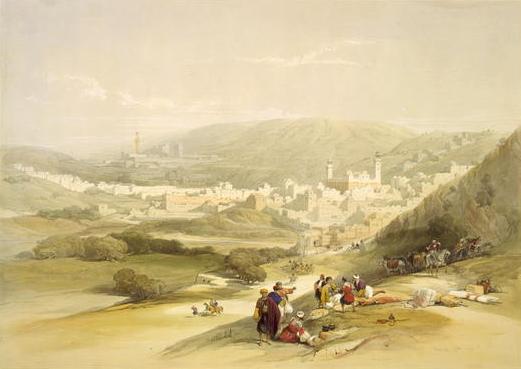
A painting of Hebron, one of the cities of refuge, 1839.

The Lord said to Joshua, “Now tell the Israelites to designate the cities of refuge, as I instructed Moses. Anyone who kills another person accidentally and unintentionally can run to one of these cities; they will be places of refuge from relatives seeking revenge for the person who was killed.

“Upon reaching one of these cities, the one who caused the death will appear before the elders at the city gate and present his case. They must allow him to enter the city and give him a place to live among them. If the relatives of the victim come to avenge the killing, the leaders must not release the slayer to them, for he killed the other person unintentionally and without previous hostility. But the slayer must stay in that city and be tried by the local assembly, which will render a judgment. And he must continue to live in that city until the death of the high priest who was in office at the time of the accident. After that, he is free to return to his own home in the town from which he fled.”

The following cities were designated as cities of refuge: Kedesh of Galilee, in the hill country of Naphtali; Shechem, in the hill country of Ephraim; and Kiriath-arba (that is, Hebron), in the hill country of Judah. On the east side of the Jordan River, across from Jericho, the following cities were designated: Bezer, in the wilderness plain of the tribe of Reuben; Ramoth in Gilead, in the territory of the tribe of Gad; and Golan in Bashan, in the land of the tribe of Manasseh. These cities were set apart for all the Israelites as well as the foreigners living among them. Anyone who accidentally killed another person could take refuge in one of these cities. In this way, they could escape being killed in revenge prior to standing trial before the local assembly. (NLT)

God is concerned for justice. The Lord made sure that as soon as the Israelites got into the Promised Land that the divine rule of law would be established concerning cities of refuge. God did not take the stance of saying, “Well, these guys need to get settled in after all this military campaigning. I don’t want to overwhelm them with having to deal with this issue.” No, the Lord considered it imperative to have the cities set up. It was important enough to not put off or wait for Joshua to get around to it, even though it was on his to-do list.

The six cities of refuge in Israel.

God made it clear to Moses what was to happen in the case of involuntary manslaughter:

When the Lord your God has destroyed the nations whose land he is giving you, and when you have driven them out and settled in their towns and houses, then set aside for yourselves three cities in the land the Lord your God is giving you to possess. Determine the distances involved and divide into three parts the land the Lord your God is giving you as an inheritance, so that a person who kills someone may flee for refuge to one of these cities.

This is the rule concerning anyone who kills a person and flees there for safety—anyone who kills a neighbor unintentionally, without malice aforethought. For instance, a man may go into the forest with his neighbor to cut wood, and as he swings his ax to fell a tree, the head may fly off and hit his neighbor and kill him. That man may flee to one of these cities and save his life. Otherwise, the avenger of blood might pursue him in a rage, overtake him if the distance is too great, and kill him even though he is not deserving of death, since he did it to his neighbor without malice aforethought. Therefore, I command you to set aside for yourselves three cities. (Deuteronomy 19:1-7, NIV)

A city of refuge is a place of safety where someone who murdered another unintentionally could seek asylum. Safeguarding life is a premium value for God. If one person is accidentally killed, the last thing the Lord wanted was even more innocent blood to be shed out of vengeance.

Law and grace are meant to exist together for the benefit of the entire nation.

Six cities are named, three on the west side of the Jordan River and three on the east side. No place in the land of Israel was more than one day’s journey from at least one of these cities, so God graciously provided ample opportunity for preserving the life of the one who killed without malicious forethought or intent.

Although sanctuary was given, there was a full investigation of the killing to ensure the innocence of the killer. If the killer was found to be guilty, then appropriate legal action was taken. If not, the person was only protected while within the bounds of the refuge city.

Therefore, it is important to approach God’s law and God’s grace not as an either/or but as a both/and. We are to show grace while obeying the law, and we are to maintain just laws when extending grace.

The crime should fit the punishment, and actions, even unintended ones, have consequences.

We need to continually work to uphold both law and grace together without forfeiting one for the other. Simplistic answers along with cut-and-dried approaches will not do when holding them together. Instead, issues of human life and death are to be given due diligence with examining the situation in all its complexity.

There is to be public respect for the sanctity of human life.

Showing such respect will come through both law and grace. By establishing cities of refuge, God was squelching generational feuds that go on and on and on. Justice will be done, yet it will be done with grace and not by family vendettas and blood feuds, like the Hatfield’s and McCoy’s.

God’s people are to live differently, with gracious respect for all life at the forefront of civil law.

Lord God, thank you for creating human life in your image and likeness, for the inherent worth you place on human existence. Help us to uphold the sanctity of life in our communities. Give us the strength to stand up to those forces that seek to destroy the lives of those most vulnerable. Today I commit myself never to be silent, never to be passive, never to be forgetful of respecting life. I commit myself to protecting and defending the sacredness of life according to your will, through Christ our Lord. Amen.

Joshua 2:1-14 – The Faith of Rahab

Then Joshua son of Nun secretly sent two spies from Shittim. “Go, look over the land,” he said, “especially Jericho.” So, they went and entered the house of a prostitute named Rahab and stayed there.

The king of Jericho was told, “Look, some of the Israelites have come here tonight to spy out the land.” So, the king of Jericho sent this message to Rahab: “Bring out the men who came to you and entered your house, because they have come to spy out the whole land.”

But the woman had taken the two men and hidden them. She said, “Yes, the men came to me, but I did not know where they had come from. At dusk, when it was time to close the city gate, they left. I don’t know which way they went. Go after them quickly. You may catch up with them.” (But she had taken them up to the roof and hidden them under the stalks of flax she had laid out on the roof.) So the men set out in pursuit of the spies on the road that leads to the fords of the Jordan, and as soon as the pursuers had gone out, the gate was shut.

Before the spies lay down for the night, she went up on the roof and said to them, “I know that the Lord has given you this land and that a great fear of you has fallen on us, so that all who live in this country are melting in fear because of you. We have heard how the Lord dried up the water of the Red Sea for you when you came out of Egypt, and what you did to Sihon and Og, the two kings of the Amorites east of the Jordan, whom you completely destroyed. When we heard of it, our hearts melted in fear and everyone’s courage failed because of you, for the Lord your God is God in heaven above and on the earth below.

“Now then, please swear to me by the Lord that you will show kindness to my family, because I have shown kindness to you. Give me a sure sign that you will spare the lives of my father and mother, my brothers and sisters, and all who belong to them—and that you will save us from death.”

“Our lives for your lives!” the men assured her. “If you don’t tell what we are doing, we will treat you kindly and faithfully when the Lord gives us the land.” (NIV)

I personally know of many persons who struggle with the notion that persons of ill repute can exhibit any kind of faith. *Sigh* Methinks such persons ought to reread their Bibles with more acumen, for “sinners” of all kinds fill the pages of Holy Scripture.

In our Old Testament lesson for today, Rahab the prostitute not only displays faith; she displays the kind of belief that lands her in the great hall of faith in the New Testament:

Rahab, the prostitute, welcomed the Israelite spies like friends. And because of her faith, she was not killed with the ones who refused to obey. (Hebrews 11:31, ERV)

Rahab evidenced a confident and unwavering belief that God existed and would surely overtake her city of Jericho with a profession of faith which rivals any life-long pious believer:

“I know that the Lord has given you the land, and that dread of you has fallen on us, and that all the inhabitants of the land melt in fear before you.” (Joshua 1:9, NRSV)

Rahab’s bold assertion of faith is both sincere and linked to God’s promise that the Israelites would take the land. Rahab is Exhibit A of the kind of person that inherits the kingdom of God. Rahab’s faith, not her works or reputation, is what spared her life and spared her from judgment.

Please ponder and consider that truth for a bit. Sit with it if you must. Rahab was not judged by God or the spies. In far too many quarters of the Christian world, judgment instead of mercy is levied to persons like Rahab. If there is anyone who should have a non-judgmental presence toward “sinners” it is Christians. And, if there is any institution which ought to consistently, both personally and through policy, display unflagging grace and forsake judgment, it is the Church.

Yet, unfortunately, as many have experienced, the Church has often fallen short of the glory of God’s grace in Christ by condemning people of ill repute. *Sigh* Perhaps we all need to rethink what faith truly is: not a checklist of doctrinal beliefs to sign-off on but a confident and bold action based solidly in the promises of God.

Knowing what those promises are, and living our lives appropriately in consideration of them, is the kind of faith that pleases God. Those who attempt to be judge, jury, and executioner need not apply as followers of God.

Genuine righteousness is never earned; it is given by the compassionate grace of God. So, let us lay hold of God’s promise of grace and mercy with gusto! Let the gracious God, who is full of steadfast love, effect the way we live our lives. Let us believe with a bold biblical belief that God always does what has been decreed and proclaimed.

Lord God Almighty, I may have not always lived my life well, yet I trust you today that you can and will deliver me from all my troubles because you are with me.  May your Holy Spirit give me the gift of faith to believe in such a way that forever impacts how I live my life.  Amen.

James 2:8-13 – On Mercy and Against Favoritism

“Benevolent Mercy” by Iowa artist William Butler

If you really keep the royal law found in Scripture, “Love your neighbor as yourself,” you are doing right. But if you show favoritism, you sin and are convicted by the law as lawbreakers. For whoever keeps the whole law and yet stumbles at just one point is guilty of breaking all of it. For he who said, “You shall not commit adultery,” also said, “You shall not murder.” If you do not commit adultery but do commit murder, you have become a lawbreaker.

Speak and act as those who are going to be judged by the law that gives freedom, because judgment without mercy will be shown to anyone who has not been merciful. Mercy triumphs over judgment. (NIV)

One of my bedrock foundational unshakable beliefs is that God’s big world spins on the axis of grace. Without grace we would all be living in some nightmarish dystopian novel just trying to survive. Grace is the force which overwhelms and overcomes everything. 

When I was growing up, we had a dog named Sam. Sam loved being on the farm. More than once he tussled with a skunk. In those times, I could barely get close enough to clean him up because he stunk so badly.  Favoritism stinks, and God has a hard time getting close to us when we show partiality to others. God is going to clean us up when smelling the stench of discrimination on us.

Showing favoritism to some over others is evidence the dog is running away from the bath of grace. To develop relationships and interact with people the way God wants us to, we must be free from prejudice. Favoring the rich over the poor stinks because God cares about those trapped in poverty. When Jesus began his ministry, he lifted-up the importance of poor folk by placing himself in the position of extending grace to them:

The Spirit of the Sovereign Lord is on me, because the Lord has anointed me to proclaim good news to the poor. (Isaiah 61:1; Luke 4:18, NIV)

In the Old Testament, there are seven different words for the “poor” because poverty was a pervasive reality (and still is!). The various reasons for poverty range from being born into poverty, being lazy, or being oppressed and/or in slavery. The types of poor persons run the gamut from simple beggars to the pious and humble poor.  These spiritual poor persons were called in biblical times the anawim” (Hebrew עֲנָוִ֣ים). The anawim are humble and gentle folk caught in grinding poverty with no other option but to put their trust in God.

The mistreatment, exploitation, and inattention to the needs of the poor are a chief reason why Holy Scripture is filled with references about how to treat them. The anawim are dear and near to the heart of God:

“Poor persons will never disappear from the earth. That’s why I’m giving you this command: you must open your hand generously to your fellow Israelites, to the needy among you, and to the poor who live with you in your land.” (Deuteronomy 15:11, CEB)

“If you hire poor people to work for you, don’t hold back their pay whether they are Israelites or foreigners who live in your town. Pay them their wages at the end of each day because they live in poverty and need the money to survive. If you do not pay them on time, they will complain about you to the Lord, and he will punish you.” (Deuteronomy 24:14-15, CEV)

Listen to this, you who rob the poor
    and trample down the needy!
You can’t wait for the Sabbath day to be over
    and the religious festivals to end
    so you can get back to cheating the helpless.
You measure out grain with dishonest measures
    and cheat the buyer with dishonest scales.
And you mix the grain you sell
    with chaff swept from the floor.
Then you enslave poor people
    for one piece of silver or a pair of sandals.

Now the Lord has sworn this oath
    by his own name, the Pride of Israel:
“I will never forget
    the wicked things you have done!” (Amos 8:4-7, NLT)

The Seven Corporal Works of Mercy by Unknown Dutch artist, 1580.

Nothing gets God’s hackles up more than unjust and unfair favoritism which is devoid of mercy and grace toward the poor. It all stinks to high heaven, and when God smells it, divine egalitarian power is not far behind.

It is the poor in spirit with no trust in stuff and ingenuity who will enter the kingdom of heaven. The humble person gives grace to another even though the person cannot offer something in return. It is easy to be merciful to people who have a deal with you about scratching each other’s backs. However, it is altogether a different thing to be gracious simply because it is the right thing to do and pleases the heart of God. 

God cares about the condition of our souls and not the balance of our bank accounts. Inattention to the poor and needy only betrays a heart of unjust favoritism – a materialistic heart full of greed. A 2012 Boston Globe article asked the following question: Does money change you?

The Globe article stated, “most people are convinced that gaining a lot of money … wouldn’t change who they are as people. Yet, a mounting body of research is showing, wealth can actually change how we think and behave—and not for the better. Rich people have a harder time connecting with others, showing less empathy to the extent of dehumanizing those who are different from them. They are less charitable and generous. They are less likely to help someone in trouble. And they are more likely to defend an unfair status quo. If you think you would behave differently in their place, meanwhile, you are probably wrong: These are not just inherited traits but developed ones. Money, in other words, changes who you are.”

The University of Minnesota’s Carlson School of Management found in their research that even the mere suggestion of getting more money makes people less friendly, less sensitive to others, and more likely to view some groups of people as inferior to others.  Another series of studies from the University of California at Berkley concluded that wealthier people tend to be less compassionate toward others in a bad situation than people from lower-class backgrounds. Their research concluded, “If you win the lottery and you want to avoid becoming an insensitive jerk, there is a simple solution: Give at least half the money away.” 

Some poor people, as in the days of the Apostle James, are willing to put up with being treated unfairly so they might get a piece of the rich person’s pie. Favoritism ignores the sin in others to gain something from them. God says that is stinking thinking.

Favoritism is flat out a violation of God’s law. The entire law is summed up in two commands: Love God and love neighbor. Favoritism violates our neighbor, and therefore, is sinful disobedience of God. Any needy human we encounter is our neighbor – no matter their social or economic status, their ethnicity, race, gender, or anything that identifies them as different. They are to be helped when we can do so.

We are to speak and act with mercy because we will eventually have to face the Judge. God is always watching us – every word and every action. Judge Jesus will respond to how we have treated each person we encountered and how we talked about other people when they were not around. We will all appear before Christ at the end of the age and must give an account of ourselves. (2 Corinthians 5:10)

Words are important, so they ought to be full of grace, seasoned with salt. Showing mercy instead of favoritism is the way love expresses itself.  Mercy is best given when we have first received it ourselves from God. A heart touched by the grace of the Lord Jesus is one which will stand in the judgment.

We rid ourselves of favoritism’s stench through the cleansing bath of God’s mercy in Jesus Christ.  There is grace available if we will receive it. God is the expert in transforming lives, renewing minds, and putting to death the pride of favoritism. The work is done with needed grace and compassionate mercy.

So, we are to make it our goal to be a grace-givers, to have willing hearts which seek to emulate the mercy of Christ. The bath of mercy and grace takes away the stank of prideful favoritism and leaves us with the sweet aroma of love, justice, peace, and joy in the Holy Spirit.

May it be so to the glory of God.