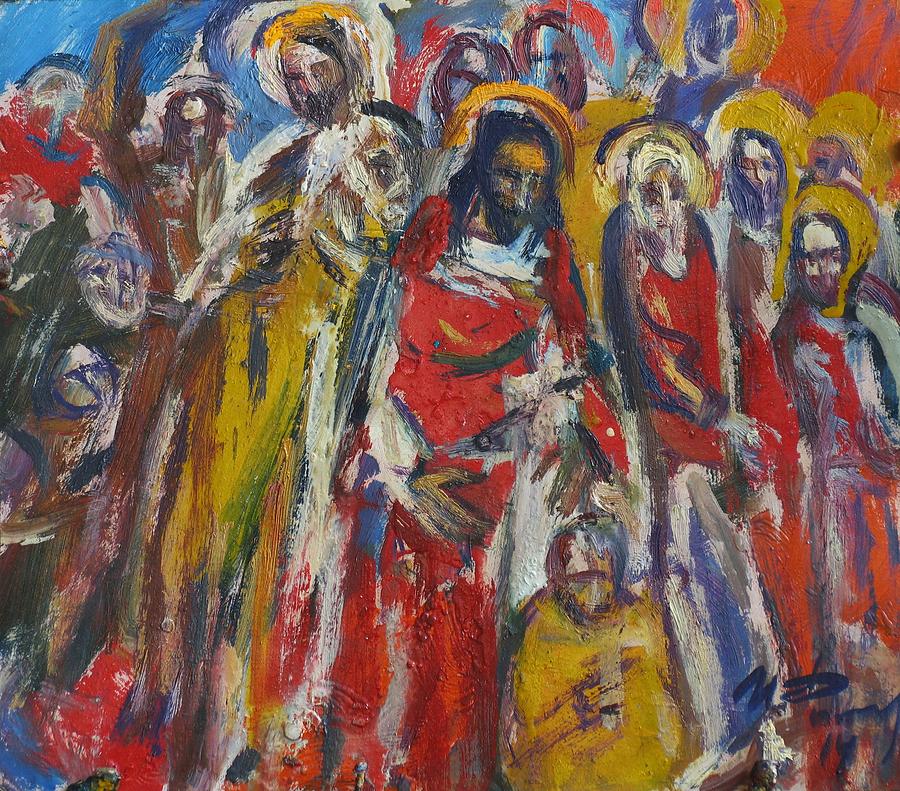
Matthew 9:2-13 – Why Jesus Came

Healing by Russian painter Ivan Filichev

Some men brought to Jesus a paralyzed man, lying on a mat. When he saw their faith, Jesus said to the man, “Take heart, son; your sins are forgiven.”

At this, some of the teachers of the law said to themselves, “This fellow is blaspheming!”

Knowing their thoughts, Jesus said, “Why do you entertain evil thoughts in your hearts? Which is easier: to say, ‘Your sins are forgiven,’ or to say, ‘Get up and walk’? But I want you to know that the Son of Man has authority on earth to forgive sins.” So, he said to the paralyzed man, “Get up, take your mat and go home.” Then the man got up and went home. When the crowd saw this, they were filled with awe; and they praised God, who had given such authority to man.

As Jesus went on from there, he saw a man named Matthew sitting at the tax collector’s booth. “Follow me,” he told him, and Matthew got up and followed him.

While Jesus was having dinner at Matthew’s house, many tax collectors and sinners came and ate with him and his disciples. When the Pharisees saw this, they asked his disciples, “Why does your teacher eat with tax collectors and sinners?”

On hearing this, Jesus said, “It is not the healthy who need a doctor, but the sick. But go and learn what this means: ‘I desire mercy, not sacrifice.’ For I have not come to call the righteous, but sinners.” (NIV)

The late Abigail Van Buren, better known as the newspaper columnist, “Dear Abby,” was the person who made famous the phrase: “The church is a hospital for sinners, not a museum of saints.” That quote is an accurate reflection of what Jesus was doing and saying. We occasionally need words like Dear Abby’s to remind and reorient us toward why the church exists.  

The church of the Lord Jesus does not remain on this earth solely for our benefit, any more than a hospital exists for the benefit of the doctors or insurance companies! Rather, the church lives to extend the mission of Jesus through proclamation of good news with the restorative touch of grace. The church’s calling is not to find others who can help them with their tithing and keep warm seats in the pew. Instead, the church is the community of the redeemed, gathered and sent to be the continuing presence of Jesus on this earth.

Some who are reading this are not healthy. Some are sick with sin; others are heart-sick; yet others are plain sick-and-tired of being sick-and-tired. Jesus came neither to condemn nor heap a pile of unrealistic expectations on us. Christ points us to the source of healing and change and invites us to admit our need and come to him. 

Conversely, many others today are healthy, spiritually alive, and well. It is our job to roll up our sleeves and serve, participating fully in the mission of Jesus to the world. The question I want us to grapple with is this: Why did Jesus come to this earth? The answer to that question is to also answer the question of our own purpose and existence as followers of Christ.

Jesus came to forgive sin and transform sinners.In today’s Gospel healing, it was a case where the person’s sin was connected to his paralysis – and the paralytic found in Jesus not only physical healing, but new spiritual life.

The religious insiders observed the healing. Yet there was no rejoicing by them about the transformation. Instead, they became hung up on Jesus claiming to be God. Granted, this was a hard truth for them to get a hold of. But Jesus labeled such thinking as evil – the inability to see and perceive the situation as a divine intervention, and that Jesus really is the Lord who graciously did it. Because they wrongly discerned who Jesus is, they wrongly interpreted the situation. 

Therefore, it is important to see Jesus as the Human One who extends compassion and forgiveness. If we fail to see this about Christ, we will get caught up in all kinds of silly matters of personal preference and ridiculous power plays, based in how we think things should go, rather than the gospel.

Jesus came to forgive sin. Healing the body is good but not enough. Just focusing on the physical well-being of individuals was not why Christ came. At the heart of the human condition is spiritual brokenness, and Jesus is all about taking away guilt and shame, creating a new person and a new community. It is a radical vision which seeks to encompass all persons – which means Jesus touched many people overlooked by others.

Jesus came to call the despised people of society, the “sinners.” He called Matthew, a tax collector. Tax collectors were hated. They were corrupt characters who extorted money from innocent people. Jesus not only called the despised Matthew but had dinner with him and all his unsavory buddies. This kind of behavior by Jesus was deeply offensive to upstanding citizens.

However, Jesus did not back down. He responded by saying that it is not the healthy who need a doctor, but the sick. And he backed up his social actions with Scripture by encouraging offended folks to meditate on what this biblical phrase means: “I desire mercy, not sacrifice.” (Hosea 6:6)

For I desire mercy, not sacrifice, and acknowledgment of God rather than burnt offerings.

hosea 6:6, niv

It is possible to engage in outward rituals of worship, do all the right things, fulfill our duty, yet still miss the heart of God wants for humanity. Mercy is what God wants. Jesus knew this. So, Christ entangled himself with sinners to bring spiritual healing and restoration.

When Corrie Ten Boom sought to bring deliverance of the Jews from the Nazis during World War II, she had to entangle herself with Jewish refugees. When Christian missionaries seek to be the light of Jesus to people, they must entangle themselves with the people’s culture. If we want to see God deliver people from their situations, we must entangle ourselves with them, into complicated lives that are not pretty, with persons who have been tainted by sin. 

Lots of people are in awful predicaments. Christians, like their Lord, will need to get their hands dirty and their feet wet to extend Christ’s ministry of mercy and forgiveness. The gospel was never intended to be proclaimed from afar, but up close and personal through entanglement in people’s lives. If the merciful mission of Jesus is to occur, it requires the following three activities:

  1. Intimacy with Jesus. Engaging in the spiritual disciplines of prayer, giving, fasting, reading, and meditating on Scripture are the activities which help us to know Christ better and know and how to respond with mercy.
  2. Intimacy with fellow believers. We are hard-wired by God for community. Superficial relationships can only provide superficial community. Christians need to help one another with spiritual growth. They must hold one another accountable for the mission of Christ.
  3. Intimacy with “sinners.” This world is filled with sick, needy, hurting, lonely, unhealthy people who are locked in unhealthy patterns of living. They need a merciful change of life that comes from the merciful Jesus acting through merciful Christians. 

Mercy, not judgment, is at the heart of all change. If we desire others to be different, we will need to be acquainted with the mercy of God.

Most merciful God, we confess we have sinned against you in thought, word, and deed, and by neglect. We have not held fast to your commandments and have strayed from your teachings. We turn from our self-centered actions and pride. For the sake of your Son, Jesus Christ, have mercy on us and forgive us so that we are released from anything that seeks to keep us from delighting in your presence. Empower us with your wisdom, revelation, and discernment so that we might be your merciful hands, feet, and words to one another and those who do not yet know you. Amen.

1 Timothy 1:12-20 – Grateful for Grace

I thank Christ Jesus our Lord, who has given me strength because he considered me faithful. So, he appointed me to ministry even though I used to speak against him, attack his people, and I was proud. But I was shown mercy because I acted in ignorance and without faith. Our Lord’s favor poured all over me along with the faithfulness and love that are in Christ Jesus. This saying is reliable and deserves full acceptance: “Christ Jesus came into the world to save sinners”—and I am the biggest sinner of all. But that is why I was shown mercy, so that Christ Jesus could show his endless patience to me, first. So, I am an example for those who are going to believe in him for eternal life. Now to the king of the ages, to the immortal, invisible, and only God, may honor and glory be given to him forever and always! Amen.

Timothy, my child, I am giving you these instructions based on the prophecies that were once made about you. So, if you follow them, you can wage a good war because you have faith and a good conscience. Some people have ruined their faith because they refused to listen to their conscience, such as Hymenaeus and Alexander. I have handed them over to Satan so that they can be taught not to speak against God. (CEB)

Toward the end of his life, the Apostle Paul reflected upon the grace given to him by God. In writing to Timothy, his protégé, Paul distilled his reflections into one short succinct phrase: Christ Jesus came into the world to save sinners. 

Before Christ got a hold of his life, Paul actively opposed Christians as much as he could. He had the persecution of Christ’s followers down to a science. But God had mercy on Paul and delivered him from his misguided and tortuous ways.

Paul was forever grateful for the grace of God. He well knew that he deserved no good thing from God. Paul knew firsthand the words of the Lord Jesus:

“I didn’t come to call righteous people, but sinners.” (Mark 2:17, CEB)

Once one’s heart has been captivated by God’s mercy, that person is never the same. Grace results in a new and wondrous perspective. The soul is filled with love. The mind is changed and charged with the realization that God is not only good but has given you a status as his beloved – a privilege and a position which you neither earned nor deserve. Gratitude erupts from your lips: “Christ Jesus came into the world to save sinners, to save me, the chief of sinners!”

We need not have a past like Paul’s to know God’s grace. Whether you are now a follower of Jesus after having lived a life far from God; or, you cannot remember a time when you didn’t know God; or, you grew-up in faith, walked away from it all, then were captured by grace and came back to Christ – from whatever backgrounds we all come from, it is the saving grace, the delivering mercy, the infinite love, the abiding compassion, and the undeserved kindness of Jesus Christ which makes your world spin the opposite direction on its axis. 

Take time throughout today to utter that simple phrase over and over: Christ Jesus came into the world to save sinners. What does this mean for the world as it is right now? What does it mean for you?

Loving Lord Jesus, there are not words to express my gratitude for your salvation given to me. I was once lost, but now am found by the boundless mercy of God. May sinners be saved, as was your servant Paul, so that the world will be undone and changed forever by grace. Amen.

Acts 15:36-41 – Imperfect Relations

Paul said to Barnabas, “Let’s go back and visit all the brothers and sisters in every city where we preached the Lord’s word. Let’s see how they are doing.” Barnabas wanted to take John Mark with them. Paul insisted that they should not take him along, since he had deserted them in Pamphylia and had not continued with them in their work. Their argument became so intense that they went their separate ways. Barnabas took Mark and sailed to Cyprus. Paul chose Silas and left, entrusted by the brothers and sisters to the Lord’s grace. He traveled through Syria and Cilicia, strengthening the churches. (CEB)

Perfect consensus, complete harmony, and perpetual peace are ideals, not reality, this side of heaven. Oh, it is not as though we ought to give up striving for such things – we just need to understand we will only experience them partially, and not fully, until Christ returns. 

Imagine if Paul and Barnabas, along with their entire coterie of people who traveled with them, decided that they would not go anywhere until there was 100% consensus on every decision to be made. It could be that they would never get anything done at all. It is sad when people cannot come together and be of one mind, but it happens, and will happen again. Sometimes we simply need to go and do what we think is best, whether others agree with us, or not.

“Honest disagreement is often a good sign of progress.”

Mahatma Gandhi

I am a bit adverse to taking sides on most things, but I admit to having a bent toward going with Barnabas. His name means “Son of Encouragement.” He understands taking someone under his wing and giving them a second chance when they screw up.  Barnabas had a soft spot for John Mark.  Barnabas seems like the kind of guy who knows about grace. This is a guy I could hang out with.

Paul, on the other hand, had much more of a Type A personality. I can just imagine Paul saying, “There are things to do, goals to reach, areas to conquer. I don’t have time for this whining and cry baby stuff.”  Paul did not want someone in the group slowing them down with fear or lack of courage. For all that I appreciate about the great Apostle Paul in the New Testament, sometimes he strikes me as being too driven and difficult to work with.

Yet, in the end, taking sides is not really the issue. It is about God working a divine, sovereign, and good will through stubborn and stupid people like me, and maybe like you, who sometimes get lost in winning an argument. 

When all is said and done, nothing is going to thwart God’s providential plans and purposes in this world.  So, rather than taking sides, I think I will rely solely on God’s grace and mercy in my life to work through me, despite my oft short-sightedness.

Holy God, you work your good purposes in and through your people, no matter what.  I want my life and work to be a joy to you and with others, and not a burden.  Create in me a clean heart.  See if there is any offensive way in me and lead me in the way everlasting, through Jesus Christ, my Lord, in the power of the Holy Spirit.  Amen.

Galatians 5:2-15 – Faith Expressing Itself Through Love

Mark my words! I, Paul, tell you that if you let yourselves be circumcised, Christ will be of no value to you at all. Again, I declare to every man who lets himself be circumcised that he is obligated to obey the whole law. You who are trying to be justified by the law have been alienated from Christ; you have fallen away from grace. For through the Spirit, we eagerly await by faith the righteousness for which we hope. For in Christ Jesus neither circumcision nor uncircumcision has any value. The only thing that counts is faith expressing itself through love.

You were running a good race. Who cut in on you to keep you from obeying the truth? That kind of persuasion does not come from the one who calls you. “A little yeast works through the whole batch of dough.” I am confident in the Lord that you will take no other view. The one who is throwing you into confusion, whoever that may be, will have to pay the penalty. Brothers and sisters, if I am still preaching circumcision, why am I still being persecuted? In that case the offense of the cross has been abolished. As for those agitators, I wish they would go the whole way and emasculate themselves!

You, my brothers, and sisters, were called to be free. But do not use your freedom to indulge the flesh; rather, serve one another humbly in love. For the entire law is fulfilled in keeping this one command: “Love your neighbor as yourself.” If you bite and devour each other, watch out or you will be destroyed by each other. (NIV)

Faith, expressing itself through love, is the grace others need from us. I did not grow up committed to learning the Bible or following Christ. I pretty much went my own way throughout childhood, and especially my teenage years. I still remember what it feels like to not be a Christian. 

I have found throughout my Christian life that folks with a past in which they did not live by grace, but only looked out for themselves, have a temptation to embrace strict rules when they become Christians. They know what it feels like to not have Jesus in their lives, so they sometimes go beyond Scripture and impose standards on themselves, and then others, to keep on the straight and narrow.

If, and when, that happens, the Apostle Paul has something to say about it. Embracing certain practices to obtain or maintain righteousness mean nothing in God’s kingdom. For the Galatian church who went down the path of strict outward rule-keeping, Paul had strict words. Here is how one version of the New Testament puts it:

“You people who are trying to be made righteous by the Law have been estranged from Christ. You have fallen away from grace! We eagerly wait for the hope of righteousness through the Spirit by faith. Being circumcised or not being circumcised doesn’t matter in Christ Jesus, but faith working through love does matter.” (Galatians 5:4-6, CEB)

Any Christian tradition or individual believer which ignores God’s grace in favor of controlling one’s own faith through certain rules is no Christianity, at all. Paul would have nothing to do with it. His position was clear and pointed. We are called to freedom, and we are to use that freedom to serve others through love. Freedom is not something where we do whatever we want without regard to others. That is selfishness, not freedom.

“Grace must find expression in life, otherwise it is not grace.”

karl barth

Freedom is a gift of grace. It is given to us so that we will live freely into who we are meant to be as humanity. In other words, there are to be no obstacles of extra-biblical or unbiblical rules impeding us to realize our full potential as Christians saved by grace through faith. Our possibilities include full unhindered expressions of love, joy, peace, patience, kindness, goodness, faithfulness, gentleness, and self-control for the benefit of ourselves and the entire community of the redeemed.

Grace is the currency of God’s kingdom, flowing freely through love. God has your back. Grace forgives, and never runs out. Love endures and never withdraws. When we grab hold of this essential and beautiful truth about God with spiritual gusto, then the only rule we want to keep is the continuing debt to love one another.

Are there any practices, rules, beliefs, or doctrines you impose on yourself which are burdensome to you, or others?  Why do you do them?  Do you expect others to keep them?  What would change if you threw grace and love into the mix?

Gracious God, your love has extended so far as to give your one and only Son on our behalf.  Through Jesus, I embrace the faith and love gifted to me through his redeeming work.  Help me to daily die to myself and my propensity for outward rule-keeping, and to live the gracious life you died to procure for me.