Christ the King Sunday (Luke 23:33-43)

The 118 feet high Christ the King statue in Świebodzin, Poland

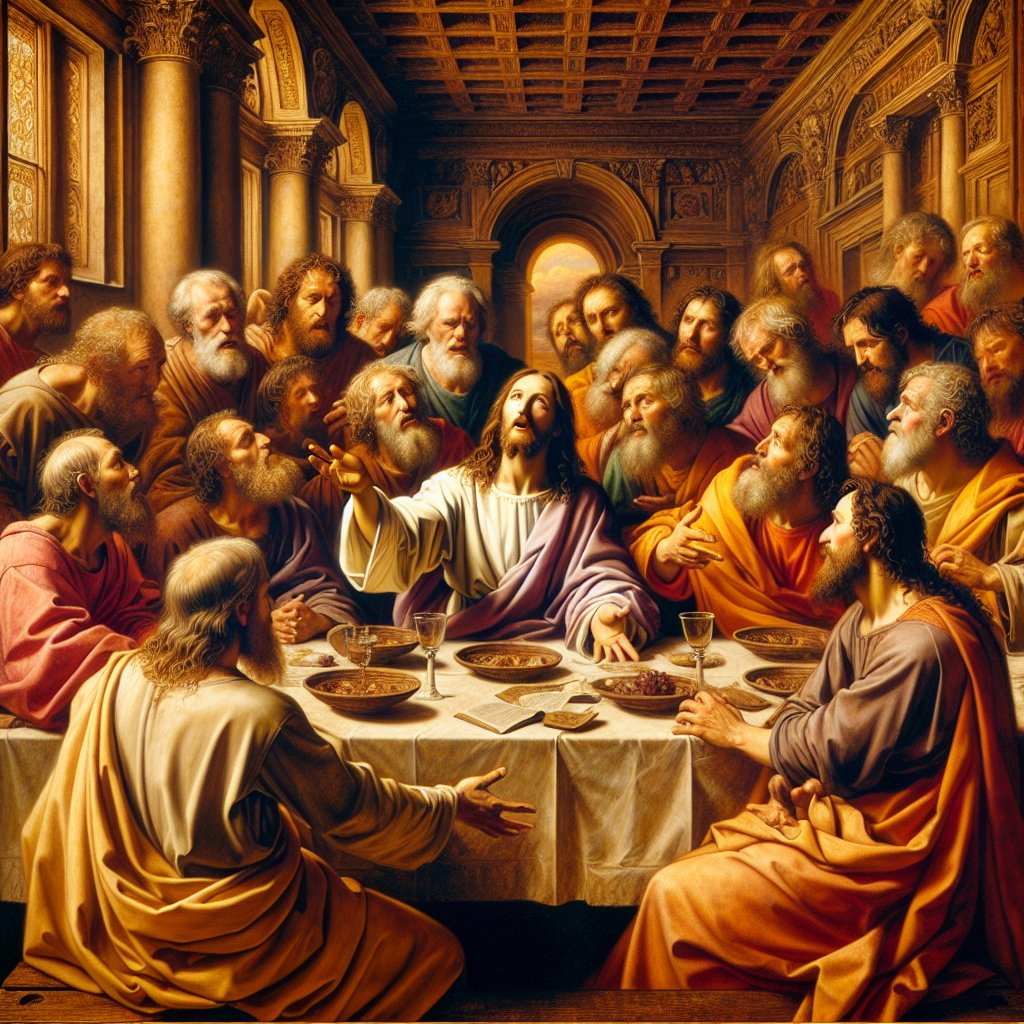
When they came to the place that is called The Skull, they crucified Jesus there with the criminals, one on his right and one on his left. Then Jesus said, “Father, forgive them, for they do not know what they are doing.” And they cast lots to divide his clothing. And the people stood by watching, but the leaders scoffed at him, saying, “He saved others; let him save himself if he is the Messiah of God, his chosen one!” The soldiers also mocked him, coming up and offering him sour wine and saying, “If you are the King of the Jews, save yourself!” There was also an inscription over him, “This is the King of the Jews.”

One of the criminals who were hanged there kept deriding him and saying, “Are you not the Messiah? Save yourself and us!” But the other rebuked him, saying, “Do you not fear God, since you are under the same sentence of condemnation? And we indeed have been condemned justly, for we are getting what we deserve for our deeds, but this man has done nothing wrong.” Then he said, “Jesus, remember me when you come in your kingdom.” He replied, “Truly I tell you, today you will be with me in paradise.” (New Revised Standard Version)

I’m glad that the Gospel text on this Christ the King Sunday is the story of Christ on the cross with the two criminals on each side also crucified. Why?

Because our cultural contexts tend to associate power and authority with high level earthly positions. But, in reality, Christianity is a paradoxical religion full of truths which seem antithetical to each other; yet they are not.

Many people (including many Christians) believe that, in order to influence the culture, Christians must have prominent positions in society. This leaves the majority of Christians feeling as if they have nothing to offer the world. After all, they have no important title at their job, in the government, or within the church.

But nothing could be further from the truth. Christ, in the lowest earthly position possible by being nailed to a cross, was a king who had the highest heavenly position in the universe. One will never come to grips with Jesus apart from understanding that Christianity is an inherently paradoxical religion.

The Sanctuary of Christ the King in Almada, Portugal

One of the criminals crucified with Christ discerned this reality well; the other criminal did not understand at all. One demonstrated the reality that humility is the powerful key to all things, whereas the other criminal remained full of himself.

The scene portrayed for us on Golgotha’s hill shows us what the kingly reign of Jesus Christ truly looks like: It is characterized by the power of humility and sacrifice. It highlights Christ’s authority by giving mercy to those hanging on a cross alongside himself.

True power is not found in the halls of earthly political power, but rather in the elevating power of God’s grace and Christ’s self-sacrifice. Therefore, Christians can best demonstrate their own power and authority by extending grace and mercy toward others, even when it’s hard to do.

It can be difficult to wrap both our heads and our hearts around this reality of possessing power without actually having positions and titles of authority in the world and the church.

Many a church pastor bemoans the fact that a number of their parishioners fail to be active servants in the wrongheaded notion that the clergy are supposed to do all the work. The laity may believe that the clergy are the ones with the educational, experiential, and positional power to influence culture and society.

What’s more, it can be even harder for those who once had positions of power to believe they themselves can no longer effectively work for the good, because they are now nobodies. They may ask, “Who would listen to me?”

The answer is: A lot of people. God uses all sorts of persons in all sorts of places and situations. What we all need, whether clergy or laity, is the willingness to be humble and to sacrifice one’s time or talent in showing mercy to another.

Christians must take their cues from the Lord Jesus. In the setting of the interaction between Christ and the other two crucified men in today’s story, Jesus is the innocent one sandwiched between two guilty persons. Christ’s humiliation is on full public display. The crowd of onlookers mock him, along with one of the criminals. Because of the apparent incongruence between being ‘King of the Jews’ yet not freeing himself from his awful situation.

Whereas most of us might avoid being humiliated in public at any cost, Jesus embraced the rejection and the suffering, knowing that he was offering a sacrifice for the benefit of the whole world.

Even though Jesus was extremely vulnerable, and in emotional, spiritual, and physical pain which we can only imagine, he nonetheless chose to use his kingly power and authority on behalf of others – including those who blatantly rejected and mocked him.

Grace and mercy were demonstrated by submitting to an ignominious death, and by willingly acting to be the bridge connecting others to God. Relationship is at the very heart of the divine will; God would do anything to restore broken relations with his fallen people. No one is beyond the reach of grace.

In a contemporary culture of polarized relations and angry vitriol toward one another, the ordinary Christian without earthly title or authority is in the best position to provide basic human kindness by extending mercy to “enemies” and demonstrating humility in all things.

Christ embodied love and forgiveness. He used his power for mercy, not judgment;  and for grace, not revenge.

Jesus demonstrated for us how grace is the greatest operative force in the universe.

To love and forgive another is the best demonstration of power and authority that anyone could ever show.

God’s action in Christ through the cross is what can move us to true acts of love and selflessness. We participate in Christ by giving grace through acts of mercy in comforting, encouraging, and helping others.

The only way we can give grace is to receive grace. It is God’s action in Christ through the Spirit that moves us to true acts of love and selflessness.

Personally, I am encouraged with the image of Christ as King – the One who is both sovereign over all creation, and yet is with me and knows my every need, giving grace and mercy and unconditional love.

For me, the idea of both God’s transcendence and God’s immanence is the perfect lead-in for the Advent season.

Earthly leaders can be capricious, petty, enamored with earthly power, and wield authority only in ways that serve themselves and not the common good of all. No wonder there is so much corruption and injustice in this old fallen world of ours.

Such hateful leadership has no problem leaving us beaten, bruised, and hanging on a cross. In our pain and our suffering, what will we do?

Hopefully, we will let Jesus transform our understanding of power and authority.

Ideally, in our worst situations of suffering and confusion, we will remember Jesus lifted-up on the cross, lifted-up as sovereign over all things. We will find our own true power in self-giving-love to a world which appears it has given itself to hate and selfish judgment of people they don’t like.

A participation in Christ’s rule and reign over all things means that his crucified power has given us grace and forgiveness, so that we might pass it on, pay it forward, and work for that which is just, right, and good.

May it be so, to the glory of God.

Almighty God, you rescue us from our enemies, so that we may serve you without fear. Strengthen us, that we might share in the inheritance of the saints in your kingdom of light. Amen.

Against Exorbitant Wealth (Amos 3:9-4:5)

Proclaim to the strongholds in Ashdod
    and to the strongholds in the land of Egypt,
and say, “Assemble yourselves on Mount Samaria,
    and see what great tumults are within it
    and what oppressions are in its midst.”
They do not know how to do right, says the Lord,
    those who store up violence and robbery in their strongholds.
Therefore thus says the Lord God:
An adversary shall surround the land
    and strip you of your defense,
    and your strongholds shall be plundered.

Thus says the Lord: As the shepherd rescues from the mouth of the lion two legs or a piece of an ear, so shall the people of Israel who live in Samaria be rescued, with the corner of a couch and part of a bed.

Hear and testify against the house of Jacob,
    says the Lord God, the God of hosts:
On the day I punish Israel for its transgressions,
    I will punish the altars of Bethel,
and the horns of the altar shall be cut off
    and fall to the ground.
I will tear down the winter house as well as the summer house,
    and the houses of ivory shall perish,
and the great houses shall come to an end,
            says the Lord.

Hear this word, you cows of Bashan
    who are on Mount Samaria,
who oppress the poor, who crush the needy,
    who say to their husbands, “Bring something to drink!”
The Lord God has sworn by his holiness:
    The time is surely coming upon you
when they shall take you away with hooks,
    even the last of you with fishhooks.
Through breaches in the wall you shall leave,
    each one straight ahead,
    and you shall be flung out into Harmon,
            says the Lord.
Come to Bethel—and transgress;
    to Gilgal—and multiply transgression;
bring your sacrifices every morning,
    your tithes every three days;
bring a thank offering of leavened bread
    and proclaim freewill offerings, publish them;
    for so you love to do, O people of Israel!
            says the Lord God. (New Revised Standard Version)

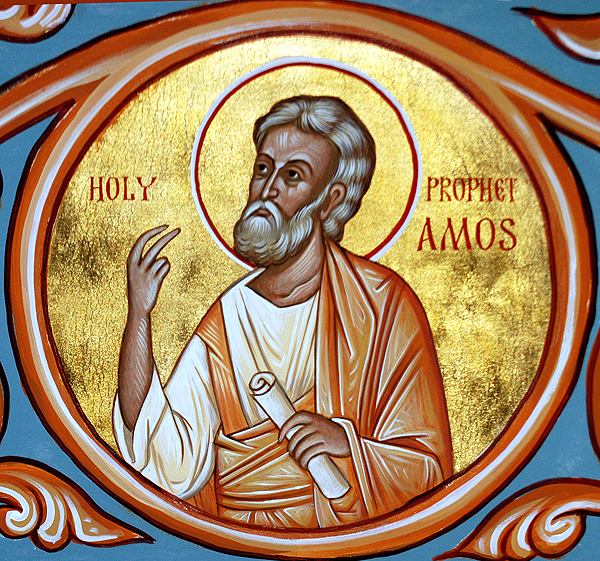
Orthodox icon of the prophet Amos

The prophet Amos sought to leave no stone unturned in exposing the transgressions of God’s wayward people. He went after social injustice; personal sins; religious idolatry; and all aspects of life in which the nation practiced self-indulgent hoarding of wealth and power.

Whenever people become focused on earthly power and control, they fall out of the realm of living in God’s power. If there is ever a personal or corporate sense of losing spiritual power, the problem is never with the Lord. The more one amasses worldly power and authority, the less effective they are with spiritual power.

It is possible for a nation or a church to have great political strength, yet in reality be powerless. Impressive constructed human strongholds are totally defenseless before the all-powerful God of the universe.

It’s always been curious to me why folks who claim the name of Christ, or who make grand confessions of faith, can then turn around and be enamored with obtaining wealth, real estate, resources of all sorts, and high-level positions. Such persons don’t deserve worldly power. It’s like putting a gold ring in a pig’s snout.

Persons with lots of worldly wealth and power will eventually find that their acquisitions fail them. And if their religion is powerless, everything in their life will lack power – no matter how it looks, or what spin they put on their situation.

Ignoring grace and mercy, compassion and kindness, to the poor and needy is a surefire way of experiencing divine condemnation. Treating one’s society and social relationships as mere pawns to get what I want is a prescription for alienation from God.

Whether someone believes in an almighty God, or not, oppressing and gaslighting others breaks down a society, and compromises basic law and order. Being concerned only with one’s constituents, and turning away from the common good of all, brings about injustice for the many.

But the ones in charge simply don’t care – which is why it raises the ire of a holy God. Any person who demeans meekness and gentleness, and clearly evidences a profound lack of humility, you can be sure that person is up to no good – despite any “good” words they might say.

Violence and robbery are the tools of those who care nothing for what their actions do to others. Justifying the rounding up of people into detention centers and robbing them of their lives and livelihood doesn’t fool God.

Those who go after unjust gain through any means possible will find that there is a boomerang effect to their actions. Their violent and unjust ways will turn back on them. They themselves shall be destroyed, and not the powerless and vulnerable.

In ancient Israel at the time of Amos, it was the Gentile nations who would rise up and be their judge. Pagan nations who thought nothing of despising and abusing others were the very ones to stand up and judge Israel. That’s how bad it was, even though there was wild prosperity, exorbitant wealth, and loads of power, that is, only among the upper class.

Living below the level of grace means showing no dignity or respect to one’s fellow humanity. It is unthinkable that such persons could or would ever exercise power in a democratic form of government. Just because they were elected and appointed to office, doesn’t mean they’ll act as civil servants.

Those in power who act only in self-interest will find themselves on the bad side of a holy God:

“Why would God withdraw from such a people? Because there was nothing in their lives corresponding to a heart concern for spiritual things; their character-reference could be written without mentioning God, or prayer, or holiness; their legacy to the future was wholly a testimony to a life lived for the body. And these claimed to be the people of God!” J.A. Motyer

Unchecked covetousness is actually a form of war against the poor. And any worship disconnected from righteousness and justice is an affront to both the needy among us, and God.

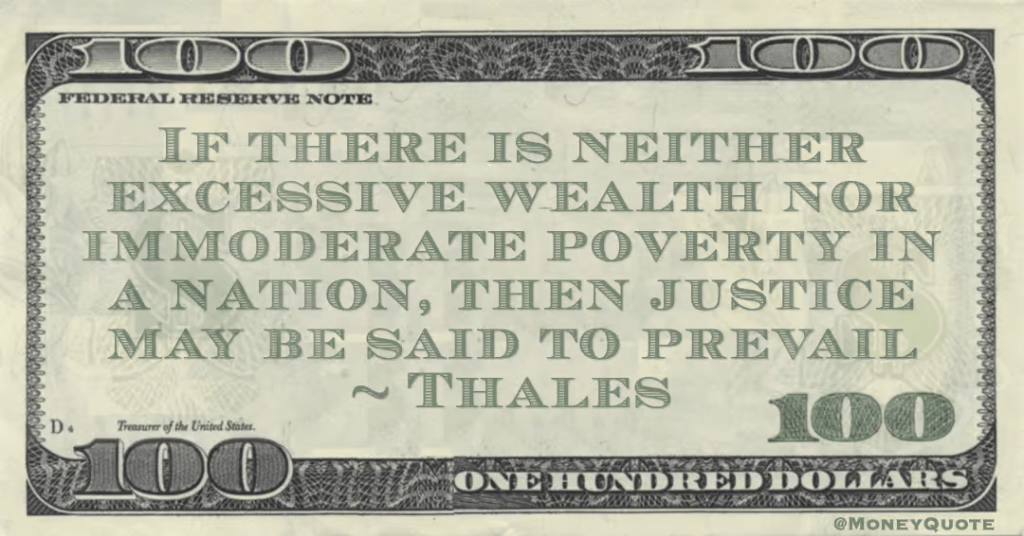
Wealth and power, in and of themselves, are neither good nor bad; they just are. But what we do with them is of vital concern. However, exorbitant riches and a lust for power, in and of themselves, are egregious sins.

In Holy Scripture, the poor are never chastised for their poverty and neediness. But the rich are continually exhorted and warned against for any sort of failing to care for the lower classes of people. (Matthew 25:14-30; Luke 12:13-21; 16:19-31)

The psalmist has a reality check for us:

Don’t be overly impressed when someone becomes rich,
    their house swelling to fantastic proportions,
    because when they die, they won’t take any of it with them.
    Their fantastic things won’t accompany them down under.
Though they consider themselves blessed during their lives,
    and even thank you when you deal well with them,
    they too will join the ancestors who’ve gone ahead;
    they too will never see the light again.
Wealthy people? They just don’t understand;
    they’re just like the animals
    that pass away. (Psalm 49:16-20, CEB)

The Teacher gives us some practical wisdom:

If you love money and wealth, you will never be satisfied with what you have. This doesn’t make a bit of sense. (Ecclesiastes 5:10, CEV)

Whoever becomes wealthy through unfair loans and interest collects them for the one who is kind to the poor. (Proverbs 28:8, GW)

And the Lord Jesus said:

“No one can serve two masters. Either you will hate the one and love the other, or you will be devoted to the one and despise the other. You cannot serve both God and money.” (Matthew 6:24, NIV)

“God blesses you who are poor,
    for the Kingdom of God is yours.” (Luke 6:20, NLT)

As for me, I’ll choose to take my cues from Jesus and the prophets, and not from those with earthly influence, riches, and power. How about you?

Almighty God, everything we possess – our time, abilities, resources, money, and material possessions – are gifts from You, and belong to You. Enable me to be a good steward of all that you have provided for me, so that I may be a blessing to the poor and needy; through Jesus Christ my Lord, in the strength of the Holy Spirit. Amen.

The Parable of the Good Samaritan (Luke 10:25-37)

Good Samaritan, by Olga Bakhtina

An expert in the law stood up to test Jesus. “Teacher,” he said, “what must I do to inherit eternal life?” 

He said to him, “What is written in the law? What do you read there?” 

He answered, “You shall love the Lord your God with all your heart and with all your soul and with all your strength and with all your mind and your neighbor as yourself.” 

And he said to him, “You have given the right answer; do this, and you will live.”

But wanting to vindicate himself, he asked Jesus, “And who is my neighbor?” 

Jesus replied, “A man was going down from Jerusalem to Jericho and fell into the hands of robbers, who stripped him, beat him, and took off, leaving him half dead. Now by chance a priest was going down that road, and when he saw him he passed by on the other side. So likewise a Levite, when he came to the place and saw him, passed by on the other side. 

“But a Samaritan while traveling came upon him, and when he saw him he was moved with compassion. He went to him and bandaged his wounds, treating them with oil and wine. Then he put him on his own animal, brought him to an inn, and took care of him. The next day he took out two denarii, gave them to the innkeeper, and said, ‘Take care of him, and when I come back I will repay you whatever more you spend.’ 

“Which of these three, do you think, was a neighbor to the man who fell into the hands of the robbers?” 

He said, “The one who showed him mercy.”

Jesus said to him, “Go and do likewise.” (New Revised Standard Version)

The Good Samaritan, by Paula Modersohn-Becker

Let’s establish upfront that the chief point of Christ’s parable is mercy shown from one person to another. Mercy is at the heart of Holy Scripture. Mercy is the very heart of Christ – even more than routine obedience:

“Go and learn what this means, ‘I desire mercy, not sacrifice.’” (Matthew 9:13; 12:7; Hosea 6:6)

The message of the Old and New Testaments of the Bible continually reinforces mercy to those who are in need – mercy to immigrants, strangers, the poor, the infirmed, and foreigners.

Therefore, any system – no matter whether church, neighborhood, or government – which seeks to ignore, round up, or get rid of those in need of mercy, is in direct contradiction to the instruction of Jesus, the message of the prophets, and the consistent teaching of the early church fathers (and mothers).

We get in trouble whenever we distinguish between people who “deserve” our help from those who don’t. In truth, there is no such thing. Everyone needs mercy and deserves mercy, simply because they are created in the image and likeness of God.

There are no exceptions. And if we think there ought to be, we are playing the judge and trying to take the reins of decision-making away from God, so that we ourselves can execute our own standard of who deserves mercy and who deserves judgment.

In today’s Gospel lesson, the expert in the law started out by testing Jesus. Then, he changed tactics by trying to justify himself as one who deserves to be recognized as worthy of mercy. He believed that, as one who strictly observes the law and obeys the commandments, he is more deserving than others who are less observant.

It’s this privileged mentality which continually connects adjectival words to humans, and even Christians – when, in truth, there are no adjectives to being a human and/or a Christian.

But, in order to justify ourselves, many people like their adjectives, so they can make sure to distinguish before God who is worthy and right, and who is not. The following are just a smattering of adjectives I’ve heard in the church throughout the years:

  • Backslidden Christian
  • Lukewarm Christian
  • Weak Christian
  • Liberal Christian
  • Conservative Evangelical Christian
  • Real Christian
  • Born Again Christian
  • Committed Christian
  • Fairweather Christian
  • Christmas and Easter Christian
  • True Christian
  • Baptized Christian

Yet, in reality, a Christian is a Christian. If we feel the need to add adjectives in describing how less or more of a Christian they are, then we are no longer describing Christianity at all.

When it comes to the word neighbor, there are a plethora of adjectives that we might use to describe our neighbors. Again, all the words are meant to distinguish between “us” and “them.”

I once lived in a very diverse neighborhood. One day I was outside praying, and looking at all the various houses. I prayed for my neighbors by affixing adjectives to them: my black neighbor; my nerdy neighbor; my lesbian neighbors; my single neighbor; my agnostic neighbor; my mean obnoxious neighbor.

On and on I went, until I heard that still small voice of God whisper to me saying, “Tim, these are not your neighbors with adjectives. They are just your neighbors.”

I got the message. I was praying on my holy hill for all these other folks who were different than me, using my adjectives to keep separate from them. My neighbors, however, are simply my neighbors. We live together in the same neighborhood. We are neighbors – nothing more, nothing less.

Even though my neighbors have many differences about them, we all share the need for receiving mercy and giving mercy. Without mercy, neighborliness vanishes.

My sacrificial offerings of prayer for my neighbors didn’t make me better. But both my attitude of mercy and my actual extensions of mercy toward my neighbors, no matter how little, meant a great deal to them.

The priest and the Levite who passed by the man in need, likely only saw that they would become unclean by helping this needy person. “Besides,” they may have pondered, “there’s nothing in it for me.”

There was no way for the man lying in the ditch to reciprocate or pay back the priest or the Levite. A Samaritan (despised by both priests and Levites) ended up being the one to show mercy to the man.

It didn’t matter who helped the victimized person – whether it was a priest, a Levite, or a Samaritan. It didn’t matter how any of them might describe the other. Only mercy mattered.

I admit that I desperately want to see my national government have at least a little neighborly sense. When I observe the opposite, it’s hard for me to live with. I find myself not wanting to see any mercy extended to them, to the current administration.

Yet just because politicians may not show mercy, doesn’t infer that I should withhold it from them. I really do want to take my cues from Jesus by loving my enemies and doing good to them – even if they ignore, mistreat, or oppress others.

God will sort out the judgment thing. As for me, I’m called to a gospel of grace, not a gospel of judgment.

Nobody can justify themselves. In Christianity, only God can justify the person.

Christ’s mercy is not dependent on what kind of people we are but is based simply on need. God graciously gives us the gift of faith and the mercy of deliverance.

Divine Judge, You framed the earth with love and mercy, declaring it good. Yet we, desiring to justify ourselves, judge others harshly without knowledge or understanding. Keep us faithful so that we may be filled with the knowledge of Your will, and not ignore or pass by another’s need, but plumb the depths of love in showing mercy. Amen.

His Resurrection Is Ours

The Resurrection, by Andrea Mantegna, c.1458 C.E.

The story of Christianity, the very heart and essence of the religion, is a tale of transformation from all the obstacles, impediments, and barriers which confine or cripple. The person and work of Jesus accomplished this. In his earthly ministry, Christ continually called people to transformative change into the reality of God’s gracious and benevolent realm.

“I have come to give the good life, a life that overflows with beauty and harmony.”

Jesus (John 10:10, First Nations Version)

Christ’s resurrection made possible our own transformative new life. This is both exciting and scary. Resurrection is frightening because it’s a call to live a life without any of the walls which have defined us and/or imprisoned us.

The massive stone covering the tomb of Jesus Christ was rolled away. He walked out of the grave by the power of resurrection. The cave of death was changed into the place of liberation.

That place is a powerful image of moving aside any and all obstacles to our own faith and freedom. The prison doors have been opened. Our self-contrived inner prisons, as well as the unjust shackles placed upon us, have dropped away.

As a result, those who have been exiled, excommunicated, and treated as expendable are visited by the luminous healing presence of God’s great liberating force: resurrection.

All of these words may either seem strange and/or compelling. If this is the case, it is a sad situation. Because it’s quite necessary that we become familiar with such language. Unfortunately, the gap between the world we are presently living in, and the world our hearts yearn to know, is quickly coming to an unsustainable place of high stress.

There is now a profound disconnect between the love deep inside us, and the way in which we are living our day-to-day lives on this earth. The issue has become so great as to warrant the need for resurrection.

And I am not simply addressing Christians. In his earthly ministry, Jesus was not only talking to his own Jewish people; he came for the whole world. Jesus is for everyone – whether we acknowledge him according to Christian dogma and doctrine, or not.

The evil gaslighting sort of person wants you to believe that you are alone, bereft of any help – that somehow you need to assert yourself aggressively into the dog-eat-dog world. Wickedness always looks to chaos and war as the path to gaining the life one wants.

But Jesus is the bridge to another kind of thinking, another sort of life. He is the guide to the greatest power which exists in the world: Love. And Love is why resurrection is a reality.

Although we suffer from systemic evil and all kinds of structural “ism’s” in this world, our shackles and chains have been largely forged by ourselves, through spiritual ignorance and misunderstandings of who we are and why we are here.

Resurrection opens us to new life. It provides identity, purpose, and passion to live the good life. Even though we live in this world below, our answers to living in the here-and-now are found in the world above.

All of us have experienced walking a dark path in life. But now it is high time to walk away from uncontrolled emotions and evil ways. There are plenty of lying spirits who intend on deceiving you and I for their own selfish purposes. Instead, we can refuse and resist such evil.

We can live in ways that represent the good, the right, and the just. We can experience living a resurrected life. Let us choose the pure path of the new person in Christ, the person you and I were created to be.

The telltale signs of the person living into resurrection are a deep feeling for the pain of others, kindness, humility of heart, a gentle spirit, and long-suffering patience with others. Such persons wear forgiveness like a well-worn pair of jeans.

This is the path of resurrection, the way of unity, peace, and harmony. And these qualities will always guide us and inform us in helpful and sacred ways.

Our current global decline comes from an accumulation of greed and sheer lovelessness. But the possibility of rebirth, of resurrection, rises from our deep universal yearning for the good and the true. It comes from our radical willingness to change and live a different counter-cultural life.

Resurrection does not occur because of lofty thoughts; it comes from a humble, and contrite heart which yearns for a better and more sacred existence.

Only until we find our present life on this world as intolerable with its injustice and persistent carelessness, will we see that we must put love where love is not.

The great lesson of resurrection is that Love makes all things right.

May resurrection move from being merely a theological concept, to a powerful reality that permeates and fills your life with meaning, power, and love. Amen.