
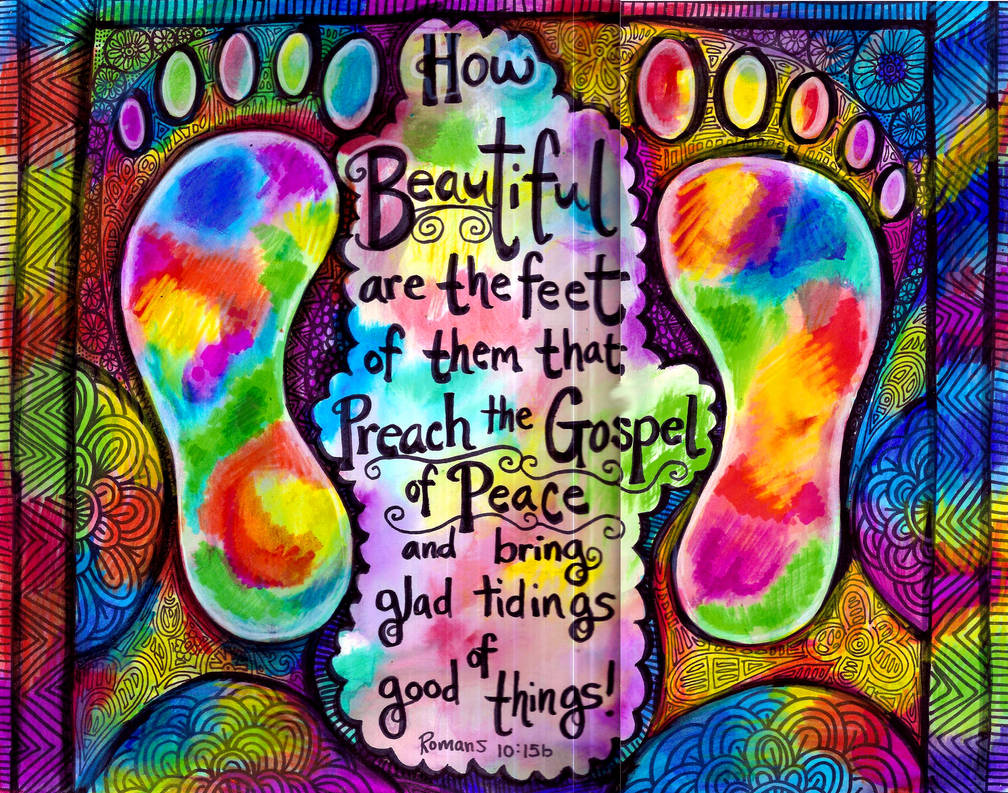
Beautiful Feet (Romans 10:15b-21)

As it is written: “How beautiful are the feet of those who bring good news!”

But not all the Israelites accepted the good news. For Isaiah says, “Lord, who has believed our message?” Consequently, faith comes from hearing the message, and the message is heard through the word about Christ. But I ask: Did they not hear? Of course they did:

“Their voice has gone out into all the earth,
    their words to the ends of the world.”

Again I ask: Did Israel not understand? First, Moses says,

“I will make you envious by those who are not a nation;
    I will make you angry by a nation that has no understanding.”

And Isaiah boldly says,

“I was found by those who did not seek me;
    I revealed myself to those who did not ask for me.”

But concerning Israel he says,

“All day long I have held out my hands
    to a disobedient and obstinate people.” (New International Version)

“Beautiful” is not a typical description of anybody’s feet. That’s because feet are kind of gross. Feet stink. They get dirty and itchy; they’re often calloused and downright nasty looking. And no one comments that their feet feel good. People’s feet rarely feel that way.

It seems to me that feet are an apt metaphor for the bringing of salvation, of good news.

The Christian good news is this: There is salvation – forgiveness of sins – through Jesus Christ; and it is accessed by faith.

“Salvation” is a term which perhaps gets overused by Christians to the point that it becomes misunderstood and/or taken for granted. When that happens, it only becomes “meh” news and is no longer good news. For some, it’s a bit like feet – they’re there, but they hurt too much. We don’t think much about our feet until the corns, the bunions, or the toenails bother us. There’s a “meh” relationship to the foot.

In Christianity, the triune God has conspired within himself to bring us salvation. The good news is that God the Father has mercifully sent God the Son for the rescue of the entire world from sin, death, and hell; and Father and Son have further sent God the Holy Spirit to help us respond and live by faith.

Even back in the Old Testament, with the prophet Isaiah, such a merciful deliverance was predicted. Isaiah’s description of the life and rejection of the Suffering Servant wondered if faith would happen in response to salvation. Would they really see it as “good” news? Can feet really be beautiful?

Who has believed our message
    and to whom has the arm of the Lord been revealed? (Isaiah 53:1, NIV)

The Apostle Paul, knowing a thing or two about suffering, walking a lot of missionary miles with his feet, was confident that, indeed, faith is awakened in the hearing of the message. The message is good news, and it will be received. Good news has to be proclaimed before it can take hold.

So faith comes from what is heard, and what is heard comes through the word of Christ. (Romans 10:17, NRSV)

Good news has to be announced up-close and personal. It takes getting on our two feet, walking across the street, across the room, or across the world to bring it. That’s because salvation is relational. The message of salvation is there amongst people; it has always been deep within them, as those created in the image and likeness of God.

The heavens are telling the glory of God,
    and the firmament proclaims his handiwork.
Day to day pours forth speech,
    and night to night declares knowledge.
There is no speech, nor are there words;
    their voice is not heard;
yet their voice goes out through all the earth
    and their words to the end of the world. (Psalm 19:1-4, NRSV)

In the book of Romans, we see Jewish Christians and Gentile Christians together in one church. Historically, the Jews were God’s people – the insiders – and the Gentiles were not a people, the outsiders. Now the Gentiles are included and are no longer outsiders. Not all the insiders were okay with this situation.

In the Old Testament, Moses predicted insider Israel’s overall response to this situation of feet walking amongst the Gentiles and announcing the good news of salvation.

They have roused my jealousy by worshiping things that are not God;
    they have provoked my anger with their useless idols.
Now I will rouse their jealousy through people who are not even a people;
    I will provoke their anger through the foolish Gentiles. (Deuteronomy 32:21, NLT)

The prophet Isaiah also spoke of Gentile inclusion into God’s saving activity; and the Jewish response to salvation for them:

I was ready to respond to those who didn’t ask.
    I was ready to be found by those who didn’t look for me.
I said, “I’m here! I’m here!” to a nation
    that didn’t call on my name.
I extended my hands all day
    to a rebellious people
        walking in a way that isn’t good,
        following their own plans.” (Isaiah 65:1-2, CEB)

This in no way is meant to be hard on ancient Israelites and the Jewish people. It is really a commentary on including others who are different, what God thinks about it, and the challenge this poses to those holding onto the status quo.

Throughout all of biblical history, into the past two thousand years of church history, and even today, those who consider themselves as God’s people, the insiders, tend to be blinded by the privileges bestowed on them by a gracious God. And they usually think of only one thing: To preserve their status and their spiritual monopoly by excluding others who are different.

It is a hardening of the heart – or maybe the calloused feet – that does not want to recognize that certain persons and people groups can be saved and included as God’s people alongside the rest.

Fortunately, the Apostle Paul, a Jewish Christian, longed for all to be saved and to come to a knowledge of God. He himself wanted to know Christ and “be found in him, not having a righteousness of my own that comes from the law, but that which is through faith in Christ—the righteousness that comes from God on the basis of faith.” (Philippians 3:19)

Salvation is neither attained through strict observance of the rules, nor by being a good or nice person. It is graciously given by the God who came and whose feet walked amongst us. Deliverance comes through an acceptance by faith in the Son of God who loved us and gave himself for us – including people who others might consider as outsiders or unworthy of it.

From my vantage point, the feet that bring a gracious message of good news for all are truly beautiful.

Almighty God, Father of all mercies, we give you humble thanks for your goodness and steadfast love to all kinds of people. We thank you especially for your immeasurable love in the redemption of the world by our Lord Jesus Christ. And, we pray, give us such an awareness of your mercies, that with truly thankful hearts we may show forth your praise, not only with our lips, but in our lives, by giving ourselves to your service, and by walking before you in holiness and righteousness all our days. Amen.

A Divine Calling (Jeremiah 1:4-10)

The Prophet Jeremiah by Marc Chagall, 1960

The Lord gave me this message:

“I knew you before I formed you in your mother’s womb.
    Before you were born I set you apart
    and appointed you as my prophet to the nations.”

“O Sovereign Lord,” I said, “I can’t speak for you! I’m too young!”

The Lord replied, “Don’t say, ‘I’m too young,’ for you must go wherever I send you and say whatever I tell you. And don’t be afraid of the people, for I will be with you and will protect you. I, the Lord, have spoken!” Then the Lord reached out and touched my mouth and said,

“Look, I have put my words in your mouth!

Today I appoint you to stand up
    against nations and kingdoms.
Some you must uproot and tear down,
    destroy and overthrow.
Others you must build up
    and plant.” (New Living Translation)

“Don’t let anyone think less of you because you are young. Be an example to all believers in what you say, in the way you live, in your love, your faith, and your purity.”

St. Paul to St. Timothy (1 Timothy 4:12, NLT)

I write to you, young people,
    because you are strong
    and the word of God abides in you,
        and you have overcome the evil one. (1 John 2:14, NRSV)

Young Jeremiah had an unusual calling from the Lord. It wasn’t to reach thousands with a life-giving message of hope and encouragement; the call was to declare destruction to an unjust people who believed they were fine, thank you very much.

It was a calling that would have been a huge challenge for the most seasoned of veteran prophets. But God called the young Jeremiah. This was his first crack at being a prophet of the Lord; and it was a doozy of a call!

Yet, when it comes to God’s call, age really means nothing. That’s because the Lord equips whomever the Lord wants to empower. Young or old makes no difference. All that’s needed is a willingness to submit to the voice of divine calling.

And to Jeremiah’s credit, the lengthy prophecy bearing his name in the Bible is a testament to his sense of call and straightforward obedience to it.

There is, and always has been, a divine/human cooperative in the world. God, of course, could do everything without humanity’s assistance. But it’s never been that way. Throughout the entirety of Holy Scripture, the Lord calls and empowers people for service.

On the one hand, this may seem like some strange convergence which, on the surface, is sure to end in some screw-ups and failure. Yet, on the other hand, this cooperation between Creator and creature gives people, at the least, a sense of ownership in the world; and, at the most, a powerful opportunity to bless the world with divine gifts of speaking and service.

Although Jeremiah was called to (mostly) pronounce doom, it’s first and foremost a message of justice. The Lord is concerned for the common good of all persons, not just some. Yahweh is not about to be forever idle whenever certain segments of humanity go rogue and harm their fellow sisters and brothers with unjust ways.

The Prophet Jeremiah by Marc Chagall, 1968

What’s more, the Lord delights in using people whom society at large might deem less than usable.

Now remember what you were, my friends, when God called you. From the human point of view few of you were wise or powerful or of high social standing. God purposely chose what the world considers nonsense in order to shame the wise, and he chose what the world considers weak in order to shame the powerful. He chose what the world looks down on and despises and thinks is nothing, in order to destroy what the world thinks is important. (1 Corinthians 1:26-28, GNT)

If God can use a donkey to communicate a message, then it’s likely that the Lord can enable any person on earth to speak words of justice – no matter if they’re young, uneducated, or underprivileged – and make the older, educated, and privileged look like jack asses. (Numbers 22:22-35)

For Christians everywhere, every believer has been called by God to proclaim the gospel of grace. The Word has come to us in Christ, in the flesh (John 1:14). Jesus is the primary and ultimate revelation of God’s Word to us.

God has also set the Church apart to serve as proclaimers of God’s Word to the nations. The Great Commission and the Great Commandment summarize our call to ministry. (Matthew 22:37-40; 28:19-20)

Yahweh’s intentional purpose was for Jeremiah to proclaim God’s word. That’s also God’s intentional purpose for the Church; the Lord puts God’s words in the church’s mouth. Christians proclaim the Word, which we know most fully and experience most personally in Jesus Christ.

With our words, perspectives, attitudes, relationships, and actions, God’s Word flows through us to the world. As believers, we know that gospel proclamation will accomplish God’s purposes.

We trust that God is empowering us to effectively proclaim God’s words with effectiveness so that all the earth may be renewed and blessed.

Most High God, you knew each of us before we were ever born. And so, you know us better than we know ourselves. Your divine power is already there, deep within us. As you call forth that power, enable us to respond with submission, obedience, and willingness to speak words of justice, love, and grace to a world in need of hope and betterment, through Jesus Christ, the Word made flesh, in the strength of the Holy Spirit. Amen.

The Motivation of a Christian (Acts 4:1-12)

The Great Sanhedrin (Jewish ruling council) by Edouard Moyse, 1868

The priests and the captain of the temple guard and the Sadducees came up to Peter and John while they were speaking to the people. They were greatly disturbed because the apostles were teaching the people, proclaiming in Jesus the resurrection of the dead. They seized Peter and John and, because it was evening, they put them in jail until the next day. But many who heard the message believed; so, the number of men who believed grew to about five thousand.

The next day the rulers, the elders and the teachers of the law met in Jerusalem. Annas the high priest was there, and so were Caiaphas, John, Alexander and others of the high priest’s family. They had Peter and John brought before them and began to question them: “By what power or what name did you do this?”

Then Peter, filled with the Holy Spirit, said to them: “Rulers and elders of the people! If we are being called to account today for an act of kindness shown to a man who was lame and are being asked how he was healed, then know this, you and all the people of Israel: It is by the name of Jesus Christ of Nazareth, whom you crucified but whom God raised from the dead, that this man stands before you healed. Jesus is

“‘the stone you builders rejected,
    which has become the cornerstone.’

Salvation is found in no one else, for there is no other name under heaven given to mankind by which we must be saved.” (New International Version)

What motivates you? What is it that moves you to speak and act? What is your motivation in life? 

The answer to the question of motivation says a lot about the person. 

People are motivated by all sorts of things: to prove someone else wrong; to make a lot of money; to become famous; to help underprivileged kids in the inner city; to take on the problem of the world’s sex trade; to quietly make God known in everything. 

As you well know, our motivations can be rather selfish, or quite altruistic. Or both.

In today’s New Testament lesson, the Apostle Peter offered to the nation’s leaders his motivation. Peter was moved to have a dedicated ministry of proclaiming Jesus and healing in his name. 

Whereas the ruling religious authorities thought Jesus just another man, Peter’s conviction was that Jesus has the power to save. The name of Jesus Christ is the one which saves.

Our words and actions – what we actually say and do in life – comes from our deepest motivations. 

Peter’s proclamation the gospel through both word and deed came from his deep wellspring of knowing Christ. Peter believed that Jesus could deliver on life’s most pressing problems of guilt, shame, and sin.

For Christians everywhere, motivation comes from knowing Christ Jesus as Lord and him crucified, died, risen from death, ascended, and coming again. This, ideally, is an intrinsic motivation – and not simply something we feel we “have to” believe.

Intrinsic motivation is an internal desire, inspiring us to perform particular tasks. When we are intrinsically motivated, we start enjoying even those tasks that we never thought of as bringing joy.

I’m not particularly fond of housework. I don’t get an internal kick out of pushing a vacuum, doing laundry, or cleaning the house. But because my dear wife is limited in what she can do, I find that I actually enjoy these tasks. You see, I clearly link what I’m doing with my love for her – which, for me, makes all the difference. My intrinsic motivation to love my wife works it’s way out in the loving service of doing the necessary mundane tasks around the house.

An intrinsic motivation allows me to connect the task at hand as the good and beautiful thing to do.

Extrinsic motivation, on the other hand, comes from external factors exerting themselves on our lives. This isn’t necessarily a bad thing. When someone holds us accountable for following through on expectations, this is a good thing. Laws exist, ideally, as positive extrinsic motivations to do the right thing.

Being motivated to get good grades, a better job, or a trophy can be a powerful means of acting and speaking for good in the world. It’s just that sometimes we lose sight of why we do what we do, In those times, we then fail to connect with our original intrinsic desires to make a difference.

Unfortunately, a lot of churches get stuck here – simply doing the same things over and over and forgetting why they’re doing it – maybe acting a lot like the religious leaders of Peter’s day. Churches can too easily stray from making disciples of Christ to making followers of tradition. And then they wonder why they aren’t reaching anyone.

If we lack motivation, then we need to run to Jesus. When the believer’s deepest needs are met in Christ, the supernatural by-product is being moved to make Jesus known in every sphere of life. 

May it be so, to the glory of God.

Saving God, you have made your glory and grace known to me through your Son, the Lord Jesus.  May I know him better and better so that the motivations that impel me in life are pure, holy, righteous, and, above all, gracious. Amen.