The Temptation of Jesus (Matthew 4:1-11)

Temptation of Jesus by Gustave Doré (1832-1883)

Then Jesus was led by the Spirit into the wilderness to be tempted there by the devil. For forty days and forty nights he fasted and became very hungry.

During that time the devil came and said to him, “If you are the Son of God, tell these stones to become loaves of bread.”

But Jesus told him, “No! The Scriptures say,

‘People do not live by bread alone,
    but by every word that comes from the mouth of God.’”

Then the devil took him to the holy city, Jerusalem, to the highest point of the Temple, and said, “If you are the Son of God, jump off! For the Scriptures say,

‘He will order his angels to protect you.
And they will hold you up with their hands
    so you won’t even hurt your foot on a stone.’”

Jesus responded, “The Scriptures also say, ‘You must not test the Lord your God.’”

Next the devil took him to the peak of a very high mountain and showed him all the kingdoms of the world and their glory. “I will give it all to you,” he said, “if you will kneel down and worship me.”

“Get out of here, Satan,” Jesus told him. “For the Scriptures say,

‘You must worship the Lord your God
    and serve only him.’”

Then the devil went away, and angels came and took care of Jesus. (New Living Translation)

Get Thee Behind Me Satan, by Ilya Repin, 1895

In our most vulnerable moments, there are dark forces that attempt to swoop in and offer demonic delights for us to consider. This is what we call “temptation.” Indeed, it can be quite alluring to entertain ways of getting what we need, and want, through dubious avenues and shadowy back alleys, other than the light of God.

In the desert, the place of preparation for ministry, Jesus fasted and prayed forty days and nights. If ever there was a time when Jesus would be vulnerable to alternative religion, the devil mused, wringing his demonic hands together with wicked delight, it would be out in the desert by himself.

So, Satan tempted Jesus with three whoppers he thought would get to Jesus, for sure. Having tempted Jesus with food and a way to fame, and having failed both times, Satan gave his final temptation, and his best effort at getting Jesus to take a different path.

To us this temptation to bow down and worship Satan seems like a no-brainer. Well, of course, no one would do such a thing as this, especially Jesus. And he did not. But it was still quite tempting, and this why: Jesus knew very well what was ahead of him.

He had just spent forty days in an intense orientation for an upcoming three years of hard ministry with an end that he knew would be characterized by torture and a horrendous death. If there was a way to get around all that pain and suffering, maybe Jesus would take it. 

Satan presented to Jesus an alternative way, a different path to achieve his purpose for being on this earth. Jesus could have it all without the three years, without the hard slugging to communicate the kingdom of God has come. Most of all, Jesus could circumvent the cross and establish his rule over all the earth – all pain free! The temptation, yes, was very tempting. Become King Jesus now with no suffering.

This has always been one of our great temptations, as well: Take the easy path. Get what you want, what you deserve, now, with no hardship. 

The values of God’s kingdom include trust, patience, and perseverance. Temptation insists we need none of those hard things to be successful.

Satan is the original slickster, marketing his quick and easy wares for people to buy into the notion that life can lived without pain and hardship, and with wild success, right now! The scary thing about it is, Satan can deliver… but it will cost us our very lives. Slavery to sin is the price we pay for hitching our hopes to the quick and easy.

The Christian season of Lent is a time for the slow, patient, deliberate development of the soul in attachment with the Lord Jesus. Engaging in spiritual disciplines is hard. It is difficult to fast and pray. Growing in Christ is slow and takes a great deal of learned perseverance.

Far too many of us are tempted to circumvent the hard work of discipleship and simply have some spiritual professionals distill everything we need into one hour on Sunday morning, or in a nice neat 5-minute devotional.

For yet another easy alternative, it could be that we opt to fabricate our own religious practices and beliefs, picking and choosing what fits our lifestyle, as if convenience and comfort are the summum bonum of life, instead of worship.

Christ was able to face down temptation because the desert strengthened him. Yes, he was vulnerable. But he was not weak. If we want to handle temptation, it will take the hard slog of Lent to help us. It will require the desert to spiritually form us and prepare us for godly ministry that puts the devil in his place.

Lord Jesus, you are the king of all creation. Just as you chose the hard path of God’s kingdom, so help me to persevere with faith and patience. May my life reflect your words and ways, in the power of the Holy Spirit.  Amen.

Why Are We Here? (Matthew 9:2-13)

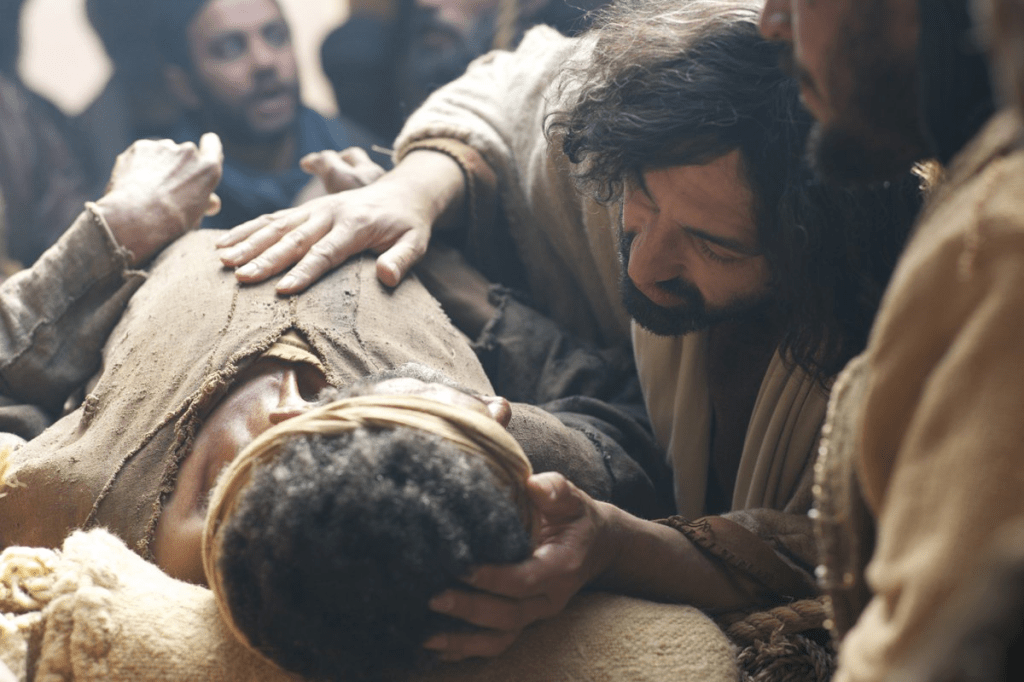
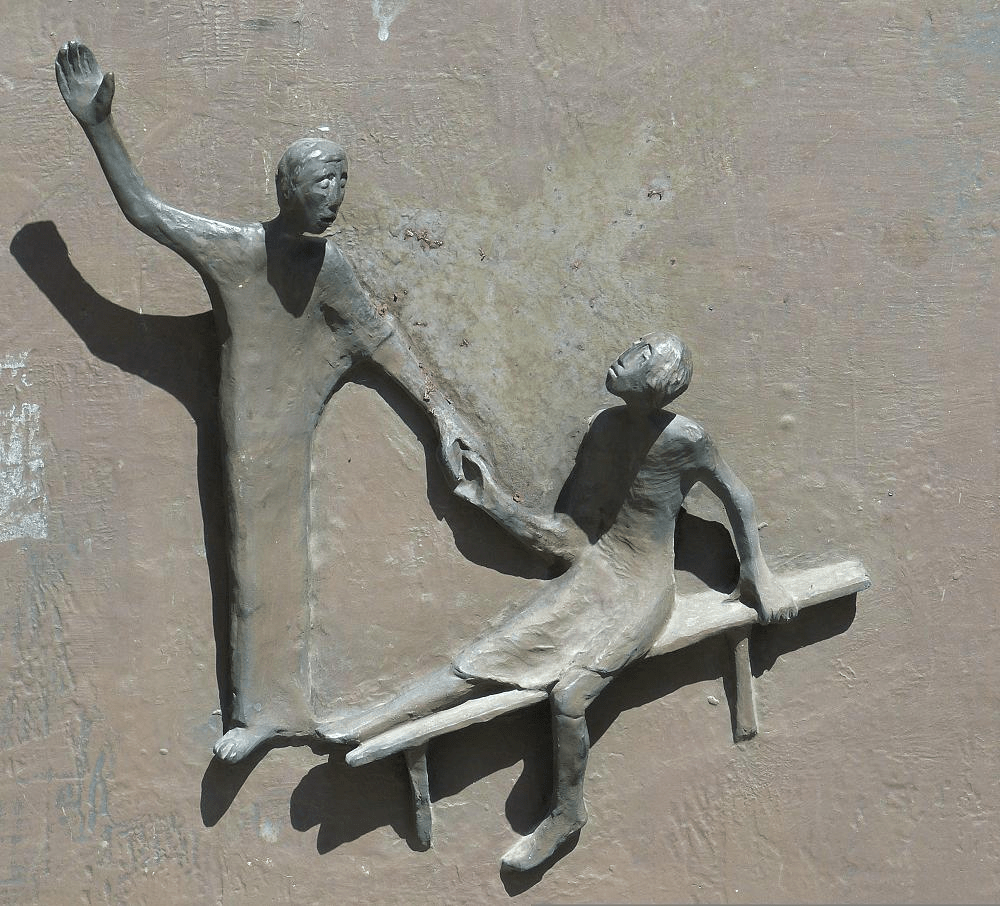
Jesus heals and forgives a paralyzed man

Some men brought to him a paralyzed man, lying on a mat. When Jesus saw their faith, he said to the man, “Take heart, son; your sins are forgiven.”

At this, some of the teachers of the law said to themselves, “This fellow is blaspheming!”

Knowing their thoughts, Jesus said, “Why do you entertain evil thoughts in your hearts? Which is easier: to say, ‘Your sins are forgiven,’ or to say, ‘Get up and walk’? But I want you to know that the Son of Man has authority on earth to forgive sins.” So he said to the paralyzed man, “Get up, take your mat and go home.” Then the man got up and went home. When the crowd saw this, they were filled with awe; and they praised God, who had given such authority to man.

As Jesus went on from there, he saw a man named Matthew sitting at the tax collector’s booth. “Follow me,” he told him, and Matthew got up and followed him.

While Jesus was having dinner at Matthew’s house, many tax collectors and sinners came and ate with him and his disciples. When the Pharisees saw this, they asked his disciples, “Why does your teacher eat with tax collectors and sinners?”

On hearing this, Jesus said, “It is not the healthy who need a doctor, but the sick. But go and learn what this means: ‘I desire mercy, not sacrifice.’ For I have not come to call the righteous, but sinners.” (New International Version)

“The church is a hospital for sinners, not a museum of saints.”

Abigail Van Buren (“Dear Abby”)

Why does the Church exist? Why did Jesus come to this earth? What are we supposed to be doing? Does Christianity make any difference in this world? Why are we here?

The Church is not on this earth solely for the benefit of Christians, any more than a hospital exists for the benefit of the doctors or insurance companies.

Rather, the Church is designed to extend the mission of Jesus through proclamation of good news with the restorative touch of grace. The Church is the community of the redeemed, gathered together for worship and encouragement, and then sent into the world to be the continuing presence of Jesus on this earth.

This mean that the Church’s calling is not to find others who can help them with their tithing and budget, or to keep the pews warm with fresh bottoms.

Some folks are not healthy. Some are sick physically, and others spiritually. Even more are emotionally brokenhearted. And then there are those who are sick-and-tired of being sick-and-tired.

Please know that Jesus came neither to condemn nor heap a pile of unrealistic expectations on us. Christ points us to the source of healing and transformation, and invites us to come to him. 

Conversely, there are many other people today who are healthy, spiritually alive, and have a good well-being. And they possess the opportunity to participate in ways that bring holistic healing to the world as Christians. The mission of Jesus is our mission, as well.

Jesus came to bring forgiveness and transformation. In today’s Gospel healing, it was a case where the person’s paralysis was both physical and spiritual. The paralytic found in Jesus healing of both body and soul.

The religious insiders observed the healing of the paralytic. Yet, they didn’t rejoice over it. Instead, they were hung up on Jesus claiming to be God. Although this may have been a hard truth to accept, Jesus labeled their response as evil – because of an inability to perceive the situation as a divine intervention. Since the religious insiders wrongly discerned who Jesus is, they wrongly interpreted the situation. 

It’s important to see Jesus as the Human One who extends compassion and forgiveness. If we fail to see this about Christ, we will get caught up in all kinds of silly matters concerning personal preferences and power plays, based in how we think things should go, rather than how God is shaking out things.

Jesus came to forgive our guilt and shame. Healing the body is good, but it’s not enough. Christ came to heal both the body and the spirit. At the heart of the human condition is spiritual brokenness, and Jesus wants to remove the obstacle of sin and create a new healthy society. This is a radical vision which seeks to encompass all persons – which means Jesus touched many people overlooked by others.

Jesus came to call the despised people of society, the “sinners.” He called Matthew, a tax collector. Tax collectors were hated. They were corrupt characters who extorted money from innocent people. And furthermore, Jesus had dinner with Matthew, along with all of his unsavory buddies. This kind of behavior by Jesus was deeply offensive to upstanding citizens.

However, Jesus did not back down, saying that it’s not the healthy who need a doctor, but the sick. And he backed up his social actions with Scripture by encouraging offended folks to meditate on what the biblical phrase, “I desire mercy, not sacrifice.” (Hosea 6:6)

It is possible to engage in outward rituals of worship, do all the right things, fulfill duty, yet still miss the heart of what God wants for humanity. Mercy is what God wants. Jesus knew this. So, Christ entangled himself with sinners to bring spiritual healing and restoration.

If we want to see God deliver people from their unhealthy situations, we must entangle ourselves with them, into complicated lives that are not pretty, with persons who have been tainted by sin. 

Lots of people are in awful predicaments. Christians, like their Lord, will need to get their hands dirty and their feet wet to extend Christ’s ministry of mercy and forgiveness.

The gospel was never intended to be proclaimed from afar, but up close and personal. The merciful mission of Jesus requires the following three activities:

  1. Intimacy with Jesus. Engaging in the spiritual disciplines of prayer, giving, fasting, reading, and meditating on Scripture. These practices help us to know Christ better and how to respond with mercy.
  2. Intimacy with fellow believers. We are hard-wired by God for community. Superficial relationships only provide superficial community. Christians need to help one another with spiritual growth, and to hold one another accountable for the mission of Christ.
  3. Intimacy with “sinners.” This world is filled with sick, needy, hurting, and lonely people who are locked in unhealthy patterns of living. They need a merciful change of life that comes from the merciful Jesus acting through merciful Christians. 

Mercy, not judgment, is at the heart of all change. For things to be different, we must be acquainted with mercy.

Most merciful God, we confess we have sinned against you in thought, word, deed, and neglect. We have not held fast to your commandments and have strayed from your teachings. We turn away from self-centered actions and pride. For the sake of your Son, Jesus, have mercy on us and forgive us so that we are released from all sinful obstacles. Empower us with your wisdom, revelation, and discernment so that we might be your merciful hands, feet, and words to one another and those who do not yet know you. Amen.

What Do You Value? (Matthew 6:1-6, 16-21)

The Sermon on the Mount, by Beryl Lewis (1939-2021)

“Be careful not to practice your righteousness in front of others to be seen by them. If you do, you will have no reward from your Father in heaven.

“So when you give to the needy, do not announce it with trumpets, as the hypocrites do in the synagogues and on the streets, to be honored by others. Truly I tell you, they have received their reward in full. But when you give to the needy, do not let your left hand know what your right hand is doing, so that your giving may be in secret. Then your Father, who sees what is done in secret, will reward you.

“And when you pray, do not be like the hypocrites, for they love to pray standing in the synagogues and on the street corners to be seen by others. Truly I tell you, they have received their reward in full. But when you pray, go into your room, close the door and pray to your Father, who is unseen. Then your Father, who sees what is done in secret, will reward you….

“When you fast, do not look somber as the hypocrites do, for they disfigure their faces to show others they are fasting. Truly I tell you, they have received their reward in full. But when you fast, put oil on your head and wash your face, so that it will not be obvious to others that you are fasting, but only to your Father, who is unseen; and your Father, who sees what is done in secret, will reward you.

“Do not store up for yourselves treasures on earth, where moths and vermin destroy, and where thieves break in and steal. But store up for yourselves treasures in heaven, where moths and vermin do not destroy, and where thieves do not break in and steal. For where your treasure is, there your heart will be also. (New International Version)

Spiritual Disciplines

In Christ’s day, there were three spiritual disciplines that were especially important: giving, prayer, and fasting. For the Jewish faithful, these three practices were meant to work together in helping them to know God and serve others. 

Yet, over time, although the disciplines were maintained, they were observed for all the wrong reasons. Jesus was concerned to communicate that not only are people to do the right thing, but that they do the right things for the right reasons.

To do any less, is to be a hypocrite who maintains an outward form of religion, but is inwardly motivated by the praise and recognition of others. Such a person is, in reality, far from God. 

Ash Wednesday is the beginning of Lent on the Christian Calendar. This season is a time devoted to spiritual disciplines, especially fasting.

Fasting

Those who truly hunger and thirst for righteousness take the time eat spiritual food in order to pursue God and seek right relationships in this world. It’s not a matter if we fast, but when.

The Bible has a great deal to say about fasting:

  • Fasting is a sign of humility and brokenness before God in recognizing both personal and corporate guilt. (1 Samuel 7:2-6)
  • Fasting is a means of preparation for ministry. Jesus used fasting in the desert as preparation for his ministry, and to face down the devil (Matthew 4:1-2). And the apostles fasted when seeking God’s direction about a new ministry. (Acts 13:2-3)
  • Fasting is meant to connect with God and serve others; and not to simply go through the motions. (Isaiah 58:3-7)

Therefore, fasting is a time to get in touch with God, to know the divine will, and then to do it. 

God doesn’t operate on a point system. If we only go through the motions of a spiritual discipline, or do it so that others will notice that I am doing my duty, then we have come under the condemnation of Jesus and are proved as hypocrites.

True fasting in an outward practice reflecting an inner attitude of heart; it’s an expression of devotion in order to connect with God and do good works of service to others.

Framing the topic another way: Why don’t we fast? Because it’s culturally okay not to? Because nobody cares whether I do, or don’t?

The spiritual disciplines of giving, praying, fasting, and other Christian practices have changed my life because they are a vital means of connecting with God and engaging the world.

A farmer disciplines himself to plow, plant, and cultivate – not because he wants to impress others (“Y’all see my big ol’ tractor and my implements!?”) but so that he will receive the reward of reaping a harvest at the proper time. 

So, we also, can engage in spiritual disciplines, like fasting, in order to see a harvest of righteousness.

Earthly vs. Heavenly Treasure

Do not store up for yourselves treasures on earth. What are earthly treasures? It’s stuff, money, possessions, as well as control, power, position, and recognition from others.

You may rightly ask, “Is this really, in and of itself, wrong?” No, it’s not. The real question is not whether we possess earthly treasure (because we all do) but rather:

Do I use my earthly treasure to build heavenly treasure? Do I hoard earthly treasure for my own purposes apart from Christ’s kingdom values?

Jesus once illustrated the difference:

Someone in the crowd said to him, “Teacher, tell my brother to divide the inheritance with me.” 

Jesus replied, “Man, who appointed me a judge or an arbiter between you?” 

Then he said to them, “Watch out! Be on your guard against all kinds of greed; life does not consist in an abundance of possessions.” 

And he told them this parable: “The ground of a certain rich man yielded an abundant harvest. He thought to himself, ‘What shall I do? I have no place to store my crops.’ “Then he said, ‘This is what I’ll do. I will tear down my barns and build bigger ones, and there I will store my surplus grain. And I’ll say to myself, “You have plenty of grain laid up for many years. Take life easy; eat, drink and be merry.”’  “But God said to him, ‘You fool! This very night your life will be demanded from you. Then who will get what you have prepared for yourself?’ 

“This is how it will be with whoever stores up things for themselves but is not rich toward God.”(Luke 12:13-21, NIV)

Again, earthly possessions are tools to be used; and not for accumulating personal wealth, esteem, and success for the sake of security in money. Rather, everything the Christian has is for the advancement of God’s kingdom values. 

Why do this? Because earthly treasure is temporary, and heavenly treasure is permanent. 

Is what you are pursuing today really going to matter in 50 billion millennia?

Heavenly treasure is righteousness as defined by Jesus: right relationships with both God and other humans.  Humility, peace, grace, mercy, purity, forgiveness are all relational values. The only thing that we will take with us when we die is relationships.

If I am genuinely committed to God’s kingdom, my most cherished values will be established by God. 

Our real values consume our thoughts and our efforts; what is in our hearts directs our work. And our ultimate values derive from how we perceive our identity. 

For a great many Americans, the primary noun that characterizes and defines us is not American Christians, not American citizens, not American workers; we are known primarily as American Consumers. 

Jesus is not necessarily advocating that we take vows of poverty, or that we ought not to enjoy the good things we have; what he is asking of us is to make a decision where your loyalty is placed.

Spiritual disciplines such as fasting help us to maintain our most cherished values, to see them clearly, and to choose wisely based upon those values.

May it be so, to the glory of God. Amen.

Have a Healthy Spiritual Heart (Matthew 12:9-14)

Going on from that place, he went into their synagogue, and a man with a shriveled hand was there. Looking for a reason to bring charges against Jesus, they asked him, “Is it lawful to heal on the Sabbath?”

He said to them, “If any of you has a sheep and it falls into a pit on the Sabbath, will you not take hold of it and lift it out? How much more valuable is a person than a sheep! Therefore it is lawful to do good on the Sabbath.”

Then he said to the man, “Stretch out your hand.” So he stretched it out and it was completely restored, just as sound as the other. But the Pharisees went out and plotted how they might kill Jesus. (New International Version)

The juxtaposition of this story is pronounced: A man with a shriveled hand stretched it out and is healed by Jesus in full view of everyone in the synagogue; and the synagogue leaders with shriveled hearts withhold their hearts from Jesus, and are not healed of their paralyzed beliefs.

Asking questions out of a desire to make a point, instead of asking out of sincere curiosity, is a telltale sign of the small and shriveled heart. And the surefire signal that the heart is wadded-up like a crumpled piece of paper, is the concern for policy and procedure over people.

There was, of course, an allowance for life-threatening medical situations to be attended to on the Sabbath. The man’s shriveled hand, however, didn’t fall into this category. Jesus could have handled the question of healing by stating that he would do it the next day. That certainly would have protected him and quelled any concerns of his orthodoxy.

But Jesus didn’t go there.

Jesus heals the man with a withered hand, from a 17th century Arabic copy of the Gospels

Instead, he deliberately made a stink in front of everyone. Why? Because the whole situation already stunk to high heaven. The ensconced handling of the law by the religious authorities was calloused to real human need. In other words, such a view of the law was ungodly.

Somewhere along the line, the command of a Sabbath day’s rest had turned from a devoted time for community renewal to an opportunity for showing off one’s religiosity and personal piety.

And the height of offense for Jesus was that God was used as the justification for the peacocking to happen. It is to place the supreme spirituality of a holy person above the hard reality of human need and pain. Jesus wanted nothing to do with such a charade of law.

The divine purpose of the Sabbath command was the health of the entire community – even including animals. It’s meant to be a day of mercy, and not a day of restrictions to the point of perpetuating or even causing ill health.

In truth, to not heal on the Sabbath is a travesty of God’s law.

This isn’t only an ancient problem, but also a contemporary issue, as well. One reason so many modern people today believe that Christianity (and, in some cases, all religion) is nothing but a bunch of goofiness, is that there are far too many Christians and churches who espouse a reading of Scripture that is unhealthy instead of healthy.

Whenever Holy Scripture is used a weapon to keep women in check, existing power structures in place, and people different from one’s religious tradition out of congregational life, then such a practice will eventually be challenged by Jesus. And, ironically, all the nice religious folk will turn on Christ and plot how to be rid of him altogether.

And who, pray tell, wants to be a part of that sort of goofiness?

The bottom line, for many people, is their wealth, money, property, and resources. And if someone happens to get in the way of those economic resources, well then, we’ll simply reinterpret existing biblical commands to protect and maintain our stuff.

For Jesus, the whole point of the banter in the synagogue was to actually help the man right in front of him – to do the right thing on the Sabbath day, and not the hard-hearted thing of nothing.

Sabbath is intended to give everyone, without exception, an opportunity to “be” instead of “do.” The Sabbath is designed for the interests and betterment of all creation, all humanity, and not the other way around. The very fact that the upstanding religious folk even have to be told this, signals that they have drifted very far from the actual commands of God.

“If Jesus had been more diplomatic, he may have reformed Judaism, but he would not have won the world. He would not have give us a gospel that serves the depth intention of the law by freeing us from a slavish service to its surfaces.”

Frederick Dale Bruner

In short, Jesus healed the man’s shriveled hand. But the pious religious persons were not healed of their shriveled hearts. Instead, they were mad as hell. They held an after-church meeting in the parking lot about how to do away Jesus, once and for all.

They did this because the entire movement of maintaining religious power and authority was being threatened to the core.

There are those who hate the one who upholds justice in court and detest the one who tells the truth. (Amos 5:10, NIV)

Therefore, I strongly urge every believer in Jesus Christ to be completely devoted to the Scriptures of the Old and New Testaments, by actually reading them every day; instead of relying upon slick preachers who tell you what you like to hear.

Be discerning and wise in the reading, hearing, and study of God’s Holy Word. It’s a matter of health and illness, hope and despair, life and death. Don’t have a shriveled heart; have a healthy heart, my friend.

Almighty God, to you all hearts are open, all desires known, and from you no secrets are hid: Cleanse the thoughts of our hearts by the inspiration of your Holy Spirit, that we may perfectly love you, and worthily magnify your holy Name; through Christ our Lord. Amen.