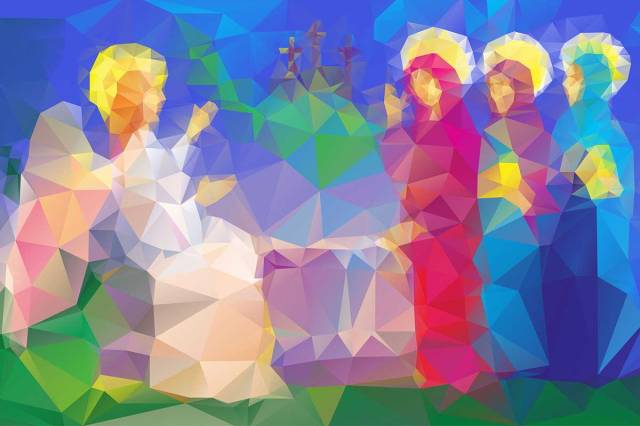
After the Sabbath, as the first day of the week was dawning, Mary Magdalene and the other Mary went to see the tomb. And suddenly there was a great earthquake, for an angel of the Lord, descending from heaven, came and rolled back the stone and sat on it. His appearance was like lightning and his clothing white as snow. For fear of him the guards shook and became like dead men.
But the angel said to the women, “Do not be afraid, for I know that you are looking for Jesus who was crucified. He is not here, for he has been raised, as he said. Come, see the place where he lay. Then go quickly and tell his disciples, ‘He has been raised from the dead, and indeed he is going ahead of you to Galilee; there you will see him.’ This is my message for you.”
So they left the tomb quickly with fear and great joy and ran to tell his disciples. Suddenly Jesus met them and said, “Greetings!” And they came to him, took hold of his feet, and worshiped him. Then Jesus said to them, “Do not be afraid; go and tell my brothers and sisters to go to Galilee; there they will see me.” (NRSVUE)
“Christ is risen!”
“Christ is risen, indeed! Alleluia!”
“The Lord suffered for the sake of him who suffered, and was bound for the sake of him who was imprisoned, and was judged for the sake of the condemned, and was buried for the sake of the buried. So come, all families of human beings who are defiled by sins, and receive remission of sins.
“For I am your remission, I am the Passover of salvation. I am the Lamb sacrificed for your sake. I am your ransom. I am your life. I am your Resurrection. I am your light. I am your salvation. I am your King. I lead you toward the heights of heaven. I will show you the eternal Father. I will raise you up with my right hand.” Melito, Bishop of Sardis (died c.190 C.E.)
So, why not today, of all days on the calendar? Why not experience miracles on this Day of Resurrection in which new life abounds? Why not sense the power of Christ’s Resurrection coursing through your spiritual veins? For this is the day of new beginnings, leaving old grudges and bitterness behind. This is the day of deliverance from all things which hinder us from knowing God and seeing the Savior.
O God, of unchangeable power and eternal light: Look favorably on your whole Church, that wonderful and sacred mystery; by the effectual working of your providence, carry out in tranquility the plan of salvation; let the whole world see and know that things which were cast down are being raised up, and things which had grown old are being made new, and that all things are being brought to their perfection by him through whom all things are made, your Son Jesus Christ our Lord. Amen.
Then Jesus came from Galilee to John at the Jordan, to be baptized by him. John would have prevented him, saying, “I need to be baptized by you, and do you come to me?” But Jesus answered him, “Let it be so now, for it is proper for us in this way to fulfill all righteousness.” Then he consented. And when Jesus had been baptized, just as he came up from the water, suddenly the heavens were opened to him and he saw God’s Spirit descending like a dove and alighting on him. And a voice from the heavens said, “This is my Son, the Beloved, with whom I am well pleased.” (New Revised Standard Version)
Today is the Sunday on the Christian Calendar in which the baptism of Jesus is annually remembered. It also marks the first Sunday of the season of Epiphany – a celebration of God’s salvation being extended not only to Jews, but also to Gentiles. In other words, everyone on planet earth is within the scope of Christ’s work of deliverance.
Baptism is important. Remembering is important. Put together, remembering our baptism is highly important. Here’s why….
Baptism is important to Jesus
Baptism is the distinguishing mark or symbol of being a Christian.
The New Testament knows nothing of an unbaptized Christian – it’s biblically oxymoronic. That’s because baptism is tied to our identity as believers. Each individual baptism is based in the baptism of the Lord who, in his Great Commission, told us to baptize in the name of the Father, Son, and Spirit.
The absence of baptism is like a bride without a wedding ring; or a football player not wearing a uniform; or a motorcycle gang without tattoos; or like an Iowa farmer without a Pioneer seed corn hat!
Baptism is the outward sign that we belong to God. It is the distinguishing symbol that we have been adopted by God and will receive all the promises of salvation in Christ.
Christ’s baptism fulfilled all righteousness through identification with repentant people
John the Baptist was understandably hesitant to baptize Jesus; he knew Jesus had no need of repentance. Although Jesus had no sin to confess, his baptism is a powerful symbol of his humility. It anticipates his ministry to people who recognize their need for God.
It was necessary for Jesus to be baptized in order to communicate solidarity with people who are coming to God. “Righteousness” means having a right relationship with both God and other people. By being baptized, Jesus is proclaiming that a renewed and right relationship with God will become a reality through himself.
Baptism is the sign that we belong to God and that our righteousness is tied to our union with Jesus.
It was important for Jesus to identify with sinners; and so, it is important for us, as well. We remember our baptism – that we belong to God – by identifying with “sinners.” We do this by:
Practicing hospitality (love of strangers)
Using our spiritual gifts of speaking and serving on their behalf
Getting to know people very different from ourselves
Meeting people on their turf (not just ours)
Showing respect and upholding dignity
Asking thoughtful and caring questions
Listening with focused attention
It isn’t what we “do” for people that’s as important as affirming our shared humanity with them. We thus lead folks to the ultimate person who can address the needs of their heart: Jesus.
Christ’s baptism fulfilled all righteousness through the affirmationof witnesses
Before Jesus began his ministry, it was necessary to receive validation of what he was about to teach and do. In ancient Judaism, one of the protections guaranteeing that Scripture would be taught according to the way of God, was through an ordination, of sorts. In order for a new rabbi to become a new rabbi, he needed the laying on of hands from two other rabbis who had authority to do so.
That’s why Christ’s baptism is important. John the Baptist was a powerful teacher and prophet who was recognized by the people as such. John publicly said he wasn’t worthy to carry Jesus’s sandals, that Jesus is the Lamb of God that takes away the sin of the world. So, a baptism by John validated Jesus and inaugurated his ministry.
And a second voice – another witness from heaven – affirmed Jesus: “This is my Son, the Beloved, with whom I am well pleased.” Then, the Holy Spirit, in the form of a dove, came upon Jesus. This further affirmed that Jesus would save people, not through arm-twisting and great shows of power, but through humility and gentleness.
Baptism was Christ’s first recorded act as an adult. In some ways, it was his first miracle – the miracle of humility in identifying with sinners.
Remember your baptism
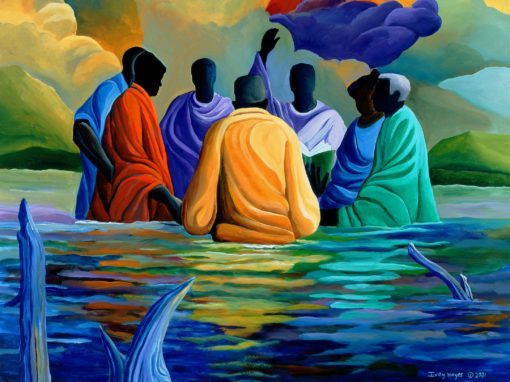
“Baptism” by American artist Ivey Hayes (1948-2012)
Baptism is a sign and a seal of God’s grace. Just as Christ’s baptism focused all the promises of God in salvation as being fulfilled in one person, so in our baptism we claim all the promises of God as found in Jesus. Water symbolizes new life, God identifying with us – Immanuel, God with us.
In baptism, God promises and seals to us our union with Jesus so that identity is not found in my past and my profession of faith, but in Christ’s past of bringing redemption to us. Baptism does not so much express faith as call one to a life of faith and sets us apart as belonging to God.
Baptism is a visible declaration of an invisible reality: union with Christ. Just as circumcision was the outward visible sign of the old covenant, so baptism is the sign of the new covenant in Christ – available to both male and female – thus opening the way for women to participate fully in the ministry of the gospel.
In particular, infant baptism confirms that salvation is not initiated by us, but by God. It affirms that one is betrothed to God. As a child, then an adult, grows into the faith, it is our task to remember our baptism, to be reminded that God’s mark is upon us, that we belong to the Lord.
God has set us apart to be a holy people, given to Jesus to live as he did. We must never forget that baptism is God’s identifying mark upon us; that our union and solidarity with Jesus is affirmed through this practice.
We are not solitary Christians; we belong to Christ and to one another. Baptism is the initiation rite that takes a lifetime to complete. Therefore, we must struggle together in working out our salvation.
Because of our union with Jesus Christ, we must remember:
I do not belong to the world. So, I will not live selfishly, only seeking my own comfort agenda. Instead, I will give and serve others from a pure and humble heart.
I do not belong to sin. So, I will not give myself over to shameful words or actions, to bullying or manipulating people, to throwing fits and pity parties to get my way, nor using my tongue to speak gossip, slander, or suck-up to others. Instead, I will use my speech wisely, building up others through thoughtful and heartfelt encouragement.
I do not belong to the devil. So, I will not seek his agenda of lying, cheating, stealing, and being bitter.
I belong to Jesus, so therefore:
I will uphold biblical justice by championing the cause of the fatherless and the widow, the poor and the needy, the least and the lost among us.
I will love others with all the grace God gives me.
I will forgive others because Christ has forgiven me.
I will consider others better than myself by embracing the humility of Christ.
I will hunger and thirst for righteousness by seeking and maintaining right relations with others.
I will seek peace and pursue it.
I will, give myself to my Lord and Savior Jesus Christ my Savior and Lord – completely and thoroughly, unabashedly and unreservedly.
I will live into my baptism and remember it always, because I belong to Jesus!
Creator God, our soul’s delight, your voice thunders over the waters, liberating the future from the past. In the Spirit’s power and the waters of rebirth, Jesus was declared your blessed and beloved Son; may we recall our baptism, and be disciples of the Anointed One. Amen.
Then Jesus was led by the Spirit into the wilderness to be tempted there by the devil. For forty days and forty nights he fasted and became very hungry.
During that time the devil came and said to him, “If you are the Son of God, tell these stones to become loaves of bread.”
But Jesus told him, “No! The Scriptures say,
‘People do not live by bread alone, but by every word that comes from the mouth of God.’”
Then the devil took him to the holy city, Jerusalem, to the highest point of the Temple, and said, “If you are the Son of God, jump off! For the Scriptures say,
‘He will order his angels to protect you. And they will hold you up with their hands so you won’t even hurt your foot on a stone.’”
Jesus responded, “The Scriptures also say, ‘You must not test the Lord your God.’”
Next the devil took him to the peak of a very high mountain and showed him all the kingdoms of the world and their glory. “I will give it all to you,” he said, “if you will kneel down and worship me.”
“Get out of here, Satan,” Jesus told him. “For the Scriptures say,
‘You must worship the Lord your God and serve only him.’”
Then the devil went away, and angels came and took care of Jesus. (New Living Translation)
Get Thee Behind Me Satan, by Ilya Repin, 1895
In our most vulnerable moments, there are dark forces that attempt to swoop in and offer demonic delights for us to consider. This is what we call “temptation.” Indeed, it can be quite alluring to entertain ways of getting what we need, and want, through dubious avenues and shadowy back alleys, other than the light of God.
In the desert, the place of preparation for ministry, Jesus fasted and prayed forty days and nights. If ever there was a time when Jesus would be vulnerable to alternative religion, the devil mused, wringing his demonic hands together with wicked delight, it would be out in the desert by himself.
So, Satan tempted Jesus with three whoppers he thought would get to Jesus, for sure. Having tempted Jesus with food and a way to fame, and having failed both times, Satan gave his final temptation, and his best effort at getting Jesus to take a different path.
To us this temptation to bow down and worship Satan seems like a no-brainer. Well, of course, no one would do such a thing as this, especially Jesus. And he did not. But it was still quite tempting, and this why: Jesus knew very well what was ahead of him.
He had just spent forty days in an intense orientation for an upcoming three years of hard ministry with an end that he knew would be characterized by torture and a horrendous death. If there was a way to get around all that pain and suffering, maybe Jesus would take it.
Satan presented to Jesus an alternative way, a different path to achieve his purpose for being on this earth. Jesus could have it all without the three years, without the hard slugging to communicate the kingdom of God has come. Most of all, Jesus could circumvent the cross and establish his rule over all the earth – all pain free! The temptation, yes, was very tempting. Become King Jesus now with no suffering.
This has always been one of our great temptations, as well: Take the easy path. Get what you want, what you deserve, now, with no hardship.
The values of God’s kingdom include trust, patience, and perseverance. Temptation insists we need none of those hard things to be successful.
Satan is the original slickster, marketing his quick and easy wares for people to buy into the notion that life can lived without pain and hardship, and with wild success, right now! The scary thing about it is, Satan can deliver… but it will cost us our very lives. Slavery to sin is the price we pay for hitching our hopes to the quick and easy.
The Christian season of Lent is a time for the slow, patient, deliberate development of the soul in attachment with the Lord Jesus. Engaging in spiritual disciplines is hard. It is difficult to fast and pray. Growing in Christ is slow and takes a great deal of learned perseverance.
Far too many of us are tempted to circumvent the hard work of discipleship and simply have some spiritual professionals distill everything we need into one hour on Sunday morning, or in a nice neat 5-minute devotional.
For yet another easy alternative, it could be that we opt to fabricate our own religious practices and beliefs, picking and choosing what fits our lifestyle, as if convenience and comfort are the summum bonum of life, instead of worship.
Christ was able to face down temptation because the desert strengthened him. Yes, he was vulnerable. But he was not weak. If we want to handle temptation, it will take the hard slog of Lent to help us. It will require the desert to spiritually form us and prepare us for godly ministry that puts the devil in his place.
Lord Jesus, you are the king of all creation. Just as you chose the hard path of God’s kingdom, so help me to persevere with faith and patience. May my life reflect your words and ways, in the power of the Holy Spirit. Amen.
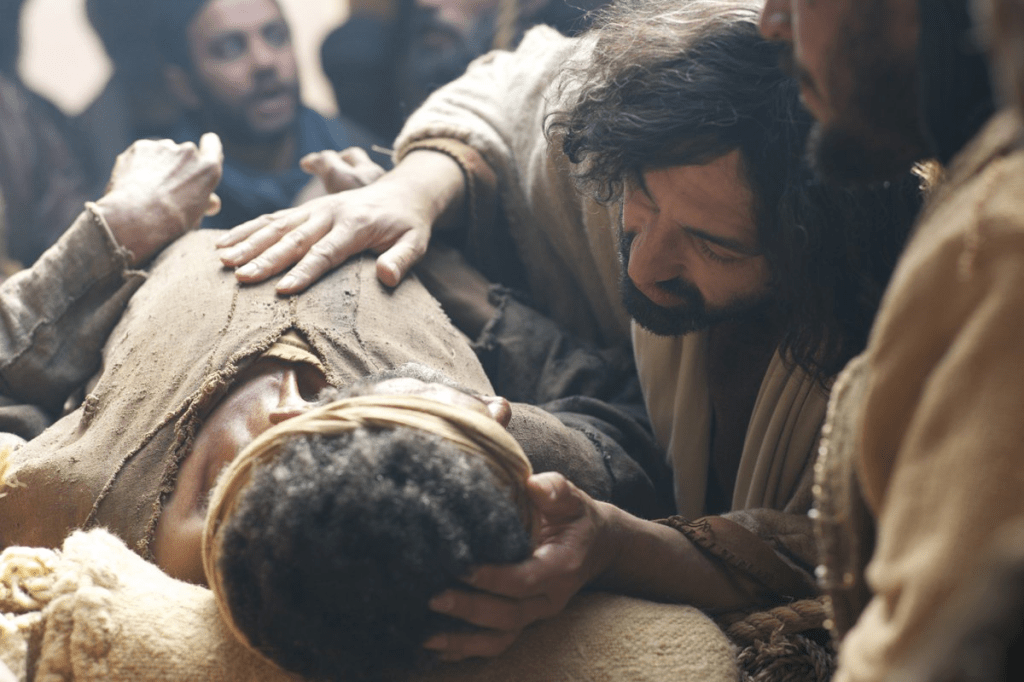
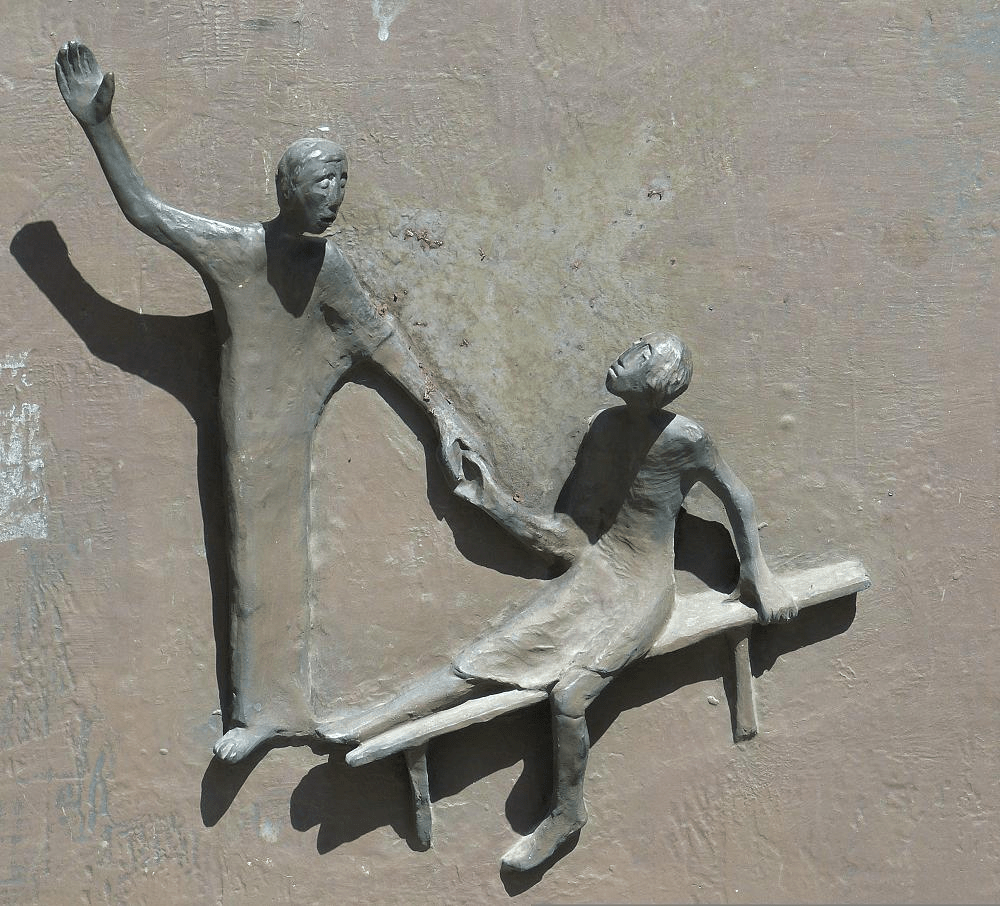
Some men brought to him a paralyzed man, lying on a mat. When Jesus saw their faith, he said to the man, “Take heart, son; your sins are forgiven.”
At this, some of the teachers of the law said to themselves, “This fellow is blaspheming!”
Knowing their thoughts, Jesus said, “Why do you entertain evil thoughts in your hearts? Which is easier: to say, ‘Your sins are forgiven,’ or to say, ‘Get up and walk’? But I want you to know that the Son of Man has authority on earth to forgive sins.” So he said to the paralyzed man, “Get up, take your mat and go home.” Then the man got up and went home. When the crowd saw this, they were filled with awe; and they praised God, who had given such authority to man.
As Jesus went on from there, he saw a man named Matthew sitting at the tax collector’s booth. “Follow me,” he told him, and Matthew got up and followed him.
While Jesus was having dinner at Matthew’s house, many tax collectors and sinners came and ate with him and his disciples. When the Pharisees saw this, they asked his disciples, “Why does your teacher eat with tax collectors and sinners?”
On hearing this, Jesus said, “It is not the healthy who need a doctor, but the sick. But go and learn what this means: ‘I desire mercy, not sacrifice.’ For I have not come to call the righteous, but sinners.” (New International Version)
“The church is a hospital for sinners, not a museum of saints.”
Abigail Van Buren (“Dear Abby”)
Why does the Church exist? Why did Jesus come to this earth? What are we supposed to be doing? Does Christianity make any difference in this world? Why are we here?
The Church is not on this earth solely for the benefit of Christians, any more than a hospital exists for the benefit of the doctors or insurance companies.
Rather, the Church is designed to extend the mission of Jesus through proclamation of good news with the restorative touch of grace. The Church is the community of the redeemed, gathered together for worship and encouragement, and then sent into the world to be the continuing presence of Jesus on this earth.
This mean that the Church’s calling is not to find others who can help them with their tithing and budget, or to keep the pews warm with fresh bottoms.
Some folks are not healthy. Some are sick physically, and others spiritually. Even more are emotionally brokenhearted. And then there are those who are sick-and-tired of being sick-and-tired.
Please know that Jesus came neither to condemn nor heap a pile of unrealistic expectations on us. Christ points us to the source of healing and transformation, and invites us to come to him.
Conversely, there are many other people today who are healthy, spiritually alive, and have a good well-being. And they possess the opportunity to participate in ways that bring holistic healing to the world as Christians. The mission of Jesus is our mission, as well.
Jesus came to bring forgiveness and transformation. In today’s Gospel healing, it was a case where the person’s paralysis was both physical and spiritual. The paralytic found in Jesus healing of both body and soul.
The religious insiders observed the healing of the paralytic. Yet, they didn’t rejoice over it. Instead, they were hung up on Jesus claiming to be God. Although this may have been a hard truth to accept, Jesus labeled their response as evil – because of an inability to perceive the situation as a divine intervention. Since the religious insiders wrongly discerned who Jesus is, they wrongly interpreted the situation.
It’s important to see Jesus as the Human One who extends compassion and forgiveness. If we fail to see this about Christ, we will get caught up in all kinds of silly matters concerning personal preferences and power plays, based in how we think things should go, rather than how God is shaking out things.
Jesus came to forgive our guilt and shame. Healing the body is good, but it’s not enough. Christ came to heal both the body and the spirit. At the heart of the human condition is spiritual brokenness, and Jesus wants to remove the obstacle of sin and create a new healthy society. This is a radical vision which seeks to encompass all persons – which means Jesus touched many people overlooked by others.
Jesus came to call the despised people of society, the “sinners.” He called Matthew, a tax collector. Tax collectors were hated. They were corrupt characters who extorted money from innocent people. And furthermore, Jesus had dinner with Matthew, along with all of his unsavory buddies. This kind of behavior by Jesus was deeply offensive to upstanding citizens.
However, Jesus did not back down, saying that it’s not the healthy who need a doctor, but the sick. And he backed up his social actions with Scripture by encouraging offended folks to meditate on what the biblical phrase, “I desire mercy, not sacrifice.” (Hosea 6:6)
It is possible to engage in outward rituals of worship, do all the right things, fulfill duty, yet still miss the heart of what God wants for humanity. Mercy is what God wants. Jesus knew this. So, Christ entangled himself with sinners to bring spiritual healing and restoration.
If we want to see God deliver people from their unhealthy situations, we must entangle ourselves with them, into complicated lives that are not pretty, with persons who have been tainted by sin.
Lots of people are in awful predicaments. Christians, like their Lord, will need to get their hands dirty and their feet wet to extend Christ’s ministry of mercy and forgiveness.
The gospel was never intended to be proclaimed from afar, but up close and personal. The merciful mission of Jesus requires the following three activities:
Intimacy with Jesus. Engaging in the spiritual disciplines of prayer, giving, fasting, reading, and meditating on Scripture. These practices help us to know Christ better and how to respond with mercy.
Intimacy with fellow believers. We are hard-wired by God for community. Superficial relationships only provide superficial community. Christians need to help one another with spiritual growth, and to hold one another accountable for the mission of Christ.
Intimacy with “sinners.” This world is filled with sick, needy, hurting, and lonely people who are locked in unhealthy patterns of living. They need a merciful change of life that comes from the merciful Jesus acting through merciful Christians.
Mercy, not judgment, is at the heart of all change. For things to be different, we must be acquainted with mercy.
Most merciful God, we confess we have sinned against you in thought, word, deed, and neglect. We have not held fast to your commandments and have strayed from your teachings. We turn away from self-centered actions and pride. For the sake of your Son, Jesus, have mercy on us and forgive us so that we are released from all sinful obstacles. Empower us with your wisdom, revelation, and discernment so that we might be your merciful hands, feet, and words to one another and those who do not yet know you. Amen.