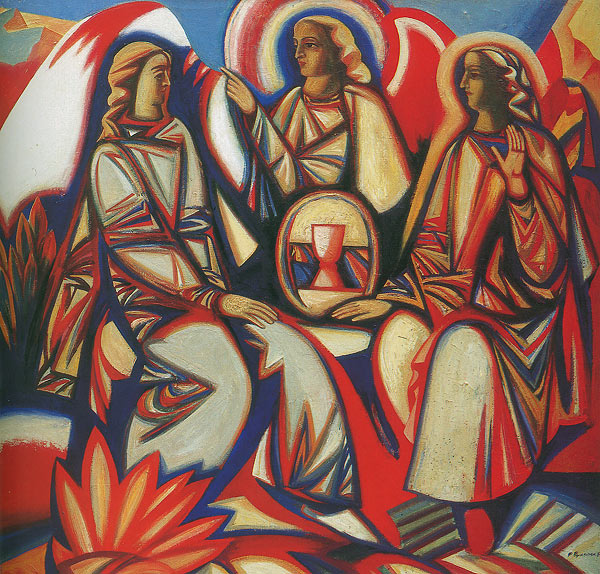
Like Father Like Son (John 5:19-29)

The Trinity, by Ukrainian painter Feodosiy Humeniuk, 1981

Jesus responded to the Jewish leaders: 

“I assure you that the Son can’t do anything by himself except what he sees the Father doing. Whatever the Father does, the Son does likewise. The Father loves the Son and shows him everything that he does. He will show him greater works than these so that you will marvel. 

As the Father raises the dead and gives life, so too does the Son give life to whomever he wishes. The Father doesn’t judge anyone, but he has given all judgment to the Son so that everyone will honor the Son just as they honor the Father. Whoever doesn’t honor the Son doesn’t honor the Father who sent him.

I assure you that whoever hears my word and believes in the one who sent me has eternal life and won’t come under judgment but has passed from death into life.

I assure you that the time is coming—and is here!—when the dead will hear the voice of God’s Son, and those who hear it will live. Just as the Father has life in himself, so he has granted the Son to have life in himself. He gives the Son authority to judge because he is the Human One.

Don’t be surprised by this, because the time is coming when all who are in their graves will hear his voice. Those who did good things will come out into the resurrection of life, and those who did wicked things into the resurrection of judgment.”

(Common English Bible)

So goes the parent, so goes the child. Sons look and act a great deal like their fathers. And there is no mistaking the resemblance between Father of the heavens and Son of the incarnation.

In Christianity, to see Jesus is to see God. To know Christ is to know the Lord. They are distinct, yet inextricably linked as one; each is differentiated from the other in personhood, yet united with the same divine substance.

The deity of the Father and the deity of the Son is one, equal in glory, co-eternal in majesty.

What the Father is, the Son is.

Uncreated, eternal, almighty, and sovereign is the Father; uncreated, eternal, almighty, and sovereign is the Son.

The Father and the Son are not two gods but one God.

There is only one Father; there is only one Son. Each is neither greater nor lesser than the other.

Whoever wants to be saved from guilt, shame, sin, death, and hell – and to be delivered from the injustice of the world, the failings of oneself, and the machinations of evil, should think about the Father and the Son and the Spirit, the Holy Trinity, one God.

– Athanasian Creed

So, why is all this creedal Christian doctrine of any importance? Why pay attention to such things?

Because there are many issues and problems in this world of great importance which must be addressed and dealt with. We need to have some idea of how to go about: 

  • Governing ourselves as a free people
  • Eradicating poverty and disease
  • Educating our children
  • Paying taxes
  • Providing excellent and cost effective healthcare for everyone
  • Dismantling racism
  • Seeking peaceful international relations
  • Building responsible and accountable local community relationships
  • Supporting small businesses
  • Helping workers make a decent contributive living
  • Loving our families and faith communities 

It is my unshakable conviction that all these issues, and many others, need more than our collective mental attention and physical resources; these problems also need spiritual resolutions and solutions.

Seasons, years, centuries, and millennia come and go. People are born, live, and die. Generations exist and then are no more. Civilizations rise and fall. Through it all and above it all is the person of Jesus.

Christ is alive. He brings breath from dust, beauty from ashes, order from chaos, stability from insecurity, dignity from disrespect, and meaning from uncertainty. Jesus gives life, abundant and to the full.
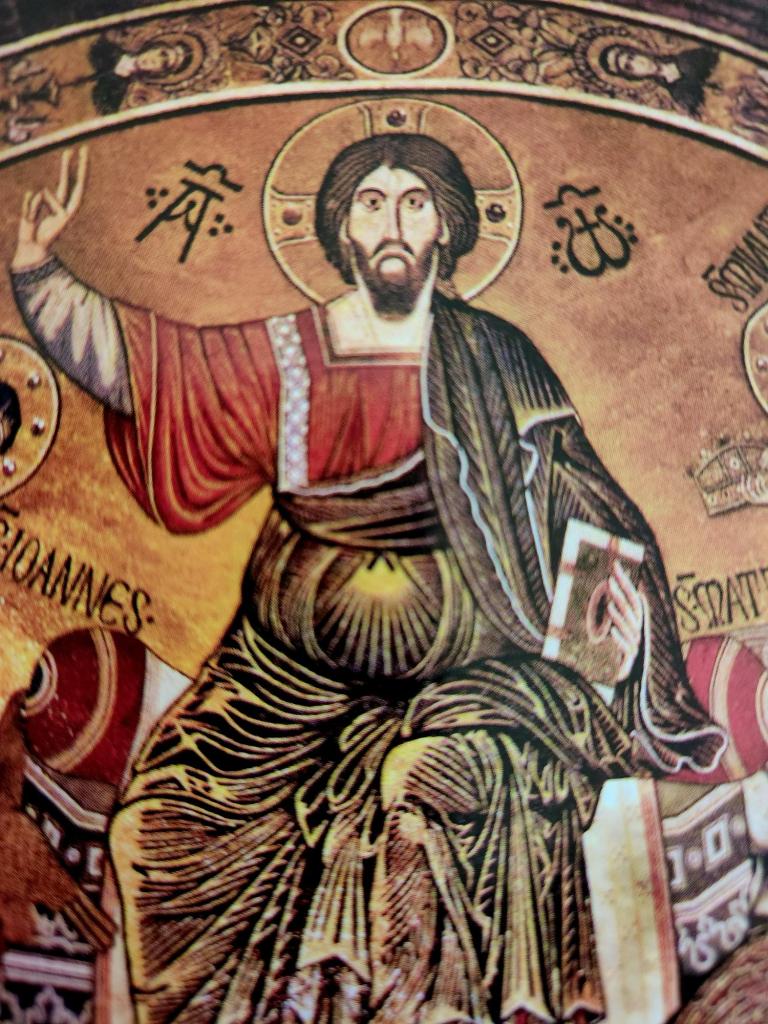
Christ the King, San Miniato al Monte Church, Florence, Italy

Today, this very moment, Christ is still on the throne of all creation. 

Human elections and institutions only have authority as given by Jesus, the Ruler of all.

Presently, Jesus is attentive and vigilant to people, actively interceding for us at the right hand of his Father in heaven. At this very moment, the Holy Spirit is the continuing presence of Christ on this earth, applying Christ’s redemption of humanity to the lives of millions. 

Sometimes we need to remember how important our spiritual resources are to living in this world – and to clarify what’s really of ultimate significance in this old broken world. 

My unwavering spiritual persuasion is this: People need the Lord. Therefore, it only makes good spiritual sense to live in ways that foster a connection with Jesus. 

This morning, I did what I do every morning – whether I’m sick or well, sad or happy, facing a busy day or a relaxed day – I began my day with Scripture reading, prayer, reflection, and gratitude. And I do it with the realization that Christ is King, that as the divine/human Lord of all, his:

  • authority is real
  • rule is benevolent
  • sovereignty is ubiquitous
  • reign is supreme
  • judgments are right and good
  • power is mighty enough to raise the dead

The Christian tradition holds that Jesus Christ is the exalted and glorified Son of God, the Sovereign authority over every dominion. The works of Jesus bear testimony to the cosmic reality that he is Lord of all. And, if that were not enough, Jesus shares his divine power with us, his people.

In the face of Christ’s majesty, the valid and appropriate response is sheer submission to Christ’s authority. 

Just as Jesus listened to the Father and obeyed the Father’s will, so we need to listen to Jesus and carry out his will. 

Just as Jesus enjoyed his relationship with the Father, so we are to bask in our wonderful relationship with Jesus. 

Since Jesus submitted to death on a cross and rose from the dead through God’s power, we now have access to that power by God’s grace through faith in Christ. And we are to use that divine power to take up our own cross and bear the great issues and problems of our day with all the spiritual resources granted to us in Christ Jesus.

Like Father, like Son. Like Christ, like Christians. May all followers of Jesus resemble their Lord in each word and in every way.

Almighty God, to you all hearts are open, all desires known, and from you no secrets are hid: Cleanse the thoughts of our hearts by the inspiration of your Holy Spirit, that we may perfectly love you, and worthily magnify your holy Name; through Christ our Lord. Amen.

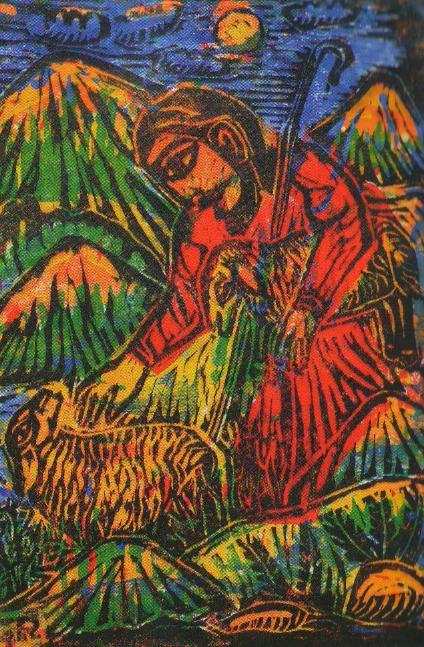
John 10:11-21 – The “Good” Shepherd

Jesus, the Good Shepherd, by P. Solomon Raj (1921-2019)

“I am the good shepherd. The good shepherd lays down his life for the sheep. When the hired hand sees the wolf coming, he leaves the sheep and runs away. That’s because he isn’t the shepherd; the sheep aren’t really his. So, the wolf attacks the sheep and scatters them. He’s only a hired hand and the sheep don’t matter to him.

“I am the good shepherd. I know my own sheep and they know me, just as the Father knows me and I know the Father. I give up my life for the sheep. I have other sheep that don’t belong to this sheep pen. I must lead them too. They will listen to my voice and there will be one flock, with one shepherd.

“This is why the Father loves me: I give up my life so that I can take it up again. No one takes it from me, but I give it up because I want to. I have the right to give it up, and I have the right to take it up again. I received this commandment from my Father.”

There was another division among the Jews because of Jesus’ words. Many of them said, “He has a demon and has lost his mind. Why listen to him?” Others said, “These aren’t the words of someone who has a demon. Can a demon heal the eyes of people who are blind?” (Common English Bible)

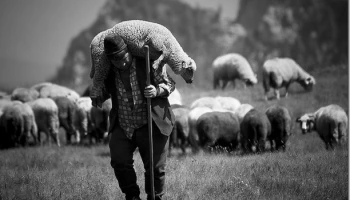
Many people in today’s urban and suburban world are completely unfamiliar with sheep and shepherds. So, when it comes to picturing Jesus as the good shepherd, idyllic scenes might come to mind, full of green meadows and pastoral landscapes, where there is perfect peace and rest, at all times.

Having been raised in rural Midwest America, I can confidently say there is little romanticism to the life of shepherds and sheep. Sheep eat a lot. They’ll eat just about anything that’s growing out of the ground. Think about how you would feel if you ate copious amounts of plants…. Lots of gas, trips to the bathroom, and stink.

That’s how it is with sheep. They continually poop and the smell is downright awful. A lot of a shepherd’s daily work is helping sheep deal with all the gas inside them. Sheep are easily prone to bloating from excess gas. This isn’t just an uncomfortable situation for a sheep; it’s an emergency life-and-death scenario. The shepherd must continually be vigilant to the sheep and take care of such circumstances immediately and carefully.

Taking care of sheep is dangerous, difficult, and tedious work. Historically, shepherds were rough characters, constantly on the move to find lush pastures for the flock’s voracious appetite. They had to deal with both animal and human predators looking for an easy meal. Being mostly outdoors, even at night, led to their reputation as drinkers – keeping up a consistent nip of spirits to remain warm. And, of course, they smelled bad.

So, when Jesus described himself as the “good shepherd,” this was anything but a pleasing picture for people in the ancient world. The closest equivalents to our modern day might be for Jesus to say, “I am the good migrant worker,” or the “good carny” (carnival employee).

Anyone or any profession in which we might deem a person in that line of work as of dubious character – that is precisely how a shepherd, and their work, were viewed by ancient people. It’s often the low-wage workers of society who get down and dirty. Because of their work, they get a suspicious and contemptuous reputation. Remarkably, Jesus unabashedly aligned himself with such people.

And yet, it is the discounted professions and the dismissed people from which we must pay attention; God is probably at work in their midst.

The despised Samaritan gained the label of “good” by Jesus for giving himself fully to save a stranger. Jesus puts the same adjective in front of shepherd. Whereas no one in polite society would use “good” for shepherd, Jesus labels himself as the Good Shepherd who lays down his life for the sheep.

Jesus, this incredible figure who puts good and shepherd together, also goes out of his way to bring other sheep into his fold. Since Christ identifies himself as a stinky lowly shepherd, he has no problem connecting with everyone. After all, when one is already low, there’s no looking down on another.

People everywhere, no matter their station in life, can hear the voice of Jesus speaking to them when they, too, are low enough to be able to listen.

The Good Shepherd by He Qi

Jesus, the Good Shepherd, is also the sacrificial lamb. In laying down his life he takes it up again (John 10:17). And when we participate in that dying and rising, when we eat the bread and drink the cup of salvation, we know he abides in us(1 John 3:24). Remaining in Christ with our Good Shepherd means, we, too, lay down our lives:

This is how we’ve come to understand and experience love: Christ sacrificed his life for us. This is why we ought to live sacrificially for our fellow believers, and not just be out for ourselves.

If you see some brother or sister in need and have the means to do something about it but turn a cold shoulder and do nothing, what happens to God’s love? It disappears. And you made it disappear.

My dear children, let’s not just talk about love; let’s practice real love. This is the only way we’ll know we’re living truly, living in God’s reality. (1 John 3:16-18, MSG)

Community is messy. People are stinky. Stepping into another’s life is rarely picturesque or idyllic. Yet, it’s at the same time elegant and aromatic. For we discover that our old ideas of beauty are obsolete. We gain a new spiritual sense which is redolent with the fragrance of Christ.

O God, Shepherd of all your people, deliver us from all troubles, worries and cares that assail us so that we may always do what is pleasing in your sight, and remain safe in the care of our Good Shepherd, Jesus Christ our Lord. Amen.

John 6:41-51 – The Bread of Life

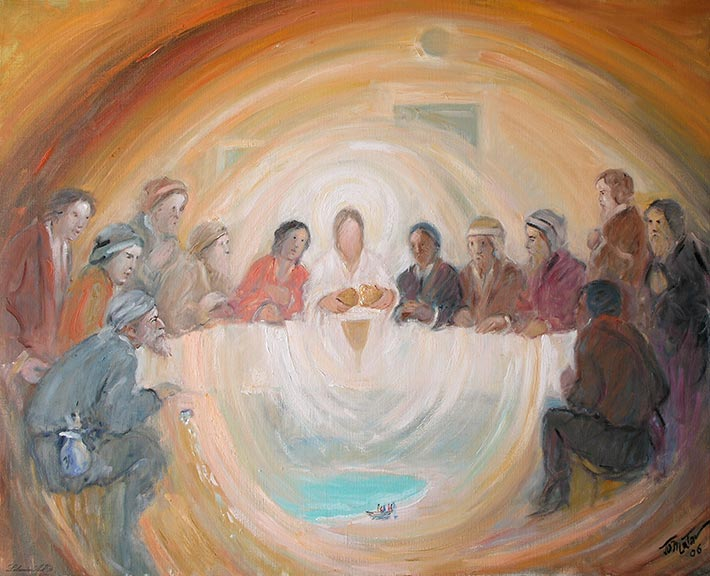
“I Am the Bread of Life” by Lebanese painter Joseph Matar

The Jews there began to grumble about him because he said, “I am the bread that came down from heaven.” They said, “Is this not Jesus, the son of Joseph, whose father and mother we know? How can he now say, ‘I came down from heaven’?”

“Stop grumbling among yourselves,” Jesus answered. “No one can come to me unless the Father who sent me draws them, and I will raise them up at the last day.It is written in the Prophets: ‘They will all be taught by God.’ Everyone who has heard the Father and learned from him comes to me. No one has seen the Father except the one who is from God; only he has seen the Father. Very truly I tell you, the one who believes has eternal life.

I am the bread of life. Your ancestors ate the manna in the wilderness, yet they died. But here is the bread that comes down from heaven, which anyone may eat and not die. I am the living bread that came down from heaven. Whoever eats this bread will live forever. This bread is my flesh, which I will give for the life of the world.” (New International Version)

Christians everywhere hold to Jesus as the Son of God, Lord of the universe, and Savior of all.

However, for most people who were following Jesus around in the first century, this was not their understanding of Christ. In his earthly ministry, Jesus spoke in ways that introduced people to who he really was and sought to bring them to a point of following him based on his identity. 

Jesus wanted the crowds to see him for who he really is – themselves for what they really needed – and follow him based on the deepest needs of their lives.

I believe Jesus is the hope of all nations and all people, and in him humanity’s most basic and profound needs are met for forgiveness, love, and purpose in life. To address this, I ask three basic philosophical and theological questions of life:

What should human beings seek in life?

The responses in history are legion. The ancient Greek philosopher Aristotle thought a proper appreciation for an ethical and virtuous life found in practical wisdom was where people’s most concerted efforts should be. 

Karl Marx, the father of communism and socialism believed the proletariat should use their heads and their hands to rise above their economic conditions and oppression.

In the late 1960’s, Bobby Kennedy said we ought to be working the hardest to achieve justice and not advance ourselves on the misfortunes of others.

In more recent times, the Harvard Business Review is continually on the lookout for the best ways of being efficient, productive, and making the most of time because work itself is paramount.

Jesus insisted that people are not to work for food that spoils, but for food that endures to eternal life. Christ positioned himself as the bread of life – the one who is able to sustain humanity and enable to thrive and flourish in life.

By literally feeding thousands of people, Jesus wanted the people to understand the source of life itself comes from him. Jesus aspired beyond providing a supper for folks – he desired the people to feast on himself – to ingest him, to take him into their lives in a deep and profound way as the fulfillment of all the hope and promises of the Old Testament. 

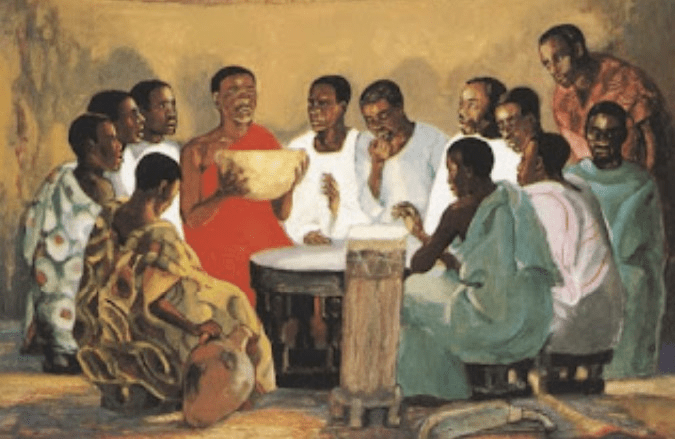
“The Lord’s Supper” by Cameroon artist Jesus Mafa, 1973

Jesus is the bread, the basic staple of life, that meets the cravings and needs of all people everywhere. Starving people, in both body and soul, find in Jesus a meal which keeps on giving, a feast of grace that is both delectable and unending.

The answer to my own question is that, for me, one’s highest pursuit and greatest quest is Jesus. Apart from Christ, I will starve. Furthermore, Jesus is not some cheap fast food off a value menu; he is real soul food to be ingested and enjoyed with others.

I believe people need Jesus. A passionate seeking of Jesus, to follow him, live for him, center life around him, is my most ardent desire. I do not simply desire Jesus for what he can do for me; I vigorously chase after him because if I do not have Jesus, I will die, I will starve to death. 

For me, Jesus is so much more than a nice addition to my life, like a new puppy; Jesus is Lord and Savior. I must consume him, or I will be completely undone, and I will not survive! Jesus is my bread, my food, my life!  I cannot survive on a daily crumb, but I feast on every word that comes from the mouth of Jesus because in Christ there is the life that is truly life.

What should human beings do in life?

Believe. To have and keep faith in the One God has sent, Jesus, is the primary “work” that pleases God.

Jesus communicated to the crowd that they can do so much more than follow him for another earthly meal – they can place their faith and hope in him for food that will last, food that will transcend the three-dimensional world.

Faith is more than an intellectual recognition to some facts about Christianity.

Belief is not about always having clarity and certainty to every facet and loci of Christian doctrine. Rather, Christian faith is a complete trust in Jesus as our hope and our life.

Education, economic uplift, political stability, and institutional peace and justice are important activities for this world. For the Christian, the accomplishment of these and so much more comes from the grace of God in Christ. As people come to the end of themselves with their homebrewed and half-baked attempts at being satisfied, Jesus stands at the door and knocks, the Living Bread who offers himself for humanity’s deepest needs.

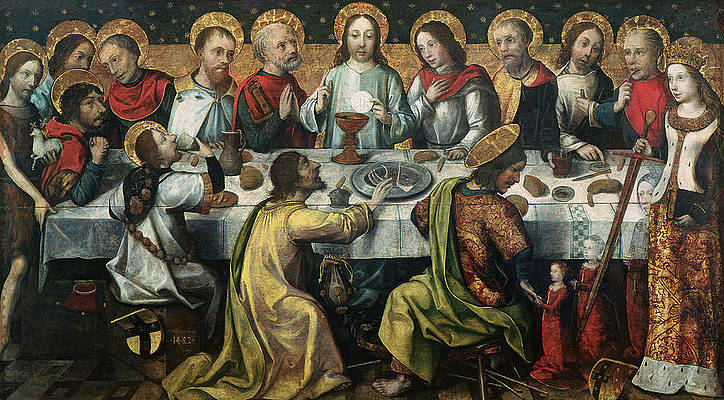
“The Last Supper” by Godefroy, 1482, C.E.

Giving kudos to Jesus might be nice, yet Christ himself cares about folks placing their trust in him for grace, forgiveness, and hope in their world. Jesus longs to reconnect people with God through giving himself as the means of making that happen.

All the works we do in this life, every good deed we accomplish, and each positive action we do are all helpful and necessary… and they all pale in comparison to the greatest work of all, to believe in Jesus Christ as the hope of this world, the hope of your family, the hope of the church, and the hope of your life. It’s all accessed by faith in the Son of God who loved me and gave himself for me.

Church buildings and furniture, stained-glass windows, pews, and even the Bible are not Jesus – they are simply and hopefully signs which point to him. They are all designed to lead us to Christ so that we may come to him. And coming to Christ is what the Lord’s Supper, Holy Communion, the Eucharist, and any other description you want to give about ingesting Jesus is about. The elements of bread and cup bring us to Christ so that we can experience Jesus and be joined to him by faith in a mystical union of human and divine in the unseen heaven.

Conclusion

Where will you find true satisfaction and hope? Probably not in the clearance aisle at Wal-Mart. Likely not in conforming to cultural Christianity or embracing generic forms of Jesus as merely a good teacher and moral example.

Furthermore, life’s ultimate satisfaction and hope are not to be found in a spotless house and perfect kids; in working more hours and making more money. Nor will we find contentment and peace in the radical independence of doing things my way.

Jesus is the Bread of Life. Through ingesting him, passionately pursuing him, believing in him, and coming to him in everything, we find the life that is truly life. Do not settle for any substitutes to Jesus. Come to the real person.

Lord God, you said that when we seek you with all our hearts, you will be found.  As the deer pants for streams of water, so we, your people, long for you in a dry and weary land.  We hunger and thirst for your righteousness.  We deeply desire your presence in all things. So, we die to ourselves and surrender to your will and way for us, by faith trusting you will come into our lives and completely take over. May your blessing rest upon us as we seek Jesus. Amen.

John 17:20-26 – The Need for and Importance of Unity

“My prayer is not for them alone. I pray also for those who will believe in me through their message, that all of them may be one, Father, just as you are in me, and I am in you. May they also be in us so that the world may believe that you have sent me. I have given them the glory that you gave me, that they may be one as we are one—I in them and you in me—so that they may be brought to complete unity. Then the world will know that you sent me and have loved them even as you have loved me.

“Father, I want those you have given me to be with me where I am, and to see my glory, the glory you have given me because you loved me before the creation of the world.

“Righteous Father, though the world does not know you, I know you, and they know that you have sent me. I have made you known to them and will continue to make you known in order that the love you have for me may be in them and that I myself may be in them.” (New International Version)

What is the Church’s identity?

What is the Church all about?

Why is the Church important?

The Church’s Identity

The Church is made up of people who have been reconciled to God through Christ’s sacrificial death on the cross and brought to new life in the Spirit. This special relationship that believers and Jesus enjoy with their God is a covenant relationship, and, so, the Church is a covenant community – receiving the blessings first promised to Abraham in the Old Testament that all nations would be blessed by grace through faith. 

God mercifully acts on the Church’s behalf through choosing, adopting, and redeeming people. This new covenant community receives the promises of God and exists to follow Jesus Christ in all things. 

So then, the Church is not a voluntary society, like other human institutions. Rather, it is divinely called by God. The Church is the community of the redeemed whom God has joined through the Spirit to Christ. Therefore, an individual, theologically speaking, does not join a church; instead, God joins the Church to Jesus.

The Nicene Creed

This ancient ecumenical creed describes the Church with four identifying marks:

  1. The Church is one. The unity of the Church comes from being in fellowship with God through Jesus in the Spirit – expressed through the bond of love and a common worship which includes the spiritually forming practices of preaching, liturgy, and sacraments. Since believers serve a triune God of Father, Son, and Spirit who exists in unity, so Christians are to work toward maintaining their unity through the bond of peace.
  2. The Church is holy. The Church is holy by virtue of Christ’s finished work. Therefore, the members of the Church are saints, called by God to live in holiness and participate with him in carrying out his purposes on earth. As God is holy, so believers are to be holy in all they do. Since Christians are holy through God’s justification in Christ, so the Church as saints must uphold justice in the world.
  3. The Church is catholic. This means that God’s people are found in all parts of the world throughout all times in history, including every race, class, gender, and ethnicity. Since the Church includes all kinds of people from different cultures, these believers must work together. The Church, across all kinds of denominations, ought to minister together to the total life of all people through gospel proclamation and good works done in the Spirit.
  4. The Church is apostolic. Apostolic means “to be sent.” The Church is not only a people who are gathered for worship and teaching; they are also sent into the world as salt and light to those who remain in darkness. Where the Church goes, the rule and reign of Jesus goes with them so that good news is spread to all nations.

The Church’s Mission

  1. The Church is called to love God.  The Church is the temple of the Holy Spirit, and the house where God dwells. The Church exists to glorify God and enjoy him forever. Christians are to develop intimacy with Jesus through the Spirit.
  2. The Church is called to love one another. The Church is the Body of Christ and is to be a haven for saints. The Church exists for community and is the place where believers are strengthened in faith through the proclamation of the Word in preaching and sacrament.
  3. The Church is called to love its neighbors. The Church is the people of God, being a hospital for sinners. The Church exists to serve the kingdom of God so that God’s benevolent and gracious rule might extend to all creation.

These three dimensions define the Church as being a “missional” community of redeemed persons who are concerned and focused on making disciples of Jesus Christ. The forward direction of the Church is to come ever closer to Christ through faith, be strengthened in that faith together through the Word of God, confidently stepping into the world to engage it with the love and grace of God so that others may come to faith in Jesus Christ.

The Church’s Importance

  1. The Church is a Trinitarian community, birthed as a free expression of God’s love through Word and Spirit. As people created in the image and likeness of God and redeemed for his purposes, believers reflect the image of the triune God.  The Church was important enough for Christ to die for.
  2. What the Church “does” flows from its identity as a redeemed community, being the people of God. So, then, the Church’s mission is not so much about establishing evangelistic programs so much as it is to listen to the Spirit of God and live in the power of the Spirit as it rubs shoulders with unbelievers.
  3. Just as the Father sent the Son, and the Son sent the Spirit, so the Church is sent into the world armed with the grace and love of God as if believers were ambassadors for Christ in a ministry of reconciliation.
  4. God has moved in a “downwardly mobile” way to bring reconciliation to all of creation. God has gathered the Church on earth to be sent as witnesses of Christ’s person and work through humility, meekness, and gentleness so that God’s mercy and peace might become realities in this world.

Therefore, the Church is to glorify the triune God by embracing its missional identity and mandate by making disciples of Jesus Christ through worship, community, and outreach. The Church is to aim its love toward God, one another, and neighbor through Jesus Christ in the power of the Spirit.

The Belhar Confession

This Reformed Confession of faith directly addresses the need for and importance of Christian unity, which was of great significance to Jesus in his high priestly prayer.

We believe in one holy, universal Christian church, the communion of saints called from the entire human family.

We believe that Christ’s work of reconciliation is made manifest in the church as the community of believers who have been reconciled with God and with one another.

We believe that this unity of the people of God must be manifested and be active in a variety of ways:

That we love one another;

That we experience, practice, and pursue community with one another; that we are obligated to give ourselves willingly and joyfully to be of benefit and blessing to one another;

That we share one faith, have one calling, are of one mind; have one God and Father, are filled with one Spirit, are baptized with one baptism, eat of one bread and drink of one cup, confess one name, are obedient to one Lord, work for one cause, and share one hope.

That together we come to know the height and the breadth and the depth of the love of Christ;

Together are built up to the stature of Christ, to the new humanity;

Together know and bear one another’s burdens, thereby fulfilling the law of Christ that we need one another and upbuild one another, admonishing and comforting one another;

That we suffer with one another for the sake of righteousness; pray together; together serve God in this world; and together fight against all which may threaten or hinder this unity.

Amen.