God Will Take Care of You (Ezekiel 34:23-31)

I will give them a king like my servant David to be their one shepherd, and he will take care of them. I, the Lord, will be their God, and a king like my servant David will be their ruler. I have spoken. I will make a covenant with them that guarantees their security. I will get rid of all the dangerous animals in the land, so that my sheep can live safely in the fields and sleep in the forests.

“I will bless them and let them live around my sacred hill. There I will bless them with showers of rain when they need it. The trees will bear fruit, the fields will produce crops, and everyone will live in safety on his own land. When I break my people’s chains and set them free from those who made them slaves, then they will know that I am the Lord. The heathen nations will not plunder them anymore, and the wild animals will not kill and eat them. They will live in safety, and no one will terrify them. I will give them fertile fields and put an end to hunger in the land. The other nations will not sneer at them anymore. Everyone will know that I protect Israel and that they are my people. I, the Sovereign Lord, have spoken.

“You, my sheep, the flock that I feed, are my people, and I am your God,” says the Sovereign Lord. (Good News Translation)

We all need a safe place to live and our needs provided. When protection from harm and provision of needs are realized, we call this “peace.”

So many people long for peace, simply because they aren’t experiencing it. They feel unsafe – either physically, mentally, emotionally, or spiritually – and are separated from the sort of resources which would give them what they need to live well.

God is the expert on security and safety, peace and protection. The Lord has provided what we need.

His divine power has given us everything we need for a godly life through our knowledge of him who called us by his own glory and goodness. Through these he has given us his very great and precious promises, so that through them you may participate in the divine nature, having escaped the corruption in the world caused by evil desires. (2 Peter 1:3-4, NIV)

The Shepherd Ruler

God made a covenant with David that was to last forever. There was the anticipation of a leader, even the Messiah, who would come from the line of King David. Such a ruler will bring unity to the people. This leader shall be a servant of the people, a shepherd, characterized by humility. And, most of all, the hoped for ruler will usher in an unprecedented time of peace.

The flock of sheep – the people – will not have a care in the world. The new divine shepherd will not live off the sheep, but will instead live for the sheep. The shepherd shall be the ultimate non-anxious presence among the sheep, assuaging their fears and keeping them well-fed.

“I am the good shepherd; I know my sheep and my sheep know me—just as the Father knows me and I know the Father—and I lay down my life for the sheep.”

Jesus (John 10:14-15, NIV)

From the standpoint of Christianity, this great restoration project of the Lord finds its fulfillment in the person and work of Jesus. We needed a faithful shepherd, a merciful ruler, and we now have one.

The Settled Rest

Wholeness, integrity, thriving, flourishing, satisfaction, contentment, and a good life are all wrapped up in the biblical concept of peace and rest. And that is what the shepherd does for the sheep.

There is no peace when shepherds view the sheep as merely animals to be fleeced and used. But with a good shepherd, predators are kept away from the flock, plenty of pasture is provided to feed upon, and other shepherds in other fields attempting to steal sheep don’t stand a chance against the Good Shepherd.

A large chunk of humanity lives in a state of fear and anxiety because of violence, lack of basic necessities, disease, or natural disaster. Life can become so overwhelming that the future seems bleak and without hope. People long for peace – personal peace, family peace, world peace. They’re tired, and just want some rest.

“Come to me, all you who are weary and burdened, and I will give you rest.”

Jesus (Matthew 11:28, NIV)

Although the list of stressors may seem endless, divine blessings shall create the conditions in which humanity can live without fear and with hope in the world. No one will make them afraid, ever again.

“Peace I leave with you; my peace I give you. I do not give to you as the world gives. Do not let your hearts be troubled and do not be afraid.” (John 14:27, NIV)

The Sure Restoration

The divine/human relationship, so marred and messed up by the presence and power of sin, will be perfectly restored. The Lord is God; and God is with us. The divine energy is no longer against us, but is for us. And if God is for us, who can be against us?

Who shall separate us from the love of Christ? Shall trouble or hardship or persecution or famine or nakedness or danger or sword? As it is written:

“For your sake we face death all day long;
    we are considered as sheep to be slaughtered.”

No, in all these things we are more than conquerors through him who loved us. For I am convinced that neither death nor life, neither angels nor demons, neither the present nor the future, nor any powers, neither height nor depth, nor anything else in all creation, will be able to separate us from the love of God that is in Christ Jesus our Lord. (Romans 8:35-39, NIV)

God will care for you. Along with you, the Lord will care for your loved ones who need a faithful leader, a place of peace and rest, and a new life.

O God, the source of all holy desires, all good counsels, and all just works: Give to your servants the peace which the world cannot give, so that our hearts may obey your commandments, and that we, being defended from the fear of our enemies, may pass our time in rest and quietness, through the merits of Jesus Christ our Savior. Amen.


I Am the Gate (John 10:1-10)

“Very truly I tell you Pharisees, anyone who does not enter the sheep pen by the gate, but climbs in by some other way, is a thief and a robber. The one who enters by the gate is the shepherd of the sheep. The gatekeeper opens the gate for him, and the sheep listen to his voice. He calls his own sheep by name and leads them out. When he has brought out all his own, he goes on ahead of them, and his sheep follow him because they know his voice. But they will never follow a stranger; in fact, they will run away from him because they do not recognize a stranger’s voice.” Jesus used this figure of speech, but the Pharisees did not understand what he was telling them.

Therefore Jesus said again, “Very truly I tell you, I am the gate for the sheep. All who have come before me are thieves and robbers, but the sheep have not listened to them.I am the gate; whoever enters through me will be saved. They will come in and go out, and find pasture. The thief comes only to steal and kill and destroy; I have come that they may have life, and have it to the full. (New International Version)

In an idyllic world, we would never have to contend with thieves and interlopers within the flock of God. But, as you well know, we live in a less than perfect world. The spiritual robber-baron is the one who poses as a religious figure, yet is really around to fleece the sheep.

Obviously, anyone who has to jump the fence, instead of entering through the gate, has something nefarious up their dastardly sleeve. In fact, these interlopers feel they have a right to get in, by any means, because of their inflated sense of self-importance.

Jesus, of course, is using metaphor and figure of speech to communicate something important: The thieves are robbing God’s honor for themselves and bringing harm to God’s people. By trying to take away the way, the truth, and the life, the religious leaders were spiritual burglars attempting to be both gate and gatekeeper.

In short, the religious leaders believed they were more important than Jesus; and they tried to keep Christ and the people from connecting with each other.

And that is the insidious form of all religious quackery – to keep people separated from what can help them the most so that the charlatan can soak up all the attention, authority, and accolades.

But a faithful and true shepherd enters through the gate with confidence and care. Such a person has no other agenda and no other concern than Jesus and what Christ has said, has done, and will do.

The pastoral ministers amongst us help lead the flock through the gate so that they might enjoy safety, security, and succulence. The shepherd calls people by name, and doesn’t generically yell at nameless folk, to bring them alongside the Good Shepherd.

Thus, we are to have a faithful concentration and commitment to Christ; a voice which is discernibly oriented toward pointing people’s attention to Christ; and a teaching and leadership which moves into the world in order to bring Christian speech and action that blesses the world.

One of the problems many persons experience is that they listen to strange voices, instead of the familiar voice of their trusted pastor and the voice of Scripture, reason, and history. They follow a pet preacher’s or person’s interpretation of everything without reservation, rather than seeking to hear the voice of God in everything which is said.

Big churches, large ministries, and eloquent people are not necessarily the vocal chords of God. We must be discerning and wise. Not everyone who says, “Lord, Lord,” will enter the kingdom of heaven. It’s only the person and the faith community which does the will of God that’s able to get in.

Wolves in sheep’s clothing exist. So, we must beware.

Idioms, figures of speech, and metaphors get lost on some folk. That’s what happened for Christ’s original hearers. A lot of head-scratching was happening because they couldn’t figure out what in the world Jesus was talking about. “They” are the people who interpret all of life through personal agendas and selfish means. Their self-absorption prevented them from seeing the person right in front of them, who he really was, and what he was actually saying to them.

I Am the Gate of the Sheepfold, by Kathrin Burleson

So, Jesus plainly told them that he himself is the gate of the sheep. “I am” the gate. Deliverance, reconciliation, freedom, and protection all come together in Christ to provide a good life, a life of abundance that is worth living. We have peace with God through the Lord Jesus.

In today’s Gospel lesson, we learn from Jesus the following:

  • The key to being a good shepherd is being faithful to Jesus Christ
  • The concerns of a good shepherd are to attract, bring in, protect, free, feed, and lead God’s people into a good life through Jesus Christ
  • The way for a good shepherd is to love the sheep, care for them, and be with them through thick and thin, as Christ does
  • The preoccupations of those who ignore entering through the gate, which is Jesus, are to gain for themselves what rightly belongs to God: glory, honor, praise, power, authority, accolades, and devotion.

Everything hinges on Jesus as the gate of life. In centering ourselves completely around Christ, and by giving up the false self of keeping up appearances to others, we find our true self, connected to God in which all our needs are fully met and satisfied.

Merciful Father, you gave your Son Jesus Christ to be the Good Shepherd. In his love for us, he laid down his life and rose again. Keep us always under his protection, and give us grace to follow in his steps, in the strength and enablement of the Holy Spirit. Amen.

John 10:11-21 – The “Good” Shepherd

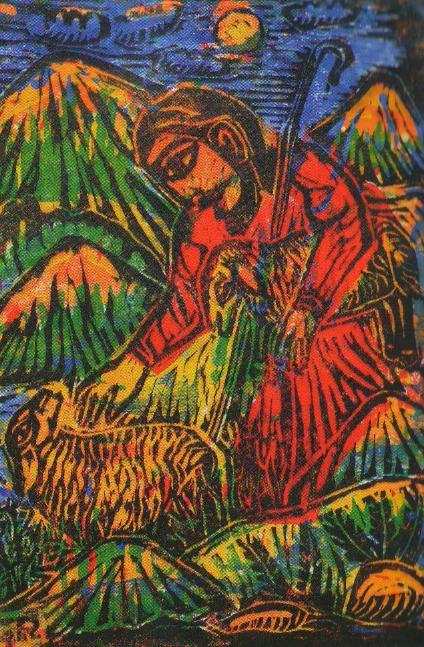
Jesus, the Good Shepherd, by P. Solomon Raj (1921-2019)

“I am the good shepherd. The good shepherd lays down his life for the sheep. When the hired hand sees the wolf coming, he leaves the sheep and runs away. That’s because he isn’t the shepherd; the sheep aren’t really his. So, the wolf attacks the sheep and scatters them. He’s only a hired hand and the sheep don’t matter to him.

“I am the good shepherd. I know my own sheep and they know me, just as the Father knows me and I know the Father. I give up my life for the sheep. I have other sheep that don’t belong to this sheep pen. I must lead them too. They will listen to my voice and there will be one flock, with one shepherd.

“This is why the Father loves me: I give up my life so that I can take it up again. No one takes it from me, but I give it up because I want to. I have the right to give it up, and I have the right to take it up again. I received this commandment from my Father.”

There was another division among the Jews because of Jesus’ words. Many of them said, “He has a demon and has lost his mind. Why listen to him?” Others said, “These aren’t the words of someone who has a demon. Can a demon heal the eyes of people who are blind?” (Common English Bible)

Many people in today’s urban and suburban world are completely unfamiliar with sheep and shepherds. So, when it comes to picturing Jesus as the good shepherd, idyllic scenes might come to mind, full of green meadows and pastoral landscapes, where there is perfect peace and rest, at all times.

Having been raised in rural Midwest America, I can confidently say there is little romanticism to the life of shepherds and sheep. Sheep eat a lot. They’ll eat just about anything that’s growing out of the ground. Think about how you would feel if you ate copious amounts of plants…. Lots of gas, trips to the bathroom, and stink.

That’s how it is with sheep. They continually poop and the smell is downright awful. A lot of a shepherd’s daily work is helping sheep deal with all the gas inside them. Sheep are easily prone to bloating from excess gas. This isn’t just an uncomfortable situation for a sheep; it’s an emergency life-and-death scenario. The shepherd must continually be vigilant to the sheep and take care of such circumstances immediately and carefully.

Taking care of sheep is dangerous, difficult, and tedious work. Historically, shepherds were rough characters, constantly on the move to find lush pastures for the flock’s voracious appetite. They had to deal with both animal and human predators looking for an easy meal. Being mostly outdoors, even at night, led to their reputation as drinkers – keeping up a consistent nip of spirits to remain warm. And, of course, they smelled bad.

So, when Jesus described himself as the “good shepherd,” this was anything but a pleasing picture for people in the ancient world. The closest equivalents to our modern day might be for Jesus to say, “I am the good migrant worker,” or the “good carny” (carnival employee).

Anyone or any profession in which we might deem a person in that line of work as of dubious character – that is precisely how a shepherd, and their work, were viewed by ancient people. It’s often the low-wage workers of society who get down and dirty. Because of their work, they get a suspicious and contemptuous reputation. Remarkably, Jesus unabashedly aligned himself with such people.

And yet, it is the discounted professions and the dismissed people from which we must pay attention; God is probably at work in their midst.

The despised Samaritan gained the label of “good” by Jesus for giving himself fully to save a stranger. Jesus puts the same adjective in front of shepherd. Whereas no one in polite society would use “good” for shepherd, Jesus labels himself as the Good Shepherd who lays down his life for the sheep.

Jesus, this incredible figure who puts good and shepherd together, also goes out of his way to bring other sheep into his fold. Since Christ identifies himself as a stinky lowly shepherd, he has no problem connecting with everyone. After all, when one is already low, there’s no looking down on another.

People everywhere, no matter their station in life, can hear the voice of Jesus speaking to them when they, too, are low enough to be able to listen.

The Good Shepherd by He Qi

Jesus, the Good Shepherd, is also the sacrificial lamb. In laying down his life he takes it up again (John 10:17). And when we participate in that dying and rising, when we eat the bread and drink the cup of salvation, we know he abides in us(1 John 3:24). Remaining in Christ with our Good Shepherd means, we, too, lay down our lives:

This is how we’ve come to understand and experience love: Christ sacrificed his life for us. This is why we ought to live sacrificially for our fellow believers, and not just be out for ourselves.

If you see some brother or sister in need and have the means to do something about it but turn a cold shoulder and do nothing, what happens to God’s love? It disappears. And you made it disappear.

My dear children, let’s not just talk about love; let’s practice real love. This is the only way we’ll know we’re living truly, living in God’s reality. (1 John 3:16-18, MSG)

Community is messy. People are stinky. Stepping into another’s life is rarely picturesque or idyllic. Yet, it’s at the same time elegant and aromatic. For we discover that our old ideas of beauty are obsolete. We gain a new spiritual sense which is redolent with the fragrance of Christ.

O God, Shepherd of all your people, deliver us from all troubles, worries and cares that assail us so that we may always do what is pleasing in your sight, and remain safe in the care of our Good Shepherd, Jesus Christ our Lord. Amen.

Psalm 23 – I Have Everything I Need

Psalm 23 by John August Swanson, 2010

The Lord is my shepherd;
    I have everything I need.
He lets me rest in fields of green grass
    and leads me to quiet pools of fresh water.
He gives me new strength.
He guides me in the right paths,
    as he has promised.
Even if I go through the deepest darkness,
    I will not be afraid, Lord,
    for you are with me.
Your shepherd’s rod and staff protect me.

You prepare a banquet for me,
    where all my enemies can see me;
you welcome me as an honored guest
    and fill my cup to the brim.
I know that your goodness and love will be with me all my life;
    and your house will be my home as long as I live. (Good News Translation)

I once had a neighbor named Art. Art was a shepherd. He spent a good chunk of his day, every day, leading his sheep around his five acres of property across the road from me. On occasion, Art would politely ask if some of his sheep could come to my backyard and feed on some of the wild plants that were in abundance. I was amazed how “artfully” he cared for his sheep.

Sheep get a bad rap, in my opinion. I have often heard others refer to them as stupid. Having grown up on a farm, I realize there are animals that are not so bright. Sheep aren’t one of them. Cows, however, are. I think when God created cows the raccoons came along and stole some of their brains. 

There’s a reason sheep possess the reputation of lacking smarts – they are prone to being afraid. Sheep get spooked and upset easily. And, when they are skittish and scared, sheep tend to panic.

More than once I’ve seen a flock of sheep run full-steam head-first into a stone wall. If you don’t know much about sheep and come along and see this, they most certainly appear to be downright stupid. Yet, sheep are really, quite intelligent.  It’s just when fear overcomes them, they can do some nonsensical things.

Jesus the Good Shepherd by Solomon Raj

The presence of a faithful shepherd makes all the difference.

Sheep become familiar with their shepherd and learn to depend on them. There were times that Art had to leave the sheep alone and I would do a sort of babysit with them. Around me the sheep were cautious and had their guard up. The presence of anxiety was clear. But when Art showed up, he didn’t have to say a word. I could feel and observe the flock collectively relaxing.

God Pastors

God is the ultimate shepherd of the sheep. Jesus is the Good Shepherd. When we sense the presence of God’s Spirit, there is faith, trust, and confidence. This, then, brings a settled conviction of calm and comfort. Whenever that sense is absent, we do things like buy two pallets of toilet paper and try to bring it home in a compact car. It’s non-sense.

Psalm 23 is a beloved portion of Holy Scripture for a reason; it helps us as sheep to settle down and trust, even in the middle of uncertainty and anxiety. 

God’s presence + God’s provision + God’s protection = God’s providential care. God’s presence is constant, not sporadic; his provision is enough, not stingy; and his protection is total, not partial.

To know and feel God’s presence watching over us and giving generously to us is the very balm we need. It melts our fear in the face of adversity and opposition; it helps us relax in tough economic times; and it inoculates us from believing the sky is falling. 

Our courage and confidence cannot be ginned-up through sheer willpower; it comes as we get to know the great shepherd of the sheep standing there watching over us with compassionate and competent care.

God Provides

God is personal, not generic. God is the great “I AM,” the God who is. The Lord is my shepherd – not was or will be – is. God is not just somebody else’s God and shepherd, but my shepherd. 

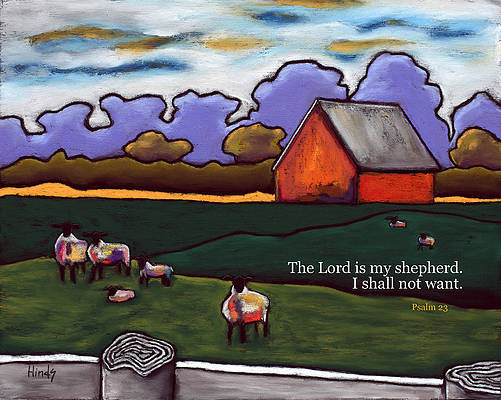
The Lord is My Shepherd by David Hinds

Shepherd is an apt term because a shepherd cares for the sheep – watches over them, is present with them, protects them, and provides whatever they need to both survive and thrive.

God benevolently leads us; and does not act outside of his character and attributes. If we believe this about the great “I AM,” then worry and anxiety begins to diminish. Too many of us suffer from the heebie-jeebies because we don’t see the shepherd standing in the field watching over us.

The answer to our worry is not to keep telling ourselves to stop being anxious. With God on the job as shepherd, I shall not be in want; I have everything I need. 

Troubled times will always be with us, this side of heaven. Fear can grab hold and prevent us from living with settled intentions and reasonable plans toward the future. Every day we see folks running headlong into a stone wall. 

It’s okay to be afraid; it is not okay to let fear rule our lives. The solution is to speak, despite your fear; to act, despite your worry; to live, knowing God has your back.

God Is Present

Within much of Hebrew poetry, the focus of the writing is found smack in the middle. Everything before it builds toward it; everything after it points back. Smack in the middle of Psalm 23 is that God is with us. 

Even though I walk through the valley of the shadow of death, even though it may seem that everything is bleak and that all things are against me – God is with me, which is why I do not succumb to fear. 

We walk through the valley, not around it. God does not cause us to avoid difficult circumstances. Instead, God promises to be with us through them. The way to deliverance is to confront our fears and walk with God, rather than expecting God to take away everything unpleasant that we don’t like.

My neighbor Art had a shepherd’s crook. He mostly used it as a walking stick. Yet, I did see times when he fended-off predators seeking to get to the sheep. More often, Art used his shepherd’s crook as a way of guiding the sheep where they could feed and be protected. 

The discovery of God’s guidance comes from movement and creativity. We aren’t going to experience the leading we want apart from embracing the uncomfortable in the confidence that God provides and protects through the trouble, and not apart from it.

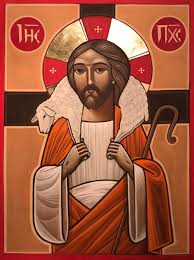
Coptic Church icon of Jesus the Good Shepherd

God Protects

Even with enemies of disease, death, and disorder surrounding us, God’s presence is such that his protection and provision are providentially working to create blessing in the middle of trouble. Whereas fear and panic believe in a culture of scarcity, a culture of abundance discerns that there is plenty for all – and will thus work toward equitable distribution and fostering an egalitarian spirit.

God refreshes, encourages, and restores. There are abundant blessings – even within troubled times. God’s provision is right here, amidst the worst of circumstances. We don’t have to pick a fight with someone in the Costco parking lot, who has what I want, to get the things we need.

It’s easy to believe that God’s goodness and love will follow me when my health is good, my income is solid, and I have plenty of friends around me. It is another thing to have an awareness of that goodness in dark days.  Yet, God’s love and goodness hasn’t sequestered itself.  God providentially uses each life situation and bends it to redemptive purposes.

Experientially knowing God brings contentment and confidence. The radical nature of Psalm 23 is that peace is realized while chaos and uncertainty is all around. Establishing spiritual practices that reinforce our sense of security can aid us through difficulty and hardship.

With a settled conviction that God indeed has our backs and stands as the divine sentinel watching over the beloved sheep, we find the ability to relax and trust that all is well with my soul.

Lord, help me to relax.

Take from me the tension
that makes peace impossible.
Take from me the fears
that do not allow me to venture.
Take from me the worries
that blind my sight.
Take from me the distress
that hides your joy.

Help me to know
that I am with you,
that I am in your care,
that I am in your love,
that you and I are one,

Through the mighty name of Jesus,

In the power of the Holy Spirit. 

Amen.