Immortal God and Mortal Humanity (Psalm 90)

Digital artwork by Bruce Butler

Lord, you have been our dwelling place
    in all generations.
Before the mountains were brought forth
    or ever you had formed the earth and the world,
    from everlasting to everlasting you are God.

You turn us back to dust
    and say, “Turn back, you mortals.”
For a thousand years in your sight
    are like yesterday when it is past
    or like a watch in the night.

You sweep them away; they are like a dream,
    like grass that is renewed in the morning;
in the morning it flourishes and is renewed;
    in the evening it fades and withers.

For we are consumed by your anger;
    by your wrath we are overwhelmed.
You have set our iniquities before you,
    our secret sins in the light of your countenance.

For all our days pass away under your wrath;
    our years come to an end like a sigh.
The days of our life are seventy years
    or perhaps eighty, if we are strong;
even then their span is only toil and trouble;
    they are soon gone, and we fly away.

Who considers the power of your anger?
    Your wrath is as great as the fear that is due you.
So teach us to count our days
    that we may gain a wise heart.

Turn, O Lord! How long?
    Have compassion on your servants!
Satisfy us in the morning with your steadfast love,
    so that we may rejoice and be glad all our days.
Make us glad as many days as you have afflicted us
    and as many years as we have seen evil.
Let your work be manifest to your servants
    and your glorious power to their children.
Let the favor of the Lord our God be upon us
    and prosper for us the work of our hands—
    O prosper the work of our hands! (New Revised Standard Version)

All of the psalms are prayers. Most of them are prayers of David. Today’s psalm is a prayer of Moses.

Moses acknowledged and affirmed that God is eternal, and we humans are not. We are frail and in need of God. We are dependent upon God for health, hope, and happiness in life.

There are observations to notice in today’s Psalm lesson, that are then followed by prayerful petitions which arise from those observations.

First Observation: God Is Eternal

God is immortal. God has always been, and will always be. Therefore, the Lord’s rule and reign existed way before this world was ever created, and shall extend way beyond the lifespan of creation. God’s dwelling place is without beginning or end – which means that God isn’t going anywhere. That is a great comfort to me.

Second Observation: Humans Are Finite

Whereas God is immortal, we humans are mortal beings. We are creatures with limited time on this earth. We all eventually die. Everyone returns to the dust from which they came – which isn’t even a blink of an eye when compared to God’s eternal existence.

This isn’t meant to be a downer for us, but rather to help us. It is necessary to work within our limitations while living in this world. To live as if we are immortal has grave consequences (pun intended).

Third Observation: The World Is Broken

Our world is fundamentally messed up. Another way of saying this is that everything in creation is under a curse. Things are not as they should be. And that’s on us, not God. Because of our own human proclivity to sin, our world is beset with a great deal of suffering and toil.

Hopefully, in the best scenario, people learn to understand the brevity of life, and gain wisdom on how to live a humble, just, and good life with one another, and with their God.

Now notice the petitions which Moses offered to God, based upon the observations of God’s nature, human nature, and the world’s situation.

First Petition: Turn, O Lord!

Moses was pleading with God to turn away from divine judgment and wrath, which was more than deserved for a group of people who were chronically complaining and disobedient. Moses was well aware of all Israel’s sins, and was counting on the Lord’s mercy for God’s covenant people.

Second Petition: How long, O Lord?

Moses was asking one of those questions that we ask, knowing that he wasn’t really going to get an answer. Yet, in the asking, there is an understanding that human misery won’t go on forever. Our suffering is temporary.

In this petition of Moses, he was also calling for a change, for God to deal with the people in a different way. Moses wanted gladness to replace affliction, and the sufferings of this life to give way to the joy of living in a good world.

Third Petition: Prosper the work of our hands

This wasn’t a petition for God to simply make everyone healthy and wealthy. It was a focused prayer that God’s work and our human work would be one seamless activity. That is, this is a prayerful longing for what we do in our lives to completely synchronize with God’s law in this world we all inhabit together.

Whenever we sin, we cause damage, not prosperity. Yet, with a divine/human cooperative in which we acknowledge and affirm God’s sovereignty over our lives, and take up our own human responsibility, then humanity thrives and flourishes in the goodness we were meant to enjoy as God’s creatures.

Christian Observations

In Christianity, the immortal and invisible God comes to us in the mortal and visible life of Jesus. In Christ, the sovereignty of God and the responsibility of humanity is not only synchronized; it is perfectly united and harmonized so that there is deliverance from the power of evil and from God’s judgment.

God’s steadfast love is brought to us with skin on.

For the Christian, Jesus is the answer to the prayers and petitions of Moses. Christ is the prophet foretold by Moses who was to come:

I [Yahweh]will raise up for them [the Israelites] a prophet like you [Moses] from among their own people; I will put my words in the mouth of the prophet, who shall speak to them everything that I command. (Deuteronomy 18:18, NRSV)

The incarnation, life, ministry, crucifixion, death, resurrection, ascension, and glorification of Jesus Christ has dealt with the weeds and overgrowth of guilt and shame that has taken over the garden of this world.

In Christ, we can begin to hack through all the stuff, in order to see the beauty underneath all of the spiritual neglect which has occurred for so long.

May the grace of the Lord Jesus Christ, the steadfast love of God the Father, and the encouragement of the Holy Spirit be with you, now and forever. Amen.

Divine Judgment and Human Judgmentalism (Luke 21:20-24)

Jesus Wept Over It, by Enrique Simonet, 1892

“When you see Jerusalem surrounded by armies, then know that its desolation has come near. Then those in Judea must flee to the mountains, and those inside the city must leave it, and those out in the country must not enter it, for these are days of vengeance, as a fulfillment of all that is written. Woe to those who are pregnant and to those who are nursing infants in those days! For there will be great distress on the earth and wrath against this people; they will fall by the edge of the sword and be taken away as captives among all nations, and Jerusalem will be trampled on by the nations, until the times of the nations are fulfilled. (New Revised Standard Version)

Judgment is coming… and is already here…

To be more specific, God’s judgment is coming; and humanity’s judgmentalism is already here.

Because of our judgmental spirits, we ought not be surprised that the judgment of God will be here soon.

I cannot get through a day – barely an hour – without hearing judgmental statements coming from another’s mouth. And sometimes, it’s my own mouth.

Judgmentalism is rife. It’s everywhere. And there’s no way to escape it. In a “normal” day (if there is such a thing for me) I hear all sorts of statements, without even trying to hear them. And when I do, I usually have a thought about it (in the parentheses):

  • “They did it because they don’t care about anything.” (And you don’t seem to give a rat’s rear end about understanding why they did it.)
  • “They deserved all the bad stuff they received.” (And you don’t?)
  • “The only reason they got the job to begin with is because of their connections.” (I didn’t realize that you are all-seeing, like God)
  • “You don’t know what you’re talking about!” (Maybe, but neither do you.)
  • “The rain is terrible.” (That’s your assessment. But it isn’t the local farmer’s assessment of the rain. He thinks it’s wonderful.)

Judgmentalism is the tendency to make quick and excessively critical judgments of others, especially moral judgments which characterize another’s thinking or way of being as immoral, unethical, monstrous, and/or harmful.

Our human judgmentalism of one another tends to detract from the sort of judgment we ought to be paying attention to.

Ultimately, none of us sits as Judge to arbitrate what who deserves punishment, or not. That is the job of Judge Jesus. So, when the true judge speaks, it behooves us to listen and follow through with what he (Christ) says about upcoming divine judgment.

When Jesus said his words of Jerusalem’s impending destruction, he was making it clear that these would be days of God’s vengeance, of divine judgment against the people. It would not last forever, because the wrath of God never does.

Yet, judgment is imminent. God will not let times of injustice, unrighteousness, and hatred last without end.

Therefore, Jesus was warning his disciples, and all who would follow him, about how they are to live while they await the end of all things.

We are not to be led astray, and be fooled by anyone who claims the name of Christ, yet lives like a devil. Unfortunately, some will foolishly succumb to falsehood. Everyone will suffer in some way.

Believers are to be watchful and prayerful. This is not passivity on our part, but actively putting a great deal of energy into becoming wise and interceding on behalf of others.

If we cannot sit still in silence, in contemplative prayer, for even 20 minutes, then we have a problem. It will be quite difficult to discern the good, right, and just.

If we cannot go half the day without making a judgmental statement about another person, then we have an addiction which needs to be broken.

If we continue to have reasons why we cannot (and therefore will not) read or listen to Holy Scripture, especially the New Testament Gospels of Jesus, then we are likely following someone else other than Christ.

If we keep moaning about the state of the world, the problems in our families, and all the local issues of our communities, then it is imperative that we come back to examining the words and ways of Jesus and deal with our own junk, instead lamenting everyone else’s.

If you know how to prepare for a zombie apocalypse, a new movie that’s coming out, or a birthday party for someone, but don’t have any idea about how to make life preparations for a coming disaster (let alone your own eventual death) then the last thing that ought to be happening is judging another person for anything at all.

You’ve got some work to do to get ready for the coming of Christ.

“Let us be alert to the season in which we are living. It is the season of the Blessed Hope, calling for us to cut our ties with the world and build ourselves on this One who will soon appear. He is our hope—a Blessed Hope enabling us to rise above our times and fix our gaze upon Him.”

A.W. Tozer

It’s possible that you may want to judge me for saying not to be judgmental. It’s happened more than once in my life. Yet, if we can learn to distinguish between the person and the behavior, then we can deal with unjust behavior, and leave any condemnation of the person to God.

If ever we struggle to know what to do, one can never go wrong with showing grace.

Gracious God, I repent for being quick to pass judgement both in speech and thought. For every time my words or actions of judgment and condemnation have hurt someone, I repent. Lord, I pray that I will not focus on the faults or shortcomings of others. Help me to see others through the eyes of grace. Amen.

With Great Power Comes Great Responsibility (1 Kings 16:1-7)

This message from the Lord was delivered to King Baasha by the prophet Jehu son of Hanani: “I lifted you out of the dust to make you ruler of my people Israel, but you have followed the evil example of Jeroboam. You have provoked my anger by causing my people Israel to sin. So now I will destroy you and your family, just as I destroyed the descendants of Jeroboam son of Nebat. The members of Baasha’s family who die in the city will be eaten by dogs, and those who die in the field will be eaten by vultures.”

The rest of the events in Baasha’s reign and the extent of his power are recorded in The Book of the History of the Kings of Israel. When Baasha died, he was buried in Tirzah. Then his son Elah became the next king.

The message from the Lord against Baasha and his family came through the prophet Jehu son of Hanani. It was delivered because Baasha had done what was evil in the Lord’s sight (just as the family of Jeroboam had done), and also because Baasha had destroyed the family of Jeroboam. The Lord’s anger was provoked by Baasha’s sins. (New Living Translation)

“With great power there must also come great responsibility.” Uncle Ben to Peter Parker, Spiderman

That’s one of those popular modern proverbs that resonate with us because we readily acknowledge the truth of it. No matter the culture, ethnicity, or place, we all have an inherent sense of justice and what is right.

And that makes sense to me, since we are created in the image of the Lord who is a God of justice and cares about what is right and good. So, whenever a person or a people buck their conscience, and practice injustice, it will raise the ire of both other people, as well as God.

Anger, at its core, is a response to injustice. Whenever we are treated unfairly in some way and are denied what we need to survive and thrive in this life, it makes us mad! Not only that, but it also makes God mad, too.

The use and abuse of power is a vital issue. Power must not be accumulated simply for someone (or a particular group of people) to enjoy its privileges. Power is given by God to individuals and groups so that they will use their position and authority for the common good of everyone.

To possess power is to possess a great moral responsibility for making good and just decisions. If the people in power fail to do this, then they shall be held accountable by a sovereign God who has ultimate authority over everyone and everything.

King Baasha of Israel was given a solemn responsibility by God to ensure the proper worship of God and to provide for the needs of everyone in the kingdom. In a theocratic society such as ancient Israel, the king served as the person who was responsible for knowing the commands of God and making sure that they were fulfilled. And that meant that justice for all should be ensconced throughout the land, and injustice should be eradicated wherever it is found.

By discarding the proper worship of God, and instead following other gods who engaged in injustice, Baasha was shirking his responsibility and setting up the nation for the misuse and abuse of power. So, God was determined to uproot the evil so that it didn’t destroy the whole nation.

“Whoever has been given much will be responsible for much. Much more will be expected from the one who has been given more.”

Jesus (Luke 12:48, ERV)

We all possess some level of power – whether it be small or great. Everyone is held responsible for what they have. If we have been blessed with talent, wealth, knowledge, time, position – or whatever it is – it’s expected that we benefit others. With whatever we have received, we are, in turn, to give for the sake of another.

Each of you has been blessed with one of God’s many wonderful gifts to be used in the service of others. So use your gift well. (1 Peter 4:10, CEV)

It’s not a matter of how much or how little power you have been given, but how faithful you are with the power you actually possess. Those who are trusted with something valuable must show they are worthy of that trust by stewarding their resources and their decision-making well. (1 Corinthians 4:2)

God’s anger serves the purpose of fueling God’s great purposes in justice for all people everywhere. And if we channel our own anger into love for all humanity, then we are rightly ordering our own power in good, redemptive, and responsible ways.

Almighty and eternal God, empower us all by your Spirit to be good, just, and faithful stewards of the power and authority you have given to us. Help us to live conscientiously, to bless others graciously and generously with the grace and generosity given to us by your goodness. May the very life of Christ be manifested in us and through us to your glory and honor. Amen.

Against Injustice (Jeremiah 19:1-15)

This is what the Lord says: “Go and buy a clay jar from a potter. Take along some of the elders of the people and of the priests and go out to the Valley of Ben Hinnom, near the entrance of the Potsherd Gate. There proclaim the words I tell you, and say, ‘Hear the word of the Lord, you kings of Judah and people of Jerusalem. This is what the Lord Almighty, the God of Israel, says:

Listen! I am going to bring a disaster on this place that will make the ears of everyone who hears of it tingle. For they have forsaken me and made this a place of foreign gods; they have burned incense in it to gods that neither they nor their ancestors nor the kings of Judah ever knew, and they have filled this place with the blood of the innocent. 

They have built the high places of Baal to burn their children in the fire as offerings to Baal—something I did not command or mention, nor did it enter my mind. So beware, the days are coming, declares the Lord, when people will no longer call this place Topheth or the Valley of Ben Hinnom, but the Valley of Slaughter.

“‘In this place I will ruin the plans of Judah and Jerusalem. I will make them fall by the sword before their enemies, at the hands of those who want to kill them, and I will give their carcasses as food to the birds and the wild animals. I will devastate this city and make it an object of horror and scorn; all who pass by will be appalled and will scoff because of all its wounds. I will make them eat the flesh of their sons and daughters, and they will eat one another’s flesh because their enemies will press the siege so hard against them to destroy them.’

“Then break the jar while those who go with you are watching, and say to them, ‘This is what the Lord Almighty says: I will smash this nation and this city just as this potter’s jar is smashed and cannot be repaired. They will bury the dead in Topheth until there is no more room. This is what I will do to this place and to those who live here, declares the Lord. I will make this city like Topheth. The houses in Jerusalem and those of the kings of Judah will be defiled like this place, Topheth—all the houses where they burned incense on the roofs to all the starry hosts and poured out drink offerings to other gods.’”

Jeremiah then returned from Topheth, where the Lord had sent him to prophesy, and stood in the court of the Lord’s temple and said to all the people, “This is what the Lord Almighty, the God of Israel, says: ‘Listen! I am going to bring on this city and all the villages around it every disaster I pronounced against them, because they were stiff-necked and would not listen to my words.’” (New International Version)

When God wants to get someone’s full attention, the Lord engages the people’s full senses in order to communicate an important message. Through the prophet Jeremiah, we get symbolic action that does just that.

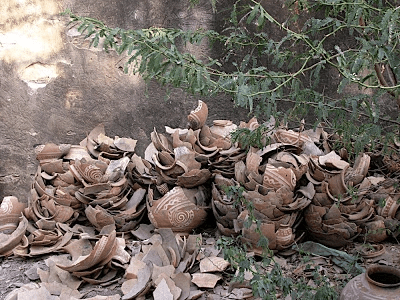
The symbolism, in this case, is a judgment speech, visually and viscerally depicted through the breaking of a pottery jug. The point of the action, and the words, was meant to convey a singular message: God will bring disaster and destruction against Jerusalem and its surrounding towns.

The act of breaking the pottery took place at the entrance to the Potsherd Gate – which was also known as the Dung Gate because that is where the garbage and refuse came out of the city to a dump located in the Valley of Ben Hinnom. It just so happened that this valley was also the location of altars to false gods other than Yahweh. Idolatrous practices – including child sacrifice – were carried on there.

In the ancient Near East, smashing pottery was a ritual act that depicted the destruction of enemies.

I will proclaim the Lord’s decree:

He said to me, “You are my son;
    today I have become your father.
Ask me,
    and I will make the nations your inheritance,
    the ends of the earth your possession.
You will break them with a rod of iron;
    you will dash them to pieces like pottery.” (Psalm 2:7-9, NIV)

The prophet Jeremiah was going to make his oracle against the people both unforgettable and irreversible. He wanted to be clear about what God truly thinks about harming children in religious rituals. But more than that, that it’s absolutely unacceptable for people who worship Yahweh to let it happen, just outside their own city gates, and to even participate in it.

The pottery jar represented Jerusalem. And when a piece of pottery is broken and smashed, there is no opportunity of remaking it from all that destruction. That’s what it would be like for the city who turned their backs on the Lord’s holiness.

Sometimes contemporary people may struggle with the reality that God gets angry – even angry to the point of pouring out wrath on a city. Yet, perhaps we fail to notice the gross and terrible injustice that has been done in the name of religion. The anger of God is always a reflection of God’s love. For love cannot contend with evil perpetrated on innocent people, especially children.

Love is purely subversive. It declares that harming others and hurting people by means of religious violence is not to be accepted nor tolerated. Love is an absolute refusal to settle for the injustice that exists in the world.

Today, and every day, is our opportunity, purpose, and privilege to put love where love is not – to upset the status quo of injustice and establish love as the supreme ethic of God’s commands.

Grant us, Lord God, a vision of your world as your love would have it:
a world where the weak are protected, and none go hungry or poor;
a world where the riches of creation are shared, and everyone can enjoy them;
a world where different races and cultures live in harmony and mutual respect;
a world where peace is built with justice, and justice is guided by love.
Give us the inspiration and courage to build it, through Jesus Christ our Lord. Amen.