With Great Power Comes Great Responsibility (1 Kings 16:1-7)

This message from the Lord was delivered to King Baasha by the prophet Jehu son of Hanani: “I lifted you out of the dust to make you ruler of my people Israel, but you have followed the evil example of Jeroboam. You have provoked my anger by causing my people Israel to sin. So now I will destroy you and your family, just as I destroyed the descendants of Jeroboam son of Nebat. The members of Baasha’s family who die in the city will be eaten by dogs, and those who die in the field will be eaten by vultures.”

The rest of the events in Baasha’s reign and the extent of his power are recorded in The Book of the History of the Kings of Israel. When Baasha died, he was buried in Tirzah. Then his son Elah became the next king.

The message from the Lord against Baasha and his family came through the prophet Jehu son of Hanani. It was delivered because Baasha had done what was evil in the Lord’s sight (just as the family of Jeroboam had done), and also because Baasha had destroyed the family of Jeroboam. The Lord’s anger was provoked by Baasha’s sins. (New Living Translation)

“With great power there must also come great responsibility.” Uncle Ben to Peter Parker, Spiderman

That’s one of those popular modern proverbs that resonate with us because we readily acknowledge the truth of it. No matter the culture, ethnicity, or place, we all have an inherent sense of justice and what is right.

And that makes sense to me, since we are created in the image of the Lord who is a God of justice and cares about what is right and good. So, whenever a person or a people buck their conscience, and practice injustice, it will raise the ire of both other people, as well as God.

Anger, at its core, is a response to injustice. Whenever we are treated unfairly in some way and are denied what we need to survive and thrive in this life, it makes us mad! Not only that, but it also makes God mad, too.

The use and abuse of power is a vital issue. Power must not be accumulated simply for someone (or a particular group of people) to enjoy its privileges. Power is given by God to individuals and groups so that they will use their position and authority for the common good of everyone.

To possess power is to possess a great moral responsibility for making good and just decisions. If the people in power fail to do this, then they shall be held accountable by a sovereign God who has ultimate authority over everyone and everything.

King Baasha of Israel was given a solemn responsibility by God to ensure the proper worship of God and to provide for the needs of everyone in the kingdom. In a theocratic society such as ancient Israel, the king served as the person who was responsible for knowing the commands of God and making sure that they were fulfilled. And that meant that justice for all should be ensconced throughout the land, and injustice should be eradicated wherever it is found.

By discarding the proper worship of God, and instead following other gods who engaged in injustice, Baasha was shirking his responsibility and setting up the nation for the misuse and abuse of power. So, God was determined to uproot the evil so that it didn’t destroy the whole nation.

“Whoever has been given much will be responsible for much. Much more will be expected from the one who has been given more.”

Jesus (Luke 12:48, ERV)

We all possess some level of power – whether it be small or great. Everyone is held responsible for what they have. If we have been blessed with talent, wealth, knowledge, time, position – or whatever it is – it’s expected that we benefit others. With whatever we have received, we are, in turn, to give for the sake of another.

Each of you has been blessed with one of God’s many wonderful gifts to be used in the service of others. So use your gift well. (1 Peter 4:10, CEV)

It’s not a matter of how much or how little power you have been given, but how faithful you are with the power you actually possess. Those who are trusted with something valuable must show they are worthy of that trust by stewarding their resources and their decision-making well. (1 Corinthians 4:2)

God’s anger serves the purpose of fueling God’s great purposes in justice for all people everywhere. And if we channel our own anger into love for all humanity, then we are rightly ordering our own power in good, redemptive, and responsible ways.

Almighty and eternal God, empower us all by your Spirit to be good, just, and faithful stewards of the power and authority you have given to us. Help us to live conscientiously, to bless others graciously and generously with the grace and generosity given to us by your goodness. May the very life of Christ be manifested in us and through us to your glory and honor. Amen.

Against Injustice (Jeremiah 19:1-15)

This is what the Lord says: “Go and buy a clay jar from a potter. Take along some of the elders of the people and of the priests and go out to the Valley of Ben Hinnom, near the entrance of the Potsherd Gate. There proclaim the words I tell you, and say, ‘Hear the word of the Lord, you kings of Judah and people of Jerusalem. This is what the Lord Almighty, the God of Israel, says:

Listen! I am going to bring a disaster on this place that will make the ears of everyone who hears of it tingle. For they have forsaken me and made this a place of foreign gods; they have burned incense in it to gods that neither they nor their ancestors nor the kings of Judah ever knew, and they have filled this place with the blood of the innocent. 

They have built the high places of Baal to burn their children in the fire as offerings to Baal—something I did not command or mention, nor did it enter my mind. So beware, the days are coming, declares the Lord, when people will no longer call this place Topheth or the Valley of Ben Hinnom, but the Valley of Slaughter.

“‘In this place I will ruin the plans of Judah and Jerusalem. I will make them fall by the sword before their enemies, at the hands of those who want to kill them, and I will give their carcasses as food to the birds and the wild animals. I will devastate this city and make it an object of horror and scorn; all who pass by will be appalled and will scoff because of all its wounds. I will make them eat the flesh of their sons and daughters, and they will eat one another’s flesh because their enemies will press the siege so hard against them to destroy them.’

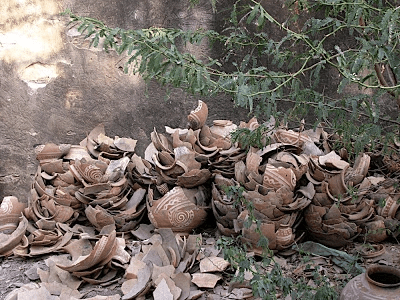
“Then break the jar while those who go with you are watching, and say to them, ‘This is what the Lord Almighty says: I will smash this nation and this city just as this potter’s jar is smashed and cannot be repaired. They will bury the dead in Topheth until there is no more room. This is what I will do to this place and to those who live here, declares the Lord. I will make this city like Topheth. The houses in Jerusalem and those of the kings of Judah will be defiled like this place, Topheth—all the houses where they burned incense on the roofs to all the starry hosts and poured out drink offerings to other gods.’”

Jeremiah then returned from Topheth, where the Lord had sent him to prophesy, and stood in the court of the Lord’s temple and said to all the people, “This is what the Lord Almighty, the God of Israel, says: ‘Listen! I am going to bring on this city and all the villages around it every disaster I pronounced against them, because they were stiff-necked and would not listen to my words.’” (New International Version)

When God wants to get someone’s full attention, the Lord engages the people’s full senses in order to communicate an important message. Through the prophet Jeremiah, we get symbolic action that does just that.

The symbolism, in this case, is a judgment speech, visually and viscerally depicted through the breaking of a pottery jug. The point of the action, and the words, was meant to convey a singular message: God will bring disaster and destruction against Jerusalem and its surrounding towns.

The act of breaking the pottery took place at the entrance to the Potsherd Gate – which was also known as the Dung Gate because that is where the garbage and refuse came out of the city to a dump located in the Valley of Ben Hinnom. It just so happened that this valley was also the location of altars to false gods other than Yahweh. Idolatrous practices – including child sacrifice – were carried on there.

In the ancient Near East, smashing pottery was a ritual act that depicted the destruction of enemies.

I will proclaim the Lord’s decree:

He said to me, “You are my son;
    today I have become your father.
Ask me,
    and I will make the nations your inheritance,
    the ends of the earth your possession.
You will break them with a rod of iron;
    you will dash them to pieces like pottery.” (Psalm 2:7-9, NIV)

The prophet Jeremiah was going to make his oracle against the people both unforgettable and irreversible. He wanted to be clear about what God truly thinks about harming children in religious rituals. But more than that, that it’s absolutely unacceptable for people who worship Yahweh to let it happen, just outside their own city gates, and to even participate in it.

The pottery jar represented Jerusalem. And when a piece of pottery is broken and smashed, there is no opportunity of remaking it from all that destruction. That’s what it would be like for the city who turned their backs on the Lord’s holiness.

Sometimes contemporary people may struggle with the reality that God gets angry – even angry to the point of pouring out wrath on a city. Yet, perhaps we fail to notice the gross and terrible injustice that has been done in the name of religion. The anger of God is always a reflection of God’s love. For love cannot contend with evil perpetrated on innocent people, especially children.

Love is purely subversive. It declares that harming others and hurting people by means of religious violence is not to be accepted nor tolerated. Love is an absolute refusal to settle for the injustice that exists in the world.

Today, and every day, is our opportunity, purpose, and privilege to put love where love is not – to upset the status quo of injustice and establish love as the supreme ethic of God’s commands.

Grant us, Lord God, a vision of your world as your love would have it:
a world where the weak are protected, and none go hungry or poor;
a world where the riches of creation are shared, and everyone can enjoy them;
a world where different races and cultures live in harmony and mutual respect;
a world where peace is built with justice, and justice is guided by love.
Give us the inspiration and courage to build it, through Jesus Christ our Lord. Amen.

A Vision of the End (Revelation 14:1-11)

The Great Day of His Wrath, by John Martin, 1852

Then I looked, and there before me was the Lamb, standing on Mount Zion, and with him 144,000 who had his name and his Father’s name written on their foreheads. And I heard a sound from heaven like the roar of rushing waters and like a loud peal of thunder. The sound I heard was like that of harpists playing their harps. And they sang a new song before the throne and before the four living creatures and the elders. No one could learn the song except the 144,000 who had been redeemed from the earth. These are those who did not defile themselves with women, for they remained virgins. They follow the Lamb wherever he goes. They were purchased from among mankind and offered as first-fruits to God and the Lamb. No lie was found in their mouths; they are blameless.

Then I saw another angel flying in midair, and he had the eternal gospel to proclaim to those who live on the earth—to every nation, tribe, language and people. He said in a loud voice, “Fear God and give him glory, because the hour of his judgment has come. Worship him who made the heavens, the earth, the sea and the springs of water.”

A second angel followed and said, “‘Fallen! Fallen is Babylon the Great,’ which made all the nations drink the maddening wine of her adulteries.”

A third angel followed them and said in a loud voice: “If anyone worships the beast and its image and receives its mark on their forehead or on their hand, they, too, will drink the wine of God’s fury, which has been poured full strength into the cup of his wrath. They will be tormented with burning sulfur in the presence of the holy angels and of the Lamb. And the smoke of their torment will rise for ever and ever. There will be no rest day or night for those who worship the beast and its image, or for anyone who receives the mark of its name.” (New International Version)

Throughout the book of Revelation (The Apocalypse of John) the Apostle John communicates visions of the end, of God’s wrath and human suffering. Yet John also pauses throughout his vision to offer encouragement for the faithful followers of Jesus in the present time who are undergoing suffering, even persecution.

The assurance believers have is that God sees their struggle, their devotion; the Lord will protect them – not from suffering and death – but from the effects of divine judgment and punishment on the earth. The Lord will not abandon the believers. Instead, they will share in God’s new realm.

The Lamb and the Redeemed

The ultimate destiny of Christ’s faithful followers is not in judgment but in triumph – even though many of them had to face extreme circumstances and died the martyr’s death. Christ, the Lamb of God, stands in the center of God’s kingdom with the 144,000, who sing a new song to God.

It could be that these 144,000 persons are representative and symbolic of all redeemed humanity. Or, they may likely be Christian martyrs, the ones who were the victims of evil (Revelation 13). Whoever they actually are, their description is figurative in order to convey that these faithful persons are morally and spiritually pure; they did not defile themselves with the wickedness of the world’s systemic and structural evil.

These redeemed persons are the first fruits, believers who have sacrificed their lives for God and maintained their witness to King Jesus, and not to Ceasar as Lord. In the Old Testament, every firstborn (both human and animal) belonged to the Lord. The first fruits (the initial yield of crops) were set aside specifically as a sacrificial offering to God.

In the New Testament, the concept and practice of first fruits is used as a metaphor for something given to God in advance. So, in the book of Revelation, this refers to the harvest at the end of the age; the first fruits are the 144,000, the ones who are the anticipation of Christian resurrection. In other words, there are many more converts to come – people redeemed by the Lamb and set aside for resurrection and new creation. A great harvest of souls comes; because of Christ’s resurrection, his followers shall also experience resurrection.

The Message of the Three Angels

The Apostle John spoke of three angels, each of whom proclaim a coming judgment of God. The first angel has a call to repentance and a warning of imminent judgment. The second angel announces the fall of Babylon (Rome). And the third angel pronounces judgment upon those who gave themselves to the powers of this fallen world, who participated in organizational wickedness through oppression, abuse, neglect, disrespect, and dishonor of others.

It is with the third angel that the “mark of the beast” upon a person’s forehead is the mark of judgment on them. Although the language and picture of this, and what happens to them, was (and still is for some) used to scare the hell out of people so that they would embrace heaven, we must very much distance ourselves from such disgraceful rhetoric.

Again, the vision is full of symbolism and is not to be taken literally; it is John’s attempt to convey an otherworldly experience he had, in terms which his readers could grasp. The big idea is that those who have become devoted members to the machinations of evil in its various forms on this earth will experience the judgment of God.

As they sought glory in this world by any means possible – including using people to keep and hold power – so, they will face an inglorious end when God holds them accountable for their wrongdoing and for letting their own hearts become shriveled and dry.

This is neither the time to participate in evil, nor to procrastinate in making things right – while you still have time to do so.

For those holding on to bitterness, it is time to forgive.

For the ones giving in to their anger through hating others, it is now time to humble yourself, repent, and turn to right and healthy ways of dealing with that anger.

For the persons allowing themselves to be used by others for perpetuating evil in their workplace, neighborhood, or church, it is high time to find your voice, renounce the damaging practices, and speak truth to power.

We all must suffer. What it is we suffer for, is up to us.

Almighty and everlasting God, the rightful Judge of all things and all people, help us, your people, to be rightly prepared for Christ’s coming, through a right confession and right practices in this life. Enable us to walk in a manner worthy of our calling so that we might cast the bright beams which radiate from the approaching day of glory into those dark days and nights of suffering.

Sovereign God, draw us, we pray, near to Christ and in union with him. May we taste and see the goodness of the Lord; be strengthened in faith for the trials and tribulations which lie before us; bask in the love of Jesus; and hold fast to divine promises, and our confession, especially since the end of all things is at hand. Amen.

The Second Woe Upon the Earth (Revelation 9:13-21)

The sixth angel sounded his trumpet, and I heard a voice coming from the four horns of the golden altar that is before God. It said to the sixth angel who had the trumpet, “Release the four angels who are bound at the great river Euphrates.” And the four angels who had been kept ready for this very hour and day and month and year were released to kill a third of mankind. The number of the mounted troops was twice ten thousand times ten thousand. I heard their number.

The horses and riders I saw in my vision looked like this: Their breastplates were fiery red, dark blue, and yellow as sulfur. The heads of the horses resembled the heads of lions, and out of their mouths came fire, smoke and sulfur. A third of mankind was killed by the three plagues of fire, smoke and sulfur that came out of their mouths. The power of the horses was in their mouths and in their tails; for their tails were like snakes, having heads with which they inflict injury.

The rest of mankind who were not killed by these plagues still did not repent of the work of their hands; they did not stop worshiping demons, and idols of gold, silver, bronze, stone and wood—idols that cannot see or hear or walk. Nor did they repent of their murders, their magic arts, their sexual immorality or their thefts. (New International Version)

In an apocalyptic vision of God’s judgment at the end of time, the Apostle John saw seven angels with seven trumpets. Each blast of the horn brought ever increasing levels of destruction upon the earth. The final three trumpets are also described as the three woes. (Revelation 8:2-6, 13)

The Sixth Trumpet (Second Woe)

The sixth angel sounded the sixth trumpet, which was also the second woe pronounced on the world. Four angels are released from their place of restraint. Whereas the invasion of locusts in the fifth trumpet (first woe) came from the pit of hell, the next invasion comes from the east, from the outskirts, that is, outside the Roman Empire.

The terrible angels go out to kill a third of all humanity. They lead a massive destructive force that overwhelms the earth. The incredible army looks something like centaurs, being horse and rider in one. And out of their mouths come fire, smoke, and sulfur. These are three plagues which brings death to a third of humanity.

The Response to the Second Woe’s Invasion

John records the human response to the divine judgment unleashed upon humanity with the four angels and their three plagues. In reality, it’s actually a lack of response; there is no change of heart and no repentant attitude from anyone. The awful devastation does nothing to elicit any sort of self-reflection, public awareness of sin, or reconsideration of ways by those left alive.

The Apostle records that the rest of the people, after going through such a traumatic time, keep up their worship of demons and their idolatry. They continue to murder, carouse, and steal, as if nothing had happened.

What’s more, John’s graphic and disturbing vision – from it’s very beginning – does not record a single person turning away from their evil ways. The surviving inhabitants of the earth act like old Pharaoh in Egypt during the days of Moses and the exodus; their hearts are hard, and they are not about to change.

What It Means For Us

A big question for us as contemporary people, two-thousand years removed from John’s apocalyptic vision is this: Do the judgments contained in the book of Revelation have any relevance for us today?

Some might dismiss all of this as weird historical story that nobody can really understand, so we might just as well put it aside as belonging in the past. Others grew up hearing “fire and brimstone” sermons from Revelation that did nothing for them other than help them decided that they never want to be in a church again and listen to a sinner about how sinful everybody is.

Although I do not condone hellfire preaching that does little more than make people feel bad, I do believe these difficult judgment chapters in the book of Revelation have something to say to us which we would do well to hear.

  • If we dig in and want what we want, without considering anyone else or even God, then we really cannot expect blessing either in this life or the life to come.
  • If and when disaster or destruction happens – and afterwards go on our merry way as if nothing even occurred – then we have come under divine judgment.
  • If we purposely stick our heads in the sand, and intentionally avoid what is happening around us in this world, then it will not go well for us in the end.
  • If we become angry, and nurse the grudge to the point of becoming hateful and unloving, then the hardness of heart will not recognize God’s visitation when it comes.
  • If we hurt and harm others without any remorse, or make excuses for bad behavior when called out on it, then we are no better than the unrepentant mass of humanity in the book of Revelation.

There is coming a time when it will be too late. The Day of the Lord will come. There will be a final judgment. But if you are reading this, there is obviously still time. Spiritual procrastination only leads to destruction. Spiritual attention to the here-and-now leads to life. What will you do “Today?”

Our Father who is in heaven,

uphold the holiness of your name.

Bring in your kingdom

so that your will is done on earth as it’s done in heaven.

Give us the bread we need for today.

Forgive us for the ways we have wronged you,

just as we also forgive those who have wronged us.

And don’t lead us into temptation,

but rescue us from the evil one. Amen.