Relying on the Presence (Exodus 13:17-22)

When Pharaoh let the people go, God did not lead them on the road through the Philistine country, though that was shorter. For God said, “If they face war, they might change their minds and return to Egypt.” So God led the people around by the desert road toward the Red Sea. The Israelites went up out of Egypt ready for battle.

Moses took the bones of Joseph with him because Joseph had made the Israelites swear an oath. He had said, “God will surely come to your aid, and then you must carry my bones up with you from this place.”

After leaving Sukkoth they camped at Etham on the edge of the desert. By day the Lord went ahead of them in a pillar of cloud to guide them on their way and by night in a pillar of fire to give them light, so that they could travel by day or night. Neither the pillar of cloud by day nor the pillar of fire by night left its place in front of the people. (New International Version)

From a human perspective, God makes some nonsensical decisions in the Bible such as telling Noah to build a big boat in a place with no water; Abraham to leave everything, and later, to sacrifice his son; Moses to stroll into Egypt and tell Pharaoh to let the people go; and, the people to walk through a body of water without getting wet. Indeed, it’s as if God has an odd predilection for making weird requests of people.

Although today’s Old Testament story gives us a glimpse into God’s thinking, the people were not privy to that information. Yes, God’s people were experiencing an unbelievable exodus out of Egypt. Their wildest dreams could not have imagined such a reality as strolling out of slavery having seen not one but a string of miraculous wonders. Yet, God was not done with the miracle thing.

Although many people would really like to see a miracle happen in their lives, rarely do we think about the circumstances we might need to face for that miracle to occur. God typically asks folks to do some outrageous-sounding things to set up the miracle.

An entire nation left Egypt with celebration only to be told to go in a misdirection toward the Promised Land, as if God were somehow geographically challenged. I can imagine that this decision had Moses raising a Spock-like eyebrow and the Israelites wondering if God was off his celestial rocker.

There is, however, a reason why folks like Noah, Abraham, and Moses obeyed instructions that didn’t make sense to them at the time: The Presence of God.

Pillar of Fire, Pillar of Cloud in the Desert, Congregation Beth Emeth, Herndon, VA

It is the personal Presence and power of God which makes all the difference. For God has not promised to create an existence with a zero factor of hardship. God, instead, has created a world that is full, vibrant, and alive with Presence – and a zero tolerance for bullies like Egypt. The uncertainty, doubt, and mystery of the future is thoroughly mitigated with the effusive Presence.

When sitting with patients in the hospital who struggle with the unknown of why they are there and what will become of them (and their families) the last thing I do is try to fabricate reasons so that it makes sense – because it doesn’t, and I’m not going pretend that it does.

Rather, I remind them of what I know: The Presence of God is here. Although God does not go out of the way to give us an easy life, God does, however, go far out of the way to communicate the glorious divine Presence with us.

God kept constant vigil over the ancient Israelites, powerfully seen with the pillar of cloud by day and pillar of fire by night. Nothing was going to happen to the Jewish people without first passing through the mighty hands of God.

Not only do I know God is with us, but I also know the Lord neither slumbers nor sleeps (Psalm 121). When God keeps vigil, God keeps vigil! No smoke or bathroom breaks with God. God’s vigilance is relentless and wondrous, giving assurance to the godly, and terrifying the ungodly.

Once we are out in the wilderness of uncertainty, there is no turning back. And that’s okay – because the Presence of God patrols the area and divinely guards our every move.

For the Christian, the Presence has found its fulfillment in the person of Jesus. Although Christians everywhere serve a risen and ascended Christ, the Divine Presence remains with glorious constancy through the Holy Spirit, the Paraclete, the One who is consistently alongside us, empowering us and advocating on our behalf.

The beautiful theological truth here is that God is both transcendent (far above us) and immanent (intimately close to us) at the same time, all the time. Armed with such a robust theological understanding, trust and confidence come to us without having to resort to ginning up positive thoughts.

Instructions and commands which seem like nonsense? No problem. The Transcendent and Immanent One has the Presence all around it. In between a rock-and-hard-place (or an Egyptian army and a Red Sea)? Not an issue. I willingly place myself there knowing that with the Presence, the miraculous is about to happen.

We need not buck the difficult circumstances. The Presence has got this.

So, then, let us pray for the Church and for the world, and let us thank God for the great Presence: In the power of the Spirit and in union with Christ, we pray to you, Almighty God, and Father. From the rising of the sun to its setting, we pray to you, ever-vigilant Lord, on behalf of those in despair and darkness, that they may find the hope and light of Christ; those in fear of death, that they may find faith through the resurrection of Jesus; prisoners and captives, widows and orphans, and all those who today need a blessed assurance of the Presence; through Jesus Christ, your Son, our Lord, who with you and the Holy Spirit are one God, now and forever. Amen.

From Where Will Our Help Come? (Psalm 121)

I lift up my eyes to the hills—
    from where will my help come?
My help comes from the Lord,
    who made heaven and earth.

He will not let your foot be moved;
    he who keeps you will not slumber.
He who keeps Israel
    will neither slumber nor sleep.

The Lord is your keeper;
    the Lord is your shade at your right hand.
The sun shall not strike you by day
    nor the moon by night.

The Lord will keep you from all evil;
    he will keep your life.
The Lord will keep
    your going out and your coming in
    from this time on and forevermore. (New Revised Standard Version)

One of the rituals my family does when leaving on a long road trip is to pray. It’s in those special times of traveling, and anticipating the destination, that we can be especially cognizant of both the blessings and the dangers which may lie ahead.

When the Israelites set out together from places all over Israel to go to Jerusalem and ascend the temple mount for a special festival, they also prayed. Specifically, they prayed many of the psalms and sang them together.

One never knows what lies ahead. We trust the Lord to protect us by being our divine keeper and guardian, to help us and watch out for us. This is why today’s psalm reading is alongside the Old Testament lesson of the Passover. (Exodus 12:14-28)

In Exodus, God was readying the people for deliverance from Egypt. The ancient Israelites were about to leave the land of slavery and travel to the Promised Land. They would be vulnerable to all sorts of dangers and obstacles on their way. The people needed Yahweh’s oversight and protection on their long journey.

Will we arrive safely? Can we get where we need to go without an accident or trouble? Those are questions people ask in any age with any significant trip.

Throughout the psalms of ascent (or the pilgrimage psalms) there are some fundamental convictions about God through them all:

  1. The Lord is a mighty God, the Creator and Sustainer of the universe
  2. The Lord is a caring God, the people’s Helper and Deliverer
  3. The Lord is near, an imminent God who is close to us as our Immanuel
  4. The Lord is an attentive God, always watching and never sleeping on the job in order to guard us
  5. The Lord is far above, a transcendent God who is able watch over everything and always see us

If you think about it, life itself is one long extended pilgrimage from birth to death. Life is an earthly sojourn, continually moving about the earth from one place to the next. Even if we stay put and never move, the world itself is continually spinning on it’s axis and furthermore circling in space around the sun. In other words, no matter what we do, life is always risky.

We need the consistent and continual divine presence to go before us, with us, and after us wherever we are and wherever we go. There is a constant need for God’s watching and caring for us. What’s more, we are invited to move and participate in the Lord’s dealings in this world. The call of every Christian is Christ’s call to “follow me.”

The life of the believer is a call to a life of pilgrimage and discipleship. It is to step out in faith and live life to the full, knowing that God has your back. We need not run for the hills whenever there is trouble; we can look beyond the mountains to the God of heaven who is our divine helper.

At the end of the day, we can lay our head on the pillow to sleep with trust that the non-slumbering God keeps watch over us during the dark night hours. Unlike the gods who need to be stirred from their rest, Yahweh is never absent and always alert to whatever is happening.

In the morning, we can rise with confidence knowing that our going out and coming home again will be watched with vigilance and care from the Lord who is our keeper. Nothing escapes the God who is both far and near, able to see the big picture of our lives, as well as notice every little nuance by being up close and personal.

We exist in a day and age where God is looked upon with askance – as if the universe’s Sovereign has neither the ability nor the will to impact our daily lives and positively govern the world’s affairs. This is not the God of the Psalms – a grand Being who knows the score of everything going on, cares about the intimate details of life, and has the power to bring about a good outcome for humanity.

Even though God may at times be silent, and although the Lord rarely acts quickly, we ultimately know down deep in our soul that we matter and that Yahweh is there. The real issue is whether we will take the time and effort to connect with this incredible benevolent Being and take a walk, that is, a pilgrimage of faith and encounter God.

When all is said and done, from where will our help come? It will ultimately come from the Lord, the maker of heaven and earth.

Eternal God, in whose benevolent realm there is no weapon drawn except the sword of righteousness, and there is no strength known but the strength of love: Mightily spread abroad your gracious and powerful Spirit, so that all people everywhere may be gathered under the banner of the Prince of Peace, as children of one God and Father of all, to whom belongs dominion and glory, now and forever. Amen.

God Is Both Near and Far (Psalm 145:1-5, 17-21)

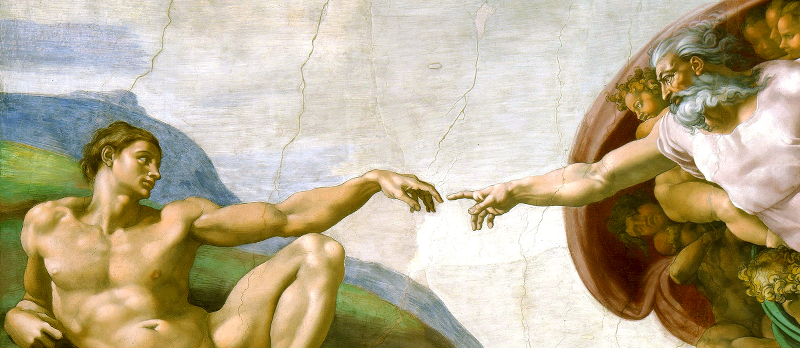
God giving life to Adam, by Michelangelo (1475-1564) on the ceiling of the Sistine Chapel, Rome

I will exalt you, my God the King;
    I will praise your name for ever and ever.
Every day I will praise you
    and extol your name for ever and ever.

Great is the Lord and most worthy of praise;
    his greatness no one can fathom.
One generation commends your works to another;
    they tell of your mighty acts.
They speak of the glorious splendor of your majesty—
    and I will meditate on your wonderful works….

The Lord is righteous in all his ways
    and faithful in all he does.
The Lord is near to all who call on him,
    to all who call on him in truth.
He fulfills the desires of those who fear him;
    he hears their cry and saves them.
The Lord watches over all who love him,
    but all the wicked he will destroy.

My mouth will speak in praise of the Lord.
    Let every creature praise his holy name
    for ever and ever. (New International Version)

The Lord is both near and far. The God of Holy Scripture is, at the same time, both:

  • approachable and aloof
  • close and distant
  • beside us and beyond us
  • available and elusive
  • revealing and remote
  • warm and cool
  • knowable and mysterious
  • readily at hand and at arm’s length
  • a good neighbor next door and a politician over in a city you’ve never been

The technical theological terms for describing God in such a way is that the Lord is both immanent and transcendent. And that is a good thing. We need the Lord to be both.

This psalm is a hymn of praise to God. The psalmist, David, celebrates the attributes and the actions of the Lord. David understood, better than most, that God is so far above humanity in divine majesty that miracles are always possible. Because God is God, the Lord’s arm is never too short to extend help and deliverance.

David knew that God’s powerful ability and God’s loving affection go hand-in-hand together; God’s mighty strength and God’s compassionate spirit work together harmoniously for our benefit.

They did not conquer the land with their swords;
    it was not their own strong arm that gave them victory.
It was your right hand and strong arm
    and the blinding light from your face that helped them,
    for you loved them. (Psalm 44:3, NLT)

God’s interventions, wonders, and miracles are never done dispassionately; the Lord’s arm is extended with deep concern and loving care for people.

The Lord acts as a close relative, like a parent, exhibiting qualities of both father and mother. God is close enough to not only hear our verbal prayers but to also hear our faint whispers. Indeed, the Lord is so close that we don’t even have to speak for the prayers of our heart to be heard.

The righteous call to the Lord, and he listens;
    he rescues them from all their troubles.
The Lord is near to those who are discouraged;
    he saves those who have lost all hope.

Good people suffer many troubles,
    but the Lord saves them from them all. (Psalm 34:17-19, GNT)

In the New Testament Gospels, Jesus gave us instruction on how to address God: “Our Father in heaven.” Not just “my” Father, but “our” Father. We are to pray with the mindful sense of our union with the Lord, as well as our connection with one another as believers.

The Lord sits in heaven as the Most High God, the transcendent Lord of me, you, and all people – watching over and protecting all whose hearts are in the right place, and effectively guarding us from a lofty divine vantage point.

My shield is God Most High, who saves the upright in heart. (Psalm 7:10, NIV)

Clap your hands, all you nations;
    shout to God with cries of joy.

For the Lord Most High is awesome,
    the great King over all the earth.
He subdued nations under us,
    peoples under our feet. (Psalm 47:1-3, NIV)

With our transcendent God always having a watchful eye over us, we need not fear anything or anyone. The Lord knows the score of how things are going in the world and in your life. And, what’s more, God knows the ropes in providing for us, protecting us, and powerfully handling any and all enemies to our souls.

Yet, at the same time, all the time, God is both our high holy King, and our close intimate Friend. Indeed, the Lord is graciously immanent as my Abba – the Father who is near and dear to our hearts.

Because you are [adopted] sons and daughters, God sent the Spirit of his Son into our hearts, crying, “Abba, Father!” Therefore, you are no longer a slave but a son or daughter, and if you are his child, then you are also an heir through God. (Galatians 4:6-7, CEB)

Christians everywhere in the world, and throughout the ages, gather together and repeat the Lord’s Prayer, every Sunday, as well as in weekly small groups, and daily individual prayers. We cry out, “Our Father in heaven” as the most used phrase over the course of our Christian lives.

And that sort of repetition is a good thing. It is important to verbalize that God is transcendent – far above all earthly powers as the sovereign Lord of the universe; and to vocalize that God is immanent – near to us as a father to a child.

Just because a phrase can become vain repetition doesn’t mean that repeating it is a bad thing. Using our words to reiterate both the far distance and the close relation of God is a worthy activity which fortifies our faith, and which passes truth to successive generations of the faithful.

The best way I know of cultivating a healthy sense of God’s transcendence and immanence (outside of reading scripture and praying) is through clouds and kids – both of which require mature adults to practice some much needed humility.

There is nothing quite like putting clocks and schedules aside, stretching out a blanket on a hill, laying back, and watching the clouds roll by. The perspective of massive highness reminds us that our problems are neither as daunting nor as important as we thought.

In contrast to the high clouds, there’s also nothing quite like forgetting your age and getting on the ground to be eye level with a kid. Fortunately, I have rambunctious and curious grandsons who continually remind me that, the lower I get, the better I understand what’s truly most important.

Neither my kids nor my grandkids care all that much about the what’s in my life – what I do – my work, my hobbies, my angst, my daily activities. But they do care a great deal about who I am and why I’m with them.

Intentionally developing a sense of God as both far and near, helps us remember who we are and why are here.

Ironically, the closer I get in touch with the reality that I’m mere dust, and will return back to the ground, the better I’m able to see the Most High God. And, conversely, the more I gaze into the sky, the greater awareness I have of the people around me. I learn to love God and neighbor, as I ought.

There’s no better time than now to get out there and take advantage of the clouds and the kids. It will likely help you to know God better; and it will probably bring a greater awareness, clarity, and connection to the truly significant which is always around us.

Father God, you formed us from the dust of the earth. Remind us of our place as your creatures at home in your creation. Forgive us when we forget our connection to the earth, and our dependence upon the goodness of your world. Lord have mercy.

Brother Jesus, you were born into this world, and made your earthly home in Nazareth. Help us to know and love the people and places where you have set us. Forgive us when we fail to care for our homes, our communities, and your creation. Christ, have mercy.

Blessed Holy Spirit, you desire to grow in us your fruit of love, joy, peace, patience, kindness, goodness, faithfulness, gentleness, and self-control. Forgive us when our roots are so shallow, and our hearts so restless, that our lives fail to bear fruit. Enable us to find our home in you, and in the places to which you call us. Lord have mercy.

Blessed Holy Trinity – Father, Son, and Spirit – the God who is both far and near: Forgive us our sins, settle us in a place of belonging, and enable us to bear fruit for your kingdom. Amen.

Psalm 113 – There Is a Deliverer

Shout praises to the Lord!
Everyone who serves him,
    come and praise his name.

Let the name of the Lord
    be praised now and forever.
From dawn until sunset
    the name of the Lord
    deserves to be praised.
The Lord is far above
    all of the nations;
    he is more glorious
    than the heavens.

No one can compare
    with the Lord our God.
His throne is high above,
    and he looks down to see
    the heavens and the earth.
God lifts the poor and needy
    from dust and ashes,
    and he lets them take part
    in ruling his people.
When a wife has no children,
    he blesses her with some,
and she is happy.
    Shout praises to the Lord! (Contemporary English Version)

It is appropriate, as we approach the Nativity of our Lord in just a few days, that we acknowledge and celebrate Christ’s incarnation by using today’s psalm.

Believers everywhere serve a God who is attentive to humanity. Although high and transcendent above all creation, the Lord carefully observes the plight of people. And God determines to do something about it. God breaks into the human experience by becoming human.

In the New Testament, the Apostle John frames this movement from heaven to earth in this way:

The Word became flesh and blood,
    and moved into the neighborhood.
We saw the glory with our own eyes,
    the one-of-a-kind glory,
    like Father, like Son,
Generous inside and out,
    true from start to finish. (John 1:14, The Message)

This grand descending to earth plumbed the very depths and despair of humanity.

In the largest cities of the world, like Mexico City, Mexico and Manilla, Philippines, there are huge garbage dumps that cover several square miles. On top of these heaps of waste there live hundreds of families who have made this their home. 

Each day they send their kids out to forage for scraps so they can have something to eat and survive.  Few others tread where these families are.  Yet, there are Christian believers who make the journey and try to bring the good news of Jesus Christ to such a place.

As incredible and sad a situation that this is, it doesn’t compare to the journey from heaven to earth that Jesus made. God became flesh, Christ descended to earth and came to the sin-soaked dump of this world – to us who were living on a heap of garbage – and entered our lives to save us from our wretched and pitiable condition.

God’s generosity in sending the Son was a gracious and cataclysmic entry to this earth on our behalf. It’s as if Jesus moved into the garbage dump and was born on the heap of waste so that God might be present with us.

Jesus did not just appear to be human, but actually became like us and lived with all the same things we face from day to day. He “tabernacled” with us, using the imagery of God’s presence with the ancient Israelites.  God is with us!

Jesus interacted with the families in the dump. God was coming to save the people.  he way to reach people, who are so concerned for scurrying about their business and trying to survive apart from God, is through the incarnation – both through testifying to what God has done in Christ, and through being sent, we ourselves, as little incarnations of entering into people’s lives. 

We are like the moon, not producing light ourselves, but in the middle of darkness, reflecting the light of the sun so that the earth may know that Jesus is coming.

The mystery of the incarnation is that Jesus became human and lived among us. 

May we believe.

May we know there is a Deliverer.

May we rejoice and be glad in this reality, and may it move us to be used of God to save those on the sin heap of this world.

May the poor and needy be lifted up.

May you have a blessed Christmas and enjoy peace with God and others in this next year.

O God, you make us glad by the yearly festival of the birth of your only Son Jesus Christ: Grant that we, who joyfully receive him as our Redeemer, may with sure confidence behold him when he comes to be our Judge, who lives and reigns with you and the Holy Spirit, one God, now and forever. Amen.