Learn to Live Well (Micah 7:18-20)

The Prophet Micah exhorting the Israelites to repent by Gustave Doré (1832-1883)

Who is a God like you, pardoning iniquity
    and passing over the transgression
    of the remnant of his possession?
He does not retain his anger forever
    because he delights in showing steadfast love.
He will again have compassion upon us;
    he will tread our iniquities under foot.
You will cast all our sins
    into the depths of the sea.
You will show faithfulness to Jacob
    and steadfast love to Abraham,
as you have sworn to our ancestors
    from the days of old. (New Revised Standard Version)

In a world obsessed with constant and rapid change, it is refreshing to know that there is a God whose essential character, attributes, and way of being in the world never changes.

The Lord is a God who is faithful, always keeping divine promises to people. God is pleased to show steadfast love and kindness through extending forgiveness. And because the Lord values pardoning human transgressions, God always looks sin square in the eye – not ever sugarcoating iniquities – and puts it down like a rabid animal.

In the prophet Micah’s day, the social and communal sins of the people were legion, leading to a great deal of injustice. Wealthy landowners creatively and unjustly seized property in order to feed their continual greed for more; false prophets went about preaching a positive future of peace, even though the poor became poorer through no fault of their own; and the nation’s leaders abused their power by fleecing the people of what little they had to begin with.

In short, dishonest business practices, dressed up by leadership as the path to prosperity, stirred up the just and right indignation of God. An assurance of pardon comes, yet only after there is confession of sin.

In this present contemporary era, we have our own legion of social sins which must be identified, confronted, confessed, expiated, and replaced with virtues that foster life and happiness.

Today’s way of doing business – whether in the corporate world and even in many faith communities – is to embrace an unholy ethic of more, faster, and better.

“Wait,” you may push back, “that doesn’t sound to me like anything bad.” And I would respond by saying that this is evidence of how far into our sin we have become, that we cannot distinguish our unjust practices from legitimate just practices.

Behind many contemporary business “ethics” are compulsions to beat the competition at all cost, obsessions with more money, and a lust for power and control. These are not practices helping people to live well.

More

In ancient Egypt, Pharaoh’s massive industrial complex was built on more – more pyramids and buildings, more wealth, more power and influence. Behind the “more” is usually old-fashioned greed. We want more market share, more numbers, more options and opportunities, more control.

Yet, what if the people doing the “more” are already tired, weary, and have given what they can? Like the Israelite slaves in Egypt, making more bricks translated to more wealth. And if it takes a literal whip to make them do more, then so be it.

Many modern workers put up with the “more” mantra only because they need their jobs and fear losing them if they don’t keep a ridiculously high level of production. And if anybody complains about it, they immediately get labeled (by the people in power) as not being grateful.

Faster

I once worked a job where a manager would occasionally and literally stand over my shoulder and time me with a stopwatch… sheesh… and I worked another job in which there was a quota for every day; we had to keep pace because production was king.

You don’t need to be in a factory for the clock to be the taskmaster. I don’t know of anyone who is hounded by a boss about time to experience contentment, peace, and rest. Speeding up to meet a quota or deadline only promises to create the necessity for more change, done faster.

None of this makes for a good life; and I would argue that it doesn’t make for good business either. It only produces empty and vacuous people who sacrifice themselves on the altar of work.

We are finite creatures with finite time and resources. We are not inanimate machines without a soul.

Better

One of the manifestations of valuing speed and productivity is also expecting fewer mistakes – because imperfection slows the wheels of progress. This is where people begin to be treated like machines instead of humans. And they become expendable; if they don’t do better, they get replaced with someone else.

Furthermore, this push to do better is often why workers are told to keep their problems at home and not bring them to the job. This has had a terrible impact on individuals, their families, and their relationships.

Forced compartmentalization has the effect of breaking down integrity and creating disparities. People’s very normal struggles cannot be shared with anyone but a professional counselor, therapist, or pastor. Their feelings and emotions become privatized.

Giving someone a list of resources might make management feel better, but it does little to actually help a grieving person who is right under their nose. Depression sets in because the person’s experience and emotions have been implicitly invalidated, leaving them with a sense that they’re meaningless and are a burden on others.

More, faster, and better – continually pumped into society’s bloodstream – is only making the world anxious, depressed, and with no energy to keep being yourself, that is, if you even know who you are anymore after such a pace of work.

What If?

Instead of more, faster, better, what if we…

  1. Embrace an unforced rhythm of life which recognizes the values of slowness, simplicity, and satisfaction?

2. Ask people to be themselves, to live life at a pace that’s doable and enjoyable?

3. Expect workers and people everywhere are to rest and adopt Christ’s easy yoke?

4. Take up the mantle as God’s people to be a counter-cultural movement of relationships which emphasize grace, love, mercy, patience, peace, joy, and spiritual support?

5. Put our energies into the careful construction of souls, instead of draining the spirits of people through unrealistic expectations?

6. Sought to live a simple life, without the need for more?

7. Learn to be satisfied with what we already have?

8. Rid ourselves of financial language to communicate with one another? (e.g. “invest in eternity,” “be an asset, not a liability,” “pay your debt to society,” etc.)

For the Christian, transformation isn’t dependent upon praying more, reading more, giving more, or serving more. Spiritual growth isn’t realized overnight; it takes time, in fact, a lifetime. And change isn’t about trying to be better, since our identity is already firmly in Christ.

My friends, you and I are enough. Transformation of life is the result of becoming open and receiving the grace of God in Christ. If we want forgiveness, we must face the sin of our world in all of its deceit, degradation, and damage.

Let’s not find ourselves on the other end of God’s ire because of unsound practices which dehumanize others. But let us accept and adopt rhythms of life that are consistent with being human and caring for others. That’s what the prophet Micah was looking for.

May it be so, to the glory of God.

Messages of Hope (Zechariah 8:1-17)

A 14th century tapestry of the Apostle John’s vision of the New Jerusalem

The word of the Lord Almighty came to me.

This is what the Lord Almighty says: “I am very jealous for Zion; I am burning with jealousy for her.”

This is what the Lord says: “I will return to Zion and dwell in Jerusalem. Then Jerusalem will be called the Faithful City, and the mountain of the Lord Almighty will be called the Holy Mountain.”

This is what the Lord Almighty says: “Once again men and women of ripe old age will sit in the streets of Jerusalem, each of them with cane in hand because of their age. The city streets will be filled with boys and girls playing there.”

This is what the Lord Almighty says: “It may seem marvelous to the remnant of this people at that time, but will it seem marvelous to me?” declares the Lord Almighty.

This is what the Lord Almighty says: “I will save my people from the countries of the east and the west. I will bring them back to live in Jerusalem; they will be my people, and I will be faithful and righteous to them as their God.”

This is what the Lord Almighty says: “Now hear these words, ‘Let your hands be strong so that the temple may be built.’ This is also what the prophets said who were present when the foundation was laid for the house of the Lord Almighty. Before that time there were no wages for people or hire for animals. No one could go about their business safely because of their enemies since I had turned everyone against their neighbor. But now I will not deal with the remnant of this people as I did in the past,” declares the Lord Almighty.

“The seed will grow well, the vine will yield its fruit, the ground will produce its crops, and the heavens will drop their dew. I will give all these things as an inheritance to the remnant of this people. Just as you, Judah and Israel, have been a curse among the nations, so I will save you, and you will be a blessing. Do not be afraid, but let your hands be strong.”

This is what the Lord Almighty says: “Just as I had determined to bring disaster on you and showed no pity when your ancestors angered me,” says the Lord Almighty, “so now I have determined to do good again to Jerusalem and Judah. Do not be afraid. These are the things you are to do: Speak the truth to each other and render true and sound judgment in your courts; do not plot evil against each other, and do not love to swear falsely. I hate all this,” declares the Lord. (New International Version)

The name “Zechariah” means “Yahweh remembers.” The Lord indeed remembers the divine covenant which was established. And God will fulfill all promises made.

The Lord is determined to do good – not really because people so much deserve it but because it is God’s character to be good, and thus, do good, even when there is little goodness on the earth to be found.

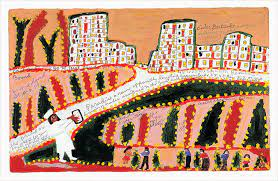
New Jerusalem by Sister Gertrude Morgan (1900-1980)

God’s judgment is but for a moment; but the Lord’s promise, salvation, and peace shall endure forever. God’s wrath is quite real and certain, yet it is a brief extension of the Lord’s steadfast love. Rebellion and judgment are never the last words; forgiveness and grace are:

Many times he [Yahweh] delivered them [the Israelites],
    but they were rebellious in their purposes
    and were brought low through their iniquity.
Nevertheless, he regarded their distress
    when he heard their cry.
For their sake he remembered his covenant
    and showed compassion according to the abundance of his steadfast love.
He caused them to be pitied
    by all who held them captive. (Psalm 106:43-46, NRSV)

All of the Old Testament prophets end their message of impending judgment with the final note of hope. That is, it won’t always be this way. There are better days ahead. The Lord’s coming is not all wrath; it’s mercy and hope. Notice the five brief messages of hope which Zechariah gives the people:

1. Yahweh burns with jealousy for Zion

Throughout the Bible, God likens the relationship to the Israelites much like a lover – as if the Lord were married to them. God’s covenant relationship with people is at the heart of understanding the whole of Scripture. Whenever they stray from divine promises, Yahweh is offended and hurt. 

God is an emotional Being, which is why we have emotions as people created in his image. Early humanity strayed so far from God that it hurt:

The Lord saw that humanity had become thoroughly evil on the earth and that every idea their minds thought up was always completely evil. The Lord regretted making human beings on the earth, and he was heartbroken. (Genesis 6:5-6, CEB)

Yet, God was gracious, sparing Noah and his family. The Lord took a group of Noah’s descendants, Abraham’s family, and set godly covenant affection on them. Through the Israelites, God hoped to lead the entire world to right relations. Yet, they, too, came to fail the gracious covenant made and set their affections on others.

Like a jilted lover, God longed for Israel to remain faithful, and, at the same time, was hurt and angry. Just as the prophet Hosea did not give up on his wife, even though she was brazenly unfaithful, so God looked at Israel as a spouse and could not bear to give her up.

2. Yahweh returns to Zion  

Jerusalem will be known as a faithful city and a holy mountain. The presence of God is what makes that happen. Because even though people can be fickle, inconsistent, complacent, and unfaithful, Yahweh remains true to the divine character of steadfast and immovable love for people.

You will never again be called ‘The People God Left.’
    Your land will never again be called ‘The Land God Destroyed.’
You will be called ‘The People God Loves.’
    Your land will be called ‘God’s Bride,’
because the Lord loves you,
    and your land will be his. (Isaiah 62:4, ERV)

3. The streets of Jerusalem will be full of children playing

The elderly will be sitting there watching the kids play, full of delight at the scene. Much too often we Westerners measure both the significance and success of our cities by its industry, businesses, buildings, wealth, and culture.

Methinks we may be misguided with such measurements. Instead, I suggest, along with the prophet, that we gage our cities by their effect on both the old and the young – because long life and children are signs of blessing from God.

4. Nothing is impossible with Yahweh

Is anything too hard for God? That, my friends, is a rhetorical question. If the Lord can cause old women to bear children (Genesis 18:10-14) and large armies to evaporate (Judges 7:1-25) then there is nothing more preposterous than to always view everything from our puny human perspective. Mary gained such a vantage and believed. We, too, have such an Advent hope within us.

“You will conceive and give birth to a son, and you are to call him Jesus. He will be great and will be called the Son of the Most High. The Lord God will give him the throne of his father David, and he will reign over Jacob’s descendants forever; his kingdom will never end.”

“How will this be,” Mary asked the angel, “since I am a virgin?”

The angel answered, “The Holy Spirit will come on you, and the power of the Most High will overshadow you. So the holy one to be born will be called the Son of God. Even Elizabeth your relative is going to have a child in her old age, and she who was said to be unable to conceive is in her sixth month. For no word from God will ever fail.”

“I am the Lord’s servant,” Mary answered. “May your word to me be fulfilled.” (Luke 1:31-38, NIV)

5. Yahweh renews and restores

Separation, diaspora, and disconnection will become a thing of the past. The Lord sets all things right again, brings people together, and heals, so that everything exists as it is meant to exist.

Deliverance from sin, death, and hell is the means of bringing renewal to the earth and its people. Salvation belongs to God. Righteousness and justice will characterize the future.

For the word of the Lord is upright,
    and all his work is done in faithfulness.
He loves righteousness and justice;
    the earth is full of the steadfast love of the Lord. (Psalm 33:4-5, NRSV)

Hope is fully realized when people put their trust in God and do their part by having strong hands and faithful hearts. We must be truthful and gracious whenever we speak. The Lord expects us to do the right thing by one another, both personally and publicly. We are to never cook up plans to take unfair advantage of others. Instead, we need to keep our lives simple and honest.

The promise of blessing is assured by God. However, the timing of that blessing is conditioned by our response. And there is no better time than the Christian season of Advent to recall what the Lord will do, as well as what God wants us to do.

May we be people of hope and let hope live in our hearts now and always, to the glory of God. Amen.

Thanksgiving Day (Psalm 100)

By Rochelle Blumenfeld

Make a joyful noise to the Lord, all the earth.
    Serve the Lord with gladness;
    come into his presence with singing.

Know that the Lord is God.
    It is he who made us, and we are his;
    we are his people and the sheep of his pasture.

Enter his gates with thanksgiving
    and his courts with praise.
    Give thanks to him; bless his name.

For the Lord is good;
    his steadfast love endures forever
    and his faithfulness to all generations. (New Revised Standard Version)

On this day, many of us Americans will engage in our annual rituals. Several verbs characterize our activities. We will:

  • “Shout” at that crazy uncle
  • “Serve” the food
  • “Come” to the table and eat
  • “Know” how much preparation went into such a big spread
  • “Enter” the living room with praise because the Dallas Cowboys lost the game
  • “Give thanks” for food, family, and football

And at the end of the day, when everyone has finally quieted down with food comas, and crazy Uncle Frank is mercifully asleep in the recliner, that underneath it all, there really is love and gratitude for everything and everyone – even Uncle Frank and his now crazy snoring.

Today’s psalm is filled with verbs, actions for both believers and unbelievers, for the animate and inanimate, for the entire earth. When the psalmist, David, and other Hebrew writers penned their poetry, they centered what they most wanted to draw attention to in the middle, so that what came before it, and after it, pointed to that central message.

The center of Psalm 100 is this: Know that the Lord is God. There are three verb imperatives (commands) that come before this central encouragement; and then, three imperatives come after it. All six verbs help us to know God better. 

The three verbs that lead up to knowing the Lord:

  • Shout or “make a joyful noise” to the Lord
  • Worship or “serve” the Lord with gladness
  • Come into God’s presence with joyful songs 

The three verbs which follow the exhortation to know God and point back to it:

  • Enter the Lord’s gates and court with thanksgiving and praise
  • Give thanks to God
  • Praise or “bless” God’s name

To “know” God is more than to have some information or some understanding of theology; it is to take that knowledge and fully internalize the Lord, to have an experiential knowledge through relational intimacy. 

We know God by God’s historical work in Holy Scripture, God’s work in other people’s lives, and God’s work in our own lives. 

It’s important to have public opportunities of praising the Lord because it strengthens everyone’s faith. And gratitude to God centers us personally and corporately so that complaints and bitterness don’t take center stage.

Our stories of God’s work helps each other to know the Lord. And knowing God is what brings about life, purpose, hope, and love.

The Lord is worthy of all the praise, adoration, and worship we can offer. So, let us do it with heartfelt thanksgiving and some emotional flavor!

I am thankful for a great many things and a great many people. I am thankful for God’s Holy Word.  It literally is my food and drink. I cannot imagine being without it. I eat it every day and have a steady diet of the Spirit teaching me. 

One of my favorite places in the Bible has to do with knowing God:

I want to [experientially] know Christ—yes, to know the power of his resurrection and participation in his sufferings, becoming like him in his death. (Philippians 3:10, NIV)

Everything in the Christian’s life, whether good or bad, is designed to help us know Jesus better. Sharing our experiences with each other encourages us to keep living for Jesus.

So, in between all the turkey and stuffing, the family drama, and the football games, let us intentionally give thanks today, out loud, for all the ways God has worked and revealed grace to us.

Accept, O Lord, our thanks and praise for all that you have done for us. We thank you for the splendor of the whole creation, for the beauty of this world, for the wonder of life, and for the mystery of love.

We thank you for the blessing of family and friends, and for the loving care which surrounds us on every side.

We thank you for setting us at tasks that demand our best efforts, and for leading us to accomplishments that satisfy and delight us.

We thank you also for those disappointments and failures that lead us to acknowledge our dependence on you alone.

Above all, we thank you for your Son Jesus Christ; for the truth of his Word and the example of his life; for his steadfast obedience, by which he overcame temptation; for his dying, through which he conquered death; and for his rising to life again, in which we are raised to the life of your kingdom.

Grant us the gift of your Spirit, that we may know Christ and make him known; and through him, at all times and in all places, may give thanks to you in all things. Amen.

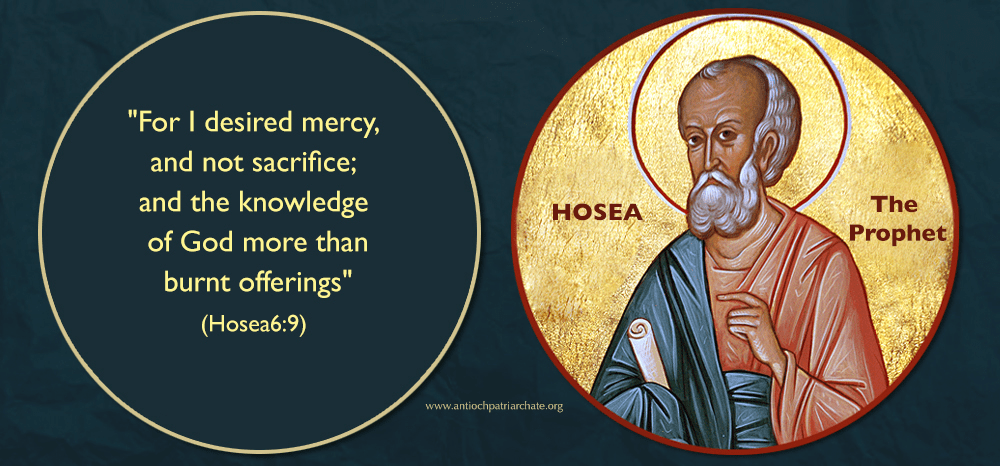
Hosea 6:1-10 – “I Want Mercy, Not Sacrifice”

“Come, let us return to the Lord.
He has torn us to pieces
    but he will heal us;
he has injured us
    but he will bind up our wounds.
After two days he will revive us;
    on the third day he will restore us,
    that we may live in his presence.
Let us acknowledge the Lord;
    let us press on to acknowledge him.
As surely as the sun rises,
    he will appear;
he will come to us like the winter rains,
    like the spring rains that water the earth.”

“What can I do with you, Ephraim?
    What can I do with you, Judah?
Your love is like the morning mist,
    like the early dew that disappears.
Therefore I cut you in pieces with my prophets,
    I killed you with the words of my mouth—
    then my judgments go forth like the sun.
For I desire mercy, not sacrifice,
    and acknowledgment of God rather than burnt offerings.
As at Adam, they have broken the covenant;
    they were unfaithful to me there.
Gilead is a city of evildoers,
    stained with footprints of blood.
As marauders lie in ambush for a victim,
    so do bands of priests;
they murder on the road to Shechem,
    carrying out their wicked schemes.
I have seen a horrible thing in Israel:
    There Ephraim is given to prostitution,
    Israel is defiled. (New International Version)

My favorite word in all of Holy Scripture is the Hebrew word חסד (“chesed” pronounced in English “kes-ed).  It is such a rich word that no one English word can capture its depth and import. 

So, chesed is translated in various ways across English translations of the Bible as:

  • Goodness (American Standard Version)
  • Faithful love (Common English Bible)
  • Loyalty (God’s Word Translation)
  • Constant love (Good News Translation)
  • Mercy (King James Version)
  • Love that lasts (The Message)
  • Faithfulness (New English Translation)
  • Loving-kindness (New Life Version)
  • Steadfast love (New Revised Standard Version)

Chesed is God’s committed, gracious, and loving covenant loyalty to people. The Lord’s very attributes are sheer Love.

Since chesed marks the character and activity of God, the Lord very much desires people to reflect this same stance toward one another. In other words, because God is merciful and kind, we, as people created in God’s image, are to be marked with this same character in all we do. 

In today’s Old Testament lesson, God is calling and wooing wayward people to return to a life of closeness with the Lord. God demonstrated chesed by not sending the people away, like a spouse outright divorcing an unfaithful partner. Instead, the Lord is committed to loving the Israelites even when they were unlovely.

At all times, the response God wants from people is not simply to go through the motions of outward worship. Ritual practices mean little if there is no heart behind them. The Lord longs for people to demonstrate both fidelity and fealty through mercy and a steadfast love to God and neighbor.

Both our work and our worship are to be infused with divine mercy. 

God deeply desires a close relationship with humanity. The Lord is deeply grieved when people whore after other gods to meet their needs for love and belonging. Hosea’s prophecy is an impassioned plea for all persons to find their true fulfillment and enjoyment in a committed loving divine/human union, like a marriage.

In Christian readings of Hosea’s prophecy, repentance means accepting God’s chesed through Jesus Christ.

The believer is to allow the character of God to rule and reign in their heart so that love and commitment come flowing out in words, actions, thoughts, and dispositions.

Mercy, in Christianity, finds its highest expression in the person and work of Jesus.

It is no wonder, then, that Jesus lifted Hosea’s prophecy as a treasured principle of operation when asked why he deliberately made connections with “questionable” people:

As Jesus continued on from there, he saw a man named Matthew sitting at a kiosk for collecting taxes. He said to him, “Follow me,” and he got up and followed him. As Jesus sat down to eat in Matthew’s house, many tax collectors and sinners joined Jesus and his disciples at the table.

But when the Pharisees saw this, they said to his disciples, “Why does your teacher eat with tax collectors and sinners?”

When Jesus heard it, he said, “Healthy people don’t need a doctor, but sick people do. Go and learn what this means: I want mercy and not sacrifice. I didn’t come to call righteous people, but sinners.” (Matthew 9:9-13, CEB)

And when confronted about “questionable” activities, Jesus appealed to the same source of Hosea’s prophecy:

“Look! Your disciples are doing something that is not right to do on the day of rest—a holy day.”

Jesus asked them, “Haven’t you read what David did when he and his men were hungry? Haven’t you read how he went into the house of God and ate  the bread of the presence? He and his men had no right to eat those loaves. Only the priests have that right. Or haven’t you read in Moses’ Teachings that on the day of rest—a holy day, the priests in the temple do things they shouldn’t on the day of rest yet remain innocent? I can guarantee that something  greater than the temple is here. If you had known what ‘I want mercy, not sacrifices’ means, you would not have condemned innocent people. (Matthew 12:2-7, GW)

One can never go wrong with mercy and grace. If in doubt between whether to judge another or show mercy, the Christian’s choice is clear.

Grace and love reconnects the disconnected. The heart of true Christian spirituality is a deep kinship with the divine. Whenever that relation is broken or severed, it is vital to restore it. The means of doing so is not judgment; it’s mercy.

Chesed is more than a word; it is a way of life.

God wants mercy. Grace is the Lord’s divine will. So, let us today receive the forgiveness of Jesus and devote ourselves to prayer and works of love which come from a heart profoundly touched by grace. 

May the result of our return to the Lord be healing of that which has been broken, and reconciled relationships with others.

Merciful and loving God, the One who shows amazing grace, forgive us for our wanderings away from the divine life. Return us, again, to the grace of Jesus Christ our Savior so that our hearts will be renewed and aflame with love for others. In the Name of the Father, Son, and Spirit, the Great Three in One. Amen.