For the story of Joseph set to song, click Bend by Brandon Heath.
May the Lord bless you and keep you. May the Lord smile down on you and show you his kindness. May the Lord answer your prayers and give you peace. Amen.
The biblical character, Joseph, went through a lot. While growing up, his brothers misunderstood and ridiculed him as “that dreamer.” Their jealousy and hatred of Joseph led them to throw him into a well and leave him for dead. Then, they turned around and pulled him out only to sell him into slavery. Joseph served as a household slave, until he was again misunderstood and wrongly accused by his master’s wife.
So, Joseph languished in a prison for years, suffering injustice. Yet, the awkward liminal space in between his family of origin and becoming the administrator over all Egypt was not a waste of time. Rather, it gave Joseph a divine perspective on his life and shaped him for his rise to power.
Likely believing he would never see his brothers and father again Joseph went about the immense work of overseeing Egypt. One day, during a severe famine, lo and behold, his brothers show up in his court looking to purchase some food for their large families! Joseph immediately recognized them. The brothers, however, did not have a clue that this was their long-lost brother.
Joseph, understandably guarded, kept his identity to himself and toyed with his brothers to discover how Jacob his father was doing. Eventually, through a labyrinthine experience of a few journeys of the brothers back and forth from Palestine to Egypt, Joseph could take it no longer; he just had to reveal his identity to his brothers. (Genesis 45:1-15)
Yet, the ultimate unveiling is much more a glimpse of what God was up to. Joseph provided a commentary on his life, why he endured hardship, and how he came to be the administrator over all Egypt. Joseph wisely discerned that God sent him to Egypt to save many lives.
It is mostly in retrospect we see what God has been doing all along. A good chunk of our lives is a mystery that is concealed, only revealed with time and patience on our part. While we exist in the strange space of the great unknowing and may struggle to understand our hardships, God is working behind the scenes, bending all our life events to his purposes. And that is the key to understanding the entire narrative of Joseph (Genesis 37-50).
Joseph’s brothers, despite being stinkers, were the means God used to send Joseph to Egypt. Furthermore, all of Joseph’s experiences in Potiphar’s house, and in the prison where he was unjustly sent were the training ground for him to lead all Egypt, second only to Pharaoh himself.
The Reconciliation of Joseph and His Brothers by Peter Cornelius, 1817
Therefore, trust and faith are imperative for God’s people. Faith is placed where the object is trustworthy. In other words, we trust God if we believe God is good and has our best interests at mind. Conversely, if we view God as sometimes fickle or inattentive, then placing faith in him becomes a gamble and we might be hesitant, hedging our bets and relying more on ourselves and our own ingenuity to get through a hard circumstance.
Don’t be deceived, my dear brothers. Every good and perfect gift is from above, coming down from the father of the heavenly lights, who does not change like shifting shadows. He chose to give us birth through the word of truth, that we might be a kind of first fruits of all he created. (James 1:16-18, NIV)
We all face times and seasons in our lives where we wonder if the Lord is sitting in his Lazy-God recliner sleeping while we wither in some miserable situation, believing that God has better things to do, or has simply lost interest in my puny life. Yet, it could be that the Lord is providentially shaping our circumstances in preparation for us to accomplish a significant godly purpose.
Although hindsight can help us see the superintendence of God, the relationship between divine sovereignty and human responsibility is still largely a mystery. Many times, we can only affirm paradoxical truths. For example:
It was ordained before the foundation of the world that Jesus would be our Savior.
Jesus chose to willingly face the cross for our sake.
Both statements are equally true at the same time, all the time.
Christ’s betrayal by Judas was foreordained and foretold in the Old Testament centuries before Judas Iscariot was born.
Judas deliberately chose to betray Jesus with a kiss for thirty pieces of silver.
Both are equally true.
Joseph was meant by God to go through all kinds of hardship for a purpose.
Joseph willingly submitted to his hardship, choosing not to become angry, bitter, or vindictive.
Both of those realities are equally true.
It is not so much what happens to us that is the issue or problem. Rather, it is how we interpret what happens to us that is the critical issue. The way Joseph interpreted his difficult circumstances and his brothers’ calloused behavior toward him was to see the big picture of what God was doing in the world, instead of merely viewing events from a narrow perspective of painful personal adversity and becoming hateful.
Just as Joseph saw his suffering, hardship, and persecution as the means to saving lives, so Jesus viewed his suffering on the cross as the means to save our lives and bring us reconciliation. And, in the same way, we too, will undergo suffering and hardship for the purpose of saving lives through peacemaking efforts.
My dear wife and I have endured our share of hardship in our lives. I choose to interpret the reason we have gone through it all just as the Apostle Paul discerned his own adversity by saying to the Corinthian Church:
Praise be to the God and Father of our Lord Jesus Christ, the Father of compassion and the God of all comfort, who comforts us in all our troubles, so that we can comfort those in any trouble with the comfort we ourselves have received from God. For just as the sufferings of Christ flow over into our lives, so also through Christ our comfort overflows. If we are distressed, it is for your comfort and salvation; if we are comforted, it is for your comfort, which produces within you a patient endurance of the same sufferings we suffer. And our hope for you is firm because we know that just as you share in our sufferings, so also you share in our comfort. (2 Corinthians 1:3-7, NIV)
Whatever you are going through, or have gone through, even if it has been many years ago, God wants to use your difficulties and troubles for both your personal strengthening of faith, and for empathic and compassionate ministry for the sake of others.
We all need to practice patience and perseverance through hard times, if we are going to realize better days and gain a better interpretation of our difficult circumstances. Here are a few ways to do just that:
Write It Out
When suffering an upsetting event, writing about it can make us feel better as well as helping us make some sense of it. The act of writing organizes our thoughts, which then makes the experience feel less chaotic. Writing also provides an emotional release, along with insight and awareness into yourself. And with awareness, we have conscious choices.
Guard your heart more than anything else because the source of your life flows from it. (Proverbs 4:23, GW)
Some thoughts to get started writing:
Set aside 10-15 minutes a day for several days to write about the event and how it made you feel.
Don’t worry about grammar or creativity. This is just for you.
Stick with it. At first writing about an upsetting experience might be painful. However, over time it can help you get past the upset. Keep in mind, though, that if it is an especially disturbing event, you might want to do this work along with a trained professional.
Tackle Your Problem(s)
When distressed, it is unhelpful to stew in self-pity or to waste energy in blame shifting. Instead, be assertive.
Make every effort to present yourself to God as a tried-and-true worker, who does not need to be ashamed but is one who interprets the message of truth correctly. (2 Timothy 2:15, CEB)
Take charge of your trouble:
Write down the problem. On paper it seems more manageable than when it is swirling inside your head.
List as many solutions as possible. You can reject options later.
Assess the list. Ask yourself how you would like this situation to end. Which of the written options likely will get you there? Weigh the pros and the cons.
Accept a reasonable solution, without searching for the perfect one. Focusing on perfection only breeds disappointment.
Form a concrete workable plan. Set some realistic and specific deadlines.
Avoid discouragement if the first solution does not pan out – just try another one on your list.
Get Support
We as people are hard-wired by God for community and needing one another.
Help each other with your troubles. When you do this, you are obeying the law of Christ. (Galatians 6:2, ERV)
Ask someone to give you a hand if you are overwhelmed.
Do not be afraid to ask for advice. Consulting and collaborating with others are always the way of wisdom.
Get emotional support. Crying, sharing our frustrations, or otherwise venting helps release tension, relieve stress, and helps us move on.
So, may we choose to have the eyes of faith and trust, discerning that God is good and sovereignly works out his will through our troubles.
Joseph and Potiphar’s Wife by Hermine F Schäfer, 1964
Now Joseph had been taken down to Egypt. Potiphar, an Egyptian who was one of Pharaoh’s officials, the captain of the guard, bought him from the Ishmaelites who had taken him there.
The Lord was with Joseph so that he prospered, and he lived in the house of his Egyptian master. When his master saw that the Lord was with him and that the Lord gave him success in everything he did, Joseph found favor in his eyes and became his attendant. Potiphar put him in charge of his household, and he entrusted to his care everything he owned. From the time he put him in charge of his household and of all that he owned the Lord blessed the household of the Egyptian because of Joseph. The blessing of the Lord was on everything Potiphar had, both in the house and in the field. So, Potiphar left everything he had in Joseph’s care; with Joseph in charge, he did not concern himself with anything except the food he ate.
Now Joseph was well-built and handsome, and after a while his master’s wife took notice of Joseph and said, “Come to bed with me!”
But he refused. “With me in charge,” he told her, “my master does not concern himself with anything in the house; everything he owns he has entrusted to my care. No one is greater in this house than I am. My master has withheld nothing from me except you because you are his wife. How then could I do such a wicked thing and sin against God?” And though she spoke to Joseph day after day, he refused to go to bed with her or even be with her.
One day he went into the house to attend to his duties, and none of the household servants was inside. She caught him by his cloak and said, “Come to bed with me!” But he left his cloak in her hand and ran out of the house.
When she saw that he had left his cloak in her hand and had run out of the house,she called her household servants. “Look,” she said to them, “this Hebrew has been brought to us to make sport of us! He came in here to sleep with me, but I screamed. When he heard me scream for help, he left his cloak beside me and ran out of the house.”
She kept his cloak beside her until his master came home. Then she told him this story: “That Hebrew slave you brought us came to me to make sport of me. But as soon as I screamed for help, he left his cloak beside me and ran out of the house.”
When his master heard the story his wife told him, saying, “This is how your slave treated me,” he burned with anger. Joseph’s master took him and put him in prison, the place where the king’s prisoners were confined.
But while Joseph was there in the prison, the Lord was with him; he showed him kindness and granted him favor in the eyes of the prison warden. So, the warden put Joseph in charge of all those held in the prison, and he was made responsible for all that was done there. The warden paid no attention to anything under Joseph’s care, because the Lord was with Joseph and gave him success in whatever he did. (NIV)
We learn a great about both God and Joseph in today’s Old Testament lesson: God is the supreme Sovereign over everything, and his providence is the force behind all of events; and, Joseph is morally conscious of his ethical accountability to the God who is always watching.
From a sheer worldly perspective, Joseph was a failure. Yet, from God’s vantage point Joseph was a resounding success because he was mindful of God despite his circumstances. Joseph was faithful in all his mundane workaday duties, which made him able to handle the advances and temptations of Potiphar’s wife.
The seductions of this life are legion. We are tempted at every turn to compromise our conscience or our convictions to either get ahead in life or avoid some difficulty. It would be easy to rationalize our actions, believing that a brief bedroom rodeo would not hurt anyone. However, sexual infidelity is the opium of unfaithfulness to God. Cheating is cheating, whether we are caught, or not. Whitewashing the picket fence does not hide anything from God.
Seductions come in all sorts of forms: materialism and the allure of new stuff; preoccupation with comfort and painless experiences; shortcuts to job success and upward mobility; the hoarding and whoring of time; and, much more.
For me, an effective counter practice to the seductions of the world is to reclaim and redeem time through keeping the Daily Office (or the Divine Hours) – set times throughout the day in which I stop what I am doing and take a few minutes for Scripture and prayer. This practice reminds me that my life orbits God and centers in the Lord Jesus, and not the other way around.
Seven times a day I praise You, because of Your righteous judgments. (Psalm 119:164, NKJV)
We succumb to seduction whenever our lives are mismanaged, lacking boundaries, and without effective structure. Discovering a rhythm of daily life that works for you is vital to resisting temptation and realizing spiritual development.
God blesses those who patiently endure testing and temptation. Afterward they will receive the crown of life that God has promised to those who love him. (James 1:12, NLT)
May you flourish and thrive with the ethical fruit of righteousness and experience the settled peace of a well-lived life.
Almighty God, blessed Father, Son, and Spirit do not lead us into temptation but deliver us from the evil one. For Yours is the kingdom and the power and the glory forever. Amen.
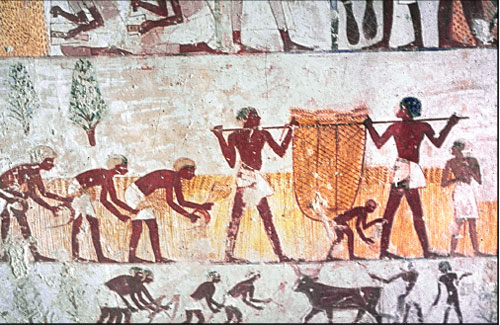
Egyptian workers harvesting grain. From the tomb of Mena in Thebes, c.1420 B.C.E.
Give thanks to the Lord and proclaim his greatness.
Let the whole world know what he has done.
Sing to him; yes, sing his praises.
Tell everyone about his wonderful deeds.
Exult in his holy name;
rejoice, you who worship the Lord.
Search for the Lord and for his strength;
continually seek him.
Remember the wonders he has performed,
his miracles, and the rulings he has given,
you children of his servant Abraham,
you descendants of Jacob, his chosen ones….
He called for a famine on the land of Canaan,
cutting off its food supply.
Then he sent someone to Egypt ahead of them—
Joseph, who was sold as a slave.
They bruised his feet with fetters
and placed his neck in an iron collar.
Until the time came to fulfill his dreams,
the Lord tested Joseph’s character.
Then Pharaoh sent for him and set him free;
the ruler of the nation opened his prison door.
Joseph was put in charge of all the king’s household;
he became ruler over all the king’s possessions.
He could instruct the king’s aides as he pleased
and teach the king’s advisers….
All this happened so they would follow his decrees
and obey his instructions.
Praise the Lord! (NLT)
Our spiritual and emotional vision can sometimes be myopic. It is precisely in those times when we have tunnel vision and neither look back to a past in which God acted with justice nor see ahead to a future with hope that we must remember God is supreme over everything, including time.
God’s providence and blessing is the animating force behind all events. The biblical character of Joseph is Exhibit A of God’s sovereign backstage orchestration of personal and world forces. Joseph’s story of brotherly betrayal, bondage, imprisonment, and rise to power include some lessons for us (Genesis 37-41):
Joseph is portrayed as a model of wisdom for us to follow.
Respect and obey the Lord! This is the beginning of knowledge. Only a fool rejects wisdom and good advice (Proverbs 1:7, CEV).
Do not letmercy and truth leave you. Fasten them around your neck. Write them on the tablet of your heart. Then you will find favor and much success in the sight of God and humanity (Proverbs 3:3-4, GW).
Joseph did not know the end of the story while he was in the middle of it, languishing in prison. Little did he know that God was testing his character, training him to listen well, and preparing him for his eventual leadership in Egypt – all to save many lives from hunger and starvation.
Now faith is the assurance of things hoped for, the conviction of things not seen. (Hebrews 11:1, NRSV)
Joseph successfully negotiated and navigated a world which was vastly different from his own religion and ethics. He was determined not to give in to the seductions of women and power around him; and, he did not become bitter against his brothers, nor against the Egyptians.
Don’t love the world’s ways. Don’t love the world’s goods. Love of the world squeezes out love for the Father. Practically everything that goes on in the world—wanting your own way, wanting everything for yourself, wanting to appear important—has nothing to do with the Father. It just isolates you from him. The world and all its wanting, wanting, wanting is on the way out—but whoever does what God wants is set for eternity. (1 John 2:15-17, MSG)
Four-hundred years later, Moses also had to navigate the situation of being an Israelite in the world of Egypt, and walked in the footsteps of his forebear, Joseph:
By faith Moses, when he had grown up, refused to be known as the son of Pharaoh’s daughter. He chose to be mistreated along with the people of God rather than to enjoy the pleasures of sin for a short time. He regarded disgrace for the sake of Christ as of greater value than the treasures of Egypt because he was looking ahead to his reward. (Hebrews 11:24-26, NIV)
We understand, knowing the end of the story, that Joseph was in Egypt (in the world) to be a blessing and that God had him there for a purpose. This is no less true for the people of God. We do not exist merely for ourselves but to be a blessing to the world. God, as he did for Joseph, shows us mercy while we are smack in the middle of hardship and not by taking us out of our worldly predicament. Life must sometimes be lived at great risk amid the world and not apart from it.
Seen from a strictly worldly perspective, Joseph’s time in slavery and prison was an unnecessary injustice. However, from God’s vantage point, Joseph was learning to be mindful of God despite his circumstances. For the Lord is much more concerned about the process we undergo in spiritual formation, rather than simply producing a product at the end of the line. Most of life is lived in the mundane, and Joseph was faithful in all the workaday decisions and demands of life. This made him able to handle all the vicissitudes of others in their fickle and feckless ways and see God’s providential working.
Lord God, you hold both heaven and earth in a single peace. Let the design of your great love shine on the waste of our anger and sorrow, and give peace to your Church, peace among nations, peace in our homes, and peace in our hearts through Jesus Christ our Lord who with you and the Holy Spirit benevolently reign as one God, now and forever. Amen.







 Rev. Tim Ehrhardt