Praise the Lord!

Praise the Lord!

Praise the Lord from heaven!
    Praise God on the heights!
Praise God, all of you who are his messengers!
    Praise God, all of you who comprise his heavenly forces!
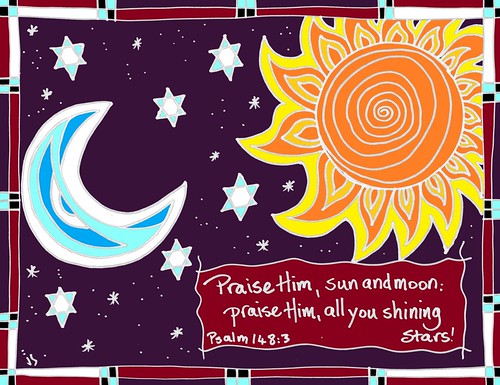
Sun and moon, praise God!
    All of you bright stars, praise God!
You highest heaven, praise God!
    Do the same, you waters that are above the sky!
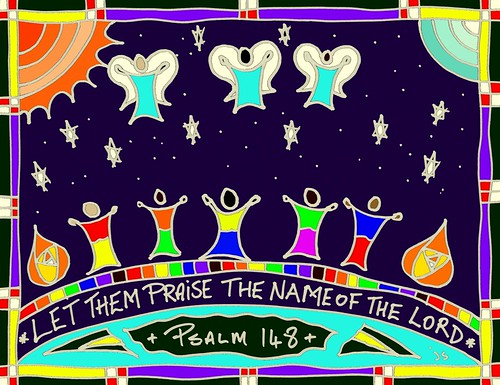
Let all of these praise the Lord’s name
    because God gave the command and they were created!
God set them in place always and forever.
    God made a law that will not be broken.

Praise the Lord from the earth,
    you sea monsters and all you ocean depths!
Do the same, fire and hail, snow and smoke,
    stormy wind that does what God says!
Do the same, you mountains, every single hill,
    fruit trees, and every single cedar!
Do the same, you animals—wild or tame—
    you creatures that creep along and you birds that fly!
Do the same, you kings of the earth and every single person,
    you princes and every single ruler on earth!
Do the same, you young men—young women too!—
    you who are old together with you who are young!

Let all of these praise the Lord’s name
    because only God’s name is high over all.
    Only God’s majesty is over earth and heaven.
God raised the strength of his people,
    the praise of all his faithful ones—
        that’s the Israelites,
        the people who are close to him.

Praise the Lord! (Psalm 148, CEB)

This is the Christmas season.  We are in the third day of the twelve days of Christmas.  This time in the Church Calendar gives focus to declare along with the angels and all of God’s creation:  Glory to God in the highest; praise the Lord!  Everything in all creation points to a creator who cares for us. 

These days between December 25 and January 5 are to be a great celebration because King Jesus has come and is the rightful Sovereign over all creation.  We are to grasp the meaning of Christ’s incarnation; and affirm the identity of Jesus as both full human and fully divine.  Beginning with Christ’s birth, we enter a reflection on the meaning of Christ’s life and prepare for the journey toward the cross and the empty tomb.

Today, however, we simply praise the Lord along with all creation.  This is what the psalmist calls us all to do.  The entire universe is called to praise the Lord.  Everything outside our earth is to give God glory.  Everything in the universe points to a God who is worthy to be praised.

Let us assume the distance between the earth and the sun (ninety-two million miles) was reduced to the thickness of a sheet of paper. If that is the case, then the distance between the earth and the nearest star would be a stack of papers seventy feet high. And the diameter of the galaxy would be a stack of papers three-hundred-ten miles high. Our galaxy is just a speck of dust in the universe, yet Jesus holds the universe together by the word of his power.

We serve a big God who is worthy to be praised, not only out there in the universe but here on earth.  The psalmist calls on all the earth to echo the adoration of God.  That means everything and everyone on earth – fish, animals, birds, even trees as well as people. 
Research in the field of bioacoustics has revealed that every day we are surrounded by millions of ultrasonic songs. For example, the electron shell of the carbon atom produces the same harmonic scale as a Gregorian chant.  Whale songs can travel thousands of miles underwater.  Meadowlarks have a range of three hundred notes. Supersensitive sound instruments have discovered that even earthworms make faint staccato sounds!

Arnold Summerfield, a German physicist, and pianist observed that a single hydrogen atom, which emits one hundred frequencies, is more musical than a grand piano, which only emits eighty-eight frequencies.  Science writer Lewis Thomas summed it up it this way: “If we had better hearing, and could discern the singing of sea birds, the rhythmic drumming of schools of mollusks, or even the distant harmonics of flies hanging over meadows in the sun, the combined sound might lift us off our feet.”

Praise the Lord.  We have a vision in this psalm of all creation praising God as one great big choir. Praise is to occur with both words and actions.  With words, praise is an expression of gratitude to God for who she is and what he has done.  With actions, praise is a posture of submission and an acknowledgement of dependence.

Therefore, through testimony we declare what God has done in our lives and how he is worthy to be praised and obeyed.  With the emphasis on praise in a season dedicated to joy, we must also recognize that for many people Christmas is difficult.  Loneliness, thin finances, unemployment, illness, strained relationships, and bittersweet memories can all be a discouraging contrast to the celebration going on around them.

Praise, however, is not just for the joyful; it can happen no matter the circumstances because the Christian’s happiness is not dependent upon positive situations but rather upon the person and work of Jesus.  It may not be easy to find our voice of praise along with everyone else, but we are not alone.  We can choose to join with all creation to praise the name of the Lord. 

A dear parishioner of mine shared this a few years ago after experiencing multiple surgeries in the year:

“I am thankful for a chance to get out of the house. Of course, my walker was with me.  I am amazed how quickly folks move over, slow down, and give me space when I am out with that thing….  At church it feels like I am parting the Red Sea! The reason I hate the walker is because it says to the whole world, ‘Hey, I’m broken!’  I realize we all have areas that we are broken, most of them we can hide or cover up. Why are we so ashamed to confess the truth? Who really has it all together? I know we love our privacy and shun pity. However, I have been shown so much grace, kindness, and compassion as I push this piece of aluminum around that I hope this experience continues to change me for the better. I hope in the future I will be sensitive to those who are broken on the inside as well as the outside. May the love of Christ give me eyes to see people as he does, precious and accepted, just as they are.”

That, my friends, is the reasonable and logical end of praising the Lord – to connect what God has done and is doing with what he can do through us as we glorify his name. By simply being who we are created to be, we praise the Lord along with all creation.  When we as people in God’s image, reflect that image in how we talk and how we live, we participate with the universe in declaring God is good. 

Praise is to be the glue that binds us all together. Let us praise the name of the Lord. To be more specific, let the church praise the Lord!  Let leaders everywhere praise the Lord!  Let healthcare workers praise the Lord!  Let salespersons and factory workers praise the Lord!  Let police and lawyers praise the Lord! Let the trees, mountains, and all living things praise the Lord!  Let engineers and educators praise the Lord!  Let the little children praise the Lord!  Let clerks and cashiers, waiters and waitresses, janitors and housekeepers praise the Lord!  Let the lost and the lonely praise the Lord along with the happy and satisfied. Let everything that has breath praise the Lord!  Praise the Lord!

Whether you are bursting to proclaim it, or struggle to say it and live it, praise the Lord along with everything in the universe because we serve a God who keeps us close to heart.  Praise the Lord!

What do you have to praise the Lord for today?

How do you express your praise, both personally and publicly?

Where is your favorite place to praise the Lord?

When does praise to God come easily for you, and when it is difficult?

Who do you like praising the Lord with?

May your life become a paeon of praise to the God who is worthy to receive all glory, honor, and praise. Amen


Psalm 79 – Unbearable Pain

The nations have come into your inheritance, God!
    They’ve defiled your holy temple.
    They’ve made Jerusalem a bunch of ruins.
They’ve left your servants’ bodies
    as food for the birds;
    they’ve left the flesh of your faithful
    to the wild animals of the earth.
They’ve poured out the blood of the faithful
    like water all around Jerusalem,
    and there’s no one left to bury them.
We’ve become a joke to our neighbors,
    nothing but objects of ridicule
    and disapproval to those around us.

How long will you rage, Lord? Forever?
    How long will your anger burn like fire?
Pour out your wrath on the nations
        who don’t know you,
    on the kingdoms
        that haven’t called on your name.
They’ve devoured Jacob
    and demolished his pasture.
Don’t remember the iniquities of past generations;
    let your compassion hurry to meet us
    because we’ve been brought so low.
God of our salvation, help us
    for the glory of your name!
Deliver us and cover our sins
    for the sake of your name!
Why should the nations say,
    “Where’s their God now?”
Let vengeance for the spilled blood of your servants
    be known among the nations before our very eyes!
    Let the prisoners’ groaning reach you.
With your powerful arm
    spare those who are destined to die.
Pay back our neighbors seven times over,
    right where it hurts,
    for the insults they used on you, Lord.
We are, after all, your people
    and the sheep of your very own pasture.
We will give you thanks forever;
    we will proclaim your praises
    from one generation to the next. (CEB)

The setting behind today’s Psalm is the destruction of the temple and a conquering army who proudly gloats over their victory. This is a prayer, an angry cry for God to step in and act on behalf of the humiliated people. The psalm is more than a simple plea for help; it is a deeply passionate appeal. As a child of the 1960’s, my phrase for the psalmist’s entreaty is, “God, stick it to the man!”

There is no polite knock at the side door of God’s house in the face of such evil. This is a pounding on the front door with the demand for God to do something about this terrible trouble. For the psalmist, the incongruence between who God is and what has happened to God’s people is inconceivable and unacceptable. To profane God’s temple is to profane God; and to kill and maim God’s people is to flip the middle finger at God. The psalmist is beside himself and overwhelmed with emotion.

There is something very instructive here that we ought not miss. When we have been brutalized, victimized, and/or demoralized, we just want someone, especially the Lord we serve, to take notice and feel what we are feeling. Never underestimate the power of empathy and solidarity. To feel alone and bereft of help is an awful feeling.

Perhaps the psalmist’s prayer offends some sensibilities. I wonder, for those who find the language difficult, have ever had a daughter raped or a house destroyed by fire or seen a person killed without mercy in front of their own eyes. Methinks they have not. The feelings of helpless despair and sheer anger defy human words. These are not casual affronts but malicious destructions of property and people.

We need someone to affirm the raw ruthlessness of it all, to have some understanding of the impossible place we are in with such wanton cruelty. When our very support is ripped from our lives, the madness within is too much to bear. Who will rescue us from this body of death?

God is big enough to handle our rage and our hurt. The Lord is available and hears our desperate voice of prayer. Yet, God is not always going to directly and immediately answer on the terms we stipulate. God acts out of God’s own providence and justice, and not from our expectations. And that is a good thing, not a bad thing.

God sees, knows, and feels with us. The realization of this enables us to recenter and reorient ourselves around faith, hope, and love. New life is never a gift in a vacuum; it comes out of agonizing struggle in reckoning with the existing evil.

So, when someone goes through a hellish experience, we are to exercise our capacity to listen and witness the horrible spiritual pain of the person. Healing hurts: it is not a pleasant affair. We are to hang in there and walk alongside another in their hour of need, even when their vitriol seems over the top to us. For only in telling our story to another will any of us find relief and renewed hope.

The psalms permit us to use language appropriate to what has happened to us. They also allow us to move beyond the venom to the God who restores broken lives.

Lord Jesus Christ, by your patience in suffering you hallowed earthly pain and gave us the example of obedience to your Father’ will: Be near me in my time of weakness and pain; sustain me by your grace, that my strength and courage may not fail; heal me according to you will; and help me always to believe that what happens to me here is of little account if you hold me in eternal life, my Lord and my God. As the Lord Jesus cried out on the cross, I cry out to you in pain, O God my Creator. Do not forsake me. Grant me relief from this suffering and preserve me in peace, through Jesus Christ my Savior, in the power of the Holy Spirit. Amen.

The Holy Helper

Our ideas of God take shape in the many ways we live our lives. A God who is always right, fair, just, and loving in everything he says and does is a God we can trust. A cranky god who is aloof and indifferent does not help anyone. Yet, with the one true God we can be assured of strong spiritual support for any and every situation. When we have as our ally a robust theology which informs how we think and gives shape to how we act, then we can step forward with confidence knowing God has our back.

Sound theology needs to be identified, nurtured, and expressed in daily life. The Old Testament psalms are pregnant with vigorous views of God, as well as being the Church’s prayer book. Each individual psalm invites us to see God in a new or fresh way and inspires us to pray. Using the psalms as boots-on-the-ground prayer provides a firm foundation from which to know, worship, and serve God.

Here is my own translation of Psalm 99, which is meant to capture the spirit of the text. I encourage you to pray it over slowly, several times, and with appropriate emotional flavor behind the words:

The LORD rules everything; let all people everywhere who live unjustly, shake in their boots!

            God sits enthroned above all creation; let the earth rumble on its foundation!

The LORD is great among his people.

            In fact, God is far above all people.

Let everyone, no matter who they are or where they are from, praise Your great and awesome name. God is holy!

Mighty Ruler, the lover of everything that is just and right,

            You are the One who established what is fair and equitable.

You labored behind the scenes for causes which are just and right,

            and brought harmonious relations to folks at odds with each other.

Magnify the LORD, our God!

            Approach the Divine with great and mindful humility!

            God is holy!

Godly people of old such as Moses and Aaron were among the Lord’s devout followers.

            Those like Samuel were among the humble who called on God’s Name.

People from times long ago have cried out to the LORD and have gotten an answer.

            God spoke to the ancient Israelites in a great pillar of cloud.

They sought to keep and entrust the divine rules given to them.

O LORD our God, you answered them.

            You were a forgiving God to them,

            yet, you also were the One who held them accountable when they slid off the rails.

Magnify the LORD our God!

            Humble yourselves and worship at God’s holy mountain,

            because no one is like the LORD our God, a holy Helper!

Let’s get some hearty divine beliefs under our belt with the help of Psalm 99 so that we can live by faith, hope, and love…

God is Universal

A healthy view of God enables us to live with confidence no matter the circumstances. There is no place we can go where God is not there already. The Lord is universal – not tied to any distinct location, culture, class, race, gender, ethnicity, or group of people. God reigns supreme as Lord of all, not just some. The Lord is everywhere:

Where could I go to get away from your spirit?
    Where could I go to escape your presence?
If I went up to heaven, you would be there.
    If I went down to the grave, you would be there too!
If I could fly on the wings of dawn,
    stopping to rest only on the far side of the ocean—
        even there your hand would guide me;
        even there your strong hand would hold me tight!
If I said, “The darkness will definitely hide me;
        the light will become night around me,

     even then the darkness isn’t too dark for you!
        Nighttime would shine bright as day,
        because darkness is the same as light to you! (Psalm 139:7-12, CEB)

God is not only our God but everyone’s God – which means you will find God amongst both Democrats and Republicans, upper class and lower class, black and white, American and Asian, in every nation of the world, and within all societies. No one group of people have the corner on God, for God is much too big for that – which also means God is not limited to looking just like an old white northern European heritage male Protestant minister.

God is Just

It is important to have a proper definition of biblical justice. In the way many use the word, it refers to punishing those who do wrong and deserve incarceration. Although this idea is included in the meaning, it is only a secondary understanding of justice. The primary essence of justice is ensuring everyone has what they need to thrive and flourish on this earth – that there are no obstacles to people realizing their full humanity in God’s image.

Conversely, injustice means someone, a group of people, or even a nation is withholding resources and blocking persons, either knowingly or unknowingly, from thriving in life. A punitive implication of justice comes into play here. Unjust authorities must be replaced or even punished for their gross negligence in failing to provide for the common good of all persons under their responsibility.

Throughout Holy Scripture God spotlights those who are underprivileged and under resourced through no fault of their own. Those who love justice seek to rise above ignorance; be non-judgmental; use power on behalf of others; and are vigilant to operate fairly and equitably in all things.

The reason aliens, strangers, widows, and orphans are oft mentioned in the Bible is because they were the most vulnerable people in the ancient world to unjust actions and policies. God acts on their behalf so they will experience a fair distribution of resources instead of retribution from others.

The Lord your God is God of gods and Lord of lords, the great, powerful, and awe-inspiring God. He never plays favorites and never takes a bribe. He makes sure orphans and widows receive justice. He loves foreigners and gives them food and clothes. So, you should love foreigners, because you were foreigners living in Egypt. (Deuteronomy 10:17-19, GW)

“You must defend those who are helpless and have no hope. Be fair and give justice to the poor and homeless.” (Proverbs 31:8-9, CEV)

“I want to see a mighty flood of justice, an endless river of righteous living.” (Amos 5:24, NLT)

God is Relational

The Lord graciously gives guidance. God has spoken in the past in answer to those who called upon the name of the Lord. God’s presence was with the Israelites in their desert sojourn. God provided laws and promises to help them. And it was all done with the intimacy of a father and mother to a beloved child.

The powerful, living Spirit of God is available to us today, as well. The fallen nature of this world and our own sin is overcome through the grace of forgiveness in Christ. Even Jesus himself closely identifies with us and offers prayers on our behalf:

Jesus looked toward heaven and prayed, “Father, the hour has come. Glorify your Son, that your Son may glorify you. For you granted him authority over all people that he might give eternal life to all those you have given him. Now this is eternal life: that they know you, the only true God, and Jesus Christ, whom you have sent. I have brought you glory on earth by finishing the work you gave me to do. And now, Father, glorify me in your presence with the glory I had with you before the world began. I have revealed you to those whom you gave me out of the world. They were yours; you gave them to me, and they have obeyed your word. Now they know that everything you have given me comes from you. For I gave them the words you gave me, and they accepted them. They knew with certainty that I came from you, and they believed that you sent me. I pray for them. I am not praying for the world, but for those you have given me, for they are yours. All I have is yours, and all you have is mine. And glory has come to me through them.” (John 17:1-10, NIV)

God is Holy

God is pure, set apart from injustice, wickedness, and sin. There are no impurities of mixed motives or malevolent plans with God. God’s holiness is the ground of the divine Being. In other words, the Lord does not simply act holy in all responses, plans, and works; the very essence and character of God is holiness. Therefore, God only acts consistent with this inherent personhood. Sacred words and actions come from the holy God.

And this is what engenders trust with the psalmist and caused him to acknowledge the great and wonderful help God gives. God’s holiness encompasses both divine transcendence and immanence, that is, the Lord is both far and near at the same time, all the time. And that theological understanding is of great worth to the worshiping and devout believer.

Each Sunday Christians all over the world gather and pray, “Our Father who art in heaven.” God is as near as a parent to a child and also reigns in heaven far above all – at the same time, all the time. God maintains a close and intimate relationship with humanity while also keeping a distance from injustice and unrighteousness.

Let us, along with the multitudes of heaven, proclaim God’s holiness:

“Holy, holy, holy is the Lord God Almighty, who was, and is, and is to come… You are worthy, our Lord and God, to receive glory and honor and power, for you created all things, and by your will they were created and have their being.” (Revelation 4:8, 11, NIV)

Our holy God lives forever in the highest heavens, and this is what he says: “Though I live high above in the holy place, I am here to help those who are humble and depend only on me.” (Isaiah 57:15, CEV)

God is our holy Helper. The Lord’s assistance is available, abundant, and awesome. So, let us take courage and pray with confidence and boldness to the God who listens and answers.

Psalm 149 – Praise and Punishment

Church stained glass windows sword dividing

Praise the Lord!
Sing to the Lord a new song,
his praise in the assembly of the faithful.
Let Israel be glad in its Maker;
let the children of Zion rejoice in their King.
Let them praise his name with dancing,
making melody to him with tambourine and lyre.
For the Lord takes pleasure in his people;
he adorns the humble with victory.
Let the faithful exult in glory;
let them sing for joy on their couches.
Let the high praises of God be in their throats
and two-edged swords in their hands,
to execute vengeance on the nations
and punishment on the peoples,
to bind their kings with fetters
and their nobles with chains of iron,
to execute on them the judgment decreed.
This is glory for all his faithful ones.
Praise the Lord! (NRSV)

The initial question that arises with me is this: Is this a psalm of praise to the Lord, or an imprecatory psalm encouraging the punishment of the wicked? Well, perhaps the obvious answer is “yes.” I suppose what I am really struggling with is that out of all the one-hundred fifty psalms in the psalter, only this one has this unique combination of vocal praise and punishing action.

The psalm begins much like many psalms of praise but takes the unexpected turn of a call to a war-like operation to execute vengeance on enemies. I freely admit that I do not know quite what to make of this strange amalgam. I wonder along with the venerable Old Testament scholar Walter Brueggemann who said, “One cannot tell whether this is a responsibility to fend off oppressors or a temptation to gather imperial power.”

Perhaps my wrestling with this psalm is really the struggle with history itself. The Holy Scriptures do not shy away from the realism of its times and often offers historical events and human attitudes with unvarnished narratives. The Bible, and especially the psalmist, will not let us sanitize the past as some idyllic bygone era of divine drama to be envied. Instead, we receive the liberation of God’s people with all its harsh truth.

So, it could be that is why I also loathe seeing some mass market crosses which look ornately beautiful, as if Christ’s death was some pleasant affair. Deliverance from sin, death, and hell came at an awful price. Jesus absorbed all the foulness and degradation of a tortuous ignoble death. In other words, he was a bloody mess, publicly displayed for all to jeer at and be repulsed by.

What is more, for the Christian, perhaps the sagest approach to today’s psalm is unabashedly choosing to view it through Christocentric lenses. Christ is the strong man who has bound the ruler of this dark world with iron chains and secured our liberation from a hellish existence. And the Lord will return, the nations of the earth will be judged, and the faithful will reign with Christ forever.

Even if I read a bit too much into the psalm by interpreting it Christologically, it still leaves the intention of the imprecation open as to its true nature. In other words, the psalm simply does not tell us the trajectory of the curse which comes out of the praise. We are left to wonder in what kind of direction it goes. The Christian tradition of reading psalms and seeing Jesus in them might be our best guide.

Whichever way we choose to examine this unique psalm, the thing which we do know is that it unequivocally stands as a defiance of the nations and peoples of the earth who oppose the living God. Resistance to injustice, unrighteousness, and evil is encouraged by this psalm. The only ruler of this earth who has absolute power is God; and, anyone or any group which attempts to gain and grab such power for themselves is to be resisted. For the harsh reality of living on this created yet fallen earth is that violent and insolent people still desire total control and will do just about anything to get it and keep it.

Almighty and sovereign God, we, your people, ask in the Name of your most precious Son, Jesus Christ, our risen and ascended Lord, to look upon the good desires of your humble servants, and stretch forth the right hand of your power to be our defense against evil in all its insidious forms. And do not lead us into temptation, but deliver us from the evil one. For yours is the kingdom and the power and the glory forever. Amen.