Struggling in the Season (Genesis 25:19-28)

Art by Sefira Lightstone

These are the descendants of Isaac, Abraham’s son: Abraham was the father of Isaac, and Isaac was forty years old when he married Rebekah, daughter of Bethuel the Aramean of Paddan-aram, sister of Laban the Aramean. Isaac prayed to the Lord for his wife because she was barren, and the Lord granted his prayer, and his wife Rebekah conceived. The children struggled together within her, and she said, “If it is to be this way, why do I live?” So she went to inquire of the Lord. And the Lord said to her,

“Two nations are in your womb,
    and two peoples born of you shall be divided;
the one shall be stronger than the other;
    the elder shall serve the younger.”

When her time to give birth was at hand, there were twins in her womb. The first came out red, all his body like a hairy mantle, so they named him Esau. Afterward his brother came out, with his hand gripping Esau’s heel, so he was named Jacob. Isaac was sixty years old when she bore them.

When the boys grew up, Esau was a skillful hunter, a man of the field, while Jacob was a quiet man, living in tents. Isaac loved Esau because he was fond of game, but Rebekah loved Jacob. (New Revised Standard Version)

As we near the end of Advent and the anticipation of the Christ child, today’s Old Testament lesson is a reminder to us of a much earlier birth.

The birth of the twins Jacob and Esau from Rebekah and the patriarch Isaac, are part of the promise given to Abraham, which would find its fulfillment centuries later, according to Christians, with the incarnation of Christ.

In this time of year, we may commonly associate the season with an emphasis on peace and unity. Yet, we must bear in mind that the need to emphasize these positive elements arises because enmity and discord exists among us.

In our story for today, we are reminded that God also works within conflict, even family conflict, to further divine purposes and promises. God’s presence exists through times of strife and disagreement, just as much as it does in times of joy of celebration.

The sibling rivalry between Jacob and Esau began within the womb and at their birth. Their adverse relationship and continual competition was something God used, and bent it toward the Lord’s good plans and purposes for people.

Just as Mary and Elizabeth were mothers central to the direction of God’s will accomplished on this earth, so Rebekah is a pivotal character in the early history of the people of Israel, and their covenantal promises.

And similar to Mary and Elizabeth in the New Testament, Rebekah in the Old Testament was given children by means of God’s gracious power. We are meant to see God’s sovereign authority over all things, including control of the future. The text of Scripture values faith, and trusting in divine promises.

The two babies, Esau and Jacob, are more than twins. They each are ancestors of entire nations of people: Esau of Edom, and Jacob of Israel.

Against all odds, Jacob is the one who kept coming out on top of things. His character reveals something of the nation of Israel’s understanding of themselves. Israel is a small, and by all appearances, an insignificant nation; and yet, they become identified as God’s covenant people.

The ways of the Lord are often quite contradictory to societal convention and cultural expectations. The smallest and the youngest, the least and the forgotten, become prominent in God’s economy of things. This is a common pattern throughout Holy Scripture. (e.g. Genesis 17:18-19; 42:6-9; 1 Samuel 16:10-13; 17:33, 50)

Even though the two of them are twins, Esau and Jacob have very different personalities and interests. Esau was an outdoorsman, a hunter, who wasn’t home much. He had an extroverted life which had him interacting with all sorts of different people, especially women from other places. Jacob, however, hung around the home tents, an introvert. He comes across a stereotypical mama’s boy.

Yet, despite Jacob’s continual conniving, and Esau’s constant disdain for his family’s heritage with God, the Lord nevertheless showed generosity to both brothers.

But for a long time, it seemed as if one might kill the other, or both of them may do away with each other. Yet, eventually, there is a reunion between the brothers.

Ultimately, their story as brothers ends without any more sibling rivalry or hatred. Instead, there is reconciliation, blessing, and peace, as they positively accept one another and share in the burial of their father Isaac.

Especially in this time of year, when families gather around tables to eat, watch football games together, and go outside for semi-ceremonial smokes and drinks – and all that goes with being together around family, there is the inevitable conflict.

And when it comes, each individual responds in their typical way of either avoidance, confrontation, or quick-fix resolution. But there is also another way to respond.

Know that struggle, rivalry, emotion, longing, and belonging are all part of our human experience. And God is just as much present within those times, as God is in the blessing before eating, or the spiritual conversation between friends, or the collective sojourn to church on Christmas Eve and/or Christmas Day.

The blessing and abundance of God comes through all sorts of means. The ways of the Lord are often beyond what we might think or believe.

This season is an opportunity to embrace the conflict and the struggle, in order to know God better, know friends and family better, and better know what it means to be blessed.

Almighty, ever-living, and ever-loving God, the Nativity of your Son draws near. May divine mercy flow from your Word, made flesh for us of the Virgin Mary, to us, your unworthy yet faithful servants. Let him establish his dwelling on this earth, and in our hearts, Jesus Christ, our Lord, who lives and reigns with you in the unity of the Holy Spirit, one God, now and forever. Amen.

The Grace of Redemption and Gratitude (Exodus 37:1-16)

Bezalel made the ark of acacia wood—two and a half cubits long, a cubit and a half wide, and a cubit and a half high. He overlaid it with pure gold, both inside and out, and made a gold molding around it. He cast four gold rings for it and fastened them to its four feet, with two rings on one side and two rings on the other. Then he made poles of acacia wood and overlaid them with gold. And he inserted the poles into the rings on the sides of the ark to carry it.

He made the atonement cover of pure gold—two and a half cubits long and a cubit and a half wide. Then he made two cherubim out of hammered gold at the ends of the cover. He made one cherub on one end and the second cherub on the other; at the two ends he made them of one piece with the cover. The cherubim had their wings spread upward, overshadowing the cover with them. The cherubim faced each other, looking toward the cover.

They made the table of acacia wood—two cubits long, a cubit wide and a cubit and a half high. Then they overlaid it with pure gold and made a gold molding around it. They also made around it a rim a handbreadth wide and put a gold molding on the rim. They cast four gold rings for the table and fastened them to the four corners, where the four legs were. The rings were put close to the rim to hold the poles used in carrying the table. The poles for carrying the table were made of acacia wood and were overlaid with gold. And they made from pure gold the articles for the table—its plates and dishes and bowls and its pitchers for the pouring out of drink offerings. (New International Version)

This section is, for the most part, a mirror image of Exodus 25:23-40 – which provides meticulous instructions from God on how to build the Ark of the Covenant and the Table that goes with it.

The purpose of this section in Holy Scripture is to give a detailed report that everything the Lord instructed Moses to do, was obediently done, down to every last detail.

This was of upmost importance to the biblical writer, because half-obedience is really not obedience, at all. And there needs to be obedience in order to realize blessing.

God had a purpose with ancient Israel to establish them as God’s people, with God dwelling amongst them. The way this would happen was by means of all the specific prescriptions for the Tabernacle with its worship implements.

Foremost amongst those worship implements was the Ark and the Table, simply because that was the place of meeting with God – and even more specifically – the place of redemption.

The Tabernacle was built, then erected and put into place, just as it was described by God to Moses. And that is the point. The Lord does not change. There was no Plan B or altering the agenda as things went along, because human sin and people’s foibles mucked up everything. No, that’s not how it went down.

Nothing detracts or sidelines God from accomplishing divine purposes – especially when it comes to redeeming people and coming alongside them.

Just because the Israelites disastrously made an idol in the form of a golden calf, and worshiped it as if it were God, did not mean God’s plan failed.

In fact, the Lord made the plan even better by showing exceeding grace in not wiping out the entire lot of them – but instead used the situation to demonstrate steadfast love and accomplish the divine purpose of redemption.

No matter how you slice or dice it, it always comes out as grace.

My hope is that you can see that through all of the details of worship implements and Tabernacle protocol, God bent over backwards to be with the people.

God is holy. God is absolute purity and light. That holiness and purity would incinerate us in a nanosecond if we didn’t have things in place to help us be with God. That was what the Ark and the Table helped to do for Israel.

There are times in Holy Scripture when things get repeated. Repetition, according to many scholars, communicates emphasis. The repeated details of the Ark and the Table, as well as all the other articles associated with worship, communicate the heart of God in wanting us to have access to the divine. In other words, its repeated because it’s important.

Access, redemption, worship, and mercy are all important for the believer. We learn from today’s seemingly mundane verses that:

  • Sin must be addressed in order to have access to God
  • A way has been made for us to be with God
  • We are enabled and empowered to approach God
  • We have received the mercy of redemption from God
  • We are to therefore give mercy to others through table fellowship and forgiveness
  • And we are to give thanks and have gratitude in our hearts to God

Listening to the instructions of God, obeying them, and enjoying them is at the heart of good religion. May it be so, to the glory of God.

Accept, O Lord, our thanks and praise for all that you have
done for us. We thank you for the splendor of the whole
creation, for the beauty of this world, for the wonder of life,
and for the mystery of love.

We thank you for the blessing of family and friends, and for
the loving care which surrounds us on every side.

We thank you for setting us at tasks which demand our best
efforts, and for leading us to accomplishments which satisfy
and delight us.

We thank you also for those disappointments and failures
that lead us to acknowledge our dependence on you alone.

Above all, we thank you for your Son Jesus Christ; for the
truth of his Word and the example of his life; for his steadfast
obedience, by which he overcame temptation; for his dying,
through which he overcame death; and for his rising to life
again, in which we are raised to the life of your kingdom.

Grant us the gift of your Spirit, that we may know him and
make him known; and through him, at all times and in all
places, may give thanks to you in all things. Amen.

Spiritual Strength (Daniel 10:2-19)

At that time I, Daniel, mourned for three weeks. I ate no choice food; no meat or wine touched my lips; and I used no lotions at all until the three weeks were over.

On the twenty-fourth day of the first month, as I was standing on the bank of the great river, the Tigris, I looked up and there before me was a man dressed in linen, with a belt of fine gold from Uphaz around his waist. His body was like topaz, his face like lightning, his eyes like flaming torches, his arms and legs like the gleam of burnished bronze, and his voice like the sound of a multitude.

I, Daniel, was the only one who saw the vision; those who were with me did not see it, but such terror overwhelmed them that they fled and hid themselves. So I was left alone, gazing at this great vision; I had no strength left, my face turned deathly pale and I was helpless. Then I heard him speaking, and as I listened to him, I fell into a deep sleep, my face to the ground.

A hand touched me and set me trembling on my hands and knees. He said, “Daniel, you who are highly esteemed, consider carefully the words I am about to speak to you, and stand up, for I have now been sent to you.” And when he said this to me, I stood up trembling.

Then he continued, “Do not be afraid, Daniel. Since the first day that you set your mind to gain understanding and to humble yourself before your God, your words were heard, and I have come in response to them. But the prince of the Persian kingdom resisted me twenty-one days. Then Michael, one of the chief princes, came to help me, because I was detained there with the king of Persia. Now I have come to explain to you what will happen to your people in the future, for the vision concerns a time yet to come.”

While he was saying this to me, I bowed with my face toward the ground and was speechless. Then one who looked like a man touched my lips, and I opened my mouth and began to speak. I said to the one standing before me, “I am overcome with anguish because of the vision, my lord, and I feel very weak. How can I, your servant, talk with you, my lord? My strength is gone and I can hardly breathe.”

Again the one who looked like a man touched me and gave me strength. “Do not be afraid, you who are highly esteemed,” he said. “Peace! Be strong now; be strong.”

When he spoke to me, I was strengthened and said, “Speak, my lord, since you have given me strength.” (New International Version)

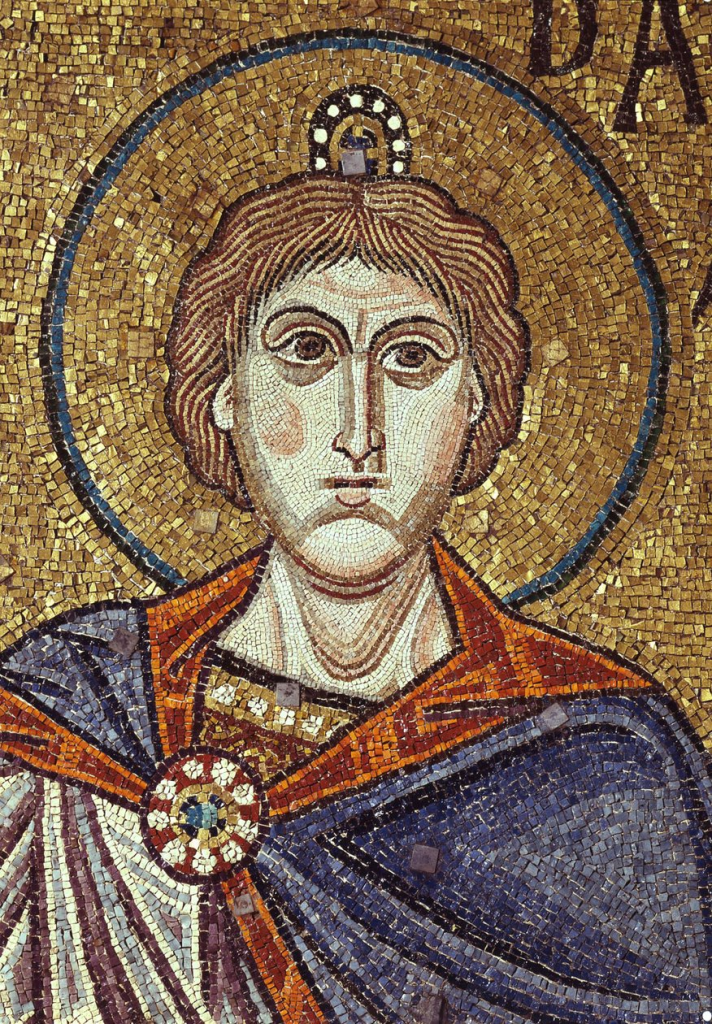
Byzantine mosaic of the prophet Daniel, 12th century, in St. Mark’s Basilica, Venice, Italy

Perhaps you, like me, have had the experience of praying, and feeling as if those prayers were only bouncing off the ceiling and never heard by God. But the Lord has been watching and listening all along. Although we may not get an immediate response, we will most certainly receive an answer to our prayers.

I am encouraged that God listened and was attentive to Daniel. The prophet had put himself in a position to hear God, so that when the Lord responded, Daniel was able to receive what was given to him.

The spiritual disciplines which Daniel was practicing almost seems like the guy was observing Lent. For three weeks, he gave up certain foods, did not eat meat, drank no wine; and he didn’t take a bath. He did all of this because he was troubled in spirit.

Daniel’s outward practices were congruent with his inward disposition. This is a far cry from our modern predilection for keeping up appearances, even though we are dying inside. But Daniel was not like us. He stopped his normal routines in order to give himself to prayer and a partial fast.

The Jews had been in exile for 70 years, and there was no sign of them going back to Jerusalem. And that troubled Daniel to no end – because the prophet Jeremiah had said the people would be in captivity for that long (Jeremiah 29:10). Daniel knew that fulfillment of the Lord’s promises would come by living in Palestine, and not by being exiled in Babylon.

While Daniel and his friends were together in a prayer meeting, Daniel experienced a vision; it was as if the veil separating this three-dimensional space from the spiritual dimension was lifted, and Daniel could see what was happening in the invisible realm.

Daniel’s prayers were being heard; they were not bouncing off the ceiling. And they were heard, I believe, because Daniel prayed according to his understanding of what God wants. He desired to participate in what God wanted, and not what he himself necessarily wanted.

And that is essentially what the Lord Jesus taught his followers in how to pray. We need not try and persuade God, as if we must be spiritual lawyers advocating for what we want. The Lord does not operate by twisting arms or harassing people; and neither ought we to try and treat God that way.

Prayer puts us in sync with what God wants. And as we desire to do God’s will, our prayers will reflect that desire. We only then need to ask. (Matthew 6:5-15; James 4:1-3)

Although God answers prayer, those responses are not always immediately put into effect. Daniel’s vision allowed him to see that there are other forces at work – dark forces – that oppose what God is doing. Sinister monkey wrenches are thrown into good plans and responses for people.

Behind the scenes of our lives, there are invisible powers which are influencing people. This is why our ultimate struggle is not on this visible realm; it is, instead, against the invisible demonic spirits of this present evil age.

Daniel saw and heard that behind the affairs of this world is a hierarchy of evil which seeks to control us for purposes contrary to God’s justice, peace, and goodness. Yet there is also an angelic host who are involved in ensuring that the Lord’s will is accomplished on this earth as it is always done in heaven.

Therefore, sometimes our delays in answered prayer have nothing to do with us; it may be because there is a great conflict happening in a dimension that you and I don’t see. In fact, if we do not have immediate answers to prayer, this is precisely the best time to persevere in prayer and not give up.

Through our perseverance in prayer, like Daniel, we are strengthened in faith. Our connection with God brings us peace and courage, emboldening us for continued wrestling in prayer and dealing with the structural and systemic evil that exists everywhere.

Faith is a belief in things we cannot see. Hope is the confidence of things which can happen. Love is a culmination of faith and hope coming together in order to make a difference in this fallen world. The Lord provides all the strength we need for the struggle. And there is perhaps no better model of how to deal with things and gain spiritual power than the prophet Daniel.

Strengthen us, O Lord, by your grace, so that we may overcome all spiritual enemies; and with pure hearts serve you; through Jesus Christ our Lord, who lives and reigns with you and the Holy Spirit, one God, for ever and ever. Amen.

Seen by God (Genesis 16:7-15)

The angel of the Lord found Hagar near a spring in the desert; it was the spring that is beside the road to Shur. And he said, “Hagar, slave of Sarai, where have you come from, and where are you going?”

“I’m running away from my mistress Sarai,” she answered.

Then the angel of the Lord told her, “Go back to your mistress and submit to her.” The angel added, “I will increase your descendants so much that they will be too numerous to count.”

The angel of the Lord also said to her:

“You are now pregnant
    and you will give birth to a son.
You shall name him Ishmael,
    for the Lord has heard of your misery.
He will be a wild donkey of a man;
    his hand will be against everyone
    and everyone’s hand against him,
and he will live in hostility
    toward all his brothers.”

She gave this name to the Lord who spoke to her: “You are the God who sees me,” for she said, “I have now seen the One who sees me.” That is why the well was called Beer Lahai Roi; it is still there, between Kadesh and Bered.

So Hagar bore Abram a son, and Abram gave the name Ishmael to the son she had borne. (New International Version)

I’m blind as a bat without my glasses. They’re the first thing I put on when waking in the morning, and the last thing I take off before retiring at night. Without them I can’t distinguish anything very well, at all. I cannot see others unless they are inches from my face.

As bad as it would be if I didn’t have my glasses, it would be even worse if you were not seen by anyone. I believe that one of the great tragedies of modern Western civilization is that we can live among so many other people, yet not be seen by so many of them. The loneliness of not being seen is a terrible situation.

Hagar certainly felt that way. Perhaps even worse, she felt that God didn’t see her. It was as if God lost his glasses somewhere. 

Because a slave, Hagar’s body was not her own. Through a bunch of decisions out her control, she became pregnant with Abraham’s son. It was messy and complicated. Dysfunction was all around. A very pregnant Hagar ran away.

Having been abused by her mistress, we can feel Hagar’s despair… but there was someone watching, someone seeing the desperation on the face of a pregnant slave: God. 

The Lord saw everything – all the craziness, all the mistreatment – and stepped-in and acted on behalf of Hagar and her unborn son.

As a result, Hagar began to call God, “The God Who Sees Me.” She never again had to wonder or doubt whether she was seen. 

You might feel today that God doesn’t see your pain, is aloof and distant from your hurt, and is blind to your deep wounds. But God sees… all of it. The Lord may not be working on the same timetable as you and me, but nevertheless, you are seen with divine eyes.

You “see,” there is someone watching who specializes in hard cases. The Lord came alongside Hagar and spoke a promise to her that she could hold onto in her time of trouble. It was a promise way beyond what she could have dreamed of, far above her station in life.

Hagar gave a name to God. “El Roi” means “the God who sees.” At a low point in Hagar’s life when it seemed she was an unseen nobody, God showed up and let her know different.

I’m sure there have been times in your life, just like there have been situations in my life, where you wonder if anybody sees you, including God. You feel that if you stepped off the earth today, nobody would even notice or care.

Conversely, to be seen brings wonder, joy, and awe into life. To know the God who sees you is to be transported into the garden of paradise, enjoying divine presence and fellowship.

You are not alone. The Lord knows your every move. God watches because God loves and adores you. The almighty Lord is not a god who is aloof and distant. The One true God looks upon you and me with the kind of affection that a new parent has standing over the crib of their infant child. It’s a look of care, protection, joy, pride, and compassion.

One of the most fundamental theological statements we could say about God is: The Lord sees each individual person, and the Lord of all creation cares for each one.

Yes, terrible tragedies and gut-wrenching evil exist in this twisted mixed-up world. And God has anger and wrath, and is not okay with all the injustice throughout the earth. Yet, God’s wrath exists because of God’s love. The Lord will do something about it, and will do it in the proper time.

God is working out good purposes and plans. God will judge the living and the dead. The Lord has not forgotten you. God sees you, created in the divine image and likeness, and will act on your behalf.

Blessed are you, Sovereign God of all, to you be praise and glory forever. In your tender compassion the dawn from on high is breaking upon us to dispel the lingering shadows of night. As we look for your coming among us, open our eyes to behold your presence. Strengthen our hands to do your will, so that the world may rejoice and give you praise. Blessed be you, God almighty. Amen.