Psalm 125 – She Rocks!

The God Who Surrounds Us by Irv Davis

The people who trust in the Lord
    are like Mount Zion:
    never shaken, lasting forever.
Mountains surround Jerusalem.
    That’s how the Lord surrounds his people
    from now until forever from now!
The wicked rod won’t remain
in the land given to the righteous
    so that they don’t use their hands to do anything wrong.
Lord, do good to people who are good,
    to people whose hearts are right.
But as for those people who turn to their own twisted ways—
    may the Lord march them off with other evildoers!

Peace be on Israel! (CEB)

Psalms 120-134 comprise a collection of short songs of ascent meant to guide Jewish pilgrims in their communal trek up to the city of Jerusalem, and ultimately to the temple mount.  The rhythm of the pious ancient Israelites centered round particular festivals, seasons, and Sabbath. 

Taking the annual pilgrimage to the Holy City was an especially anticipated time of year.  This yearly cycle bolstered their faith and gave the people some needed spiritual stability. The sameness of the routine and the ritual helped to remind the faithful of the solid theology that God cannot be moved and will always be there.

One of the most fundamental of all truths about God is divine consistency and constancy, that the Lord is forever present with God’s people. If God seems or feels distant or inattentive, it comes not from a place of uncaring. as though absent, aloof, or not listening.  It simply means the Lord self-reveals on a divine timetable, not a human one. Our responsibility in the entire affair is to engage in consistent rhythms of spirituality that place us in a position to receive grace when God decides to give it.

Therefore, we must not despair but anticipate meeting with God, just as the Israelites of old looked forward and upward to their annual worship at the top of the mountain. 

God continually surrounds people, even when we do not always perceive it to be so. 

Basic sound theology, as we possess abundantly in the psalms, is neither gender specific nor gender neutral. To have a full orbed understanding of the God of the psalms means we use both male and female pronouns in our descriptions.

To limit God as an old white guy, or only as male, truncates a strong view of true divinity.

What I am suggesting here is that we avail ourselves of the full compliment of metaphors to present a more complete picture of God. Language is our vehicle in communication about the Lord, so let us use it to its entire extent to present the Lord in all his/her grandeur, majesty, holiness, and strength.

For example, as the psalmist likens God to a mountain chain surrounding Jerusalem, if we only picture this in our imaginations as a man, we have not quite got an integral picture. Although a muscular Christianity might provide us with an understanding of God’s sheer brute power, a maternal Christianity gives us a strength of provision, care, and protection from a different angle.

When Jesus came to Jerusalem, the city surrounded by mountains, he did not use a masculine metaphor to communicate to the people; he used a maternal one:

“O Jerusalem, Jerusalem, the city that kills the prophets and stones God’s messengers! How often I have wanted to gather your children together as a hen protects her chicks beneath her wings, but you wouldn’t let me.” (Matthew 23:37, NLT)

When the Apostle Paul wanted to communicate to the Thessalonian Church his deep concern for them, he went for the maternal metaphor:

We could have thrown our weight around as Christ’s apostles (like a man). Instead, we were gentle with you like a nursing mother caring for her own children (like a woman). We were glad to share not only God’s good news with you but also our very lives because we cared for you so much. (1 Thessalonians 2:7-8, CEB)

Indeed, in my culture when we want to convey the ultimate protective behavior of another, we describe them as a “mother bear.”

The gist of theology is this: God cannot be tied down or limited to gender, race, ethnicity, class, etc. The Lord is God, and we are not. Therefore, it is perfectly appropriate, and I daresay necessary, to use both male and female pronouns and metaphors in describing God because the Lord of the universe created both male and female in his/her image. (Genesis 1:26-27)

This is neither taking liberal license of the psalms nor emasculating them; it is merely pointing out that God is Spirit, and we worship her/him in spirit and in truth. And the truth is that he is the mountains surrounding us as a manly sentinel over our lives; and she is the mountain chain encircling us with protective care for whom nobody better mess with us.

May the Lord do good to us, as the manly Rock of our salvation as well as the feminine Fortress of our souls, protecting us with the care of both a father and a mother.

Ever-present God, there is no place where I can go where you are not.  Help me to so intuit your divine presence that it bolsters my faith and resilience for daily life in Jesus Christ.  Amen.

1 Kings 18:1-18 – Faith at Work

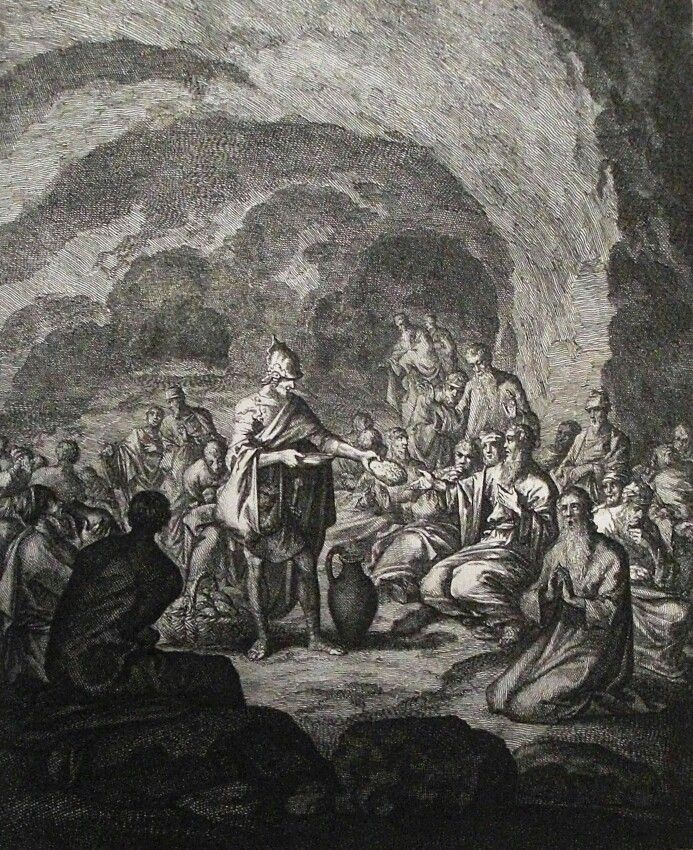
Obadiah Takes the Prophets to a Cave by Dutch engraver, Caspar Luyken (1672-1708)

For three years no rain fell in Samaria, and there was almost nothing to eat anywhere. The Lord said to Elijah, “Go and meet with King Ahab. I will soon make it rain.” So, Elijah went to see Ahab.

At that time Obadiah oversaw Ahab’s palace, but he faithfully worshiped the Lord. In fact, when Jezebel was trying to kill the Lord’s prophets, Obadiah hid one hundred of them in two caves and gave them food and water.

Ahab sent for Obadiah and said, “We have to find something for our horses and mules to eat. If we don’t, we will have to kill them. Let’s look around every creek and spring in the country for some grass. You go one way, and I’ll go the other.” Then they left in separate directions.

As Obadiah was walking along, he met Elijah. Obadiah recognized him, bowed down, and asked, “Elijah, is it really you?”

“Yes. Go tell Ahab I’m here.”

Obadiah replied:King Ahab would kill me if I told him that. And I haven’t even done anything wrong. I swear to you in the name of the living Lord your God that the king has looked everywhere for you. He sent people to look in every country, and when they couldn’t find you, he made the leader of each country swear that you were not in that country. Do you really want me to tell him you’re here?

What if the Lord’s Spirit takes you away as soon as I leave? When Ahab comes to get you, he won’t find you. Then he will surely kill me.

I have worshiped the Lord since I was a boy. I even hid one hundred of the Lord’s prophets in caves when Jezebel was trying to kill them. I also gave them food and water. Do you really want me to tell Ahab you’re here? He will kill me!

Elijah said, “I’m a servant of the living Lord All-Powerful, and I swear in his name that I will meet with Ahab today.”

Obadiah left and told Ahab where to find Elijah.

Ahab went to meet Elijah, and when he saw him, Ahab shouted, “There you are, the biggest troublemaker in Israel!”

Elijah answered:You’re the troublemaker—not me! You and your family have disobeyed the Lord’s commands by worshiping Baal.” (CEV)

Obadiah was the overseer in charge of King Ahab’s palace in Samaria of ancient Israel. To put it mildly, Ahab was a rascal. Old Testament stories frequently and purposefully contrast characters so that we will easily discern ethical differences between good and evil. Here we have a clear contrast between the godly and faithful Obadiah and the downright wicked royal couple of Ahab and Jezebel.

Whereas Obadiah was trying to preserve life and went to great lengths to do so, Ahab and Jezebel were doing everything in their sinister power to destroy life. The entire drama plays out like an episode of House of Cards. Ahab and Jezebel were a real king and queen who were thoroughly selfish and evil in all their dealings. Ahab, enabled and emboldened by his pagan wife, did away with the true worship of God and established the worship of Baal in the land of Israel. 

This did not mean, however, that God was absent or inactive. Rather, the Lord was working behind the scenes to undermine the systemic evil in the kingdom through his servant, Obadiah, who was devoted to God. Obadiah was neither a prophet nor a priest. He was simply a man working in an ungodly kingdom, doing the best he could to serve the Lord. 

Elijah may have had the prophetic voice and power, but Obadiah was the backstage administrator, daily cobbling together a living for hundreds of people without any support from the royal pain-in-the-butts.

Our ordinary everyday vocations and jobs have been ordained by God to use us where we are. Instead of lamenting our limitations or wishing the situation were different, we all have an opportunity for God to work through us in our current positions and stations in life. 

Every one of us has the daily opportunity to integrate our faith and our work through connecting biblical ethics to concrete applications at our jobs; seeing our workplaces as mission fields; interpreting our work through a Christian worldview; discerning our vocation as a calling from God; and, knowing our work is a means for God to transform and sanctify us.

So, how do you view your job?  How might you connect your faith and your work?  How does what you do reflect the nature and character of God?  In what ways do you think God wants to use you in your workplace?

Sovereign God, you cause nations and institutions to rise and fall; you set up leaders to rule and put them down.  Take my life and my work and use it in redemptive ways that glorify the name of Jesus and exemplify the power of the Holy Spirit.  Amen.

Joshua 2:1-14 – The Faith of Rahab

Then Joshua son of Nun secretly sent two spies from Shittim. “Go, look over the land,” he said, “especially Jericho.” So, they went and entered the house of a prostitute named Rahab and stayed there.

The king of Jericho was told, “Look, some of the Israelites have come here tonight to spy out the land.” So, the king of Jericho sent this message to Rahab: “Bring out the men who came to you and entered your house, because they have come to spy out the whole land.”

But the woman had taken the two men and hidden them. She said, “Yes, the men came to me, but I did not know where they had come from. At dusk, when it was time to close the city gate, they left. I don’t know which way they went. Go after them quickly. You may catch up with them.” (But she had taken them up to the roof and hidden them under the stalks of flax she had laid out on the roof.) So the men set out in pursuit of the spies on the road that leads to the fords of the Jordan, and as soon as the pursuers had gone out, the gate was shut.

Before the spies lay down for the night, she went up on the roof and said to them, “I know that the Lord has given you this land and that a great fear of you has fallen on us, so that all who live in this country are melting in fear because of you. We have heard how the Lord dried up the water of the Red Sea for you when you came out of Egypt, and what you did to Sihon and Og, the two kings of the Amorites east of the Jordan, whom you completely destroyed. When we heard of it, our hearts melted in fear and everyone’s courage failed because of you, for the Lord your God is God in heaven above and on the earth below.

“Now then, please swear to me by the Lord that you will show kindness to my family, because I have shown kindness to you. Give me a sure sign that you will spare the lives of my father and mother, my brothers and sisters, and all who belong to them—and that you will save us from death.”

“Our lives for your lives!” the men assured her. “If you don’t tell what we are doing, we will treat you kindly and faithfully when the Lord gives us the land.” (NIV)

I personally know of many persons who struggle with the notion that persons of ill repute can exhibit any kind of faith. *Sigh* Methinks such persons ought to reread their Bibles with more acumen, for “sinners” of all kinds fill the pages of Holy Scripture.

In our Old Testament lesson for today, Rahab the prostitute not only displays faith; she displays the kind of belief that lands her in the great hall of faith in the New Testament:

Rahab, the prostitute, welcomed the Israelite spies like friends. And because of her faith, she was not killed with the ones who refused to obey. (Hebrews 11:31, ERV)

Rahab evidenced a confident and unwavering belief that God existed and would surely overtake her city of Jericho with a profession of faith which rivals any life-long pious believer:

“I know that the Lord has given you the land, and that dread of you has fallen on us, and that all the inhabitants of the land melt in fear before you.” (Joshua 1:9, NRSV)

Rahab’s bold assertion of faith is both sincere and linked to God’s promise that the Israelites would take the land. Rahab is Exhibit A of the kind of person that inherits the kingdom of God. Rahab’s faith, not her works or reputation, is what spared her life and spared her from judgment.

Please ponder and consider that truth for a bit. Sit with it if you must. Rahab was not judged by God or the spies. In far too many quarters of the Christian world, judgment instead of mercy is levied to persons like Rahab. If there is anyone who should have a non-judgmental presence toward “sinners” it is Christians. And, if there is any institution which ought to consistently, both personally and through policy, display unflagging grace and forsake judgment, it is the Church.

Yet, unfortunately, as many have experienced, the Church has often fallen short of the glory of God’s grace in Christ by condemning people of ill repute. *Sigh* Perhaps we all need to rethink what faith truly is: not a checklist of doctrinal beliefs to sign-off on but a confident and bold action based solidly in the promises of God.

Knowing what those promises are, and living our lives appropriately in consideration of them, is the kind of faith that pleases God. Those who attempt to be judge, jury, and executioner need not apply as followers of God.

Genuine righteousness is never earned; it is given by the compassionate grace of God. So, let us lay hold of God’s promise of grace and mercy with gusto! Let the gracious God, who is full of steadfast love, effect the way we live our lives. Let us believe with a bold biblical belief that God always does what has been decreed and proclaimed.

Lord God Almighty, I may have not always lived my life well, yet I trust you today that you can and will deliver me from all my troubles because you are with me.  May your Holy Spirit give me the gift of faith to believe in such a way that forever impacts how I live my life.  Amen.

Psalm 121 – My Help

Mountain landscape

I lift up my eyes to the hills—
    from where will my help come?
My help comes from the Lord,
    who made heaven and earth.

He will not let your foot be moved;
he who keeps you will not slumber.
He who keeps Israel
will neither slumber nor sleep.

The Lord is your keeper;
the Lord is your shade at your right hand.
The sun shall not strike you by day,
nor the moon by night.

The Lord will keep you from all evil;
he will keep your life.
The Lord will keep
your going out and your coming in
from this time on and forevermore. (NRSV)

This is my favorite psalm.  I have read and mulled it over so many times that it is almost second nature for me to draw from its rich theological statement about God when times are difficult.  This is a psalm designed for worship – to be used by God’s people through song and prayer.  A community without Psalm 121 near to its heart is a group of people in danger. Yet, with it, there is a continual sense of security, confidence, and hope.

Psalms are meant to be spoken aloud and repeated. So, here is another version:

I look to the hills!
Where will I find help?
It will come from the Lord,
who created the heavens
and the earth.

The Lord is your protector,
and he won’t go to sleep
or let you stumble.
The protector of Israel
doesn’t doze
or ever get drowsy.

The Lord is your protector,
there at your right side
to shade you from the sun.
You won’t be harmed
by the sun during the day
or by the moon at night.

The Lord will protect you
and keep you safe
from all dangers.
The Lord will protect you
now and always
wherever you go. (CEV)

This beautiful majestic psalm can be used for any and every occasion.  So, I often use it within hospital visits, counseling in a wide array of situations, and for my own personal edification.  It seems to me that one cannot possibly overuse this psalm.  The psalm was originally used for ascending the hill into Jerusalem, anticipating meeting with God.  Just like a lover who looks forward to meeting his beloved and thinking about how wonderful she is, so the psalmist looks with adoring affection on the God he is about to encounter.

I Lift My Eyes to the Hills

Here is yet another version of this wonderful psalm:

I look up to the mountains—
does my help come from there?
My help comes from the Lord,
who made heaven and earth!

He will not let you stumble;
the one who watches over you will not slumber.
Indeed, he who watches over Israel
never slumbers or sleeps.

The Lord himself watches over you!
The Lord stands beside you as your protective shade.
The sun will not harm you by day,
nor the moon at night.

The Lord keeps you from all harm
and watches over your life.
The Lord keeps watch over you as you come and go,
both now and forever. (NLT)

The psalm is rich with a theology of grace, watch care, and loving attention.  This is a God who is powerful and merciful, a God able to help and desiring to do so.  In a world which seems so often distant and unaffected by the divine, this is a psalm to utter repeatedly in every situation of life so that the truth of the Lord is grafted deep into the soul.  In each unwanted circumstance the psalm can be spontaneously used as an immediate prayer, and with every anticipated event it can provide the words to address the most pressing of needs.  Let the words resonate within you as people created in the image of God, connecting with him on both the cerebral and visceral levels of your life in this last version:

I will lift up my eyes to the hills—
From whence comes my help?
My help comes from the Lord,
Who made heaven and earth.

He will not allow your foot to be moved;
He who keeps you will not slumber.
Behold, He who keeps Israel
Shall neither slumber nor sleep.

The Lord is your keeper;
The Lord is your shade at your right hand.
The sun shall not strike you by day,
Nor the moon by night.

The Lord shall preserve you from all evil;
He shall preserve your soul.
The Lord shall preserve your going out and your coming in
From this time forth, and even forevermore. (NKJV)

 Amen.