Messages of Hope (Zechariah 8:1-17)

A 14th century tapestry of the Apostle John’s vision of the New Jerusalem

The word of the Lord Almighty came to me.

This is what the Lord Almighty says: “I am very jealous for Zion; I am burning with jealousy for her.”

This is what the Lord says: “I will return to Zion and dwell in Jerusalem. Then Jerusalem will be called the Faithful City, and the mountain of the Lord Almighty will be called the Holy Mountain.”

This is what the Lord Almighty says: “Once again men and women of ripe old age will sit in the streets of Jerusalem, each of them with cane in hand because of their age. The city streets will be filled with boys and girls playing there.”

This is what the Lord Almighty says: “It may seem marvelous to the remnant of this people at that time, but will it seem marvelous to me?” declares the Lord Almighty.

This is what the Lord Almighty says: “I will save my people from the countries of the east and the west. I will bring them back to live in Jerusalem; they will be my people, and I will be faithful and righteous to them as their God.”

This is what the Lord Almighty says: “Now hear these words, ‘Let your hands be strong so that the temple may be built.’ This is also what the prophets said who were present when the foundation was laid for the house of the Lord Almighty. Before that time there were no wages for people or hire for animals. No one could go about their business safely because of their enemies since I had turned everyone against their neighbor. But now I will not deal with the remnant of this people as I did in the past,” declares the Lord Almighty.

“The seed will grow well, the vine will yield its fruit, the ground will produce its crops, and the heavens will drop their dew. I will give all these things as an inheritance to the remnant of this people. Just as you, Judah and Israel, have been a curse among the nations, so I will save you, and you will be a blessing. Do not be afraid, but let your hands be strong.”

This is what the Lord Almighty says: “Just as I had determined to bring disaster on you and showed no pity when your ancestors angered me,” says the Lord Almighty, “so now I have determined to do good again to Jerusalem and Judah. Do not be afraid. These are the things you are to do: Speak the truth to each other and render true and sound judgment in your courts; do not plot evil against each other, and do not love to swear falsely. I hate all this,” declares the Lord. (New International Version)

The name “Zechariah” means “Yahweh remembers.” The Lord indeed remembers the divine covenant which was established. And God will fulfill all promises made.

The Lord is determined to do good – not really because people so much deserve it but because it is God’s character to be good, and thus, do good, even when there is little goodness on the earth to be found.
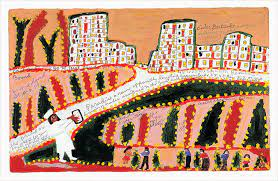
New Jerusalem by Sister Gertrude Morgan (1900-1980)

God’s judgment is but for a moment; but the Lord’s promise, salvation, and peace shall endure forever. God’s wrath is quite real and certain, yet it is a brief extension of the Lord’s steadfast love. Rebellion and judgment are never the last words; forgiveness and grace are:

Many times he [Yahweh] delivered them [the Israelites],
    but they were rebellious in their purposes
    and were brought low through their iniquity.
Nevertheless, he regarded their distress
    when he heard their cry.
For their sake he remembered his covenant
    and showed compassion according to the abundance of his steadfast love.
He caused them to be pitied
    by all who held them captive. (Psalm 106:43-46, NRSV)

All of the Old Testament prophets end their message of impending judgment with the final note of hope. That is, it won’t always be this way. There are better days ahead. The Lord’s coming is not all wrath; it’s mercy and hope. Notice the five brief messages of hope which Zechariah gives the people:

1. Yahweh burns with jealousy for Zion

Throughout the Bible, God likens the relationship to the Israelites much like a lover – as if the Lord were married to them. God’s covenant relationship with people is at the heart of understanding the whole of Scripture. Whenever they stray from divine promises, Yahweh is offended and hurt. 

God is an emotional Being, which is why we have emotions as people created in his image. Early humanity strayed so far from God that it hurt:

The Lord saw that humanity had become thoroughly evil on the earth and that every idea their minds thought up was always completely evil. The Lord regretted making human beings on the earth, and he was heartbroken. (Genesis 6:5-6, CEB)

Yet, God was gracious, sparing Noah and his family. The Lord took a group of Noah’s descendants, Abraham’s family, and set godly covenant affection on them. Through the Israelites, God hoped to lead the entire world to right relations. Yet, they, too, came to fail the gracious covenant made and set their affections on others.

Like a jilted lover, God longed for Israel to remain faithful, and, at the same time, was hurt and angry. Just as the prophet Hosea did not give up on his wife, even though she was brazenly unfaithful, so God looked at Israel as a spouse and could not bear to give her up.

2. Yahweh returns to Zion  

Jerusalem will be known as a faithful city and a holy mountain. The presence of God is what makes that happen. Because even though people can be fickle, inconsistent, complacent, and unfaithful, Yahweh remains true to the divine character of steadfast and immovable love for people.

You will never again be called ‘The People God Left.’
    Your land will never again be called ‘The Land God Destroyed.’
You will be called ‘The People God Loves.’
    Your land will be called ‘God’s Bride,’
because the Lord loves you,
    and your land will be his. (Isaiah 62:4, ERV)

3. The streets of Jerusalem will be full of children playing

The elderly will be sitting there watching the kids play, full of delight at the scene. Much too often we Westerners measure both the significance and success of our cities by its industry, businesses, buildings, wealth, and culture.

Methinks we may be misguided with such measurements. Instead, I suggest, along with the prophet, that we gage our cities by their effect on both the old and the young – because long life and children are signs of blessing from God.

4. Nothing is impossible with Yahweh

Is anything too hard for God? That, my friends, is a rhetorical question. If the Lord can cause old women to bear children (Genesis 18:10-14) and large armies to evaporate (Judges 7:1-25) then there is nothing more preposterous than to always view everything from our puny human perspective. Mary gained such a vantage and believed. We, too, have such an Advent hope within us.

“You will conceive and give birth to a son, and you are to call him Jesus. He will be great and will be called the Son of the Most High. The Lord God will give him the throne of his father David, and he will reign over Jacob’s descendants forever; his kingdom will never end.”

“How will this be,” Mary asked the angel, “since I am a virgin?”

The angel answered, “The Holy Spirit will come on you, and the power of the Most High will overshadow you. So the holy one to be born will be called the Son of God. Even Elizabeth your relative is going to have a child in her old age, and she who was said to be unable to conceive is in her sixth month. For no word from God will ever fail.”

“I am the Lord’s servant,” Mary answered. “May your word to me be fulfilled.” (Luke 1:31-38, NIV)

5. Yahweh renews and restores

Separation, diaspora, and disconnection will become a thing of the past. The Lord sets all things right again, brings people together, and heals, so that everything exists as it is meant to exist.

Deliverance from sin, death, and hell is the means of bringing renewal to the earth and its people. Salvation belongs to God. Righteousness and justice will characterize the future.

For the word of the Lord is upright,
    and all his work is done in faithfulness.
He loves righteousness and justice;
    the earth is full of the steadfast love of the Lord. (Psalm 33:4-5, NRSV)

Hope is fully realized when people put their trust in God and do their part by having strong hands and faithful hearts. We must be truthful and gracious whenever we speak. The Lord expects us to do the right thing by one another, both personally and publicly. We are to never cook up plans to take unfair advantage of others. Instead, we need to keep our lives simple and honest.

The promise of blessing is assured by God. However, the timing of that blessing is conditioned by our response. And there is no better time than the Christian season of Advent to recall what the Lord will do, as well as what God wants us to do.

May we be people of hope and let hope live in our hearts now and always, to the glory of God. Amen.

A Sacred Service Announcement (Psalm 117)

Praise the Lord, all you nations.
    Praise him, all you people of the earth.
For his unfailing love for us is powerful;
    the Lord’s faithfulness endures forever. (New Living Translation)

The Lord is God of the nations – and not only of you and me – whether they recognize it, or not.

All nations, not just the good ones, are invited to praise the Lord. Everyone is encouraged to glory in the love and faithfulness they see.

Since God is present, faithful, just, right, good, loving, and gracious – all the time – those very same dynamics are continually operating in God’s big world. Just as the storm clouds rain on both the righteous and the wicked, and just as the sun shines over every nation and people group on the earth, so the Lord’s great love is a powerful force which encompasses the entire world.

God’s faithfulness and steadfast love never ends. Let that sink in…. Ruminate on it for a bit…. 

What does it mean? How does it work itself out? Is God faithful to me? 

As a Pastor and Chaplain, I can tell you that one of the most difficult things I see people struggling with is if God can really do things in their lives like he does in other people’s lives. 

Many times, we have a strong faith for other people – that God will forgive, heal, help, and show up in their lives. Yet when it comes to me personally, it becomes an entirely different thing. My faith is like a wet noodle. We wonder if anything can really change. *Sigh*

Just as we hear public service announcements, it is good to hear the sacred service announcements which are just as important. We need our spiritual awareness raised so that we can make some behavioral changes and adjustments.

We need the reminder, and continual announcement, that God makes good on divine promises. The Lord will accomplish all the decrees and promises made, no matter how long ago they were uttered.

It certainly might seem like God is strolling through the park, burning away precious time, being agonizingly slow in moving on our behalf. 

But know this: As it is in heaven, so shall it be on earth. The sovereign Lord of all creation doesn’t only work in other places amongst other people. Jesus is presently building his church and the gates of hades shall not prevail against it. (Matthew 16:18)

There is no handwringing, nail-biting, or eye-rolling in heaven. The Lord is sovereign and limitless, and so, reaches into every geographical locale amongst every people group – and does it all with love.

I know God is a healer because I have seen him heal. I know the Lord is a deliverer because I’ve been delivered. I know God is a provider because I see the Lord’s merciful abundance every day. All this, and more, is reason to offer praise, glory, and honor to the great Sovereign who is worthy of it.

From all that dwell below the skies,
Let the Creator’s praise arise;
Let the Redeemer’s name be sung
Through every land by every tongue.

Eternal are Thy mercies Lord;
Eternal truth attends Thy Word;
Thy praise shall sound from shore to shore
Till suns shall rise and set no more.

– Isaac Watts, From All That Dwell Below the Skies

Since God can and does work everywhere, the Lord will show up in your life and your family and your church and your community, just like what has been happening throughout all eras, in all places, and in all times.

If you are waiting and watching for that to happen, perhaps the most appropriate response is to praise God for what is going to happen. Have some vision to look ahead, give thanks ahead of time, and praise the Lord for the incredible work of saving, healing, teaching, growing, and transforming that will occur in Christ through the power of the Holy Spirit. 

It isn’t just for others; it is for you, my friend. How will you trust him today?

Let every nation praise you, Lord,
each with its different tongue;
in every language learn your word,
and let your name be sung.

Let our unceasing songs now show
the mercies of our Lord;
and make succeeding ages know
how faithful is your word.

Your mercy reigns through every land;
your grace is spread abroad;
forever firm, your truth shall stand.
We’ll praise our faithful God!

– Isaac Watts (1674-1748)

God Is Both Near and Far (Psalm 145:1-5, 17-21)

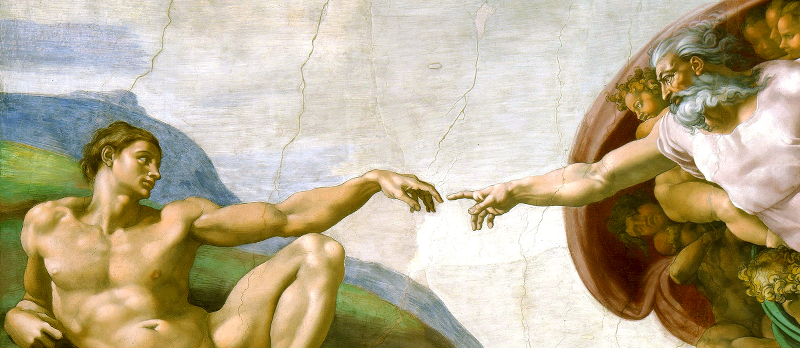
God giving life to Adam, by Michelangelo (1475-1564) on the ceiling of the Sistine Chapel, Rome

I will exalt you, my God the King;
    I will praise your name for ever and ever.
Every day I will praise you
    and extol your name for ever and ever.

Great is the Lord and most worthy of praise;
    his greatness no one can fathom.
One generation commends your works to another;
    they tell of your mighty acts.
They speak of the glorious splendor of your majesty—
    and I will meditate on your wonderful works….

The Lord is righteous in all his ways
    and faithful in all he does.
The Lord is near to all who call on him,
    to all who call on him in truth.
He fulfills the desires of those who fear him;
    he hears their cry and saves them.
The Lord watches over all who love him,
    but all the wicked he will destroy.

My mouth will speak in praise of the Lord.
    Let every creature praise his holy name
    for ever and ever. (New International Version)

The Lord is both near and far. The God of Holy Scripture is, at the same time, both:

  • approachable and aloof
  • close and distant
  • beside us and beyond us
  • available and elusive
  • revealing and remote
  • warm and cool
  • knowable and mysterious
  • readily at hand and at arm’s length
  • a good neighbor next door and a politician over in a city you’ve never been

The technical theological terms for describing God in such a way is that the Lord is both immanent and transcendent. And that is a good thing. We need the Lord to be both.

This psalm is a hymn of praise to God. The psalmist, David, celebrates the attributes and the actions of the Lord. David understood, better than most, that God is so far above humanity in divine majesty that miracles are always possible. Because God is God, the Lord’s arm is never too short to extend help and deliverance.

David knew that God’s powerful ability and God’s loving affection go hand-in-hand together; God’s mighty strength and God’s compassionate spirit work together harmoniously for our benefit.

They did not conquer the land with their swords;
    it was not their own strong arm that gave them victory.
It was your right hand and strong arm
    and the blinding light from your face that helped them,
    for you loved them. (Psalm 44:3, NLT)

God’s interventions, wonders, and miracles are never done dispassionately; the Lord’s arm is extended with deep concern and loving care for people.

The Lord acts as a close relative, like a parent, exhibiting qualities of both father and mother. God is close enough to not only hear our verbal prayers but to also hear our faint whispers. Indeed, the Lord is so close that we don’t even have to speak for the prayers of our heart to be heard.

The righteous call to the Lord, and he listens;
    he rescues them from all their troubles.
The Lord is near to those who are discouraged;
    he saves those who have lost all hope.

Good people suffer many troubles,
    but the Lord saves them from them all. (Psalm 34:17-19, GNT)

In the New Testament Gospels, Jesus gave us instruction on how to address God: “Our Father in heaven.” Not just “my” Father, but “our” Father. We are to pray with the mindful sense of our union with the Lord, as well as our connection with one another as believers.

The Lord sits in heaven as the Most High God, the transcendent Lord of me, you, and all people – watching over and protecting all whose hearts are in the right place, and effectively guarding us from a lofty divine vantage point.

My shield is God Most High, who saves the upright in heart. (Psalm 7:10, NIV)

Clap your hands, all you nations;
    shout to God with cries of joy.

For the Lord Most High is awesome,
    the great King over all the earth.
He subdued nations under us,
    peoples under our feet. (Psalm 47:1-3, NIV)

With our transcendent God always having a watchful eye over us, we need not fear anything or anyone. The Lord knows the score of how things are going in the world and in your life. And, what’s more, God knows the ropes in providing for us, protecting us, and powerfully handling any and all enemies to our souls.

Yet, at the same time, all the time, God is both our high holy King, and our close intimate Friend. Indeed, the Lord is graciously immanent as my Abba – the Father who is near and dear to our hearts.

Because you are [adopted] sons and daughters, God sent the Spirit of his Son into our hearts, crying, “Abba, Father!” Therefore, you are no longer a slave but a son or daughter, and if you are his child, then you are also an heir through God. (Galatians 4:6-7, CEB)

Christians everywhere in the world, and throughout the ages, gather together and repeat the Lord’s Prayer, every Sunday, as well as in weekly small groups, and daily individual prayers. We cry out, “Our Father in heaven” as the most used phrase over the course of our Christian lives.

And that sort of repetition is a good thing. It is important to verbalize that God is transcendent – far above all earthly powers as the sovereign Lord of the universe; and to vocalize that God is immanent – near to us as a father to a child.

Just because a phrase can become vain repetition doesn’t mean that repeating it is a bad thing. Using our words to reiterate both the far distance and the close relation of God is a worthy activity which fortifies our faith, and which passes truth to successive generations of the faithful.

The best way I know of cultivating a healthy sense of God’s transcendence and immanence (outside of reading scripture and praying) is through clouds and kids – both of which require mature adults to practice some much needed humility.

There is nothing quite like putting clocks and schedules aside, stretching out a blanket on a hill, laying back, and watching the clouds roll by. The perspective of massive highness reminds us that our problems are neither as daunting nor as important as we thought.

In contrast to the high clouds, there’s also nothing quite like forgetting your age and getting on the ground to be eye level with a kid. Fortunately, I have rambunctious and curious grandsons who continually remind me that, the lower I get, the better I understand what’s truly most important.

Neither my kids nor my grandkids care all that much about the what’s in my life – what I do – my work, my hobbies, my angst, my daily activities. But they do care a great deal about who I am and why I’m with them.

Intentionally developing a sense of God as both far and near, helps us remember who we are and why are here.

Ironically, the closer I get in touch with the reality that I’m mere dust, and will return back to the ground, the better I’m able to see the Most High God. And, conversely, the more I gaze into the sky, the greater awareness I have of the people around me. I learn to love God and neighbor, as I ought.

There’s no better time than now to get out there and take advantage of the clouds and the kids. It will likely help you to know God better; and it will probably bring a greater awareness, clarity, and connection to the truly significant which is always around us.

Father God, you formed us from the dust of the earth. Remind us of our place as your creatures at home in your creation. Forgive us when we forget our connection to the earth, and our dependence upon the goodness of your world. Lord have mercy.

Brother Jesus, you were born into this world, and made your earthly home in Nazareth. Help us to know and love the people and places where you have set us. Forgive us when we fail to care for our homes, our communities, and your creation. Christ, have mercy.

Blessed Holy Spirit, you desire to grow in us your fruit of love, joy, peace, patience, kindness, goodness, faithfulness, gentleness, and self-control. Forgive us when our roots are so shallow, and our hearts so restless, that our lives fail to bear fruit. Enable us to find our home in you, and in the places to which you call us. Lord have mercy.

Blessed Holy Trinity – Father, Son, and Spirit – the God who is both far and near: Forgive us our sins, settle us in a place of belonging, and enable us to bear fruit for your kingdom. Amen.

He Has Done Great Things For Me (Luke 1:46-55)

Madonna of the Magnificat by Sr. Mary Grace Thul

And Mary said,

“My soul magnifies the Lord,
    and my spirit rejoices in God my Savior,
for he has looked with favor on the lowly state of his servant.
    Surely from now on all generations will call me blessed,
for the Mighty One has done great things for me,
    and holy is his name;
indeed, his mercy is for those who fear him
    from generation to generation.
He has shown strength with his arm;
    he has scattered the proud in the imagination of their hearts.
He has brought down the powerful from their thrones
    and lifted up the lowly;
he has filled the hungry with good things
    and sent the rich away empty.
He has come to the aid of his child Israel,
    in remembrance of his mercy,
according to the promise he made to our ancestors,
    to Abraham and to his descendants forever.” (New Revised Standard Version)

Mary’s great song of praise, her “Magnificat” came from having grasped the reality of being pregnant with the Messiah. She affirmed that the all-powerful God “has done great things for me.” 

Indeed, the Lord shows mercy to everyone who worships and adores such mighty acts. It strikes me that Mary, instead of being full of worry and afraid of the future, and as an unmarried teen with child, is full of the Spirit and faith. 

Mary, the mother of Jesus, neither complained nor fretted for the nine months of her pregnancy; she praised God and had clear-headed faith about the grace shown to her. Mary’s canticle gives us insight into the mystery of the Christ’s incarnation: God chooses the weak, those of low esteem, and the powerless.

Mary was quite ordinary for her day. She had no wealth. There was nothing which caused anyone to pick her out of a crowd. Yet, she is the one chosen by God.

Her wonderful response to God’s grace demonstrated that there is so much more to any person than what we can see with our eyes and perceive through our earthly glasses of high positions and strength of personalities.

What’s more, Mary had the wisdom to discern that her situation typified the Lord’s egalitarian work of leveling the field so that all persons have what they need.

Her son, the Messiah, would carry this into his own life and ministry – declaring good news to the poor, comforting the brokenhearted, proclaiming freedom for captives, telling those who mourn that the time of the Lord’s favor has come.

Statue of Mary, Stella Maris Chapel, St. Joseph, Minnesota

God is full of grace, mercy, and strength to those who are powerless and in need of help. The Lord has our back. Perhaps if we all, both individually and corporately, continually used our words to identify and declare the great things God has done, then we would realize and have awareness of the Lord’s abiding blessing. 

One good way of gaining a greater awareness and appreciation of God’s gravity of grace is by journaling.

I encourage you to take some time today and write out some of the ways God has been good to you in the past days, weeks, or months.

Perhaps you might even craft your own song of praise, like Mary, and poetically and/or musically express your gratitude. Or maybe, instead of using words, a sketch or a painting may better communicate the great things God has done for you.

However you choose to do it, like Mary, offer praise for each act of mercy which comes to your memory. 

An outsider, looking in, might judge Mary to be helpless and weak, not the sort of a person who could carry a Messiah. Yet, we get a view from the inside, a glimpse into Mary’s heart. All along, she had her heart calibrated to detect the grace of God when it was present.

May we all follow her example of faith and confidence.

My Soul Magnifies The Lord ~ Chris Tomlin 

O Lord Jesus Christ, Son of God, Son of Humanity: Make me worthy to understand the profound mystery of your holy incarnation, which has happened for our sake and for our salvation.

Truly there is nothing so great and wonderful that you, my God, the Creator and Sustainer of all things, should become a creature, so that we might become children of God.

You have humbled yourself and made yourself small that we might be made mighty.

You have taken the form of a servant, so that you might confer upon us a royal and divine beauty.

You, who are beyond our understanding, have made yourself understandable to us in Jesus Christ.

You, who are the uncreated God, have made yourself a creature for us.

You, who are the untouchable One, have made yourself touchable to us.

You, who are Most High, make us capable of understanding your amazing love and the wonderful things you have done for us.

Make us able to understand the mystery of your incarnation, the mystery of your life, example, and doctrine, the mystery of your cross and passion, the mystery of your resurrection and ascension. Blessed are you, O Lord, for coming to earth as a man.

You have done great things for me!

Amen, and amen.