Ezekiel 2:8-3:11 – Use the Head-Butt

Rufus R. Jones (1933-1993)

Son of man, listen to what I say to you. Do not join them in their rebellion. Open your mouth and eat what I give you.”

Then I looked and saw a hand reaching out to me. It held a scroll, which he unrolled. And I saw that both sides were covered with funeral songs, words of sorrow, and pronouncements of doom.

The voice said to me, “Son of man, eat what I am giving you—eat this scroll! Then go and give its message to the people of Israel.” So, I opened my mouth, and he fed me the scroll. “Fill your stomach with this,” he said. And when I ate it, it tasted as sweet as honey in my mouth.

Then he said, “Son of man, go to the people of Israel and give them my messages. I am not sending you to a foreign people whose language you cannot understand. No, I am not sending you to people with strange and difficult speech. If I did, they would listen! But the people of Israel won’t listen to you any more than they listen to me! For the whole lot of them are hard-hearted and stubborn. But look, I have made you as obstinate and hard-hearted as they are. I have made your forehead as hard as the hardest rock! So don’t be afraid of them or fear their angry looks, even though they are rebels.”

Then he added, “Son of man, let all my words sink deep into your own heart first. Listen to them carefully for yourself. Then go to your people in exile and say to them, ‘This is what the Sovereign Lord says!’ Do this whether they listen to you or not.” (New Living Translation)

When I was a kid, my brother and I watched “All-Star Wrestling” on television every Saturday. One of our favorite wrestlers was Rufus R. Jones. Like all wrestlers, he had a signature move, a lights-out-nobody-is-getting-up maneuver that always ended the match. 

Rufus’ move was the head-butt. Slamming his hard forehead into the head of his opponent always brought raucous behavior from me and my brother. Then, as the boys we were, we acted out the head-butt scene over and over. The hardest head always won…. I usually lost…. That probably explains a lot.

God gave a message to the prophet Ezekiel concerning the stubborn hearts and hard heads of the Israelites. The Lord was looking for repentance, for the people to turn their hearts and minds back to true worship and an authentic humble relationship with their God. 

The prospect of facing such a task, such an opponent, seemed daunting to Ezekiel. So, the Lord assured the prophet that his forehead would be harder than that of Rufus R. Jones. So, there is no need to be afraid of the opponent. They may be hard, but they’re no match for the rock-hard head of the prophet.

In essence, God told Ezekiel to pull-out the signature wrestling move and do the lights-out head-butt maneuver. And the promise from God that backed up Ezekiel was this: There’s absolutely no way you’re going to lose the match with the kind of head I’m giving you.

Like Ezekiel, we are to speak the Word of God with the promise of not losing. Prideful ungodly stubbornness will get us knocked-out. But conversely, gracious bold stubbornness, which determines to do the will of God, shall always win the day.

The only catch is: The Word needs to sink down deeply into our own hearts through listening well – before we can effectively speak to others.

God provides us with spiritual giftedness. Yet, that doesn’t mean we never need to develop that gift or engage in any spiritual practices to make it better. We are to use that which God gives us, no matter the response from others.

There is often a fine line between sinful obstinate stubbornness and godly persevering tenacity. We are never to use our abilities to slam people, obnoxiously and persistently, upside the head with an oversized King James Version of the Bible – in the wrongheaded notion that the Word doesn’t come back without effect.

That kind of effect, however, is harmful spiritual bruising that is devoid of grace. It’s really nothing more than an individual working out their own anger and frustration on somebody else.

Rather, we are to carefully, deliberately, consistently, and daily internalize God’s Word so that what comes out of us is helpful, not harmful. Only by a constant use of solitude and silence, in truly listening well for the voice of God, can we effect the sort of positive ministry which is needed for the present moment.

Put another way, whenever we head-butt an opponent, the grace and mercy ought to be uncompromising. It’s not our job to be the judge; our task is to communicate effectively and humbly without giving in or giving up. The message may be hard, but it should always be sweet.

Almighty and ever-living God, we pray that you would give us the Spirit of wisdom and discernment so that we may know you better and love you more. Give us an understanding heart so that we may be open in hearing your voice of grace and guidance.

Use us, your people, not to be unthinking and unfeeling tools of bludgeoning others, but to be your hands and feet – your voice and heart so that we may be a channel through which you pour out your grace to help others – may we decrease to nothing so that only Christ is seen in our lives – we ask this in the power of the Spirit and in the name of Jesus. Amen.


Amos 8:1-7 – A Prophet’s Perspective on the Powerful and the Poor

This is what the Almighty Lord showed me: a basket of ripe summer fruit.

He asked, “What do you see, Amos?”

“A basket of ripe summer fruit,” I answered.

Then the Lord said to me, “My people Israel are now ripe. I will no longer overlook what they have done. On that day, the songs of the temple will become loud cries,” declares the Almighty Lord. “There will be dead bodies scattered everywhere. Hush!”

Listen to this, those who trample on the needy
and ruin those who are oppressed in the world.
You say to yourselves,
“When will the New Moon Festival be over
so that we can sell more grain?
When will the day of rest—a holy day, be over
so that we can sell more wheat?
We can shrink the size of the bushel baskets,
increase the cost,
and cheat with dishonest scales.
We can buy the poor with money
and the needy for a pair of sandals.
We can sell the husks mixed in with the wheat.”

The Lord has sworn an oath by Jacob’s pride:
“I will never forget anything that they have done.” (God’s Word Translation)

I’ve been in the church most of my life. I have listened to thousands of sermons, as well as preaching thousands of them myself. I can count on both hands how many times I’ve heard a sermon from one of the twelve minor prophets in the Bible. Although I personally have preached on them more times than that, it still pales in comparison with how many sermons I’ve preached from the New Testament gospels or epistles.

This, I believe, is an indictment on us, especially those with privilege and power. If you add the major prophets, we have sixteen books contained in Holy Scripture calling out powerful and influential people’s oppression of others. To overlook such a girth of text is to stick our fingers in our ears and refuse to listen to God.

Those with power, position, and privilege must continually be vigilant to use such influence for the benefit of all persons – not just themselves or people just like them. The books of the prophets make it quite plain that God cares about justice. God will uphold the needy. The Lord will stand with the oppressed. If we fail to share a divine sense of justice and injustice, there will be hell to pay.

“Extreme poverty anywhere is a threat to human security everywhere.”

Kofi Annan

God is longsuffering. The Lord patiently awaits us to pay attention. Yet, eventually, that patience will run its course. A prophet will be sent to voice God’s concerns. Like a basket of ripe fruit now finally ready to be eaten, so God’s justice is ripe and ready for action.

The prophet Amos delivered a scathing message to the ancient Israelites about their total disregard for the poor and needy in the land. The people in positions of authority and power only looked on the less fortunate as commodities – as pawns to be taken advantage of for the rich merchants. 

Because the wealthy never took the time to listen to the poor, God would not listen to them. Judgment was coming, and it would not go so well for the power brokers of society who only thought of their business and squeezing others for more money.

The bald fact of the matter is that few people rush to have poor folk as their friends. Those in poverty are often overlooked and disregarded. Either they are ignored altogether or are given hand-outs and services without ever having any significant human contact. Even when there is help, it comes from a distance.

In other words, those in authority rarely take the time to listen and get to know the real face of poverty. If there isn’t a photo opportunity, then encounters with the poor are not likely to happen with politicians, or anyone else. After all, so many are busy making money, checking stock portfolios, and considering how to get bigger market shares…. 

Oh, my, perhaps we have an answer as to why there is no revival in the land. God shows such solidarity with the poor that to ignore them is to ignore him.  No matter our financial picture and outlook, every one of us can grace the poor with the gift of time and listening.  For in doing so we might just be listening to the voice of God.

Gracious God, you are found everywhere – both the halls of power, and the back alleys of slums.  As I seek you more and more, may I see the face of Jesus in everyone I encounter, whether rich or poor so that I can share the gift of life with them all.  Amen.

2 Peter 3:8-13 – It’s Time

But do not forget this one thing, dear friends: With the Lord a day is like a thousand years, and a thousand years are like a day. The Lord is not slow in keeping his promise, as some understand slowness. Instead he is patient with you, not wanting anyone to perish, but everyone to come to repentance.

But the day of the Lord will come like a thief. The heavens will disappear with a roar; the elements will be destroyed by fire, and the earth and everything done in it will be laid bare.

Since everything will be destroyed in this way, what kind of people ought you to be? You ought to live holy and godly lives as you look forward to the day of God and speed its coming. That day will bring about the destruction of the heavens by fire, and the elements will melt in the heat. But in keeping with his promise we are looking forward to a new heaven and a new earth, where righteousness dwells. NIV)

The Apostle Peter invites us to see the moving of history as God sees it. Peter addressed two questions and concerns the people had about the Lord’s coming: Will this coming be worth the wait? And what should I be doing in the meantime now while I wait?

The people in Peter’s time were impatient. They saw time from a mere human perspective and needed a bigger understanding of God’s purposes. The fact of the matter is that God’s timing is different than ours. There are two words for “time” in the New Testament: chronos and kairos

Chronos is where we get our English word “chronological.” This is time measured by the clock and is the way much of our lives are governed. The other term for time, kairos, is seasonal time. Kairos is not determined by the clock but is event oriented. 

God is not time-oriented in the sense that we are, that is, God is not ruled and controlled by the clock. God is event-oriented, which is why the Lord’s understanding of time is that a thousand years are like a day, and a day like a thousand years. In other words, God measures time differently than most Westerners do. When the Bible says Christ is coming soon, it means there are no events left in the course of history except the Day of the Lord, the return of Jesus, to judge the living and the dead.

I admit I am a clock-oriented guy. I also confess that my wife and girls are not. They are much more event oriented than me, so I suppose when it comes to time, they are the godly ones. After all, the seasons will continue to come and go but a clock will eventually die, that is, when its time is up.

I cannot begin to count how many hours of my life have been spent waiting on my wife and girls. I used to get frustrated and impatient because I thought they should be clock-oriented, like me. Yet, over the years, I have learned to accept this reality. Now I take the time of waiting and read. I have read a lot of books over the years through my waiting. I used to want to time travel because of wasted time, but that is all in the past now.

A clock-oriented guy like me needs to grasp that God has all the time in the world. God serves no clock. Clocks are merely playthings for the Lord. When God wants a hot time, he just puts a clock in the oven. I, however, tend to get antsy, impatient, and frustrated, believing that God must operate on my time schedule. However, what looks like divine tardiness to me is really something else.

God seems slow in keeping divine promises. But the truth is, the Lord takes all the time in the world because of divine mercy. While I am beating my chest trying to get everyone on my time deadlines, God beats up the clock, just to kill time.

In the face of so much that is not right with the world, we might wonder why God is not just stepping in and taking care of all the evil and unjust situations on this earth. What we view as a lack of mercy is, in fact, sheer grace on God’s part – patiently waiting for all kinds of people to confess their guilt and shame and come to Jesus. God is waiting for that lost soul to make their way to forgiveness. You cannot bear your secrets with a clock around because time will tell.

Whereas I tend to think I am waiting on God, God is waiting for me, too. What should I be doing in the meantime while I wait? We ought to be living holy and godly lives as we look forward to Christ’s coming and speed its coming. Yes, God is the One who is waiting on us. Do you know the time of the Second Coming? No, me neither; we have not met yet.

The holiness and peace of God’s people will influence the timing of the Christ’s return. When God upends our current situations, it is time to get a new set of circumstances. In other words, since God is an event-oriented God, the Lord has all the time in the world to wait on us to be the kind of people we need to be.

The fact that we are two-thousand years removed from the first Advent of Christ probably does not speak very well to the church in general. It will do no good to sit on our watches so that we can be on time. God is still waiting for a lot of folks to come to repentance, as well as the church to take up her mandate of making disciples.

God is gracious and does not bully us or strike us with lightning when we disobey. Rather, God is patient, wanting us to approach and receive mercy. The Lord is waiting for us to avail ourselves of divine help to live holy and godly lives. Holiness simply means to be separated from evil and attached to God. Godliness means to live a worshipful and spiritually disciplined life.  Our Lord’s patience means deliverance from all that disconnects us from Jesus so that we might rightly attach ourselves to Christ.

Robby Robins was an Air Force pilot during the first Iraq war. After his 300th mission, he was given permission to immediately pull his crew together and fly his plane home. They flew across the ocean to Massachusetts and then had a long drive to western Pennsylvania. They drove all night, and when his buddies dropped him off at his driveway just after sun-up, there was a big banner across the garage—”Welcome Home!”  How did his wife know? No one had called her, and the crew themselves had not expected to leave so quickly.

Robins relates, “When I walked into the house, my wife came running down the hall—she looked terrific—hair fixed, make-up on, and a crisp yellow dress. ‘How did you know?’ I asked.  ‘I didn’t,’ she answered through tears of joy. ‘Once I knew the war was over, I knew you’d be home one of these days. I knew you would try to surprise me, so I was ready every day.'”

In the history of redemption, the war has been won. There is only one event left on God’s calendar: The return of Jesus. When a clock stops ticking, it just hangs around. That is not what the Lord wants. Throwing the watch across the room will not make time fly; Jesus will come when he comes. Meanwhile, our focus is on living holy and godly lives as we wait….

Even so, come Lord Jesus.

Exodus 3:16-25 – A Great Reversal

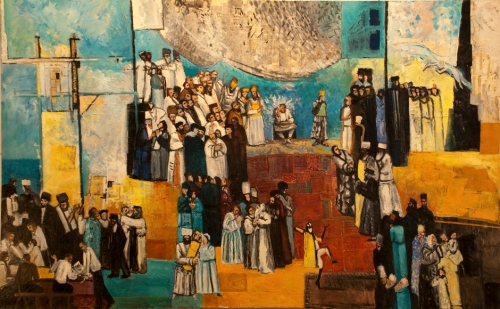
Moses and the Children of Israel by Richard McBee
“Moses and the Children of Israel” by Richard McBee

“Go, assemble the elders of Israel and say to them, ‘The Lord, the God of your fathers—the God of Abraham, Isaac and Jacob—appeared to me and said: I have watched over you and have seen what has been done to you in Egypt. And I have promised to bring you up out of your misery in Egypt into the land of the Canaanites, Hittites, Amorites, Perizzites, Hivites and Jebusites—a land flowing with milk and honey.’ 

“The elders of Israel will listen to you. Then you and the elders are to go to the king of Egypt and say to him, ‘The Lord, the God of the Hebrews, has met with us. Let us take a three-day journey into the wilderness to offer sacrifices to the Lord our God.’ But I know that the king of Egypt will not let you go unless a mighty hand compels him. So, I will stretch out my hand and strike the Egyptians with all the wonders that I will perform among them. After that, he will let you go. 

“And I will make the Egyptians favorably disposed toward this people, so that when you leave you will not go empty-handed. Every woman is to ask her neighbor and any woman living in her house for articles of silver and gold and for clothing, which you will put on your sons and daughters. And so, you will plunder the Egyptians.” (NIV) 

Moses spent forty years in the back side of the desert tending sheep. The first forty years were lived in the most powerful place on earth at the time, Egypt. Although Moses had a privileged position, he forsook his place to be in solidarity with the enslaved Israelites. With a skewed sense of timing and method, he slew a cruel Egyptian, and was forced to flee into the desert. 

The time eventually became ripe, and God was on the move. At eighty years old, God called Moses out of the desert and back to Egypt. The deliverance was going to be accomplished according to God’s designs and purposes, and not from the impetuous actions of a younger Moses. God knew exactly what he was doing and put Moses on a course which would strike at the heart of imperial Egypt and bring freedom to millions of slaves. 

Today’s story is laced thick with divine promises. After all, it is the promises of God which give people hope and a future. Referring to himself as the God of Abraham, Isaac, and Jacob, the Lord connects the generations-long covenant promise to the Israelites and reminded them they are not forgotten. God’s covenant has neither disappeared nor changed; it still exists. While the Jews were languishing in slavery, God was not aloof but watching – carefully inspecting, caring, and paying close attention. 

The inheritance of the Promised Land was coming, and it would be realized. God affirmed the covenant, knowing the plans he has for them – plans to give them abundance and joy. And God knew full well that dislodging the Israelites from Egypt would take some work, since Pharaoh relied so heavily on slave labor to support his massive imperial state. 

You, like me, have likely noticed that God tends to move rather slow by our standards. We might question and wonder about so much injustice going unabated for so long. Yet, that is our perspective of things, not God’s. Whereas we often have our own self-interest at mind, the Lord has the concern of an entire world. God is patient and long-suffering, providing full opportunity for both individual and national repentance. The Lord is on the lookout for people to amend their errant ways and return to their true purpose for living. He only judges at the proper time. 

And when that time comes, look out! Nothing can stand in the way of God’s good plans for the earth. The ancient Egyptians had built an empire on the backs of slavery, and everything went into supporting the power and wealth of the state. God was not okay with this situation. As he had done many times before, the Lord would thoroughly dismantle and destroy the powerful system of oppression. God is the expert at flip-flopping the status of people – the slaves become free, and the free are bound; the hated become favored, and those who enjoyed all the perks of power and privilege become the despised. 

Embracing God’s upside-down kingdom means advocating for justice, righteousness, and holiness for all people, not just a select few whom I like. Jesus, over 1,500 years after Moses and the exodus from Egypt, had this to say: 

“Those who are last now will someday be first, and those who are first now will someday be last.” (Matthew 20:16, NCV) 

“Blessed are you who are poor, 
    for yours is the kingdom of God. 
“Blessed are you who are hungry now, 
    for you will be filled. 
“Blessed are you who weep now, 
    for you will laugh. 

“Blessed are you when people hate you, and when they exclude you, revile you, and defame you on account of the Son of Man. Rejoice in that day and leap for joy, for surely your reward is great in heaven; for that is what their ancestors did to the prophets. 

“But woe to you who are rich, 
    for you have received your consolation. 
“Woe to you who are full now, 
    for you will be hungry. 
“Woe to you who are laughing now, 
    for you will mourn and weep. 

“Woe to you when all speak well of you, for that is what their ancestors did to the false prophets. (Luke 6:20-26, NRSV) 

And the Apostle Paul said to the Church: 

“For our present troubles are small and won’t last very long. Yet they produce for us a glory that vastly outweighs them and will last forever!” (2 Corinthians 4:17, NLT) 

The New Testament references are not meant to sanitize or put a positive spin on the very real suffering that so many people have endured both past and present. It is, however, meant to lift-up the reality that we have a sure and certain hope. Our trust in the promises and presence of God will eventually be realized and gives shape to how we live today in persistent prayers with patience and perseverance. 

So, may the Lord of all creation bless and protect you. May the Lord show you mercy and kindness in your affliction. And, may the Lord be good to you and give you peace. Amen.