
The Parable of the Tenants (Matthew 21:33-46)

Illustration of the parable of the vineyard workers, in the Codex Aureus of Echternach, c.1040 C.E.

“Listen to another parable: There was a landowner who planted a vineyard. He put a wall around it, dug a winepress in it and built a watchtower. Then he rented the vineyard to some farmers and moved to another place. When the harvest time approached, he sent his servants to the tenants to collect his fruit.

“The tenants seized his servants; they beat one, killed another, and stoned a third.Then he sent other servants to them, more than the first time, and the tenants treated them the same way. Last of all, he sent his son to them. ‘They will respect my son,’ he said.

“But when the tenants saw the son, they said to each other, ‘This is the heir. Come, let’s kill him and take his inheritance.’ So they took him and threw him out of the vineyard and killed him.

“Therefore, when the owner of the vineyard comes, what will he do to those tenants?”

“He will bring those wretches to a wretched end,” they replied, “and he will rent the vineyard to other tenants, who will give him his share of the crop at harvest time.”

Jesus said to them, “Have you never read in the Scriptures:

“‘The stone the builders rejected
    has become the cornerstone;
the Lord has done this,
    and it is marvelous in our eyes’?

“Therefore I tell you that the kingdom of God will be taken away from you and given to a people who will produce its fruit. Anyone who falls on this stone will be broken to pieces; anyone on whom it falls will be crushed.”

When the chief priests and the Pharisees heard Jesus’ parables, they knew he was talking about them. They looked for a way to arrest him, but they were afraid of the crowd because the people held that he was a prophet. (New International Version)

I once saw a guide dog gently pressing on his blind owner to go a certain way. But the man didn’t go that way. The dog kept pressing until the blind man kicked his dog. And then, the guy walked smack into a parked car on the street.

We can sometimes think too much of ourselves; and tend to believe that what we say and do and think are right – until we walk into a parked car, looking like a fool.  We need, of course, to listen to God. Yet, because we cannot see God, it’s too easy to treat the Lord as if he were an absentee landowner.

Today’s parable is about who will inherit the kingdom of God. The religious establishment of Christ’s day were not characterized by Christ’s Beatitudes. They thought they were okay. But they were really like a blind man kicking the guide dog, believing their way was right.

There are five truths illustrated in this parable that we need to grasp. The point of the parable is that Christ is looking for people who do God’s will and produce righteous fruit. Before we get into those truths, let’s get the cast of characters straight:

  • the landowner is God
  • the vineyard is Israel, God’s people
  • the tenants that the landowner put in charge are the religious leaders
  • the servants are the Old Testament prophets of God
  • the Son is Jesus

God is patient and longsuffering

God is like the guide dog who gently and lovingly keeps nudging, trying to get the person’s attention. In the parable, God’s people are likened to a vineyard. Jesus drew much of his teaching from the prophet Isaiah.

In Isaiah chapter 5, Israel is likened to a vineyard that God carefully takes care of, looking for fruit, but not getting any. For Jesus to tell the parable about a vineyard, gained the attention of people who knew the Scriptures.

Like Isaiah, Jesus pictured God as having a persistent, patient love for people, even when the tenants rebel and try and throw God out. The landowner, God, has:

  • planted
  • put in a wall
  • dug a winepress
  • built a watchtower
  • rented it out
  • sent the servants 

All these verbs describe a God who put a lot of time and energy into the vineyard. Even today, God still fusses over the vineyard and is looking for people to produce fruit in keeping with a genuine sense of righteousness. 

Humanity, especially the religious insiders, are sinful

In contrast to God’s love and care, is humanity’s persistent rebellion. The picture is of people who are hell-bent on rejecting the love of God. God’s patient love is met each time with a heightened hardness of heart on the part of the tenants. Jesus wanted the crowd to feel the situation of the landowner who goes beyond normal conventions in continuing to send servants; and the tenants’ violence in response.

God feels the weight of human sinfulness. Because the landowner is absent and we cannot see him, we may forget or not realize that God feels the full range of emotions. Each person who goes their own way and refuses God’s love; does not respond to God’s efforts to see fruit produced; and any system that is imposed contrary to God’s good order and care, all grieves God. Jesus later expressed his own grief and longing:

“Jerusalem, Jerusalem, you who kill the prophets and stone those sent to you, how often I have longed to gather your children together, as a hen gathers her chicks under her wings, and you were not willing.” (Matthew 23:37, NIV)

The Son was sent as the final act

Any “normal” landowner would throw the tenants out after the first sending of servants that didn’t go well. Yet God the landowner knew what he was doing. Jesus actually summarized the plot line of the Old Testament, and of our lives, as well. The history of salvation moves like this through Scripture:

  • God loves people
  • people keep rebelling against that love
  • God keeps pursuing peoiple
  • then, God does the unthinkable by becoming one of us 

Jesus, stepped into this messy, bloody and violent world, full of hatred and hardness of heart. Then, the Son was killed and thrown outside.

God’s judgment is awful

Jesus drew his listeners into the story, and invited a response to what the landowner would do after all of the overtures to the tenants. The listeners responded that “he will bring those wretches to a wretched end.” And in a sense Jesus says, “You are them.” 

Jesus invited them to remember and realize the Scripture by looking at it as the Son who was killed. He let the crowd know that rejection of the Son results in the Son becoming the most prominent person. Jesus wanted them to look at their bibles and see Christ. He was rejected by his own – which will result in a pulverizing judgment, like a stone falling on a person.

God replaces the whole crew

God is transferring the kingdom of God from the proud and hard-hearted religious insiders to the repentant, soft-hearted outsiders. The self-righteous people failed to accept Jesus because of their insistence on being right; the spiritual beggars accept Jesus and God’s love and are the true subjects of the kingdom. The supposedly spiritual people who had all the religious traditions failed to see what those traditions really point to. 

We don’t own the kingdom; God does. God calls the shots, and has every right to expect people to produce the fruit of mercy, purity, and peacemaking in keeping with a humble heart that desires genuine righteousness.
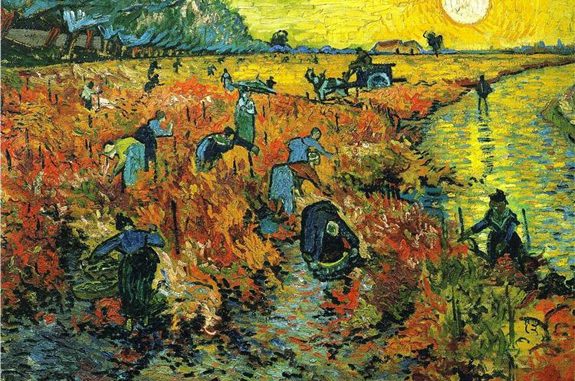
The Red Vineyard by Vincent Van Gogh, 1888

Maybe this parable seems a bit distant from us. To help us hear the story of Jesus as his original hearers heard it, I now restate the parable in a contemporary form:

Listen to another story about who is really a Christian. There was a landlord who built an upscale apartment building. The landlord spared no expense in creating apartments that were comfortable and homey. Everything he designed and built was with the care of someone who thought about what people would need and like most about a place to live. He included a host of amenities to his apartments because he really wanted the people to have as much joy living there as he did designing and building them. 

The owner put a gate around the complex so that the apartment community would be safe and secure. He hired a security firm to keep watch over the apartment complex. Then, when every detail was in place, the landlord rented out his apartments. But he didn’t just rent them out; he wanted to see the joy on the faces of the renters when he made a contract with them that included an entire year’s free rent. After that first year, when it came time for the first rent to be due, the landlord did not receive a single rent check. He was puzzled about this, so he decided to send some of his employees to collect the rent in person.

While the renters were in one of the large common lounges enjoying being together, they saw the landlord’s employees coming from a distance. So, they hatched a devious plan. Over their year of living in the beautiful apartments, they began to think they were especially special, and not like other people who lived in places that weren’t as nice as where they lived.  They gained such a twisted idea of their own importance that they believed they didn’t need to pay rent; and no one was going to tell them what to do. After all, they deserved to live where they did. They have a right to it. They don’t need to answer to anyone, including this supposed landlord who they have never seen in this last year, anyway.

Then the renters took the landlord’s employees and beat one, killed another, and took a baseball bat to a third. They took the bodies and threw them in the dumpster behind the building. Then the landlord, not wanting to evict his renters even after such a terrible experience, sent some other employees, more than the first time. But the renters had no guilt about what they had done, and did the very same thing to the second group of employees.  Even after this, the landlord was reluctant to let the law take over and decided to send his own son to collect the rent so that the renters could keep living in his apartments.

But when the renters saw the son, they said to each other. “Look! The guy sent his son. If we kill him, then we can forget about the old man and claim the whole apartment complex for ourselves.” 

After telling this story, Jesus asked all the church people listening, “When the owner of the apartment complex comes, what do you think he will do to those renters?” The crowd was into the story and replied, “He’s going to judge those ungrateful murderers, and replace the whole bunch of them with all new renters.” 

Jesus then said to them, “Have you never read in your bibles that the son who was rejected and killed has become the most important person of all? The Scriptures are all about the Son.”

“So, I am telling you that even though you have been in the Church all your life, it isn’t yours. I’m going to replace the whole lot of you with people who are humble and sensitive to sin; people who know they don’t deserve the nicest place to live in the world. If you persist in ignoring the Son, all you have to look forward to is God’s judgment.”

When all the important church people heard Jesus’ stories, they knew he was talking about them. And, even though they saw themselves in the story, they still wanted to do their own thing. They didn’t change one bit. Instead, they decided to be sneaky and try and do away with Jesus in their lives without getting in trouble. 

The kingdom of God and Christ’s Church is not an entitlement. And it does not inoculate us from God’s judgment. We must produce fruit in keeping with repentance. God is gently nudging us, like a guide dog. Will we respond in humility and turn where the Lord wants us to turn?

Impatience and Grumbling Are Poisonous (Numbers 21:4-9)

Moses and the Serpent on the Rod

The Israelites left Mount Hor and went on the road toward the Red Sea, in order to go around the country of Edom. But the people became impatient on the way and grumbled at God and Moses. They said, “Why did you bring us out of Egypt to die in this desert? There is no bread and no water, and we hate this terrible food!”

So the Lord sent them poisonous snakes; they bit the people, and many of the Israelites died. The people came to Moses and said, “We sinned when we grumbled at you and the Lord. Pray that the Lord will take away these snakes.” So Moses prayed for the people.

The Lord said to Moses, “Make a bronze snake, and put it on a pole. When anyone who is bitten looks at it, that person will live.” So Moses made a bronze snake and put it on a pole. Then when a snake bit anyone, that person looked at the bronze snake and lived. (New Century Version)

Impatience and irritability. Grumbling and complaining. Show me a person with ants-in-their-pants and I will show you a person who bellyaches and squawks like an old chicken. The antsy person sticks their hand in the glove of criticism, loudly griping about missed expectations for all to hear. Little do they realize that venomous snakes are slithering toward them, attracted by the continual vibrations of complaint.

The ancient Israelites were miraculously delivered from Egyptian bondage by the mighty hand of God. But the celebration soon turned sour. Millions of people were out in the desert, discovering they had no food or water.

There is no account of the people using their spiritual connection with God to ask for help. Instead, their reflexive response was to grumble against God and God’s appointed leader Moses.

God had enough of their constant complaints. The Lord had repeatedly shown mercy and committed love to the people over-and-over again. Yet, they kept putting on their grumpy faces any time something didn’t go their way.

God kept showing patience toward the people, but the people kept demonstrating impatience toward God.

A mosaic of the serpent in the desert in All Saints Church, London, England, by Matthew Digby Wyatt (1820-1877)

If you stop and think about the pathology of our own impatience and complaining (which we all do – come on, admit it) you’ll likely discover that at the heart of it all is a picture in your mind of how you think circumstances ought to go for you to be happy. 

The Israelites expected a nice clean break from Egypt with a smooth transition into the Promised Land. They didn’t sign up for hard circumstances and a bunch of adversity and trouble getting there.

We aren’t so different. Believers go to faith gatherings expecting to be fed and encouraged. Students expect that school will be enjoyable and that they’ll get a good paying job after graduation. Employees expect to go to work and have healthy working relationships and a good boss. Parents expect their kids to listen and obey. You expect your friend or spouse to give you focused attention, the weather to be better, the drivers on the road to be respectful, the little plastic things on the end of your shoelaces to last for the life of your shoes….

And it doesn’t happen, or at least fails to go as planned. So, what happens when all those expectations aren’t realized? 

In a perfect world, we would always respond in a reasoned, wise, and healthy manner. But if we’re feeling like we’re in an emotional place of insecurity out in the desert, our response is more likely to be an impatient and complaint-filled litany about how things are all screwed up.

A great deal of disobedience, bad behavior, angry speech, and poor decision-making has its origins in impatience.

The minute you become impatient, take a long deep breath before you make your next mental decision. Check-in with yourself. Be mindful of what your real expectations are for the circumstance or person in the present moment of becoming upset. Make the decision, from the very beginning, not to complain or argue. Instead, choose to say what you want without grumbling.

It is truly possible to stand for holiness, live for righteousness, and uphold the words and ways of Jesus without being a jerk about it through impatient sighs, annoying facial expressions, and terse words of carping at another person who is made in God’s image.

Monitor yourself throughout the day today. Notice the times you become annoyed. Stop and take a minute to analyze what you are expecting to unfold throughout the day. Instead of grumbling, ask God to strengthen your faith through your upcoming events and encounters. 

God is there to help you, and not to pick on you. If you find yourself having made a poor decision and are suffering the consequences of it, the way of dealing with it isn’t to avoid it. One of the reasons God instructed Moses to make a snake is to clearly demonstrate to the people that they must go through their problems and not try and get around them.

Fortunately, in Christianity, Jesus becomes our bronze snake of deliverance:

In the same way that Moses lifted the serpent in the desert so people could have something to see and then believe, it is necessary for the Son of Man to be lifted up—and everyone who looks up to him, trusting and expectant, will gain a real life, eternal life. (John 3:14-15, MSG)

Holy God, your patience is incredible in the face of human impatience. Yet, your boundaries are firm, and you will not put up with our petulant ways forever. Help me to live into the model of your Son, the Lord Jesus, who with you and the Holy Spirit are attentive to come alongside me to your own glory and honor. Amen.

Making Everything New

Welcome, friends! Revelation 21:1-6 brings us encouragement that the present world with its systemic evil will eventually be completely done away with. In its place, there shall be no more tears or crying, for the old order will pass away. Click the videos below and let us be reassured of God’s abiding presence with us…

Pastor Tim Ehrhardt, Revelation 21:1-6

May you know and experience the favor of God in your life.

May you be steadfast, patient, and immovable in faith.

May all things turn around and work for your good.

May your tears transform into joy and laughter.

May the Lord give your heart’s desires and grant you peace. Amen.

Revelation 21:1-6 – Making Everything New

Make All Things New by James Janknegt, 2005

Then I saw “a new heaven and a new earth,” for the first heaven and the first earth had passed away, and there was no longer any sea. I saw the Holy City, the new Jerusalem, coming down out of heaven from God, prepared as a bride beautifully dressed for her husband. And I heard a loud voice from the throne saying, “Look! God’s dwelling place is now among the people, and he will dwell with them. They will be his people, and God himself will be with them and be their God. ‘He will wipe every tear from their eyes. There will be no more death’ or mourning or crying or pain, for the old order of things has passed away.”

He who was seated on the throne said, “I am making everything new!” Then he said, “Write this down, for these words are trustworthy and true.”

He said to me: “It is done. I am the Alpha and the Omega, the Beginning and the End. To the thirsty I will give water without cost from the spring of the water of life. (New International Version)

The world as we now know it will someday pass away. For the Christian, there is a future hope – there is a time coming when it will literally be heaven on earth, a renewed earth. God will descend to dwell with us.

This will bring us full circle to the original design God had in the garden with Adam and Eve –an unhindered relationship between God and humanity in which we are no longer dogged by our sinful nature, a sinful world system, and all the sinful temptations that the devil uses to exploit for his own purposes. 

Tears, death, sorrow and pain will be a thing of the past. Eventually, our struggle with sin, guilt, and shame will be completely over.

The message of the Apostle John to the early Church was a very encouraging vision for them. The Church was facing all kinds of trouble and persecution due to their commitment to Christ. To know that contemporary problems would not last, but that Jesus would change everything, was a great comfort and help to the believers in their very real and present troubles.

One of the problems we experience in this present evil age is that we are an impatient people. We want good things to happen, now!  All of God’s people throughout history have been looking ahead for the ultimate fulfillment of God’s promises. The Apostle John was not so much giving a brand new revelation to the Church but upholding and anticipating for Christians what had also been true for Israel: 

“See, I will create
    new heavens and a new earth.
The former things will not be remembered,
    nor will they come to mind.
But be glad and rejoice forever
    in what I will create,
for I will create Jerusalem to be a delight
    and its people a joy.
I will rejoice over Jerusalem
    and take delight in my people;
the sound of weeping and of crying
    will be heard in it no more. (Isaiah 65:17-19, NIV)

When Jesus came in his first Advent, God’s people thought for sure all these promises would be fully realized. But, like a young couple in their engagement period, the promises of God had been initiated and promised, but not yet realized or consummated. Some folks might wonder if those good promises are nothing more than a politician’s word.

Above all, you must understand that in the last days scoffers will come, scoffing and following their own evil desires. They will say, “Where is this ‘coming’ he promised? Ever since our ancestors died, everything goes on as it has since the beginning of creation.” 

But they deliberately forget that long ago by God’s word the heavens came into being and the earth was formed out of water and by water. By these waters also the world of that time was deluged and destroyed. By the same word the present heavens and earth are reserved for fire, being kept for the day of judgment and destruction of the ungodly.

But do not forget this one thing, dear friends: With the Lord a day is like a thousand years, and a thousand years are like a day. The Lord is not slow in keeping his promise, as some understand slowness. Instead, he is patient with you, not wanting anyone to perish, but everyone to come to repentance.

But the day of the Lord will come like a thief. The heavens will disappear with a roar; the elements will be destroyed by fire, and the earth and everything done in it will be laid bare. (2 Peter 3:3-10, NIV)

Jesus had John write this statement down: “I am making everything new.” God is now in the process of moving history to its final stage. Can we be patient, as God is, in letting divine purposes do their work until that final day comes, or will we be impatient? 

“No step taken in faith is wasted, not by a God who makes all things new.”

Rachel Held Evans

We live in an amazing time in which we have instant communications and can travel anywhere in the world in a relatively short amount of time. The earth is a big place, but we can traverse it by plane in less than two days. It used to be that a ship going across the Atlantic Ocean took about three months from Europe to America. Now, we fly across the ocean in a matter of hours. Yet, we freak out that we have to be to the airport two hours before a flight and grump and complain about standing in a twenty minute line to board a plane.

It used to be that communication moved at the same pace as a ship. Knowing about a significant event that happened in Europe would take three months to reach America. Now we can know about what kind of bread some Frenchman ate for breakfast almost instantly after he eats it because he posted it on social media. And we complain if we have to wait a few extra seconds for something to load on our computers and phones, as if the world were about to end.

Well, actually, it is about to end.

Until that happens, we are not to twiddle our thumbs and simply wait for the end to come, spending our remaining time figuring out exactly the day and hour of Christ’s return. Instead, all things are being transformed. And it will culminate and climax in his Second Coming and the final passing away of the old order of things.

We properly anticipate Jesus coming again when we let God change our hearts and lives, our neighborhoods and workplaces, our families and churches, to be just like Jesus. God is now in the business of preparing for Christ’s return by doing away with the old order to make room for the new. 

Therefore, if anyone is in Christ, the new creation has come: The old has gone, the new is here! All this is from God, who reconciled us to himself through Christ and gave us the ministry of reconciliation: that God was reconciling the world to himself in Christ, not counting people’s sins against them. And he has committed to us the message of reconciliation. 

We are therefore Christ’s ambassadors, as though God were making his appeal through us. We implore you on Christ’s behalf: Be reconciled to God. God made him who had no sin to be sin for us, so that in him we might become the righteousness of God. (2 Corinthians 5:17-21, NIV)

The book of Revelation helps us to break our fixation with the past and holding onto the ways we have always done things. It reminds us of God’s capacity and action for renewal.  We can walk now in newness of life. 

We were therefore buried with him through baptism into death in order that, just as Christ was raised from the dead through the glory of the Father, we too may live a new life. (Romans 6:4, NIV)

The work of God will ultimately destroy the old and bring in the new. God is now in the process of renewal, changing lives so that Christ can dwell in our hearts through faith as the Alpha and Omega, the Beginning and the End, as the One who has no room for any other god.

God knows the whole story. The Lord knows your story. The sovereign ruler of the universe knows how everything is going to turn out. When everything passes away, when all is stripped from our lives, when the world as we know it is done away with, what are we left with? 

We are left with God’s purposes, not ours. Then, our own hearts can beat in sync with God’s heart for all creation. Whenever we seek to do away with the evils and troubles of this world; to eradicate global poverty; to end the world of sex-trafficking; to help others come to grips with the evil of this world through changing old satanic ways of operating; to come alongside others in their trouble; then, God is using us to make everything new.

The end is coming, but it is not yet here. Meanwhile, God is presently working to make everything new by bringing salvation of both body and soul to all kinds of people.

Blessed God, the world seems to be spinning out of control. Keep me alert and disciplined in my prayers. More than anything, help me live in constant, redeeming love for everybody. Let my hospitality be endless, generous, and without complaint. Make my tongue, my hands, and my heart a conduit for the light of Jesus Christ, the source of all goodness. Amen.