The Parable of the Tenants (Matthew 21:33-46)

Illustration of the parable of the vineyard workers, in the Codex Aureus of Echternach, c.1040 C.E.

“Listen to another parable: There was a landowner who planted a vineyard. He put a wall around it, dug a winepress in it and built a watchtower. Then he rented the vineyard to some farmers and moved to another place. When the harvest time approached, he sent his servants to the tenants to collect his fruit.

“The tenants seized his servants; they beat one, killed another, and stoned a third.Then he sent other servants to them, more than the first time, and the tenants treated them the same way. Last of all, he sent his son to them. ‘They will respect my son,’ he said.

“But when the tenants saw the son, they said to each other, ‘This is the heir. Come, let’s kill him and take his inheritance.’ So they took him and threw him out of the vineyard and killed him.

“Therefore, when the owner of the vineyard comes, what will he do to those tenants?”

“He will bring those wretches to a wretched end,” they replied, “and he will rent the vineyard to other tenants, who will give him his share of the crop at harvest time.”

Jesus said to them, “Have you never read in the Scriptures:

“‘The stone the builders rejected
    has become the cornerstone;
the Lord has done this,
    and it is marvelous in our eyes’?

“Therefore I tell you that the kingdom of God will be taken away from you and given to a people who will produce its fruit. Anyone who falls on this stone will be broken to pieces; anyone on whom it falls will be crushed.”

When the chief priests and the Pharisees heard Jesus’ parables, they knew he was talking about them. They looked for a way to arrest him, but they were afraid of the crowd because the people held that he was a prophet. (New International Version)

I once saw a guide dog gently pressing on his blind owner to go a certain way. But the man didn’t go that way. The dog kept pressing until the blind man kicked his dog. And then, the guy walked smack into a parked car on the street.

We can sometimes think too much of ourselves; and tend to believe that what we say and do and think are right – until we walk into a parked car, looking like a fool.  We need, of course, to listen to God. Yet, because we cannot see God, it’s too easy to treat the Lord as if he were an absentee landowner.

Today’s parable is about who will inherit the kingdom of God. The religious establishment of Christ’s day were not characterized by Christ’s Beatitudes. They thought they were okay. But they were really like a blind man kicking the guide dog, believing their way was right.

There are five truths illustrated in this parable that we need to grasp. The point of the parable is that Christ is looking for people who do God’s will and produce righteous fruit. Before we get into those truths, let’s get the cast of characters straight:

  • the landowner is God
  • the vineyard is Israel, God’s people
  • the tenants that the landowner put in charge are the religious leaders
  • the servants are the Old Testament prophets of God
  • the Son is Jesus

God is patient and longsuffering

God is like the guide dog who gently and lovingly keeps nudging, trying to get the person’s attention. In the parable, God’s people are likened to a vineyard. Jesus drew much of his teaching from the prophet Isaiah.

In Isaiah chapter 5, Israel is likened to a vineyard that God carefully takes care of, looking for fruit, but not getting any. For Jesus to tell the parable about a vineyard, gained the attention of people who knew the Scriptures.

Like Isaiah, Jesus pictured God as having a persistent, patient love for people, even when the tenants rebel and try and throw God out. The landowner, God, has:

  • planted
  • put in a wall
  • dug a winepress
  • built a watchtower
  • rented it out
  • sent the servants 

All these verbs describe a God who put a lot of time and energy into the vineyard. Even today, God still fusses over the vineyard and is looking for people to produce fruit in keeping with a genuine sense of righteousness. 

Humanity, especially the religious insiders, are sinful

In contrast to God’s love and care, is humanity’s persistent rebellion. The picture is of people who are hell-bent on rejecting the love of God. God’s patient love is met each time with a heightened hardness of heart on the part of the tenants. Jesus wanted the crowd to feel the situation of the landowner who goes beyond normal conventions in continuing to send servants; and the tenants’ violence in response.

God feels the weight of human sinfulness. Because the landowner is absent and we cannot see him, we may forget or not realize that God feels the full range of emotions. Each person who goes their own way and refuses God’s love; does not respond to God’s efforts to see fruit produced; and any system that is imposed contrary to God’s good order and care, all grieves God. Jesus later expressed his own grief and longing:

“Jerusalem, Jerusalem, you who kill the prophets and stone those sent to you, how often I have longed to gather your children together, as a hen gathers her chicks under her wings, and you were not willing.” (Matthew 23:37, NIV)

The Son was sent as the final act

Any “normal” landowner would throw the tenants out after the first sending of servants that didn’t go well. Yet God the landowner knew what he was doing. Jesus actually summarized the plot line of the Old Testament, and of our lives, as well. The history of salvation moves like this through Scripture:

  • God loves people
  • people keep rebelling against that love
  • God keeps pursuing peoiple
  • then, God does the unthinkable by becoming one of us 

Jesus, stepped into this messy, bloody and violent world, full of hatred and hardness of heart. Then, the Son was killed and thrown outside.

God’s judgment is awful

Jesus drew his listeners into the story, and invited a response to what the landowner would do after all of the overtures to the tenants. The listeners responded that “he will bring those wretches to a wretched end.” And in a sense Jesus says, “You are them.” 

Jesus invited them to remember and realize the Scripture by looking at it as the Son who was killed. He let the crowd know that rejection of the Son results in the Son becoming the most prominent person. Jesus wanted them to look at their bibles and see Christ. He was rejected by his own – which will result in a pulverizing judgment, like a stone falling on a person.

God replaces the whole crew

God is transferring the kingdom of God from the proud and hard-hearted religious insiders to the repentant, soft-hearted outsiders. The self-righteous people failed to accept Jesus because of their insistence on being right; the spiritual beggars accept Jesus and God’s love and are the true subjects of the kingdom. The supposedly spiritual people who had all the religious traditions failed to see what those traditions really point to. 

We don’t own the kingdom; God does. God calls the shots, and has every right to expect people to produce the fruit of mercy, purity, and peacemaking in keeping with a humble heart that desires genuine righteousness.
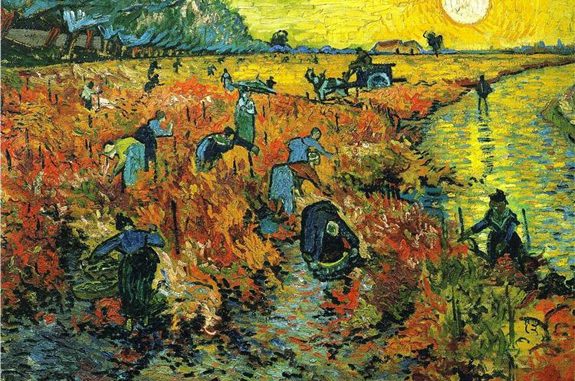
The Red Vineyard by Vincent Van Gogh, 1888

Maybe this parable seems a bit distant from us. To help us hear the story of Jesus as his original hearers heard it, I now restate the parable in a contemporary form:

Listen to another story about who is really a Christian. There was a landlord who built an upscale apartment building. The landlord spared no expense in creating apartments that were comfortable and homey. Everything he designed and built was with the care of someone who thought about what people would need and like most about a place to live. He included a host of amenities to his apartments because he really wanted the people to have as much joy living there as he did designing and building them. 

The owner put a gate around the complex so that the apartment community would be safe and secure. He hired a security firm to keep watch over the apartment complex. Then, when every detail was in place, the landlord rented out his apartments. But he didn’t just rent them out; he wanted to see the joy on the faces of the renters when he made a contract with them that included an entire year’s free rent. After that first year, when it came time for the first rent to be due, the landlord did not receive a single rent check. He was puzzled about this, so he decided to send some of his employees to collect the rent in person.

While the renters were in one of the large common lounges enjoying being together, they saw the landlord’s employees coming from a distance. So, they hatched a devious plan. Over their year of living in the beautiful apartments, they began to think they were especially special, and not like other people who lived in places that weren’t as nice as where they lived.  They gained such a twisted idea of their own importance that they believed they didn’t need to pay rent; and no one was going to tell them what to do. After all, they deserved to live where they did. They have a right to it. They don’t need to answer to anyone, including this supposed landlord who they have never seen in this last year, anyway.

Then the renters took the landlord’s employees and beat one, killed another, and took a baseball bat to a third. They took the bodies and threw them in the dumpster behind the building. Then the landlord, not wanting to evict his renters even after such a terrible experience, sent some other employees, more than the first time. But the renters had no guilt about what they had done, and did the very same thing to the second group of employees.  Even after this, the landlord was reluctant to let the law take over and decided to send his own son to collect the rent so that the renters could keep living in his apartments.

But when the renters saw the son, they said to each other. “Look! The guy sent his son. If we kill him, then we can forget about the old man and claim the whole apartment complex for ourselves.” 

After telling this story, Jesus asked all the church people listening, “When the owner of the apartment complex comes, what do you think he will do to those renters?” The crowd was into the story and replied, “He’s going to judge those ungrateful murderers, and replace the whole bunch of them with all new renters.” 

Jesus then said to them, “Have you never read in your bibles that the son who was rejected and killed has become the most important person of all? The Scriptures are all about the Son.”

“So, I am telling you that even though you have been in the Church all your life, it isn’t yours. I’m going to replace the whole lot of you with people who are humble and sensitive to sin; people who know they don’t deserve the nicest place to live in the world. If you persist in ignoring the Son, all you have to look forward to is God’s judgment.”

When all the important church people heard Jesus’ stories, they knew he was talking about them. And, even though they saw themselves in the story, they still wanted to do their own thing. They didn’t change one bit. Instead, they decided to be sneaky and try and do away with Jesus in their lives without getting in trouble. 

The kingdom of God and Christ’s Church is not an entitlement. And it does not inoculate us from God’s judgment. We must produce fruit in keeping with repentance. God is gently nudging us, like a guide dog. Will we respond in humility and turn where the Lord wants us to turn?

Isaiah 9:18-10:4 – The Reality in Front of Us

Surely wickedness burns like a fire;
    it consumes briers and thorns,
it sets the forest thickets ablaze,
    so that it rolls upward in a column of smoke.
By the wrath of the Lord Almighty
    the land will be scorched
and the people will be fuel for the fire;
    they will not spare one another.
On the right they will devour,
    but still be hungry;
on the left they will eat,
    but not be satisfied.
Each will feed on the flesh of their own offspring:
    Manasseh will feed on Ephraim, and Ephraim on Manasseh;
    together they will turn against Judah.

Yet for all this, his anger is not turned away,
    his hand is still upraised.

Woe to those who make unjust laws,
    to those who issue oppressive decrees,
to deprive the poor of their rights
    and withhold justice from the oppressed of my people,
making widows their prey
    and robbing the fatherless.
What will you do on the day of reckoning,
    when disaster comes from afar?
To whom will you run for help?
    Where will you leave your riches?
Nothing will remain but to cringe among the captives
    or fall among the slain.

Yet for all this, his anger is not turned away,
    his hand is still upraised. (New International Version)

There are times when God has some very hard things to say.

The Lord does get angry. And that’s a good thing.

The Love/Anger Reality of God

God’s anger and wrath are a form of God’s love. A heartless unloving god is fickle and unconcerned for much of the evil which happens in the world. Conversely, a loving God is not okay with wicked persons having their way. A loving God’s anger is kindled against injustice. A loving God doesn’t long put up with people oppressing other people, and taking advantage of them.

So, this is what the Old Testament prophets are all about – communicating and calling people to change their ways because they are harming others. And when the harming and the hurting is done purposefully and callously, then the ire of a holy God is raised. The Lord will not contend with this sort of attitude and action.

The language of judgment, in today’s Old Testament prophetic lesson, is an invitation for us to take a very hard look at the reality which was responsible for such an angry response from God.

The Social/Economic Reality of Both the Prophet’s World and Today’s World

God expects justice, to have people helping one another thrive and flourish in this life, to be concerned for the common good of all persons, not just some. In Isaiah’s day, all that God saw was greed and selfishness, injustice and corruption. And God was not okay with it. The unjust systems and practices were a failure of the people to live up to the Lord’s expectations for righteous living.

Sadly, issues of justice and righteousness are still relevant in our world today. Throughout the earth, this very day, the powerless are being exploited; the rich get wealthier at the cost of the poor; greed, corruption, outsourcing, and unjust legal systems are the norm and not the exception.

Much of the world gloomily faces racism, poverty, gender injustice, violence, famine, health disparities and inequities. And so called “religious” folk are at the forefront of ensuring that these evils continue to persist. So, why would not a holy God become infuriated at such a situation!?

A 12th century German depiction of Isaiah the prophet

The Religious Reality of Isaiah’s Day and Our Day

The religious reality of Isaiah’s day is not so far off from our own today. People were, and are, engaging in forms of spiritual and/or religious activity while being completely devoid of justice. Folks attend religious gatherings and believe in God – and treat others unjustly. They talk of faith in the Lord, while trusting in wealth and assets.

It was, and is, a world where people bow before their own works and ingenuity, focusing their attention on money and power. It’s a world with no room for the God of the Bible and true divine justice.

Far too many “believers” espouse unethical leaders and turn a blind eye to morally bankrupt leadership. Far too many religious folk want what they want, with no regard for the needs of others.

The Divine Reality of God’s Pathos

We as people need to contend with a God who is a profoundly emotional Being.

God is moved and affected by what happens in the world. The Lord’s anger and judgment is aroused because of God’s love and compassion.

God both binds up the injuries of people, as well as inflicts wounds. This ought not be surprising. After all, we readily understand, through our extensive healthcare systems, that medical interventions and surgeries are needed, and that they hurt.

A God of justice is, of course, angered by ethical violations. The Lord is rightly upset that the world often falls so woefully short of instituting a just social, economic, and political order for all citizens to enjoy.

Everyone must deal with the God who is not a brain-on-a-stick but has a deep heart for people everywhere to experience truth, justice, righteousness, salvation, and love.

Conclusion

Yes, there is a coming reality in which a new world will emerge. For the Christian, this occurs when Christ returns to judge the living and the dead. Complete deliverance from sin, death, and hell shall be realized.

But we aren’t there yet. We still need to cope with the world as it is today, and deal with it’s failures, shortcomings, and sins.

There is currently a massive need to be attentive to the needy, to proclaim the gospel to all nations, and to be involved in reforming unjust systems in our cities, communities, and countries. Salvation is meant for the whole person, not just the spiritual part.

Therefore, we have a choice as to how we will approach the world.

Will we withdraw from it? Will we engage it, only to take advantage of others within it? Or will we participate with God in transforming it?

  • Will we hear the cries of the oppressed?
  • Will we live out God’s commitment to the poor, the weak, and the sick?
  • Will we work for economic and social equity?
  • Will we break the bonds of injustice?
  • Will we help people to reach their full potential?
  • Will we preach good news?
  • Will we suffer with those who suffer and show solidarity with the weak?
  • Will we be truly spiritual folk who invest in the concerns of humanity?
  • Will we take up our cross and follow the Lord in being suffering servants for a lost world in need of God and God’s justice?

The reality in front of us is one which demands confrontation, participation, and reformation. Will you do it?

Blessed and holy God and Father of all, it is your will that all people be gathered together as one family in yourself. Fill the hearts of humanity with the fire of your love and with the desire to ensure justice for all. By sharing the good gifts that you give us, may we secure an equality for all our brothers and sisters throughout the world. May there be an end to division, strife and war. May there be a dawning of a just society built on love and peace. We ask this in the name of Jesus, our Lord. Amen.

Jeremiah 3:1-5 – Spiritual Adultery

“If a man divorces a woman
    and she goes and marries someone else,
he will not take her back again,
    for that would surely corrupt the land.
But you have prostituted yourself with many lovers,
    so why are you trying to come back to me?”
    says the Lord.
“Look at the shrines on every hilltop.
    Is there any place you have not been defiled
    by your adultery with other gods?
You sit like a prostitute beside the road waiting for a customer.
    You sit alone like a nomad in the desert.
You have polluted the land with your prostitution
    and your wickedness.
That’s why even the spring rains have failed.
    For you are a brazen prostitute and completely shameless.
Yet you say to me,
    ‘Father, you have been my guide since my youth.
Surely you won’t be angry forever!
    Surely you can forget about it!’
So you talk,
    but you keep on doing all the evil you can.” (New Living Translation)

We all have needs. 

As humans, each one of us has a deep hunger for love, intimacy, attention, affirmation, and encouragement. When these needs are met within gracious and loving relationships, especially in the marital bond, then there is genuine happiness and flourishing. 

But when our deep wants go unmet over a stretch of time, smiles are replaced with furrowed brows and confident strides give way to slumped shoulders.

We feel deeply and are moved at a visceral level because we are made in the image and likeness of G-d – a G-d who feels and has great emotion. 

Perhaps we too often think of G-d as some disembodied ethereal brain without any feelings. I hope today’s Old Testament lesson puts a collar on such notions. G-d entered into a loving covenant relationship with Israel. Yet, over time, the people looked for their relational, emotional, and spiritual needs to be met in other gods rather than the One true G-d. 

And it pained G-d’s heart.

G-d felt deeply about the people turning away to pursue other gods. The Lord responded to the people like a jilted lover, agonized by their acting like a prostitute – looking for their intimate needs to be satisfied elsewhere. 

It seems to me G-d was so profoundly hurt because the Lord knows that our deepest and greatest needs can only really be met through the divine covenant relationship. People need G-d.

To put it in the stark terms of Jeremiah’s prophecy: 

  • Are we playing the part of a harlot, running after all kinds of other relationships and things that we wrongheadedly believe will meet the needs of our lives? 
  • Do we sell ourselves to others in the misguided belief that we will find true happiness? 
  • Have we sought other lovers and forsaken our first love of the Divine? 

Everyone has a legitimate need for attention, love, and relational connection. The problem arises whenever we seek to meet those needs in illegitimate ways. That’s what we call “sin.”

The most important thing in life is not our job position, our social status, or even whether we are married with family. What matters most is the kind of person you are – it’s all about who you become. Because that’s what you will take into eternity. You and I are unceasing spiritual beings with an eternal destiny in G-d’s great universe.

Spiritual prostitution – and faith communities acting like spiritual brothels – are far beneath who we are and how we were designed by our Creator.

The pathos of G-d calls us to better than hanging out in a dark emotional shame lounge of sordid characters drinking cheap dandelion wine and smoking nasty cut-rate cigars in smelly old leisure suits.

We belong to G-d.

Our place is in the wide-open sunlit rooms of G-d’s kingdom. We have been adopted into G-d’s family and there is no longer any need for walking the streets and going into dive bars, looking for a quick fix of some damning elixir which promises life.

It behooves us all to become aware and connect with our longings and needs, and thereby allowing the G-d who delights to meet those needs into the core of our being.

Know who you really are. Because in that knowing, there is eternal life.

Jealous God, you are zealous for your presence to be known in the lives of all your creatures. Help me to be aware of the deepest needs of my life. May I find in you the desire of my heart and let you fill me with your infinite grace, love, mercy, and attention so that I will know true peace and joy. Amen.

Hebrews 10:26-31 – On Rejecting Divine Love

 If we deliberately keep on sinning after we have received the knowledge of the truth, no sacrifice for sins is left, but only a fearful expectation of judgment and of raging fire that will consume the enemies of God.Anyone who rejected the law of Moses died without mercy on the testimony of two or three witnesses. How much more severely do you think someone deserves to be punished who has trampled the Son of God underfoot, who has treated as an unholy thing the blood of the covenant that sanctified them, and who has insulted the Spirit of grace? For we know him who said, “It is mine to avenge; I will repay,” and again, “The Lord will judge his people.”It is a dreadful thing to fall into the hands of the living God. (New International Version)

Love isn’t all rainbows and unicorns. Sometimes it’s downright tough, unabashedly truthful, and concerned for appropriate justice.

Love is compassionate, kind, and full of good deeds. Love is also subversive. Love takes a breach in relations seriously. Love announces that the hurt which has happened is not to be accepted as normal. Love is a refusal to settle for what is.

So, whenever God’s people drift away and slide into unhealthy or damaging ways of living, God’s love is not okay with it.

There’s a reason why we feel emotional pain. That’s because God feels pain. We don’t have to go very far into that thick book, the Bible, to find the hurt:

The Lord saw that the human beings on the earth were very wicked and that everything they thought about was evil. He was sorry he had made human beings on the earth, and his heart was filled with pain. (Genesis 6:5-6, NCV)

There is perhaps no more awful pain than being brokenhearted. A thousand kidney stones are not as painful as becoming heartsick over a relationship gone awry. Love can be an affliction – a deep ache which longs for wholeness, integrity, connection, and unity.

Perhaps we have neglected how much God hurts and longs for prodigal people to return in love to a divine relationship of grace. Just because God is always content, happy, and celebrating within perfect Trinitarian Love does not mean that God isn’t also profoundly sad, full of grief, and gazing from heaven, watching and waiting for sinful humanity to come to their senses.

God’s wrath exists because of God’s love.

God doesn’t paper over humanity’s guilt and shame and pretend it isn’t there. Instead, God has gone to the ultimate length to realize a restored relationship with fallen people. God got down in the trenches with us, in the person of Jesus, and dwelt among us – willing to suffer and die for us. Grace is most certainly free; however, it is anything but cheap.

Therefore, to know this great Love, then spurn it, is much more than agonizingly painful – it isn’t right. The preacher in the New Testament book of Hebrews captures the pathos of God against all that separates people from such perfect Love.

To renege on a commitment to Jesus is tantamount to crucifying him all over again.

This is an emotional and spiritual pain which transcends any human disappointment or failed friendship. Because God’s heart is so large, so God’s agony over defiant persons who turn from Love is immense beyond what we can even imagine.

Yes, it is a dreadful thing to fall into the hands of the Living God. Those who hate ought to beware. The ones trampling God’s moral law and ethical will into the ground, like some animal dung, ought not to think they are outside the reach of Divine Love, complete with Divine Wrath purging the resentment and rancor from Earth.

The warning of the preacher is of rejecting the spirit of Love and replacing it with the ancient evil spirt of hubris, animosity, and fear. Perfect Love drives out fear, restores comity, and embraces humility.

We are responsible for our own transgressions against others; our own failures to love as we ought; and our own neglect of God. Therefore, we must forsake willful and deliberate treatment of God and others by denigrating the work of the Spirit and attributing evil intentions to them.

If we focus on loving God and neighbor, then there is no room for apostasy, for lashing out and being an evangelist of wickedness. By clarifying and focusing on what matters most; being non-retaliatory; and reminding oneself of divine Love, we can cultivate a spirit of grace and forsake the hateful spirit.

Whenever we are wounded by another, or even by God, holding onto the hurt only causes gangrene of the soul. Yet, through forsaking all forms of violent and destructive language and behavior, and embracing the wounds of Christ, we can experience healing – even if our present adverse circumstance does not change.

So, be kind to yourself and others. Allow God’s kindness to penetrate the deep portions of your heart. Live a life of grace. Why be punished for acting like a foolish person? If you must suffer, suffer for doing good, not evil.

O Lord God, I confess and acknowledge your infinite mercy and goodness to me, and my ingratitude for such grace shown. You have saved me and made me your own child, and an heir of heaven. And I end up ignoring your gracious blessings, giving into temptation, and treating faith like a paper plate to be trashed when I’m done with it. I am truly sorry for my offenses toward you and admit my failure to observe your goodness. Accept my imperfect repentance, forgive my wickedness, purify my uncleanness, strengthen my weakness, heal my unstable spirit, and let your divine Love rule in my heart, through the love of Jesus Christ. Amen.