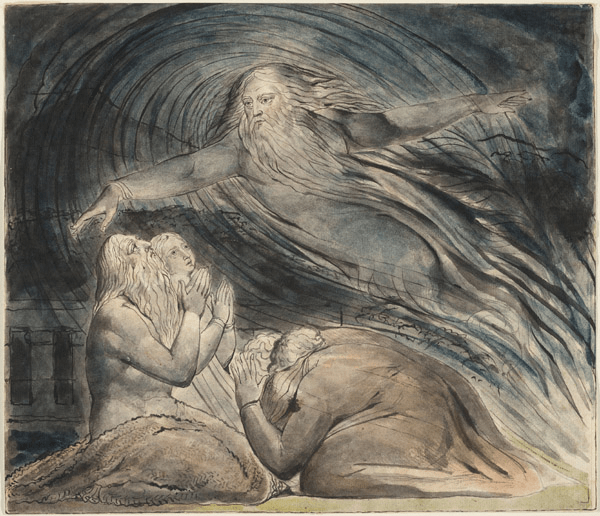
Questions Without Answers (Job 38:1-7, 38-41)

God Answers Job Out of the Whirlwind, by William Blake, 1805

Then the Lord answered Job out of the whirlwind:

“Who is this that darkens counsel by words without knowledge?
Gird up your loins like a man;
    I will question you, and you shall declare to me.

“Where were you when I laid the foundation of the earth?
    Tell me, if you have understanding.
Who determined its measurements—surely you know!
    Or who stretched the line upon it?
On what were its bases sunk,
    or who laid its cornerstone
when the morning stars sang together
    and all the heavenly beings shouted for joy?…

“Can you lift up your voice to the clouds,
    so that a flood of waters may cover you?
Can you send forth lightnings, so that they may go
    and say to you, ‘Here we are’?
Who has put wisdom in the inward parts
    or given understanding to the mind?
Who has the wisdom to number the clouds?
    Or who can tilt the waterskins of the heavens
when the dust runs into a mass
    and the clods cling together?

“Can you hunt the prey for the lion
    or satisfy the appetite of the young lions,
when they crouch in their dens
    or lie in wait in their covert?
Who provides for the raven its prey,
    when its young ones cry to God
    and wander about for lack of food? (New Revised Standard Version)

The Book of Job is rather long. After the initial two chapters which set the scene for Job’s awful suffering, we then get an extended and agonizing thirty-five chapters of speeches between Job and his companions. It’s a lot of words which generally go nowhere.

So, by the time we get to this point in chapter 38 of Job, we may likely say, “Finally, God speaks!” Indeed, this is the moment Job has anticipated.

Perhaps we are looking for something in Job’s story which may help us in our own story of suffering. Like Job, maybe we’re looking for vindication of our situation, a restoration to some semblance of life before the grief, or to have our reputation upheld.

But that is not what we get from God. For the next nearly four chapters, God only speaks in questions, and does not answer a single one of them.

If it’s answers to questions we’re searching for, it is unlikely you will get them, at least on this side of heaven. You are more likely to get even more questions than you started with. And then, imagine being questioned by God, and having no answers for God whatsoever.

Yet, that is the point. We humans know jack squat – absolutely nothing, in comparison to an omnipresent and omniscient God.

If it’s God’s voice you really want to hear, you may not know what you’re actually asking for. That was certainly true for Job and his friends. God’s questions are really rather rhetorical; there is no way any of us could really answer them with any sort of knowledge or understanding. It would be a bit like a parent asking their toddler to describe his own birth and how it happened.

God’s unanswerable questions revolve mostly around the workings of the universe. God is the Creator, and none of us were around when it all came into existence. So, of course, we have no answers.

Yet, with all of the questions, we quickly get the impression that humans have very little control over much of anything. And I think that perhaps God wants us to be aware of that reality.

It seems to me that with every question of God, we are led to believe that God is God, and is really big; and that we are not God, and are pretty dang small.

I don’t think any of this is meant to make us feel irrelevant or disposable. Rather, it gives us some needed perspective, that is, that our perspective on world issues, events, and problems is very narrow. But God sees the whole big picture and has a stellar full perspective of all things and all people.

The God in the Book of Job is no vending machine deity, in which we can pick-and-choose what we like and don’t like. There is no grand certainty that if we press the right buttons in prayer that we get what we want.

Therefore, God is not some automaton who predictably rewards the righteous, and punishes the wicked (according to our definitions of those terms). Yet this is the God that Job’s friends believed in – which is why they reflexively interpreted Job’s situation as Job himself being a sinful man.

Even Job believed in this sort of God, at least to some degree. Up to the point of his terrible trouble, he was good and righteous, and received due reward for his faithfulness. The divine system was serving Job well.

But then the system seems to have broken down. Job interpreted God as not doing the expected divine job of operating within the predictable divine structure.

Believers in every generation and era must come to grips with the reality that – although personal virtue and devotion are important – one’s piety does not necessarily lead to personal health nor wealth.

In other words, good guys don’t always win in this life, because having faith typically means we will actually suffer, rather than not.

This is, to me, good news. Why? Because it means, conversely, that persons victimized by violence, poverty, and loss are not necessarily to blame for their troubles. Frankly, there are times when bad things happen to us that are not our fault, and we don’t see any good reason for it happening.

Whenever God is silent, we might start to think that God is also absent. We may begin to entertain nihilist thoughts that nothing matters, that everything in this universe is just random chaos.

Yet, God’s response with all the questions lets us know that there is a solid structural foundation to this universe that we aren’t always aware of. In other words, there is meaning, purpose, and order to it all. We are not forgotten. God sees and remembers us.

I do believe there is a reason for everything. However, I do not believe that we are always privy to know what that purpose may be. Which means that oftentimes, like Job, we don’t have any answers to our existential questions of human tragedy and trouble. This line of thinking isn’t meant to be a cop out; it’s meant to help us accept that we are human.

Sometimes all we can do is affirm what we know to be true, and accept the limits of our own human understanding of things such as:

  • God is God. I am not.
  • God created the world. I didn’t.
  • God established order in the universe. I sometimes see order, and oftentimes see what looks like random chaos.
  • God is Love all the time. I love, but not always.
  • God is with us, even though I may not always sense or feel that divine presence.

Maybe what is most important is that we humans keep up our dialogue with God – our questions, musings, emotions, and expressions of faith and devotion. Because it is in the relationship that we discover the key to the universe.

O God, by whom the meek are guided in judgment, and light rises up in darkness: Grant us, in all our doubts and uncertainties, the grace to ask what you would have us to do, so that the Spirit of wisdom may save us from all false choices, and that in your light we may see light, and in your straight path may not stumble. Amen.

Psalm 11 – Fight, Flight, Freeze, or Faith?

I have taken refuge in the Lord.
How can you say to me:
“Flee to your mountain like a bird?
Wicked people bend their bows.
They set their arrows against the strings
to shoot in the dark at people whose motives are decent.
When the foundations of life
are undermined,
what can a righteous person do?”

The Lord is in his holy temple.
The Lord’s throne is in heaven.
His eyes see.
They examine Adam’s descendants.
The Lord tests righteous people,
but he hates wicked people and the ones who love violence.
He rains down fire and burning sulfur upon wicked people.
He makes them drink from a cup filled with scorching wind.
The Lord is righteous.
He loves a righteous way of life.
Decent people will see his face. (God’s Word Translation)

We all know what it feels like to take the brunt of someone’s poison verbal darts. And it’s scary. What do you do? In a state of fear, shock, or panic, we will likely either fight, flight, freeze, or faith.

If you have ever received a nasty email based on half-truths and accusations; stood dumbfounded as someone hurled misinformation and criticism at you; and/or experienced the victimization that comes from slanderous and gossiping tongues, then the psalmist knows exactly how you feel. 

Cobbling together a hasty email response, full of anger and vitriol, only sucks us into the person’s evil ways. Metaphorically punching someone in the face for their slap to your face is how the demonic realm handles offenses. Fighting back with an equal or greater force is diametrically opposed to the way of Jesus in loving our enemies and praying for those who persecute us.

Then, there is the response of taking flight from the nastiness. Indeed, it sometimes seems as if good people are always getting swallowed whole by unjust words and behaviors directed squarely at them. And it doesn’t help when the downers among us stroll along and give us their unhelpful fatalism about how there is nothing we can do and how nothing will ever change.

For others, they are just plain dumbfounded that another person can be so mean or controlling, so they freeze, unable to speak or do anything. They end up suffering in silence, without their victimization having a voice.

To be the target of evil speech or malevolent actions is, at the least, unsettling, and, at worst, can bring years of struggle, depression, and inability to serve. Yet, there is someone who sees it all, and that someone will address the wrong. We have an option beyond fighting back in anger or fleeing altogether in fear. We can trust God.

The Lord sits aloft, overseeing all, and knows everything humanity does and says. God always does right and wants justice done. Everyone who shares a divine sense of what is right and just will see God’s face. God will act because the Lord abhors and despises those who are cruel and enjoy violence.

It’s not a good idea to get on God’s bad side. The way to flare God’s anger is by possessing an acerbic tongue; relishing in verbal violence; and, having no remorse about any of it. Because God loves people, God hates evil. The righteous are to take solace in the truth that God really does see the harm done and is in a position to do something about it. Like the psalmist, we seek the Lord. The Lord fights our battles.

Whenever we are harassed and the ungodly give us a hard time, the psalmist isn’t offering some nice religious platitudes such as, “Just let go and let God,” “Everything works for the good of those who love God,” or “It’s okay, you’ll be in heaven someday.”

In another context, maybe those statements are helpful. But being in the teeth of the wicked, all is not okay. As much as some folks try to sanitize an evil situation with rainbows and butterflies, the evil is real, and it’s there. The truth is that everything is not okay. The earth is filled with violence, malevolence, oppression, injustice, and systemic evil. The psalmist knows this, all too well.

Humble yourselves under God’s power so that he may raise you up in the last day. Throw all your anxiety onto him because he cares about you. (1 Peter 5:6-7, CEB)

Today’s psalm is reminding and reassuring us that the Lord is aware of what’s going on and will most certainly do something about it. God will act to punish the wicked and deliver the Lord’s people. There may not be peace this present moment, yet it will not always be this way. We shall behold the face of the Lord.

The Lord is a righteous judge. Justice is the foundation of God’s throne. God sees the entire spectrum of humanity and can make a right assessment of people’s thoughts, intents, words, and actions. We, however, cannot. Therefore, it is most necessary for us to put our trust in a Divine Being who cares about right and wrong and has the power to act with justice.

Whenever we are hemmed-in through the schemes of diabolical persons and are powerless, there is always the choice to trust in the Lord. The outcome of every life on earth rests in the hands of God. And it will be a just and right rendering.

Trust in the Lord and do good. Seek peace and pursue it. We might struggle mightily on both the inside and outside – our hard circumstance might not change immediately – yet God is the One who will vindicate the just person when the time is right.

You are not alone. The Lord is with you always.

God of justice, look at the state of your servant and act on my behalf. Do not let evil prevail. Thwart the ungodly so that they can no longer do any harm. Amen.

Revelation 4:1-11 – In Another Dimension

Hallgrímskirkja in Reykjavík, Iceland

After this I looked, and there before me was a door standing open in heaven. And the voice I had first heard speaking to me like a trumpet said, “Come up here, and I will show you what must take place after this.” At once I was in the Spirit, and there before me was a throne in heaven with someone sitting on it. And the one who sat there had the appearance of jasper and ruby. A rainbow that shone like an emerald encircled the throne. Surrounding the throne were twenty-four other thrones and seated on them were twenty-four elders. They were dressed in white and had crowns of gold on their heads.From the throne came flashes of lightning, rumblings and peals of thunder. In front of the throne, seven lamps were blazing. These are the seven spirits of God. Also, in front of the throne there was what looked like a sea of glass, clear as crystal.

In the center, around the throne, were four living creatures, and they were covered with eyes, in front and in back. The first living creature was like a lion, the second was like an ox, the third had a face like a man, the fourth was like a flying eagle. Each of the four living creatures had six wings and was covered with eyes all around, even under its wings. Day and night they never stop saying:

“‘Holy, holy, holy

is the Lord God Almighty,’

who was, and is, and is to come.”

Whenever the living creatures give glory, honor and thanks to him who sits on the throne and who lives for ever and ever, the twenty-four elders fall down before him who sits on the throne and worship him who lives for ever and ever. They lay their crowns before the throne and say:

“You are worthy, our Lord and God,
    to receive glory and honor and power,
for you created all things,
    and by your will they were created
    and have their being.” (New International Version)

Whenever we open the door to God’s gracious invitation to commune with us, we gain an incredible glimpse of heavenly realities.

The Apostle John’s vision is so otherworldly that all he can do is try and describe what we saw with the limitations of language, metaphor, and simile.

Let’s acknowledge up front that, when it comes to the biblical book of Revelation, there are plenty of folk who want to understand it all. I believe this to be a fool’s errand, not because we ought not to try and make sense of things, but because far too many people try and conquer the text of Holy Scripture rather than letting Scripture capture them.

In our anxiety about the future, we would like some certitude, some semblance of knowing and understanding what will occur so that it will ease our icky feelings of not being in control. Newsflash: You and I aren’t in control of anything but ourselves. Ultimate control belongs only to God, not us. Our role is self-control.

So, before we start making complicated prophecy charts and trying to predict future events with precise certainty, let’s take a step back and see that worship is always the appropriate response to any vision of God – not conquering the Bible and colonizing other people’s minds with our supposed apocalyptic insights.

Okay, now that that’s out of the way, and the soapbox is back in the closet, let’s simply appreciate this incredible scene before us of God’s heavenly throne room in today’s New Testament lesson.

Since God is an awesome God, I imagine that John was downright slack-jawed with awe over the bedazzling vision before him. It is a vision befitting a God of great majesty and power. The scene of worship which unfolded before John’s eyes is continual – praise and adoration of God has been going on, is going on, and will keep going on forever and ever.

To a church beat down by the world, John’s vision is meant to encourage and inspire the suffering believers toward persevering in faith. Hardship is but for a season; worship, however, is for all time.

The four living creatures worshiping God reflect the nature and character of God: the lion (majesty); the ox (strength and power); the man (intelligence); and the eagle (transcendent over creation). All of them, covered with eyes, front and back, testify to the sovereignty and omniscience of God, who sees and knows all things – nothing is hidden from God’s sight.

The twenty-four elders, likely signifying the twelve patriarchs of the Old Testament and the twelve apostles of the New Testament, together represent the one new people of God without walls or barriers to unity, fellowship, harmony, and peace. They all rightly honor God by giving back their own authority, given to them from the Lord to accomplish divine purposes on the earth.

We, as the people of God today, are meant to be encouraged and uplifted by the reality that God is forever the same – powerful, loving, good, honorable, and holy – and will be so permanently for all time and beyond time.

The Lord does not exist merely in three dimensional space, as we humans do. God is truly multi-dimensional and reigns supreme over each and every one of those dimensions – however many there truly are.

I suspect the Apostle John was privileged to step into another dimension so that he could return to our three-dimensional world with the good news that God is still and forever on the throne. God’s good purposes shall be accomplished, no matter how tough things get here.

Now is temporary; then is eternal. Let us, then, embrace that which is permanent and unchanging, even Christ our Lord, who shall return to judge the living and the dead, and consummate a benevolent kingdom which will last forever.

May you be so privileged to have the dimensions unveiled, for even a few minutes, and know the eternal love and grace of God for humanity. Amen.

Genesis 39:1-23 – Lead Us Not into Temptation

Joseph and Potiphar's Wife by Hermine F Schäfer 1964
Joseph and Potiphar’s Wife by Hermine F Schäfer, 1964

Now Joseph had been taken down to Egypt. Potiphar, an Egyptian who was one of Pharaoh’s officials, the captain of the guard, bought him from the Ishmaelites who had taken him there.

The Lord was with Joseph so that he prospered, and he lived in the house of his Egyptian master. When his master saw that the Lord was with him and that the Lord gave him success in everything he did, Joseph found favor in his eyes and became his attendant. Potiphar put him in charge of his household, and he entrusted to his care everything he owned. From the time he put him in charge of his household and of all that he owned the Lord blessed the household of the Egyptian because of Joseph. The blessing of the Lord was on everything Potiphar had, both in the house and in the field. So, Potiphar left everything he had in Joseph’s care; with Joseph in charge, he did not concern himself with anything except the food he ate.

Now Joseph was well-built and handsome, and after a while his master’s wife took notice of Joseph and said, “Come to bed with me!”

But he refused. “With me in charge,” he told her, “my master does not concern himself with anything in the house; everything he owns he has entrusted to my care. No one is greater in this house than I am. My master has withheld nothing from me except you because you are his wife. How then could I do such a wicked thing and sin against God?” And though she spoke to Joseph day after day, he refused to go to bed with her or even be with her.

One day he went into the house to attend to his duties, and none of the household servants was inside. She caught him by his cloak and said, “Come to bed with me!” But he left his cloak in her hand and ran out of the house.

When she saw that he had left his cloak in her hand and had run out of the house, she called her household servants. “Look,” she said to them, “this Hebrew has been brought to us to make sport of us! He came in here to sleep with me, but I screamed. When he heard me scream for help, he left his cloak beside me and ran out of the house.”

She kept his cloak beside her until his master came home. Then she told him this story: “That Hebrew slave you brought us came to me to make sport of me. But as soon as I screamed for help, he left his cloak beside me and ran out of the house.”

When his master heard the story his wife told him, saying, “This is how your slave treated me,” he burned with anger. Joseph’s master took him and put him in prison, the place where the king’s prisoners were confined.

But while Joseph was there in the prison, the Lord was with him; he showed him kindness and granted him favor in the eyes of the prison warden. So, the warden put Joseph in charge of all those held in the prison, and he was made responsible for all that was done there. The warden paid no attention to anything under Joseph’s care, because the Lord was with Joseph and gave him success in whatever he did. (NIV)

We learn a great about both God and Joseph in today’s Old Testament lesson: God is the supreme Sovereign over everything, and his providence is the force behind all of events; and, Joseph is morally conscious of his ethical accountability to the God who is always watching.

From a sheer worldly perspective, Joseph was a failure. Yet, from God’s vantage point Joseph was a resounding success because he was mindful of God despite his circumstances. Joseph was faithful in all his mundane workaday duties, which made him able to handle the advances and temptations of Potiphar’s wife.

The seductions of this life are legion. We are tempted at every turn to compromise our conscience or our convictions to either get ahead in life or avoid some difficulty. It would be easy to rationalize our actions, believing that a brief bedroom rodeo would not hurt anyone.  However, sexual infidelity is the opium of unfaithfulness to God. Cheating is cheating, whether we are caught, or not. Whitewashing the picket fence does not hide anything from God.

Seductions come in all sorts of forms: materialism and the allure of new stuff; preoccupation with comfort and painless experiences; shortcuts to job success and upward mobility; the hoarding and whoring of time; and, much more.

For me, an effective counter practice to the seductions of the world is to reclaim and redeem time through keeping the Daily Office (or the Divine Hours) – set times throughout the day in which I stop what I am doing and take a few minutes for Scripture and prayer. This practice reminds me that my life orbits God and centers in the Lord Jesus, and not the other way around.

Seven times a day I praise You, because of Your righteous judgments. (Psalm 119:164, NKJV)

We succumb to seduction whenever our lives are mismanaged, lacking boundaries, and without effective structure. Discovering a rhythm of daily life that works for you is vital to resisting temptation and realizing spiritual development.

God blesses those who patiently endure testing and temptation. Afterward they will receive the crown of life that God has promised to those who love him. (James 1:12, NLT)

May you flourish and thrive with the ethical fruit of righteousness and experience the settled peace of a well-lived life.

Almighty God, blessed Father, Son, and Spirit do not lead us into temptation but deliver us from the evil one. For Yours is the kingdom and the power and the glory forever. Amen.