
Micah 6:1-8 – What Does the Lord Require of Us?

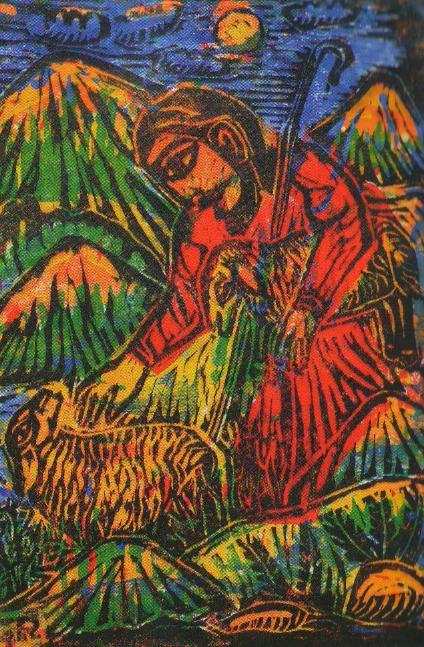
Jesus the Good Shepherd by Solomon Raj

Listen to what the Lord says:

“Stand up, plead my case before the mountains;
    let the hills hear what you have to say.

“Hear, you mountains, the Lord’s accusation;
    listen, you everlasting foundations of the earth.
For the Lord has a case against his people;
    he is lodging a charge against Israel.

“My people, what have I done to you?
    How have I burdened you? Answer me.
I brought you up out of Egypt
    and redeemed you from the land of slavery.
I sent Moses to lead you,
    also Aaron and Miriam.
My people, remember
    what Balak king of Moab plotted
    and what Balaam son of Beor answered.
Remember your journey from Shittim to Gilgal,
    that you may know the righteous acts of the Lord.”

With what shall I come before the Lord
    and bow down before the exalted God?
Shall I come before him with burnt offerings,
    with calves a year old?
Will the Lord be pleased with thousands of rams,
    with ten thousand rivers of olive oil?
Shall I offer my firstborn for my transgression,
    the fruit of my body for the sin of my soul?
He has shown you, O mortal, what is good.
    And what does the Lord require of you?
To act justly and to love mercy
    and to walk humbly with your God. (New International Version)

We are the people of God, the Church, the Body of Christ, the army of God, a holy temple. Those biblical labels are a picture of who we are and what we are to do. These metaphors all describe a people set apart for service, working in concert together toward a shared purpose.

In the prophet Micah’s day, the Israelites lost sight of the purpose and meaning of being God’s people. They needed to remember that the Lord acts in and through them for the redemption of the world. The kind of sacrifice and service which God wants is not so much a largess of tangible offerings we give. Rather, it is neatly summarized this way: Act justly. Love mercy. Walk humbly with your God.

This Old Testament passage has the feel of a courtroom scene. The defense lawyer is Micah, representing God. The people of Israel are the plaintiffs. The world is the judge. All of creation is the jury.

Israel was complaining about God. It’s an age old complaint from many people through the millennia: Blame God for anything that goes sideways in my life. The reasoning goes something like this: After all, God is powerful and in control. God should fix everything.

In their small-minded and short-sighted ways, the people seem unable to discern that easy fixes rarely help anyone. Like yanking up a big weed next to a small plant, it destroys both of them.

The defendant, Micah, speaks on behalf of God. What have I done to you? How have I burdened you? In fact, God has done just the opposite of failing to act or wronging the people in some way. The Lord actively delivered the Israelites:

  • When the people groaned and grumbled under Egyptian slavery, God delivered them with a series of miraculous deeds.
  • When the Israelites were heading to the Promised Land and vulnerable to their enemies, God protected them from the Moabites. The Lord even used a talking donkey to work on their behalf. God miraculously turned the efforts of Balak to curse the people into a blessing.
  • When the people entered the land, they did so by the powerful act of God to stop the Jordan River from flowing so the Israelites could cross over.

These saving acts of God are the motivation for living a life pleasing to God. Micah sarcastically pressed his argument, essentially asking if there’s anything that can be done to keep the people happy? What extremes need to happen to meet such excessive demands? The response by God is this: Do justice. Love mercy. Walk humbly with God.

Walk Humbly with God

Faith and action are meant to work seamlessly together. Doing justice and loving mercy are possible as we walk with God. Walking everyday with Jesus gives us the power and passion to invest in the healing of the world. God desires that we journey with Jesus and follow his words and ways. Throughout the New Testament, the Christian life is described as a road or a way we walk. In fact, the earliest believers were known as “The Way.” (Acts 9:1-19)

Jesus is the way (John 14:6). Jesus is the way to deal with our current concerns and anticipated anxieties. He himself is the way. The way is not through a program of self-improvement. The way is not through a fake-it-till-you-make-it approach. The way is not through an ability to articulate well-crafted words or through being able to answer with certainty every question of faith. The way is not through finding just the right plan or system.

Jesus is our way – he is the way of rescue, the road to a life of harmonious peace and settled rest even when the world is going to hell around us. Jesus is the way for the church everywhere – fellowship, encouragement, acts of loving service, teaching, and strengthening of faith all center around Jesus because he is love incarnate.

Jesus is the way for the world – serving neighbors and nations, advocating for those who are mistreated and facing injustice, tackling the dozens of world problems which oppress humanity – come through the continuing presence of Jesus here on this earth, that is, through the Holy Spirit and God’s people.

Love Mercy

This phrase (in the NIV) is translated various ways in other Bible versions:

  • “Embrace faithful love” (CEB)
  • “Let mercy be your first concern” (CEV)
  • “Show constant love” (GNT)
  • “Be compassionate and loyal in your love” (MSG)
  • “Love being kind to others” (NCV)
  • “Love kindness” (NRSV).

The reason for the variations is that the phrase in Hebrew carries a lot of meaning – and it’s difficult to capture that meaning in just one or two English words. It has to do with God’s steadfast loyalty to people based in a committed love and determination to do what is good and kind on their behalf – no matter whether they deserve such a grace, or not.

To love mercy comes from a large heart. The Grinch had a small heart. It caused him to be a nasty green curmudgeon who could steal gifts from a sweet little Who-girl. Only when his heart was enlarged did he mercifully return the gifts and then participate with the Whoville folks in their grand celebration.

God was merciful! We were dead because of our sins, but God loved us so much that he made us alive with Christ, and God’s wonderful kindness is what saves you. (Ephesians 2:4-5, CEV)

Love one another as if your lives depended on it.

1 Peter 1:22, MSG

Act Justly

Because many people define justice as a punitive act toward a wrongdoer, they struggle with this admonition to “do justice.” Giving people what they deserve doesn’t primarily mean someone is supposed to go to prison. Some people deserve that. Most don’t.

Instead, to act justly means to create a world in which everyone has what they need to live, thrive, and develop the gifts God has placed within them. Everyone deserves their basic human needs met – to have an equal opportunity in realizing the meeting of their needs. And that is what the heart of biblical justice is. Therefore, justice includes practical things like:

  • Providing tutors so that kids in urban schools have the same opportunities to read and as suburban kids.
  • Supporting an overwhelmed single parent who is struggling to find the time and resources to give adequate time to his or her children.
  • Taking in a foster child who needs the environment of a loving family.
  • Employing a person coming out of prison so that the terrible rates of recidivism don’t keep going.
  • Advocating for an underprivileged person who needs adequate healthcare or good housing.

Doing justice is more than giving away money or resources. It’s helping people to help themselves. It’s providing others the dignity and respect of putting them in a position so that they can take pride in their own efforts, just like we do. It’s not only giving someone a fish but taking the time and effort in teaching them how to fish.

Speak up for people who cannot speak for themselves. Help people who are in trouble. Stand up for what you know is right and judge all people fairly. Protect the rights of the poor and those who need help. (Proverbs 31:8-9, ERV)

Conclusion

What does the Lord require or desire of you?

What gifts and abilities has God given to you to act justly, love mercy, and walk humbly?

How can you and I step outside our comfort zones to other areas the Lord might be desiring for us?

The answers to those questions will determine whether we sink or swim as the people of God.

Father God, you have made all people in your image. It’s your desire and requirement that they be gathered together as one family in yourself. Fill the hearts of humanity with the fire of your love and the desire to ensure justice for all. By sharing the good things, you give us, may we secure equality for all our brothers and sisters throughout the world. May there be a truly human society built on love and peace, through Jesus Christ our Lord. Amen.

Jeremiah 31:7-14 – A Restored People

Now this is what the Lord says:
“Sing with joy for Israel.
    Shout for the greatest of nations!
Shout out with praise and joy:
‘Save your people, O Lord,
    the remnant of Israel!’
For I will bring them from the north
    and from the distant corners of the earth.
I will not forget the blind and lame,
    the expectant mothers and women in labor.
    A great company will return!
Tears of joy will stream down their faces,
    and I will lead them home with great care.
They will walk beside quiet streams
    and on smooth paths where they will not stumble.
For I am Israel’s father,
    and Ephraim is my oldest child.

“Listen to this message from the Lord,
    you nations of the world;
    proclaim it in distant coastlands:
The Lord, who scattered his people,
    will gather them and watch over them
    as a shepherd does his flock.
For the Lord has redeemed Israel
    from those too strong for them.
They will come home and sing songs of joy on the heights of Jerusalem.
    They will be radiant because of the Lord’s good gifts—
the abundant crops of grain, new wine, and olive oil,
    and the healthy flocks and herds.
Their life will be like a watered garden,
    and all their sorrows will be gone.
The young women will dance for joy,
    and the men—old and young—will join in the celebration.
I will turn their mourning into joy.
    I will comfort them and exchange their sorrow for rejoicing.
The priests will enjoy abundance,
    and my people will feast on my good gifts.
    I, the Lord, have spoken!” (New Living Translation)

Experiencing restoration is a beautiful thing. Sick and suffering bodies restored to health brings rejoicing. Estranged relationships brought together again elicits singing. Spirits broken by sin made whole again through restoring grace causes shouts of joy.

God is an expert in restoration. Dilapidated communities, broken individuals, and peoples in diaspora can find fresh hope amid challenging circumstances.

Take a look at the actions of God through the verbs in today’s Old Testament lesson:

  • “I will bring.” The Lord gathers scattered people together, as well as making the disparate parts of people into a unified whole again.
  • “I will not forget.” In the gathering action of God, no one is left behind. Attention is given to the stragglers, to those unable on their own strength or ability to journey on the road back to the Lord.
  • “I will turn.” The unfortunate are turned into the fortunate. The underprivileged become privileged. Grief, lament, and mourning give way to joy and a new lease on life.
  • “I will comfort.” A great reversal occurs with God’s intervention. Sorrow is transformed into praise. Goodness is found in abundance because the Lord is a good God.

God calls the people to action, to a response of experiencing the restorative powers of grace. The Lord encourages such behavior because it helps us never forget that no one and no circumstance is ever beyond the renewing grace of God. Notice the verbs which characterize that response:

  • “Sing.” No mumbling here, my friends. No timidity about being off tune. A lonely person, fragmented group, depressed community, polarized neighborhood, or scattered nation restored by God’s merciful grace becomes an exuberant people. Singing organically arises from them.
  • “Shout.” Even the rocks will cry out if the people don’t. A last second win in the sports stadium amongst thousands of fans doesn’t even hold a candle to celebrative shouts of believers gathered and restored.
  • “Listen.” Whenever hearing God’s voice results in restoration, then the desire and motivation to listen increases exponentially.
  • “Proclaim.” Proclaiming good news is a joy and privilege. And in anticipation of Epiphany, the gospel declared to Gentiles is a gracious message of inclusion and hope.

We are helped to picture the incredible restoration of people coming together and gathered by God with two metaphors:

  1. The Good Shepherd. Like a faithful shepherd over the flock of sheep, the Lord actively seeks the lost, brings them home, and continues to stand watch over them as a compassionate guardian.
  2. The Exodus. Just as God redeemed the people out of Egyptian slavery and took them to a good land of abundance, so the Lord shall return those persons exiled from that abundant place and restore them to the peace of settled rest.

The restoring action of God gathers the scattered. The lost are found. That which is fragmented is made whole. Those previously disabled become able. The weak become strong, the sick healed, the hungry fed, and the prisoner freed.

In times of famine, pandemic, poverty, hardship, and scant resources, there is hope. The Lord knows how to restore fortunes and bring untold abundance amid the most difficult of situations.

True joy comes through hard suffering. The pains of childbirth give way to unspeakable joy.

Today is the final day in the twelve days of the Christmas season. God, entering humanity through a woman, in the flesh, began the gracious work of ransoming, redeeming, and restoring a sinful world that had exiled itself from peace and abundance. In Christ, our lives are full of blessing.

Praise the God and Father of our Lord Jesus Christ for the spiritual blessings that Christ has brought us from heaven! (Ephesians 1:3, CEV)

“I am the gate. Those who come in by me will be saved; they will come in and go out and find pasture. The thief comes only in order to steal, kill, and destroy. I have come in order that you might have life—life in all its fullness. I am the good shepherd, who is willing to die for the sheep.” (John 10:9-11, GNT)

May you know and experience the restorative grace of God in Christ today and every day. Amen.

Micah 4:6-8 – Belonging

“In that day,” declares the Lord,

“I will gather the lame;
    I will assemble the exiles
    and those I have brought to grief.
I will make the lame my remnant,
    those driven away a strong nation.
The Lord will rule over them in Mount Zion
    from that day and forever.
As for you, watchtower of the flock,
    stronghold of Daughter Zion,
the former dominion will be restored to you;
    kingship will come to Daughter Jerusalem.” (New International Version)

One of the great tragedies of our world, as well as one of the worst feelings of humanity, is the sense that one does not belong.

Since people are hard-wired by God for community, belonging is essential, not optional. The image of the rugged individualist who gets things done on their own terms and marches to the beat of a different drum might be an appealing picture to many Westerners – but it falls woefully short of real lived human experience.

Since the fall of humanity, people have tended to group themselves into insiders and outsiders. In other words, discrimination is the enemy of true belonging. And, what’s more, there always seems to be people who are ready to create such division for their own purpose and profit. Indeed, it’s an age old tale, perhaps best told by Dr. Seuss in his classis book, Sneetches and Other Stories (1961).

In the story, Sneetches with stars on their bellies discriminate against and shun those without. A slick entrepreneur, Sylvester McMonkey McBean, offers the Sneetches without stars on their bellies the chance to get them with his Star-On machine, for three dollars, of course.

The application of stars upon thars is instantly and wildly popular. However, this abjectly upsets the original star-bellied Sneetches. They are in danger of losing their special status! So, McBean then tells them about his Star-Off machine, costing ten dollars, of course, and the Sneetches who originally had stars happily pay the money to have them removed.

Since McBean only cares about profit, he allows the recently starred Sneetches through this machine, as well. Ultimately, the entire affair escalates, with all the Sneetches running from one machine to the next…

“…until neither the Plain nor the Star-Bellies knew

whether this one was that one… or that one was this one…

or which one was what one… or what one was who.”

The Sneetches end up penniless. McBean leaves a rich man. The Sneetches learn from the experience that neither plain-belly nor star-belly Sneetches are superior. They finally become friends. Dr. Suess intended his story to be a satire of discrimination between races and cultures.

The kingdom of God is an egalitarian realm. There are no walls and barriers dividing people into opposing groups. And there isn’t such a thing as marginal, excluded, insignificant, forbidden, or discounted people.

Micah’s prophecy tells not of the privileged and powerful coming together for renewal but the lame. God’s care in maintaining a remnant and gathering them for restoration will be made up of the wounded, the ones who have no ability to bring themselves to the center.

The upside-down kingdom of God makes the last first, and the first, last. The Lord’s rule and reign champions the disabled and the misfits – those without an ability to come. They may be forgotten by others but never by God.

Like Santa coming to the island of misfit toys, rescuing and airlifting forgotten toys so that they can become treasured gifts for boys and girls – so God creates belonging where there seems none to be had. And leading the effort is a tossed aside reindeer named Rudolph, using his unique “deformity” to cut through the tough winter storm.

Perhaps you feel a bit, or maybe a lot, like the square peg trying to fit into a round hole. It could be that you wonder whether there is a place for you. You have experienced life as something of an oddity, as if the normal world around you is not aware of your very personhood.

The good news is that a prominent place is given to the humble, for those attempting to make a difference in the world that gives them no place to belong. God sees. God hears. God knows. God cares.

The Lord sends a Savior, a Deliverer, who will himself be a peculiar individual on this earth. It will seem as if he is from another place… which he is. But, then again, aren’t we all? Each of us was crafted with divine care and attention.

You are the one who created my innermost parts;
    you knit me together while I was still in my mother’s womb.
I give thanks to you that I was marvelously set apart.
    Your works are wonderful—I know that very well.
My bones weren’t hidden from you
    when I was being put together in a secret place,
    when I was being woven together in the deep parts of the earth.
Your eyes saw my embryo,
    and on your scroll every day was written that was being formed for me,
    before any one of them had yet happened. (Psalm 139:13-16, CEB)

The Lord has good plans for you and me. It might seem as if there are times God is placing a heavy hand upon us, even punishing. Yet, restoration is in the future. In this season of the year, we celebrate that Jesus is our Immanuel, God with us.

May Christ, who by his incarnation gathered into one, things earthly and heavenly, fill you with joy and peace. Amen.

Luke 1:46b-55 – Mary’s Magnificat

Mary’s Magnificat by Br. Mickey McGrath

Mary responded,

“Oh, how my soul praises the Lord.
    How my spirit rejoices in God my Savior!
For he took notice of his lowly servant girl,
    and from now on all generations will call me blessed.
For the Mighty One is holy,
    and he has done great things for me.
He shows mercy from generation to generation
    to all who fear him.
His mighty arm has done tremendous things!
    He has scattered the proud and haughty ones.
He has brought down princes from their thrones
    and exalted the humble.
He has filled the hungry with good things
    and sent the rich away with empty hands.
He has helped his servant Israel
    and remembered to be merciful.
For he made this promise to our ancestors,
    to Abraham and his children forever.” (New Living Translation)

Mary’s great song of praise grasps the reality of being pregnant with the Messiah. Mary affirmed that the all-powerful God “has done great things for me.” Indeed, the Lord shows mercy to everyone who worships and adores such mighty acts.

It strikes me that Mary, instead of being full of worry and afraid of the future, and as an unmarried teen with child, is full of the Spirit and faith. Mary neither complained nor fretted for the nine months of her pregnancy; she praised God and was clear-headed about the grace shown to her.

Mary’s canticle gives us insight into the mystery of the incarnation: God chooses the weak, those of low esteem, and the powerless.

Mary was rather ordinary. She had no wealth. She possessed nothing which would cause anyone to pick her out of a crowd. Yet, she is the one chosen by God. And her wonderful response to grace demonstrated that there is so much more to any person than what we can see with our eyes and perceive through our earthly glasses of high positions and strength of personalities.

The mother of Jesus had the wisdom to discern that her situation typified the Lord’s egalitarian work of leveling the field. Mary’s pregnancy normalized the needs of all people. Her son, the Deliverer, would carry this understanding into his own life and ministry – declaring good news to the poor, comforting the brokenhearted, proclaiming freedom for captives, telling those who mourn that the time of the Lord’s favor has come.

God is full of grace, mercy, and power to the powerless and the needy. The Lord has our backs. Perhaps if we all, both individually and corporately, continually used our words to identify and declare the great things God has done we would realize the consistent blessing of the Lord. 

As we near the night of our Lord’s birth, take some time to reflect on the ways God has been good to you in this Advent season, and like Mary, offer praise for each act of mercy. Mary exhibited no helplessness but had her heart calibrated to detect the grace of God when it was present.

Great and mighty God, I will praise you with all my heart.  You care for me and always show mercy to those who worship you.  Fulfill all your good promises in me, and in all your people, for the sake of your Son, the Lord Jesus.  Amen.