A Parable On Being Right with God (Luke 18:9-14)

The Tax Collector and the Pharisee by Peter Gallen

To some who were confident of their own righteousness and looked down on everyone else, Jesus told this parable: “Two men went up to the temple to pray, one a Pharisee and the other a tax collector. The Pharisee stood by himself and prayed: ‘God, I thank you that I am not like other people—robbers, evildoers, adulterers—or even like this tax collector. I fast twice a week and give a tenth of all I get.’

“But the tax collector stood at a distance. He would not even look up to heaven, but beat his breast and said, ‘God, have mercy on me, a sinner.’

“I tell you that this man, rather than the other, went home justified before God. For all those who exalt themselves will be humbled, and those who humble themselves will be exalted.” (New International Version)

There’s a lot to observe in Christ’s parable for today. Notice six observations of the story….

1. We Cannot Make Ourselves Right with God

I’m convinced that most Gentile Christians, standing two millennia apart from Christ’s telling of this parable, are much too hard on the Jewish Pharisees: “Well, I’m certainly glad that I am not like the Pharisee in this story!” so many tell themselves. It seems to me the Pharisees get a bad rap because of our own predilection to justify ourselves.

After all, we can only really criticize something we are already familiar with.

A temptation which every individual and community faces is the seduction toward self-justification, instead of being justified by God.

Way back in the day, when I made treadmill belts for a living, I was in charge of quality control. It was my job to make sure that the quality department provided the shipping department with a finished product, free of defects, and could stand the test of continual use. I justified the belt as being a treadmill belt of integrity; the belt did not, nor could not, justify itself, hide or fix its flaws, or make itself right.

To think that a treadmill belt could justify itself is in the same sort of crazy that believes we can make ourselves right. No, it is God alone who justifies the sinner.

The paradox of Christ’s parable is that the real sinners are those who claim to be righteous, while the truly righteous are those who recognize they cannot justify themselves and need God to make them right.

2. We Need to Be Honest about the Right Thing

In order to hear the good news about God’s ability to justify and make right, we must also hear the bad news about why we need justification to begin with. An honest look into the mirror reveals that we have been hiding behind a cosmetic façade of self-justification.

Our illusions and delusions need to be confronted and shattered. Because only then can we receive grace and realize the peace and harmony of God’s justification.

Since God justifies, I don’t have to!

I don’t need to defend myself, make myself look better than I am, nor fool myself into believing that the false façade is the true self.

The parable of Jesus is a contrast between the Pharisee who justifies himself, and the tax collector who looks to God alone for his justification.

3. The Put-Together Guy Wants to Make Himself Right

Jesus uses a Pharisee as a character in the parable because the guy represented someone who everyone else looks up to as the model of a spiritual and religious person. Christ is inviting his hearers to look beyond the façade of what we see with our physical eyes.           

We need to use our spiritual eyes to notice below the surface. Look at the attitude. The smug self-justifying disposition is flat-out sin. What’s more, self-justification is a root of all sorts of sins.

Judging ourselves to be right means that others are wrong. That attitude creates division, separates people into bad and good, fosters disharmony, and is an affront to God. 

To try and obtain what is already provided by grace is plain old-fashioned sin.

4. We’re Obsessed with the Right Lines

Adam and Eve were told by God that they could eat from any tree in the garden but were given strict instructions not to eat of the tree of the knowledge of good and evil. (Genesis 2:15-17) So, why avoid that particular tree?

Because it was a tree which spiritually and socially blinds people. Adam and Eve ate from it and their eyes were “opened” to a different reality – which was actually a “closed” view of reality that changed the way humanity deals with one another. From that point forward, people began drawing lines down the middle and placing themselves on the “good” side while vilifying those on the other side, the “bad” side.

“Apple Picking,” the fall of Adam and Eve, by Vittorio Canta

Adam and Eve immediately began justifying their actions, their attitudes, and their behavior. (Genesis 3:8-13) Adam drew a line: “That woman, Eve, gave me the fruit; she’s on the other side; it’s her fault!” Eve drew a line: “The serpent made me do it; that wasn’t really me, I’m basically good….” And ever since, the quest of making ourselves right has never stopped….

Today, we draw all sorts of lines. A popular religious line is this: “We’re good; they’re bad. Our theology is right, everybody else’s is wrong. The Bible says….” (insert a kooky interpretation of Scripture, based in self-justification and separation of people into good and bad groups)

People draw class lines, race lines, gender lines, ethnic lines, economic lines. We want clean lines, vertical lines, horizontal lines, perpendicular lines, thick lines, thin lines, any kind of line; just give me a line! Let’s go line dancing. Maybe take an airline. There are offensive lines and defensive lines. By the way, what’s the line on the Packers? We even judge the lines themselves: Long lines, short lines, front lines, back lines, and DMV lines are clearly evil, right!?

Why are we so obsessed with drawing lines? So that we can take self-justifying sides. Violence, war, and most every other sin of the world comes from the original sin project of trying to make ourselves right: “I’m okay; you’re not.”

The Pharisee (really a representative of us all) drew a very clear line between himself and the despised sinful tax collector. Notice that self-justification always compares itself with others. Those who obsessively draw lines are compulsively concerned about other people; they believe they have a right to know what’s going on with them. They remain vigilant to keep the lines drawn and distinguish themselves from those on the other side.

5. God Is On the Other Side of the Right Line

The Pharisee found that every time he drew a line, God was on the other side with the “sinners.” That makes perfect biblical sense. If God alone justifies sinners and makes them right; and if Jesus identifies with them in his life, death, and resurrection; then God is to be found on the other side of our line-drawing.  

A self-justified person sees no need for God’s justification. Therefore, God is not on their side; God is on the other side, justifying sinners by making them right.

6. The Unraveled Guy Wants To Be Made Right

“O God, Be Merciful To Me, A Sinner,” by Ronald Raab

The tax collector’s only concern was for God to show him mercy because he is a sinner. In contrast to the proud attitude of the Pharisee, the tax collector, a sinner by anyone’s definition, humbled himself and sought justification from God alone.

  • Justification by God makes us right and:
  • Lifts the curse upon humanity and reverts everything back to its original design. (Revelation 22:1-5)
  • Erases the lines. (Romans 4:7-8)
  • Restores our souls are and strengthens our faith. (Acts 16:5; Romans 4:20)
  • Enables us to rest in Christ’s finished work. (John 19:28-30)
  • Does not condemn us. (Romans 8:1-2)
  • Eliminates comparisons because Christ is sufficient for us. (Colossians 2:13-14)
  • Replaces the anxiety and fear about how we look to others with the contentment and satisfaction of God’s love in Christ. (1 John 4:16-18)

Conclusion

Self-justification separates us from people and creates distance and division. But God’s justification connects people in love and crosses the arbitrary lines created by others.

The bad news: Many religious folk, when confronted with their self-justifying attitudes, do not change. Instead, they label the person as bad and place the offending person on the other side of their line so that they can maintain their façade of righteousness.

The good news: Jesus can be found on the other side of the line because justification is a gift. Yet, until we go to him, outside our little camp, we will continue in vain to make ourselves look good and be on the right side of everything while making others look bad.

The good and the right is to humbly – and with much flavor – cry out to God for mercy because only the Lord can save us from our plight.

Lord Jesus Christ, Son of God, have mercy on me, a sinner. 

Lord Jesus Christ, Son of God, have mercy on me, a sinner. 

Lord Jesus Christ, Son of God, have mercy on me, a sinner, and grant me your peace.

Just and right God, by your mercy we were created, and by your mercy you redeemed us through your Son, the Lord Jesus. Your mercy is the light by which all people – both sinner and saint – return to you. Your divine justice and your divine mercy exist together so that you refuse to punish us as we deserve.

Lord Jesus, it was not enough for you to take on our humanity; you died for us as well. So, we humbly and gratefully receive your gracious deliverance from sin, death, and hell. Amen.


He Has Done Great Things For Me (Luke 1:46-55)

Madonna of the Magnificat by Sr. Mary Grace Thul

And Mary said,

“My soul magnifies the Lord,
    and my spirit rejoices in God my Savior,
for he has looked with favor on the lowly state of his servant.
    Surely from now on all generations will call me blessed,
for the Mighty One has done great things for me,
    and holy is his name;
indeed, his mercy is for those who fear him
    from generation to generation.
He has shown strength with his arm;
    he has scattered the proud in the imagination of their hearts.
He has brought down the powerful from their thrones
    and lifted up the lowly;
he has filled the hungry with good things
    and sent the rich away empty.
He has come to the aid of his child Israel,
    in remembrance of his mercy,
according to the promise he made to our ancestors,
    to Abraham and to his descendants forever.” (New Revised Standard Version)

Mary’s great song of praise, her “Magnificat” came from having grasped the reality of being pregnant with the Messiah. She affirmed that the all-powerful God “has done great things for me.” 

Indeed, the Lord shows mercy to everyone who worships and adores such mighty acts. It strikes me that Mary, instead of being full of worry and afraid of the future, and as an unmarried teen with child, is full of the Spirit and faith. 

Mary, the mother of Jesus, neither complained nor fretted for the nine months of her pregnancy; she praised God and had clear-headed faith about the grace shown to her. Mary’s canticle gives us insight into the mystery of the Christ’s incarnation: God chooses the weak, those of low esteem, and the powerless.

Mary was quite ordinary for her day. She had no wealth. There was nothing which caused anyone to pick her out of a crowd. Yet, she is the one chosen by God.

Her wonderful response to God’s grace demonstrated that there is so much more to any person than what we can see with our eyes and perceive through our earthly glasses of high positions and strength of personalities.

What’s more, Mary had the wisdom to discern that her situation typified the Lord’s egalitarian work of leveling the field so that all persons have what they need.

Her son, the Messiah, would carry this into his own life and ministry – declaring good news to the poor, comforting the brokenhearted, proclaiming freedom for captives, telling those who mourn that the time of the Lord’s favor has come.

Statue of Mary, Stella Maris Chapel, St. Joseph, Minnesota

God is full of grace, mercy, and strength to those who are powerless and in need of help. The Lord has our back. Perhaps if we all, both individually and corporately, continually used our words to identify and declare the great things God has done, then we would realize and have awareness of the Lord’s abiding blessing. 

One good way of gaining a greater awareness and appreciation of God’s gravity of grace is by journaling.

I encourage you to take some time today and write out some of the ways God has been good to you in the past days, weeks, or months.

Perhaps you might even craft your own song of praise, like Mary, and poetically and/or musically express your gratitude. Or maybe, instead of using words, a sketch or a painting may better communicate the great things God has done for you.

However you choose to do it, like Mary, offer praise for each act of mercy which comes to your memory. 

An outsider, looking in, might judge Mary to be helpless and weak, not the sort of a person who could carry a Messiah. Yet, we get a view from the inside, a glimpse into Mary’s heart. All along, she had her heart calibrated to detect the grace of God when it was present.

May we all follow her example of faith and confidence.

My Soul Magnifies The Lord ~ Chris Tomlin 

O Lord Jesus Christ, Son of God, Son of Humanity: Make me worthy to understand the profound mystery of your holy incarnation, which has happened for our sake and for our salvation.

Truly there is nothing so great and wonderful that you, my God, the Creator and Sustainer of all things, should become a creature, so that we might become children of God.

You have humbled yourself and made yourself small that we might be made mighty.

You have taken the form of a servant, so that you might confer upon us a royal and divine beauty.

You, who are beyond our understanding, have made yourself understandable to us in Jesus Christ.

You, who are the uncreated God, have made yourself a creature for us.

You, who are the untouchable One, have made yourself touchable to us.

You, who are Most High, make us capable of understanding your amazing love and the wonderful things you have done for us.

Make us able to understand the mystery of your incarnation, the mystery of your life, example, and doctrine, the mystery of your cross and passion, the mystery of your resurrection and ascension. Blessed are you, O Lord, for coming to earth as a man.

You have done great things for me!

Amen, and amen.

Exiled (Jeremiah 52:12-30)

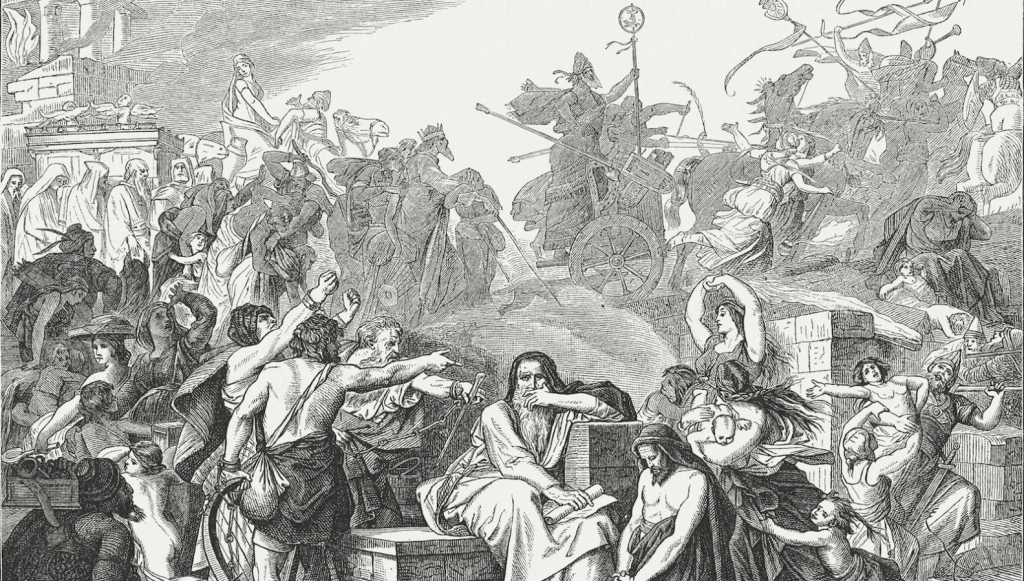
The Babylonian Exile by Jewish-German painter Eduard Bendemann (1811-1889)

In the nineteenth year of Nebuchadnezzar king of Babylon on the seventh day of the fifth month, Nebuzaradan, the king of Babylon’s chief deputy, arrived in Jerusalem. He burned the Temple of God to the ground, went on to the royal palace, and then finished off the city. He burned the whole place down. He put the Babylonian troops he had with him to work knocking down the city walls. Finally, he rounded up everyone left in the city, including those who had earlier deserted to the king of Babylon, and took them off into exile. He left a few poor dirt farmers behind to tend the vineyards and what was left of the fields.

The Babylonians broke up the bronze pillars, the bronze washstands, and the huge bronze basin (the Sea) that were in the Temple of God and hauled the bronze off to Babylon. They also took the various bronze-crafted liturgical accessories, as well as the gold and silver censers and sprinkling bowls, used in the services of Temple worship. The king’s deputy didn’t miss a thing. He took every scrap of precious metal he could find.

The amount of bronze they got from the two pillars, the Sea, the twelve bronze bulls that supported the Sea, and the ten washstands that Solomon had made for the Temple of God was enormous. They couldn’t weigh it all! Each pillar stood twenty-seven feet high with a circumference of eighteen feet. The pillars were hollow, the bronze a little less than an inch thick. Each pillar was topped with an ornate capital of bronze pomegranates and filigree, which added another seven and a half feet to its height. There were ninety-six pomegranates evenly spaced—in all, a hundred pomegranates worked into the filigree.

The king’s deputy took a number of special prisoners: Seraiah the chief priest, Zephaniah the associate priest, three wardens, the chief remaining army officer, seven of the king’s counselors who happened to be in the city, the chief recruiting officer for the army, and sixty men of standing from among the people who were still there. Nebuzaradan the king’s deputy marched them all off to the king of Babylon at Riblah. And there at Riblah, in the land of Hamath, the king of Babylon killed the lot of them in cold blood.

Judah went into exile, orphaned from her land.

3,023 men of Judah were taken into exile by Nebuchadnezzar in the seventh year of his reign.

832 from Jerusalem were taken in the eighteenth year of his reign.

745 men from Judah were taken off by Nebuzaradan, the king’s chief deputy, in Nebuchadnezzar’s twenty-third year.

The total number of exiles was 4,600. (The Message)

The Babylonian Exile by Fahri Aldin, 2017

Eventually, God’s words and decrees happen. It may take minutes. It might take centuries. But it will happen.

God promised destruction. It happened. The temple, the city walls, and the houses of Jerusalem were destroyed.

God decreed deportation of the people. It happened. Thousands of Jews were uprooted and moved to Babylon.

God foretold depression. It happened. The social and economic system of Judah collapsed.

God said there would be an occupation of Gentiles. It happened. The occupying force seized and confiscated the holy temple articles. They violated that which was sacred to Judah.

God repeatedly told the people that there would be a reckoning for the years of social injustice and religious infidelity. It happened. There was not just a deportation of persons; there were waves of removal.

The long prophecy of Jeremiah began with a proclamation of exile. It moved toward that exile. And then, in the end, the exile became reality.

Surely, it must have seemed to the citizens of Jerusalem that the end of the world was at hand. Their very identity as God’s people, as they had understood it for centuries, was now obliterated. Who are they now?

The Jewish exile changed forever their understanding of themselves and of God because they needed to reimagine what being the people of God really means without a place and without a temple.

God is both subject and object of all Holy Scripture, including the book of Jeremiah. Perhaps neglected in all the talk of exile is that the Lord was also cast-off, put away, and exiled. And rather than this being bad news, it becomes the good news that divine presence was right alongside the exiles.

In our darkest times, in the worst of circumstances, when all seems hopeless – there is a God who shows such solidarity with us that he is crucified and put to death so that we might live.

The Lord does not stand afar off from us but is beside us, even within us.

The sheer violation and agony of Good Friday and the depressive silence of Holy Saturday are the means of demonstrating the power of resurrection and new life.

We may be deported, depressed, and destroyed – exiled to a place we do not know and do not want to be. Yet, that is not the end of the story.

Exile is temporary. Mercy is forever. There cannot be a resurrection without a death. There must be suffering before there is glory.

Love wins. Every time.

God is Love. Thus, there is always hope….

Lament Your Losses (Lamentations 3:19-26)

“The Lamentations of Jeremiah,” a woodcut by Julius Schnorr von Carolsfeld (1794-1872)

I remember my affliction and my wandering,
    the bitterness and the gall.
I well remember them,
    and my soul is downcast within me.
Yet this I call to mind
    and therefore I have hope:

Because of the Lord’s great love, we are not consumed,
    for his compassions never fail.
They are new every morning;
    great is your faithfulness.
I say to myself, “The Lord is my portion;
    therefore I will wait for him.”

The Lord is good to those whose hope is in him,
    to the one who seeks him;
it is good to wait quietly
    for the salvation of the Lord. (New International Version)

“Through the prism of my tears I have seen a suffering God. It is said of God that no one can behold his face and live. I always thought this meant that no one could see his splendor and live. But I have come to see that it more likely means that no one can see his sorrow and survive.”

Nicolas Wolterstorff, Lament for a Son

None of us gets off this planet without experiencing terrible grief. It is endemic to the human condition.

Grief attaches itself to any significant change or loss – bereavement, divorce, surgery, losing a job, bankruptcy, and so much more – bring grief to our lives. They are unwanted events we did not ask for. 

The worst response to grief-producing events is to ignore them, minimize them, say they are simply in the past, stuff the feelings down, and just move on.

It’s actually unbiblical to respond that way because Holy Scripture discerns that we need to lament our losses.

Lamentations is an entire book of the Bible given to a single purpose: lamenting a grievous loss.

The prophet Jeremiah was called by God to pronounce judgment against Jerusalem. Not only was Jeremiah commissioned to proclaim an unpopular message, but he was also given a promise that the people would not listen to him. Jerusalem would be destroyed. The people sent into exile. This only compounded Jeremiah’s sadness with complicated grief.

Jeremiah is a melancholy messenger who preached exactly what the Lord wanted him to preach. God’s words came true. The people did not turn from their empty worship and wayward lifestyles. And they persecuted Jeremiah for speaking words of judgment.

The Babylonians came and tore down the walls of Jerusalem, decimated the city and the temple, and carried off the people into exile.

In his terrible grief over the ruined city of Jerusalem, Jeremiah wept and lamented the loss of his hometown and the temple.

It was only after an extended time of grieving that Jeremiah turned his attention toward the love of God. The Lord’s compassions become new every morning. And the renewal will happen without Jerusalem at the center of Jewish life.

Cheap hope tries to circumvent grieving and lamenting of loss. Genuine hope knows the true path of renewal is through the grief, not around it.

There are two popular phrases in Western culture that need to be jettisoned altogether when speaking with people experiencing change or loss. These phrases, at the least, are not helpful; and, at worst, are harmful:

  1. “Get over it!” can short circuit the grief process and puts grieving people in the awkward position of not seeing the power of lament through to its end of acceptance, resolution, and fresh hope. Far too many people in the world, and even the church, remain stuck in some stage of grief, unable to effectively move through it because others expect them to be joyful and victorious; but they really feel downright awful – and now also feel guilty for being sad.
  2. “You have to be strong!” is typically said to people who are in a state of weakness. But they can’t be strong. We would never think of telling someone with broken bones to have the strength to walk or even drive anywhere without assistance. We understand they need to heal. Yet, we tell this to people with broken spirits, and then can’t understand why they don’t just bounce back from their emotional stupor. Broken spirits and broken hearts, like broken bones, need time to heal.

Lament is the pathway to knowing compassion and becoming a compassionate person, like Jesus. Wallpapering over our losses without lamenting them is at the root of many, if not most, emotional problems today. 

“Catastrophic loss by definition precludes recovery.  It will transform us or destroy us, but it will never leave us the same….  I did not get over my loved ones loss; rather I absorbed the loss into my life until it became part of who I am. Sorrow took up permanent residence in my soul and enlarged it.”

Jerry Sittser, A Grace Disguised: How the Soul Grows Through Loss

We all accumulate losses over the course of a lifetime. Many are small losses; some are devastating losses. The death of children, disability, sexual assault, abuse, cancer, infertility, suicide, and betrayal are all examples of crushing loss – losses that need to experience lament. 

All these changes are irreversible; we cannot return to how things once were. We must move through the grief by lamenting each loss. And as we lurch ahead, we cling to the words of Jeremiah. Because of the Lord’s great love, we are not consumed and swallowed whole from grief, for his compassions never fail. They are new every morning. Great is God’s faithfulness.

So, how do we lament our losses in a healthy way?

  1. Remember our afflictions and losses. Avoid superficial responses to significant events. Acknowledge, own, and feel the pain of the loss. This is the path to realizing new life.
  2. Pay attention to faith, hope, and love. This can only be done if we are alert to the grief process. Elizabeth Kubler-Ross identified five stages of grief: denial, anger, bargaining, depression, and resolution or acceptance. We rarely move neatly through each stage. The important thing is that we get to the place of seeing God’s committed love to us, not just in spite of the suffering, but because of it.
  3. Do not minimize your pain and suffering. We must sit with our pain. Do not dismiss your loss by saying others have it worse, or that it’s nothing. Year after year, many Christians do not confront the losses of life, minimizing their failures and disappointments. The result is a profound inability to face pain. And it has led to shallow spirituality and an acute lack of compassion.
  4. Know that Jesus grieved. Messiah is a man of sorrows and acquainted with grief. (Isaiah 53:3) At the tomb of Lazarus, Jesus did not say “Come on everyone, stop all this crying” but wept with the people. (John 11:35) When entering Jerusalem, Jesus did not say “too bad guys, I’m moving on without you” but lamented over the city desiring to gather them as a hen does her chicks. (Luke 13:34) On the cross, Jesus did not say “Lighten up everyone; God is good; he will be victorious!” But instead said, “My God, my God, why have you forsaken me?” (Matthew 27:46) Holy Scripture tells us that Jesus learned obedience from what he suffered. (Hebrews 5:8)

Grief and lament is an indispensable part of a full-orbed spirituality and essential for emotional health.

Life does not always make sense. There is deep mystery to the ways of God. The Lord is doing patient and careful work inside of each one of us. While he is busy within our souls, we will likely feel lost and disconnected, not seeing the full tapestry of what he is creating. Weariness, loneliness, a sense that prayers are not being heard, and a feeling of helplessness are all common experiences of God’s resetting a broken spirit.

John Milton’s classic piece of literature, Paradise Lost, compares the evil of history to a compost pile – a mixture of decaying food, animal manure, dead leaves, and whatever else you put on it. Yet, if you cover the compost with dirt, after a long while it no longer smells. The soil becomes a rich natural fertilizer and is ideal for growing a garden. 

We must be willing to wait, in some cases, years. Milton’s point was that the worst events of history and the evil we experience are compost in God’s overall plan. Out of the greatest wrong ever done, the betrayal, crucifixion, and death of Jesus, came the greatest good – God transformed the stench of evil into good without diminishing the awfulness of that evil.

People who have submitted to grief and lamented their losses are:

  • Patient with others and able to wait on God
  • Kind and compassionate
  • Lack pretense and have no need to impress others
  • Comfortable with mystery and don’t need all the answers
  • Humble, gentle, and meek
  • Able to see God in the mundane, banal, and lowly
  • At home with themselves and with God
  • Equipped to love others as Jesus did

Maybe we are always running, working, and playing because we are constantly trying to keep grief from catching up to us.

Slow down. Let grief catch you. Express lament. Allow grief and lament to do its deep and powerful work within you, to the glory of God. Amen.