Praise the Lord, all you nations. Praise him, all you people of the earth. For his unfailing love for us is powerful; the Lord’s faithfulness endures forever. (New Living Translation)
The Lord is God of the nations – and not only of you and me – whether they recognize it, or not.
All nations, not just the good ones, are invited to praise the Lord. Everyone is encouraged to glory in the love and faithfulness they see.
Since God is present, faithful, just, right, good, loving, and gracious – all the time – those very same dynamics are continually operating in God’s big world. Just as the storm clouds rain on both the righteous and the wicked, and just as the sun shines over every nation and people group on the earth, so the Lord’s great love is a powerful force which encompasses the entire world.
God’s faithfulness and steadfast love never ends. Let that sink in…. Ruminate on it for a bit….
What does it mean? How does it work itself out? Is God faithful to me?
As a Pastor and Chaplain, I can tell you that one of the most difficult things I see people struggling with is if God can really do things in their lives like he does in other people’s lives.
Many times, we have a strong faith for other people – that God will forgive, heal, help, and show up in their lives. Yet when it comes to me personally, it becomes an entirely different thing. My faith is like a wet noodle. We wonder if anything can really change. *Sigh*
Just as we hear public service announcements, it is good to hear the sacred service announcements which are just as important. We need our spiritual awareness raised so that we can make some behavioral changes and adjustments.
We need the reminder, and continual announcement, that God makes good on divine promises. The Lord will accomplish all the decrees and promises made, no matter how long ago they were uttered.
It certainly might seem like God is strolling through the park, burning away precious time, being agonizingly slow in moving on our behalf.
But know this: As it is in heaven, so shall it be on earth. The sovereign Lord of all creation doesn’t only work in other places amongst other people. Jesus is presently building his church and the gates of hades shall not prevail against it. (Matthew 16:18)
There is no handwringing, nail-biting, or eye-rolling in heaven. The Lord is sovereign and limitless, and so, reaches into every geographical locale amongst every people group – and does it all with love.
I know God is a healer because I have seen him heal. I know the Lord is a deliverer because I’ve been delivered. I know God is a provider because I see the Lord’s merciful abundance every day. All this, and more, is reason to offer praise, glory, and honor to the great Sovereign who is worthy of it.
From all that dwell below the skies, Let the Creator’s praise arise; Let the Redeemer’s name be sung Through every land by every tongue.
Eternal are Thy mercies Lord; Eternal truth attends Thy Word; Thy praise shall sound from shore to shore Till suns shall rise and set no more.
– Isaac Watts, From All That Dwell Below the Skies
Since God can and does work everywhere, the Lord will show up in your life and your family and your church and your community, just like what has been happening throughout all eras, in all places, and in all times.
If you are waiting and watching for that to happen, perhaps the most appropriate response is to praise God for what is going to happen. Have some vision to look ahead, give thanks ahead of time, and praise the Lord for the incredible work of saving, healing, teaching, growing, and transforming that will occur in Christ through the power of the Holy Spirit.
It isn’t just for others; it is for you, my friend. How will you trust him today?
Let every nation praise you, Lord, each with its different tongue; in every language learn your word, and let your name be sung.
Let our unceasing songs now show the mercies of our Lord; and make succeeding ages know how faithful is your word.
Your mercy reigns through every land; your grace is spread abroad; forever firm, your truth shall stand. We’ll praise our faithful God!
Let us give thanks to the God and Father of our Lord Jesus Christ! Because of his great mercy he gave us new life by raising Jesus Christ from death. This fills us with a living hope, and so we look forward to possessing the rich blessings that God keeps for his people. He keeps them for you in heaven, where they cannot decay or spoil or fade away. They are for you, who through faith are kept safe by God’s power for the salvation which is ready to be revealed at the end of time.
Be glad about this, even though it may now be necessary for you to be sad for a while because of the many kinds of trials you suffer. Their purpose is to prove that your faith is genuine. Even gold, which can be destroyed, is tested by fire; and so your faith, which is much more precious than gold, must also be tested, so that it may endure. Then you will receive praise and glory and honor on the Day when Jesus Christ is revealed.
You love him, although you have not seen him, and you believe in him, although you do not now see him. So you rejoice with a great and glorious joy which words cannot express, because you are receiving the salvation of your souls, which is the purpose of your faith in him. (Good News Translation)
There’s no need for hope if everything’s going just the way you like it. I remember when I was a college undergraduate, I hoped for Christ’s return toward the end of every semester. The prospect of all those final exams and the pressure of grades had me longing for heaven.
But that’s life. Maturity, resilience, perseverance, and just about every virtue you can think of comes as a result of life’s trials and sufferings. The Christian has hope, precisely because things aren’t the way they’re supposed to be.
Faith has to be tried and tested. And hard circumstances are the way of purifying it. Like gold being purged of any dross by being exposed to extreme heat, so our faith becomes strong, robust, and genuine by the purgative fires of life’s many large and small sufferings.
The whole point of it all is to make us people worthy of our spiritual calling. Resurrection only happens because there’s been a death. Glory is only realized through suffering.
New life, the Christian life, isn’t a matter of making a new set of resolutions, as if it were nothing more than aspirations at the beginning of a calendar year. Rather, Christian faith is a response to the mercy of God in Jesus Christ.
One of my all-time favorite stories is Victor Hugo’s Les Miserables. It’s a story of grace and new life, of a hopeless man given the chance at hope.
The main character is Jean Valjean, who spends nineteen years in jail for stealing a loaf of bread for his starving family. The experience in prison caused him to become a bitter and cynical man. After his release, Jean Valjean has nowhere to go.
In desperation, he seeks lodging one night at the home of a Catholic bishop, who treats him with genuine kindness, which Valjean sees only as an opportunity to exploit. In the middle of the night, he steals the bishop’s silver and skedaddles.
The next day, however, Valjean is caught by the police. When they bring him back to the bishop’s house for identification, the police are surprised when the bishop hands two silver candlesticks to Jean, implying that he had given the stolen silver to him, saying, “You forgot these.”
After dismissing the police, the bishop turns to Jean Valjean and says, “I have bought your soul for God.” In that moment, by the bishop’s act of mercy, Valjean’s bitterness is broken. Hope springs to life.
Jean Valjean’s forgiveness is the beginning of a new life. The bulk of Victor Hugo’s novel demonstrates the utter power of a redeemed life. Jean chooses the way of mercy, as the bishop had done. Valjean raises an orphan, spares the life of a parole officer who spent fifteen years hunting him, and saves his future son-in-law from death, even though it nearly cost him his own life.
“Jean Valjean, my brother, you no longer belong to what is evil but to what is good. I have bought your soul to save it from black thoughts and the spirit of perdition, and I give it to God.”
― Victor Hugo, Les Misérables
Throughout Jean Valjean’s new life, there are trials and temptations all along the way. Yet, mercy keeps his faith strong, and hope kindled. Whereas before, Valjean responded to mercy with a brooding melancholy and inner anger, now – after being shown grace – he responds to each case of unjust suffering with gratitude, deeply thankful for the chance to live a new life full of grace.
Hope is kept alive because of suffering. Faith is strengthened by means of adversity. And both originate because of mercy and grace.
Christianity is a worldview perspective that enables one to rejoice in difficulty. For the Christian, there is no empty meaningless grief; there is the hope that our suffering means something. Like the athlete who endures all the painful practice in order to realize a future hope, so the believer in Jesus goes into strict training for the development of faith – all in the confident expectation of a fulfilled salvation.
It’s a hard lesson to learn, this seemingly weird alchemy of faith, suffering, hope, joy, and new life. And every generation of Christians needs to experientially discover it. Each believer eventually learns, in the crucible of hard circumstances, that the promises of God are the ballast to persevere in faith and patience throughout life.
Christian hope is a confident expectation that the promises of God will be completely realized.
A Christian’s salvation encompasses past, present, and future.
We were saved back there in the past when Christ died on the cross for us. We were crucified with him.
We are presently being saved from the world, the sinful nature, and the devil, through the sanctifying work of the Spirit in making us holy.
And we will be saved in the future when Christ returns to judge the living and the dead. Then, our salvation will be fully realized. Since that hasn’t happened yet, we have hope to sustain us.
It was hope that sustained me in college. I endured all the hours of study, all the exams, all the various courses taken, with the confident expectation that I would someday walk across that stage, receive my diploma, and graduate with my intended degree.
We ourselves, who have the first fruits of the Spirit, groan inwardly as we wait eagerly for our adoption to sonship, the redemption of our bodies. For in this hope we were saved. But hope that is seen is no hope at all. Who hopes for what they already have? But if we hope for what we do not yet have, we wait for it patiently. (Romans 8:23-25, NIV)
The Christian’s hope for ultimate deliverance is imperishable, undefiled, and unfading. This means we can live through a difficult day or week or month or a year, or even decades, with spiritual endurance. Our goal shall come in all its fullness.
Then I saw a new heaven and a new earth, for the first heaven and the first earth had passed away, and the sea was no more. And I saw the holy city, the new Jerusalem, coming down out of heaven from God, prepared as a bride adorned for her husband. And I heard a loud voice from the throne saying,
“See, the home of God is among mortals. He will dwell with them; they will be his peoples, and God himself will be with them and be their God; he will wipe every tear from their eyes. Death will be no more; mourning and crying and pain will be no more, for the first things have passed away.” (Revelation 21:1-4, NRSV)
Eventually, suffering will have done its work and we will be with Christ forever. Until that day, let us explore all that God has for us, embracing both the meaning and the mystery of faith.
Since our salvation is assured, let us live with confidence and run the race marked out for us.
Heavenly Father, you created us and lovingly care for us. We accept all our sufferings willingly, and as truly obedient children we submit ourselves to your holy will. Give us the strength to accept your loving visitation to us through adversity, and never let us grieve your heart by giving-in to impatience. We offer you our pains to be used for your honor and glory, through Jesus Christ our Lord, in the strength of the Holy Spirit. Amen.
Michelangelo’s depiction of the prophet Zechariah, Sistine Chapel, Rome
In the eighth month of the second year of Darius, the word of the Lord came to the prophet Zechariah son of Berekiah, the son of Iddo:
“The Lord was very angry with your ancestors. Therefore tell the people: This is what the Lord Almighty says: ‘Return to me,’ declares the Lord Almighty, ‘and I will return to you,’ says the Lord Almighty. Do not be like your ancestors, to whom the earlier prophets proclaimed: This is what the Lord Almighty says: ‘Turn from your evil ways and your evil practices.’ But they would not listen or pay attention to me, declares the Lord. Where are your ancestors now? And the prophets, do they live forever? But did not my words and my decrees, which I commanded my servants the prophets, overtake your ancestors?
“Then they repented and said, ‘The Lord Almighty has done to us what our ways and practices deserve, just as he determined to do.’”
On the twenty-fourth day of the eleventh month, the month of Shebat, in the second year of Darius, the word of the Lord came to the prophet Zechariah son of Berekiah, the son of Iddo.
During the night I had a vision, and there before me was a man mounted on a red horse. He was standing among the myrtle trees in a ravine. Behind him were red, brown and white horses.
I asked, “What are these, my lord?”
The angel who was talking with me answered, “I will show you what they are.”
Then the man standing among the myrtle trees explained, “They are the ones the Lord has sent to go throughout the earth.”
And they reported to the angel of the Lord who was standing among the myrtle trees, “We have gone throughout the earth and found the whole world at rest and in peace.”
Then the angel of the Lord said, “Lord Almighty, how long will you withhold mercy from Jerusalem and from the towns of Judah, which you have been angry with these seventy years?” So the Lord spoke kind and comforting words to the angel who talked with me.
Then the angel who was speaking to me said, “Proclaim this word: This is what the Lord Almighty says: ‘I am very jealous for Jerusalem and Zion, and I am very angry with the nations that feel secure. I was only a little angry, but they went too far with the punishment.’
“Therefore this is what the Lord says: ‘I will return to Jerusalem with mercy, and there my house will be rebuilt. And the measuring line will be stretched out over Jerusalem,’ declares the Lord Almighty.
“Proclaim further: This is what the Lord Almighty says: ‘My towns will again overflow with prosperity, and the Lord will again comfort Zion and choose Jerusalem.’” (New International Version)
God hulking-out isn’t something you want to see repeated, insisted the prophet.
Zechariah directed his message to the Jews returning from their exile in Babylon. He reminded them that their parents and forebears had been called to repent and return to the Lord. They didn’t. Hence, the Babylonian exile. Big hint from the prophet to the people: Don’t ever do that again. Things will get angry, large, and green if you do.
Zechariah’s generation was being given a chance: To live into God’s covenant and law; to hold fast onto their identity as God’s people.
The people listened to the prophet. They expressed their repentance and a desire to turn from past evil ways and embrace the ways of the Lord. And the returning exiles also acknowledged and accepted God’s judgment. The returning exiles understood that, as a people, they deserve the consequences to centuries of neglecting justice, mercy, and humility.
Every generation of believers must learn from the past. Not only do they need to receive the teachings and traditions of those who went before them, but each generation must also struggle with how to put that teaching and tradition into practice.
The past needs to be squarely faced and deliberately pulled into the present. That is the way a genuine hope is born, giving direction for the future. In other words, old words and ways from the past need new experiences in the present; only by doing this will there be guidance.
Bring in your kingdom so that your will is done on earth as it’s done in heaven. (Matthew 6:10, CEB)
Today’s Old Testament lesson includes the first of eight night visions from the prophet Zechariah. The gist of the first prophetic oracle is a message of assurance and comfort: God will restore. The Lord will renew.
Divine intervention is about to happen in the rebuilding of the temple – a physical example of the spiritual reality that is happening. Just as the ancient temple was being restored for new generations of worshipers, so the people were being renewed to be an example of piety and fidelity to God for millennia to come.
Peace and prosperity will again be realized.
Throughout Scripture, trees are a symbol of a thriving and flourishing life. The myrtle tree is a sign of God’s promise to bring new life, branching out to spread into the next generations. Like all trees, the myrtle needs plenty of moisture when young. Yet, it is distinctive in that the myrtle tree can tolerate drought, grow despite limited soil, and remain hardy when it becomes mature.
Your anger lasts a little while, but your kindness lasts for a lifetime. At night we may cry, but when morning comes we will celebrate. (Psalm 30:5, CEV)
“Tolerate,” “grow,” and “remain” are anything but passive words. People are more than mere observers. “Repent” and “return” and “renew” are verbs. There is a great deal of activity to do. A divine/human cooperation needs to occur. On God’s end, even the angels get involved in the action. What’s happening here is both heavenly and earthly business.
Relational dynamics between God and God’s people are to be a dialogue and not a one-sided monologue. The Lord and the present generation are to demonstrate for future peoples how peace is actually realized and enjoyed.
The Vision of Zechariah, by Unknown artist, c.1300 C.E., Sicily
Like all biblical visions, Zechariah’s is not readily understandable. Nobody is sure about what the symbolism is behind the vision’s horses. Yet, I’ll venture to say that it’s the colors which are significant: red is the color of action; brown is a color of stability and fertility; and white represents purity and holiness. Red, brown, and white mixed together creates a beige color.
Beige is an earthy and dependable color. It’s an inherently welcoming and calming color, offering warmth and symbolizing harmony and comfort. Together, with the horses we have a representation of strength, stability, and structure. They are signs of peace and rest, of God’s shalom.
Spiritual wholeness, moral integrity, relational harmony, and settled peace don’t just magically happen.
For the Christian, peace was bought at a price – the blood of Jesus. (Colossians 1:20)
Peace must be both passively received and actively pursued. (Ephesians 4:3)
Practices of peace need to be engrafted into our lives so that we might daily experience it. (Romans 14:13-15:7)
The name “Zechariah” is a Hebrew word meaning, “God remembered.” God has not forgotten divine promises.
The time has come to take hold of the vision God had from the very beginning to walk with humanity in continual fellowship and happiness in the garden, a place of abundant growth, beauty, and health – a place of peace and rest.
The happiest, fully rested, and most peaceful people and nations on earth continually find a steady stream of joy in their families, their rituals/traditions, and their religion.
To find joy and happiness in life is to find peace and rest. And peace is something to be shared, to be passed onto others.
“The peace of Christ be with you.”
“And also with you.”
Such ritual words and practices are reminders of continually returning to the Lord and finding simplicity and satisfaction in Jesus.
In observing and celebrating the Lord’s Table, we find our penultimate remembrance of how peace was achieved, as well as our supreme participation in the triune God.
Perhaps, then, peace and prosperity will extend their tree-like branches over the earth and into the next generations.
Grace to you and peace from God our Father and the Lord Jesus Christ.
Peace before us, Peace behind us, Peace under our feet.
Peace within us, Peace over us, Let all around us be peace.
Christ before us, Christ behind us, Christ under our feet.
Christ within us, Christ over us, Let all around us be Christ. – a Navajo Prayer
The Lord of the Parables by Argentine artist Jorge Cocco Santángelo
“What do you think? A man had two sons. Now he came to the first and said, ‘Son, go and work in the vineyard today.’
“‘No, I don’t want to,’ he replied. But later he changed his mind and went.
“The father said the same thing to the other son, who replied, ‘Yes, sir.’ But he didn’t go.
“Which one of these two did his father’s will?”
They said, “The first one.”
Jesus said to them, “I assure you that tax collectors and prostitutes are entering God’s kingdom ahead of you. For John came to you on the righteous road, and you didn’t believe him. But tax collectors and prostitutes believed him. Yet even after you saw this, you didn’t change your hearts and lives and you didn’t believe him. (Common English Bible)
Contemporary persons aren’t the only ones who want to know whose in and whose out; it’s been around forever.
In the ancient world of Jesus, people were always concerned about conformity to the established system and society of the way things are. For religious folk, who gets in and who gets left out was an important issue .So, Jesus decided to tell a parable about entrance into the kingdom of God.
Turns out, there are spiritual insiders on the outside of the kingdom, and spiritual outsiders who are the true inheritors of the kingdom.
The parable, at its core, is a warning to all the spiritually serious insiders: Beware, lest your energies be spent in correctness of behavior, conformity of belonging, and cockiness of belief rather than following Jesus. And, at the same time, the parable encourages spiritually estranged outsiders with the wonderful possibilities of a changed life.
Far too many people arrogantly assume they have the inside track by what they believe, and not by doing God’s will.
It may be challenging for us to imagine how truly offensive Christ’s story was to the original hearers of the parable, so I restate it in a more contemporary form:
There was a man who was well respected in the community and had two sons. One son grew up and became a respectable member of the community, too. He was a successful businessman and gave lots of money to causes in his community, including new lights for the school football field – which was no small cost. He only asked that appropriate and prominent recognition be given him with a plaque bearing his name on each of the light poles.
The other son was not so successful. He was the one in school who the teachers said, “Why can’t you be more like your brother?” There was nothing spectacular about this son. In fact, he lived an “alternative lifestyle” and people murmured behind his back.
The Parable of the Two Sons by Jorge Cocco Santángelo
One day the father said to this son: “Son, go and work at my place of business today; I am going away and need you to do some of the tedious paperwork I have gotten behind on.” “No way!” he answered, but later felt heartsick about the way he spoke to his father and decided to go and do all the grunt work his father needed done.
The father went to the well-respected son and said the same thing about needing him to do all the thankless paperwork that was piled up. That son answered, “Yes, sir, I will; anything you need I will do.” But that son did not go. Instead, he chose to go golfing with some people whom he was trying to coy favor with.
After telling the story, Jesus asked all the upstanding faith leaders and the people listening: “Which of the two did what his father wanted?” “The first,” they answered.
Jesus said, “I tell you the truth, folks with different sexual orientations, unemployed persons on the low rung of society, the religiously different with esoteric beliefs, immigrants from other countries, ex-convicts living in half-way houses, and persons with addictions are all entering the kingdom of God ahead of you.
For you have had heard thousands of sermons about grace and the way of righteousness, yet you did not believe by putting God’s Word into practice; but the others did. And even after you saw how God can change a person’s life from the inside-out, you yourselves did not repent and believe.
It was parables like this that created a religious scandal and eventually got Jesus killed.
The offense for many upstanding citizens is this: that their right doctrine and clean living is not the way of salvation.
Tax collectors and prostitutes were some of the most despised people in Christ’s time. It was simply assumed they were on the outside and would be judged by God.
However, the proof of genuine faith is not lip service but actively obeying God when no one is looking:
My friends, what good is it to say you have faith, when you don’t do anything to show that you really do have faith? Can that kind of faith save you?
If you know someone who doesn’t have any clothes or food, you shouldn’t just say, “I hope all goes well for you. I hope you will be warm and have plenty to eat.” What good is it to say this, unless you do something to help?
Faith that doesn’t lead us to do good deeds is all alone and dead!
Suppose someone disagrees and says, “It is possible to have faith without doing kind deeds.” I would answer, “Prove that you have faith without doing kind deeds, and I will prove that I have faith by doing them.”
You surely believe there is only one God. That’s fine. Even demons believe this, and it makes them shake with fear. (James 2:14-19, CEV)
The Christian life comes down to obedience, not cheap talk. Jesus wants to bless a lost world in need of God’s love and grace.
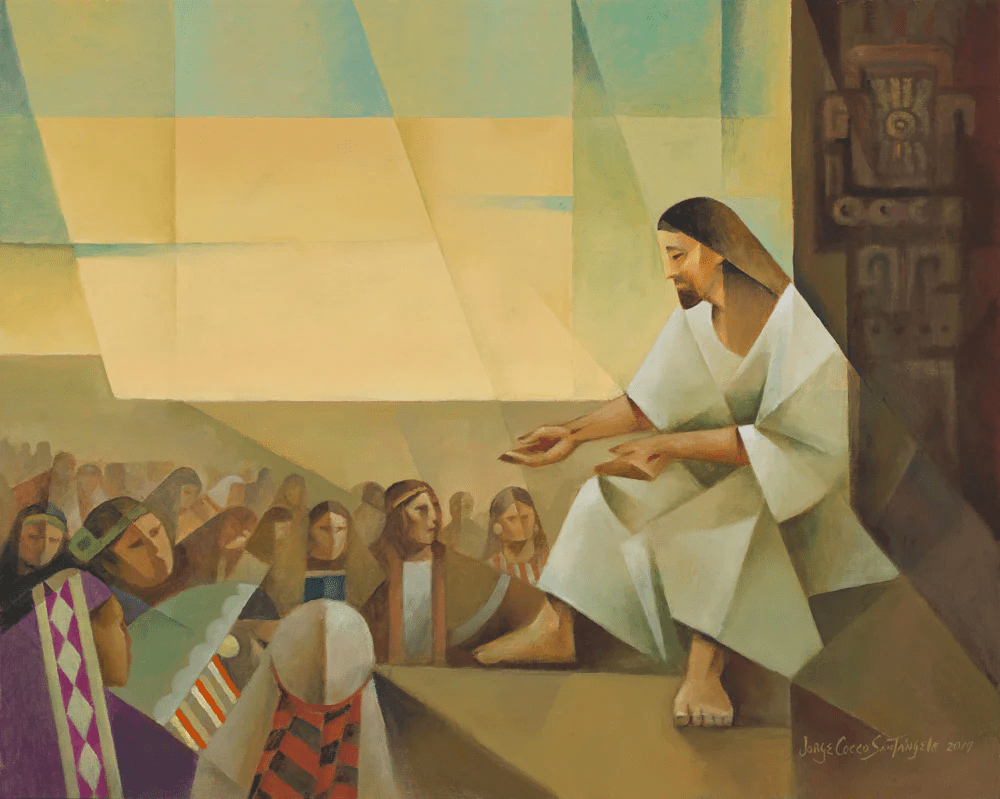
Jesus Preaching to the Multitude by Jorge Cocco Santángelo
If we have the spiritual ears to listen, we can hear numerous lost souls crying in the dark.
If we have the spiritual eyes to see, we can observe people overwhelmed with life circumstances standing in front of us.
If we have the spiritually strengthened hands willing to labor, we can support needy folks around us who can neither help themselves nor ask for it.
Whenever we take the focus off who is in and who is out, then without judgment and a heart full of compassion, we can address the:
Loneliness of so many people living alone and dying alone.
Shame which thousands secretly carry every day.
Pain of broken bodies, broken hearts, broken spirits, and broken minds experienced by individuals everywhere.
The Lord Jesus feels the loneliness, shame, and pain of people – which is why he told a parable like he did. Christ is looking to activate grace through his people, the church, to a world sinking in the depths of incredible human need.
Christ’s parable, however, is more than a warning; it is a story that flings open the door of mercy for unlikely people seemingly far from God – people who ruined their lives by saying “no” to God. The parable is an invitation for all the screw-ups and those with little faith to come to Jesus.
There is a rather obscure Scripture reference, tucked away in the Old Testament. David was on the outside looking in. King Saul was on the inside trying to capture and kill him, even though David had done nothing wrong. Here is what happened:
David got away and escaped to the Cave of Adullam. When his brothers and others associated with his family heard where he was, they came down and joined him. Not only that, but all who were down on their luck came around—losers and vagrants and misfits of all sorts. David became their leader. There were about four hundred in all. (1 Samuel 22:1-2, MSG)
This rag-tag group of outsiders in Israel became Israel’s insiders as David eventually became king and these were the “mighty men,” the ones who helped bring Israel into prominence.
Jesus Christ came into this world and identified himself as the Savior to the outsider when he quoted the prophet Isaiah:
“The Spirit of the Lord is upon me, because he has anointed me to bring good news to the poor. He has sent me to proclaim release to the captives and recovery of sight to the blind, to let the oppressed go free, to proclaim the year of the Lord’s favor.”
And he rolled up the scroll, gave it back to the attendant, and sat down. The eyes of all in the synagogue were fixed on him. Then he began to say to them, “Today this scripture has been fulfilled in your hearing.” (Luke 4:18-21, NRSV)
In Christ, there are no lost causes and no persons too far on the outside to be redeemed.
Therefore, now is the time to act on what we believe – to not only affirm right doctrine, but to live out that doctrine in obedience to God’s call. Amen.