Be Renewed (Joshua 24:25-33)

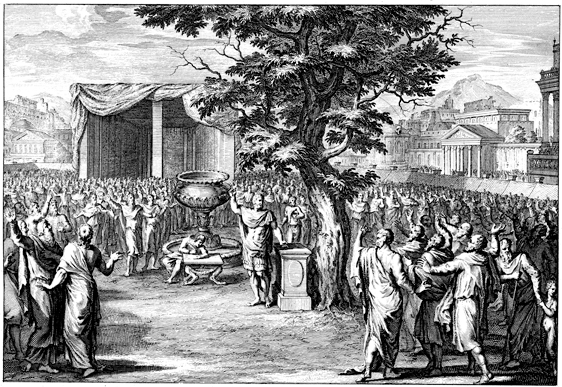
Joshua renews the covenant with the people of Israel, by David Martin (1639-1721)

On that day Joshua made a covenant for the people, and there at Shechem he reaffirmed for them decrees and laws. And Joshua recorded these things in the Book of the Law of God. Then he took a large stone and set it up there under the oak near the holy place of the Lord.

“See!” he said to all the people. “This stone will be a witness against us. It has heard all the words the Lord has said to us. It will be a witness against you if you are untrue to your God.”

Then Joshua dismissed the people, each to their own inheritance.

After these things, Joshua son of Nun, the servant of the Lord, died at the age of a hundred and ten. And they buried him in the land of his inheritance, at Timnath Serah in the hill country of Ephraim, north of Mount Gaash.

Israel served the Lord throughout the lifetime of Joshua and of the elders who outlived him and who had experienced everything the Lord had done for Israel.

And Joseph’s bones, which the Israelites had brought up from Egypt, were buried at Shechem in the tract of land that Jacob bought for a hundred pieces of silver from the sons of Hamor, the father of Shechem. This became the inheritance of Joseph’s descendants.

And Eleazar son of Aaron died and was buried at Gibeah, which had been allotted to his son Phinehas in the hill country of Ephraim. (New International Version)

All things, if they exist for any length of time, require renewal. This is especially true of relationships, and in particular, our relationship with God.

The book of Joshua is closely connected to the book of Exodus. God’s special relationship with Israel was confirmed with a covenant. God’s gave the Law to Moses as the leader of the people. And God brought a mighty deliverance to the Israelites from Egyptian bondage. These are all themes that linger with importance into the leadership and life of Joshua and the Israelites as they entered and inhabited the Promised Land.

Joshua was a faithful attendant to Moses, a model soldier, and an effective spy. After the death of Moses, Joshua was the appointed successor to bring Israel into Canaan and capture it. He was just as faithful to God and the people as Moses had been. In taking the land, Joshua made sure to do the following with the people:

  • Reminded all the Israelite tribes of their covenantal relationship and obligations to God
  • Allocated the land to each of the tribes, as specified by God’s command
  • Circumcised all the males that had been born during the forty years in the desert
  • Established cities of refuge, and cities for the Levites (because they had no land inheritance)
  • Admonished the people to be steadfast in observing the laws given to Moses by God 
  • Made it clear what the consequences are for any break or breach in the covenant agreement

Joshua did all of this by facilitating a covenant renewal ceremony. There were still some Canaanites in the land, and so, the Israelites were at risk of worshipping foreign deities and engaging in intermarriage. The people needed to have a collective memory of God’s deliverance, covenant, and law.

The covenant renewal emphasized obedience to the law and fealty to God because the Israelites are a holy nation, set apart for the Lord’s purposes. They were to serve the Lord with faithfulness and sincerity. There were to be no foreign gods whatsoever. Obedience would bring blessings, whereas disobedience would lead to the land being cursed.

As the mediator between God and Israel, Joshua commanded Israel to make a firm choice about what they were going to do. He was holding them accountable and ensuring they actively participate in the covenantal agreement.

The people declared that they would not forsake the Lord to serve other gods. And Joshua pledged to hold them accountable to their words and commitments.

Just as Israel was to be renewed in loyalty to their God, so we, too, in each generation of believers, must experience a renewal of our relationship to the Lord. We do so through reaffirmation, recording our response, and setting up a remembrance of the renewal.

Reaffirm

To reaffirm is to make a renewed commitment to something, usually verbally. In affirming God as the Lord, we are saying, “I believe!” So reaffirming repeats the belief, and makes it clear that you still feel that way. We make promises and make plans to keep them. We vow to be faithful and restate our love for God and God’s Word.

Joshua repeated, restated, and reaffirmed God’s Law for the people, so that they would know exactly what their responsibilities are, and pledge to keep them always.

Record

To record something is to establish a written record of what was said. Joshua made sure that everything was written down so that nobody in the future could say something contrary, or forget what was said.

One of the most powerful ways we can engage in personal renewal is by actually recording our promises and commitments to the Lord in a journal. The act of writing, in-and-of itself, is a transforming practice. And when we couple the practice with important and impactful words of intention and desire, then we are doubling our chances of actually following through and doing what we say we will do.

Remember

Memory is more than the mind. Remembering is activated with tangible things that we can see, touch, or smell. With the Israelites, Joshua set up a huge stone as a remembrance of what was said and promised. And he engaged the imagination by stating that the stone heard it all – and would hold them all accountable.

Physical objects, such as the cup and the bread in Christian communion, press the remembrance much better and deeper into both our minds and our hearts. Anything in life that is vital to remember ought to have a tangible item which symbolizes the importance of the memory.

Experiencing renewal in life doesn’t simply happen, but is an intentional process of reaffirming, recording, and remembering. Concerning God’s Word, Holy Scripture is something worth putting the effort into in order to realize new life and a renewed relationship with the Lord.

O God, King eternal, your light divides the day from the night and turns the shadow of death into the morning: Drive from us all wrong desires; incline our hearts to keep your law; and guide our feet into the way of peace; so that, having done your will with cheerfulness during the day, we may, when night comes, rejoice to give you thanks, through Jesus Christ our Lord. Amen.


Don’t Show Favoritism (James 2:8-13)

Yes indeed, it is good when you obey the royal law as found in the Scriptures: “Love your neighbor as yourself.” But if you favor some people over others, you are committing a sin. You are guilty of breaking the law.

For the person who keeps all of the laws except one is as guilty as a person who has broken all of God’s laws. For the same God who said, “You must not commit adultery,” also said, “You must not murder.” So if you murder someone but do not commit adultery, you have still broken the law.

So whatever you say or whatever you do, remember that you will be judged by the law that sets you free. There will be no mercy for those who have not shown mercy to others. But if you have been merciful, God will be merciful when he judges you. (New Living Translation)

Playing favorites is always a bad thing; you can do great harm in seemingly harmless ways.

Proverbs 28:21, MSG

One of my bedrock foundational unshakable beliefs is that God’s big world spins on the axis of grace. Without grace we would all be living in some nightmarish dystopian novel just trying to survive. Grace is the force which overwhelms and overcomes everything. 

When I was growing up, we had a dog named Sam. Sam loved being on the farm. More than once he tussled with a skunk. In those times, I could barely get close enough to clean him up because he stunk so badly.  Favoritism stinks, and God has a hard time getting close to us when we show partiality to others. God is going to clean us up when smelling the stench of discrimination on us.

Showing favoritism to some over others is evidence the dog is running away from the bath of grace. To develop relationships and interact with people the way God wants us to, we must be free from prejudice.

Favoring the rich over the poor stinks because God cares about those trapped in poverty. When Jesus began his ministry, he lifted-up the importance of poor folk by placing himself in the position of extending grace to them:

The Spirit of the Sovereign Lord is on me, because the Lord has anointed me to proclaim good news to the poor. (Isaiah 61:1; Luke 4:18, NIV)

In the Old Testament, there are seven different words for the “poor” because poverty was a pervasive reality (and still is!). The various reasons for poverty range from being born into poverty, being lazy, or being oppressed and/or in slavery.

The types of poor persons run the gamut from simple beggars to the pious and humble poor. These spiritual poor persons were called in biblical times the anawim” (Hebrew עֲנָוִ֣ים). The anawim are humble and gentle folk caught in grinding poverty with no other option but to put their trust in God.

The mistreatment, exploitation, and inattention to the needs of the poor are a chief reason why Holy Scripture is filled with references about how to treat them. The anawim are dear and near to the heart of God:

“Poor persons will never disappear from the earth. That’s why I’m giving you this command: you must open your hand generously to your fellow Israelites, to the needy among you, and to the poor who live with you in your land.” (Deuteronomy 15:11, CEB)

“If you hire poor people to work for you, don’t hold back their pay whether they are Israelites or foreigners who live in your town. Pay them their wages at the end of each day because they live in poverty and need the money to survive. If you do not pay them on time, they will complain about you to the Lord, and he will punish you.” (Deuteronomy 24:14-15, CEV)

Listen to this, you who rob the poor
    and trample down the needy!
You can’t wait for the Sabbath day to be over
    and the religious festivals to end
    so you can get back to cheating the helpless.
You measure out grain with dishonest measures
    and cheat the buyer with dishonest scales.
And you mix the grain you sell
    with chaff swept from the floor.
Then you enslave poor people
    for one piece of silver or a pair of sandals.

Now the Lord has sworn this oath
    by his own name, the Pride of Israel:
“I will never forget
    the wicked things you have done!” (Amos 8:4-7, NLT)

Nothing gets God’s hackles up more than unjust and unfair favoritism which is devoid of mercy and grace toward the poor. It all stinks to high heaven, and when God smells it, divine egalitarian power is not far behind.

It is the poor in spirit with no trust in physical resources who will enter the kingdom of heaven. The humble person gives grace to another, even though the person cannot offer something in return.

It’s easy to be merciful to people who have a deal with you about scratching each other’s backs. However, it is altogether a different thing to be gracious simply because it’s the right thing to do and pleases the heart of God. 

God cares about the condition of our souls and not the balance of our bank accounts. Inattention to the poor and needy only betrays a heart of unjust favoritism – a materialistic heart full of greed. Does money change you?

“Most people are convinced that gaining a lot of money … wouldn’t change who they are as people. Yet, a mounting body of research is showing, wealth can actually change how we think and behave—and not for the better. Rich people have a harder time connecting with others, showing less empathy to the extent of dehumanizing those who are different from them. They are less charitable and generous. They are less likely to help someone in trouble. And they are more likely to defend an unfair status quo. If you think you would behave differently in their place, meanwhile, you are probably wrong: These are not just inherited traits but developed ones. Money, in other words, changes who you are.”

Boston Globe, 2012

The University of Minnesota’s Carlson School of Management found in their research that even the mere suggestion of getting more money makes people less friendly, less sensitive to others, and more likely to view some groups of people as inferior to others. 

Another series of studies from the University of California at Berkley concluded that wealthier people tend to be less compassionate toward others in a bad situation than people from lower-class backgrounds. Their research concluded:

“If you win the lottery and you want to avoid becoming an insensitive jerk, there is a simple solution: Give at least half the money away.” 

Some poor people, as in the days of the Apostle James, are willing to put up with being treated unfairly so they might get a piece of the rich person’s pie. Favoritism ignores the sin in others to gain something from them. God says that is stinking thinking.

Favoritism is a violation of God’s law. The entire law is summed up in two commands: Love God and love neighbor. Favoritism violates our neighbor, and therefore, is sinful disobedience of God. Any needy human we encounter is our neighbor – no matter their social or economic status, their ethnicity, race, gender, or anything that identifies them as different. They are to be helped when we can do so.

We are to speak and act with mercy because we will eventually have to face the Judge. God is always watching us – every word and every action. Judge Jesus will respond to how we have treated each person we encountered and how we talked about other people when they were not around. We will all appear before Christ at the end of the age and must give an account of ourselves. (2 Corinthians 5:10)

Words are important, so they ought to be full of grace, seasoned with salt. Showing mercy instead of favoritism is the way love expresses itself.  Mercy is best given when we have first received it ourselves from God. A heart touched by the grace of the Lord Jesus is one which will stand in the judgment.

We rid ourselves of favoritism’s stench through the cleansing bath of God’s mercy in Jesus Christ. There is grace available if we receive it. God is the expert in transforming lives, renewing minds, and putting to death the pride of favoritism. The work is done with needed grace and compassionate mercy.

So, make it your goal to be a grace-giver, to have a willing heart that seeks to emulate the mercy of Christ. The bath of mercy and grace takes away the stank of prideful favoritism and leaves us with the sweet aroma of love, justice, peace, and joy in the Holy Spirit.

May it be so to the glory of God. Amen.

Embrace the Change, Slowly (Exodus 24:12-18)

Moses receives the law from God on Mount Sinai, by Unknown artist, 1877

The Lord said to Moses, “Come up to me on the mountain and wait there; I will give you the tablets of stone, with the law and the commandment, which I have written for their instruction.” So Moses set out with his assistant Joshua, and Moses went up onto the mountain of God. To the elders he had said, “Wait here for us, until we come back to you. Look, Aaron and Hur are with you; whoever has a dispute may go to them.”

Then Moses went up on the mountain, and the cloud covered the mountain. The glory of the Lord settled on Mount Sinai, and the cloud covered it for six days; on the seventh day he called to Moses out of the cloud. Now the appearance of the glory of the Lord was like a devouring fire on the top of the mountain in the sight of the Israelites. Moses entered the cloud and went up on the mountain. Moses was on the mountain for forty days and forty nights. (New Revised Standard Version)

The Lord graciously entered into a covenant with the ancient Israelites. Following this, Moses was summoned to come up the mountain into God’s presence. There he would receive the tablets of stone with the law and the commandment on it. Yahweh was providing the people with instruction on how to live in the covenant relationship.

The scene was set for the Lord to give an extended revelation to Moses. Moses ascended the mountain, into the cloud, so that the people did not see him. For the next forty days and nights, God’s law and commandments were relayed and taught to Moses.

What did not happen is God tossing some stone tablets containing the law to Moses and then going on God’s merry way. The whole encounter unfolds over an extended period of time. That’s because we are people; we need time to wrap our heads and hearts around new realities. Humans require the gift of slowness to learn and absorb.

Western society, however, does not operate that way. More, faster, and better seems to be our cultural creed. And it’s found everywhere around us. Speed reading. More money. Bigger stuff.

Hogs and chickens are raised on factory farms in large confinement buildings. They never see the light of day. Instead, they are given steroids and growth hormones to grow faster and bigger, so that they can get to the market more quickly and get a better price.

Churches and faith communities in financial trouble look for quick solutions and fast turnarounds by expecting pastors to work more, faster, and better. Sports teams hire and fire coaches with dizzying frequency, believing that if the athletes aren’t faster and better with more wins, then there’s something wrong with them, the coach, or both.

But we have no further than the end of our nose to look for change.

People are in control of very little in this world, and so, a great deal of life is the ability to respond in changing circumstances – both wanted and unwanted. Resilience and flexibility are needed.

Moses receives the Ten Commandments, by Julius Schnorr von Carolsfeld, 1860

The Lord brought about the end of Egyptian slavery for the Israelites through a series of plagues against Egypt. God miraculously delivered the people from the Egyptian army by parting the Red Sea. And Yahweh graciously entered into covenant with them at the mountain. All of this was a major change of life.

It was the people’s responsibility to respond in faith and obedience to the actions and words of God. The Lord was allowing them the space and the time to come to grips with their new reality – which is one reason why Moses met with God for forty days and nights on the mountain.

The Israelites needed to spend their time adjusting to their new life, and contemplating the giving of the law, which was about to happen. Since we are privy to the end of the story, we know that the people did not do this. They became impatient, and experienced a failure of faith and obedience.

Aaron and Hur were the leaders who needed to step up and guide the people in the special opportunity of preparation for receiving the law. Whatever it is they did, it wasn’t that.

Murmuring, complaining, and arguing are the initial signs of impatience and wanting things to happen faster, even immediately. But faith is not forged this way. Faith is developed through dealing with adversity by looking to God, listening, and obeying. Faith knows that all things can be faced with joy.

My brothers and sisters, whenever you face various trials, consider it all joy, because you know that the testing of your faith produces endurance. And let endurance complete its work, so that you may be complete and whole, lacking in nothing. (James 1:2-4, NRSV)

Waiting, patience, and the stretching of faith is not typically what people sign up for. Whenever there are circumstances which warrant endurance and perseverance, it’s far too easy to become antsy and begin grumbling about the situation.

That’s what happened to the ancient Israelites. They had a stiff price to pay for their impatience and impertinence. Don’t be like them. Instead, decide now for encouragement, in and through, all circumstances.

Watch out, brothers and sisters, so that none of you have an evil, unfaithful heart that abandons the living God. Instead, encourage each other every day, as long as it’s called “today,” so that none of you become insensitive to God because of sin’s deception. We are partners with Christ, but only if we hold on to the confidence we had in the beginning until the end. (Hebrews 3:12-13, CEB)

May almighty God give you grace to persevere with joy, so that the Spirit may complete the work begun in you, through Jesus Christ our Lord. Amen.

Follow God’s Word (Deuteronomy 6:10-25)

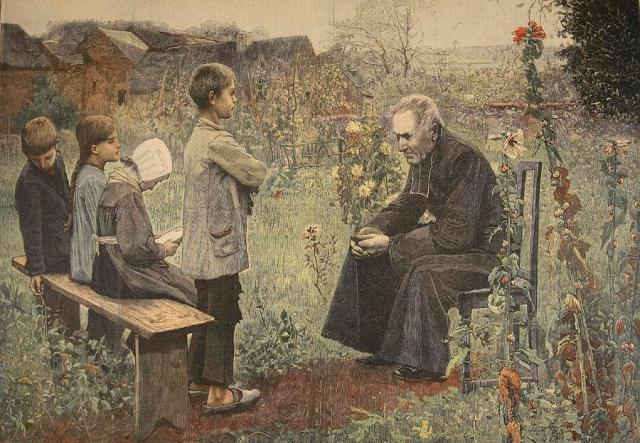
Priest Teaching Children The Catechism, by Jules-Alexis Meunier, 1898

Now once the Lord your God has brought you into the land that he swore to your ancestors, to Abraham, Isaac, and Jacob, to give to you—a land that will be full of large and wonderful towns that you didn’t build, houses stocked with all kinds of goods that you didn’t stock, cisterns that you didn’t make, vineyards and olive trees that you didn’t plant—and you eat and get stuffed, watch yourself! Don’t forget the Lord, who brought you out of Egypt, out of the house of slavery. 

Revere the Lord your God, serve him, and take your solemn pledges in his name! Don’t follow other gods, those gods of the people around you—because the Lord your God, who is with you and among you, is a passionate God. The Lord your God’s anger will burn against you, and he will wipe you off the fertile land. Don’t test the Lord your God the way you frustrated him at Massah. 

You must carefully follow the Lord your God’s commands along with the laws and regulations he has given you. Do what is right and good in the Lord’s sight so that things will go well for you and so you will enter and take possession of the wonderful land that the Lord swore to your ancestors, and so the Lord will drive out all your enemies from before you, just as he promised.

In the future, your children will ask you, “What is the meaning of the laws, the regulations, and the case laws that the Lord our God commanded you?” Tell them: We were Pharaoh’s slaves in Egypt. But the Lord brought us out of Egypt with a mighty hand. Before our own eyes, the Lord performed great and awesome deeds of power against Egypt, Pharaoh, and his entire dynasty. But the Lord brought us out from there so that he could bring us in, giving us the land that he swore to our ancestors. Then the Lord commanded us to perform all these regulations, revering the Lord our God, so that things go well for us always and so we continue to live, as we’re doing right now. What’s more, we will be considered righteous if we are careful to do all this commandment before the Lord our God, just as he commanded us. (Common English Bible)

The Catechism, by Edith Hartry, 1919

Christians often refer to the Bible as “God’s Word.” By that reference we mean that God has graciously revealed the divine nature to us through this Book, the Holy Scriptures. 

The ancient Hebrews referred to the first five books of the Old Testament as the Law of the Lord or the Torah. The Jewish people understood God as a great, high and holy Being who mercifully accommodated or communicated to us on our level by giving the Law. 

Just as a parent coos and babbles and speaks in a very different way to a baby in a crib, so God speaks to us in a way we can understand about the care, concern, and love the Lord has for us. Just as an infant is unable to understand an adult conversation taking place, so God is a lofty Being who is well above our comprehension. We have no ability to understand anything God says unless the Lord graciously and lovingly bends down to speak to us on our level.

God’s Law, the Torah, was the curriculum for Israel’s religious instruction. The Law of the Lord is meant to be a behavior pattern, to be embodied in the lives of God’s people through both teachers and parents who learn God’s Word and, in turn, pass it along to children and others – thereby providing guidance for how to live in God’s world. 

God’s law is an extension of God’s grace, and we are to gratefully accept the grace of God expressed in God’s Word. We are to ingest it, eat it, reflect on it, and dwell with it, in order to know God and be the people God wants us to be.

There are several other words that come from the root word for Law, Torah, in the Hebrew language. A teacher is a “moreh.” A parent is a “horeh.” Parents and teachers are to be living guides in the way of God’s Word. The Hebrew word for teaching is “yarah.” 

So, in other words, the moreh’s and the horeh’s are to yarah the Torah. Parents and teachers are to point and lead others into the ways of the Lord. The fifth book of the Law, Deuteronomy, makes it clear how parents, mentors, teachers, and influencers are to pass on God’s Word:

Israel, listen! Our God is the Lord! Only the Lord! Love the Lord your God with all your heart, all your being, and all your strength. These words that I am commanding you today must always be on your minds. Recite them to your children. Talk about them when you are sitting around your house and when you are out and about, when you are lying down and when you are getting up. Tie them on your hand as a sign. They should be on your forehead as a symbol. Write them on your house’s doorframes and on your city’s gates. (Deuteronomy 6:4-9, CEB)

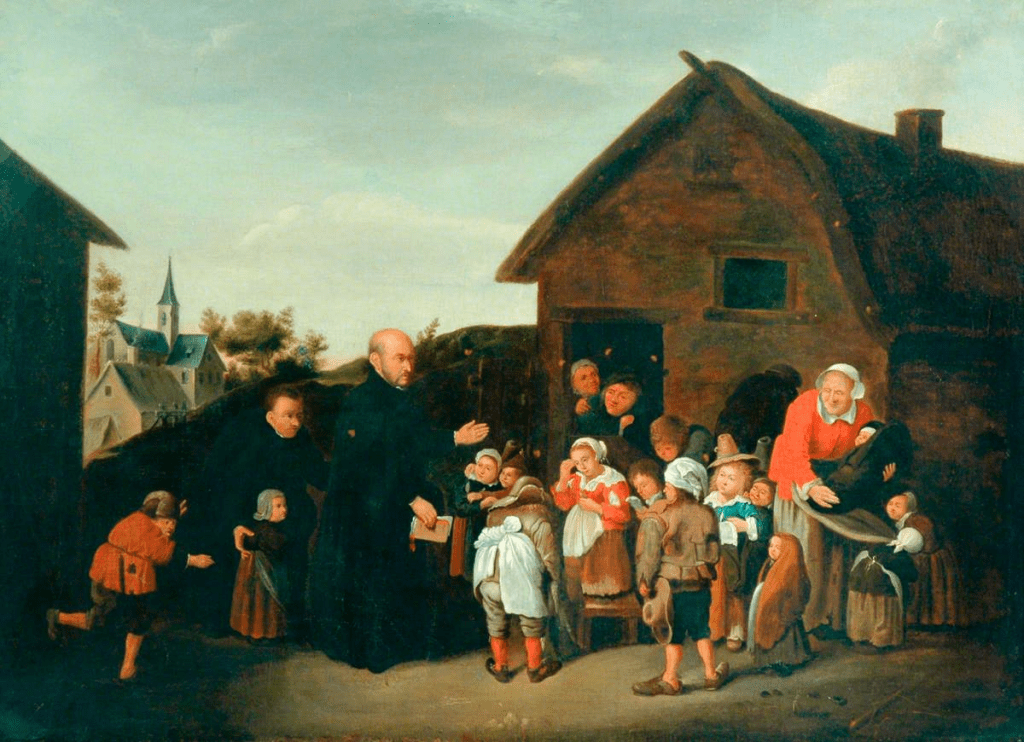
A Village Catechism, by David Rychaert III (1612-1661)

God’s Law, or God’s Word, is to be as familiar to us as our back door and it is to be in front of us all the time. When children ask us anything about God’s commands and regulations, we are to have a ready answer for them, in language and ways that they can understand.

We do this by carefully and systematically engrafting Holy Scripture into our minds and hearts. As we get God’s Word into ourselves, we are to also get it into our children and others. It happens by continually talking about Scripture – at home around the dinner table, as well as when we are working or playing together.

God’s Holy Word is to be continually in front of us, so that we do not forget it. We need to start each day and end each day with God’s Word. We can put the words of God on our refrigerator and our car’s dashboard. There is always an opportunity refer to God’s Word and incessantly chatter about it with others.

Someone may say, “That’s pretty radical – I don’t need to do all that!” Then I would say that you are missing out on living a blessed life because people are blessed when they walk according to God’s Word and keep God’s Law in front of them and seek God through God’s Word with all their heart. 

Let us not be so busy, pre-occupied, nor worried, that we end up pushing God’s Word to the margins of our lives as only a Sunday activity – or something for our discretionary time (which doesn’t actually exist). 

Let’s take the time to carefully look at God’s Word and let God speak to us through it.

Let us be intentional about connecting with the God who has so graciously given us a guide for grateful living. 

And let us lay solid plans to catechize people into the basics of faith and holy living in the church. Amen.