James 2:8-13 – On Mercy and Against Favoritism

“Benevolent Mercy” by Iowa artist William Butler

If you really keep the royal law found in Scripture, “Love your neighbor as yourself,” you are doing right. But if you show favoritism, you sin and are convicted by the law as lawbreakers. For whoever keeps the whole law and yet stumbles at just one point is guilty of breaking all of it. For he who said, “You shall not commit adultery,” also said, “You shall not murder.” If you do not commit adultery but do commit murder, you have become a lawbreaker.

Speak and act as those who are going to be judged by the law that gives freedom, because judgment without mercy will be shown to anyone who has not been merciful. Mercy triumphs over judgment. (NIV)

One of my bedrock foundational unshakable beliefs is that God’s big world spins on the axis of grace. Without grace we would all be living in some nightmarish dystopian novel just trying to survive. Grace is the force which overwhelms and overcomes everything. 

When I was growing up, we had a dog named Sam. Sam loved being on the farm. More than once he tussled with a skunk. In those times, I could barely get close enough to clean him up because he stunk so badly.  Favoritism stinks, and God has a hard time getting close to us when we show partiality to others. God is going to clean us up when smelling the stench of discrimination on us.

Showing favoritism to some over others is evidence the dog is running away from the bath of grace. To develop relationships and interact with people the way God wants us to, we must be free from prejudice. Favoring the rich over the poor stinks because God cares about those trapped in poverty. When Jesus began his ministry, he lifted-up the importance of poor folk by placing himself in the position of extending grace to them:

The Spirit of the Sovereign Lord is on me, because the Lord has anointed me to proclaim good news to the poor. (Isaiah 61:1; Luke 4:18, NIV)

In the Old Testament, there are seven different words for the “poor” because poverty was a pervasive reality (and still is!). The various reasons for poverty range from being born into poverty, being lazy, or being oppressed and/or in slavery. The types of poor persons run the gamut from simple beggars to the pious and humble poor.  These spiritual poor persons were called in biblical times the anawim” (Hebrew עֲנָוִ֣ים). The anawim are humble and gentle folk caught in grinding poverty with no other option but to put their trust in God.

The mistreatment, exploitation, and inattention to the needs of the poor are a chief reason why Holy Scripture is filled with references about how to treat them. The anawim are dear and near to the heart of God:

“Poor persons will never disappear from the earth. That’s why I’m giving you this command: you must open your hand generously to your fellow Israelites, to the needy among you, and to the poor who live with you in your land.” (Deuteronomy 15:11, CEB)

“If you hire poor people to work for you, don’t hold back their pay whether they are Israelites or foreigners who live in your town. Pay them their wages at the end of each day because they live in poverty and need the money to survive. If you do not pay them on time, they will complain about you to the Lord, and he will punish you.” (Deuteronomy 24:14-15, CEV)

Listen to this, you who rob the poor
    and trample down the needy!
You can’t wait for the Sabbath day to be over
    and the religious festivals to end
    so you can get back to cheating the helpless.
You measure out grain with dishonest measures
    and cheat the buyer with dishonest scales.
And you mix the grain you sell
    with chaff swept from the floor.
Then you enslave poor people
    for one piece of silver or a pair of sandals.

Now the Lord has sworn this oath
    by his own name, the Pride of Israel:
“I will never forget
    the wicked things you have done!” (Amos 8:4-7, NLT)
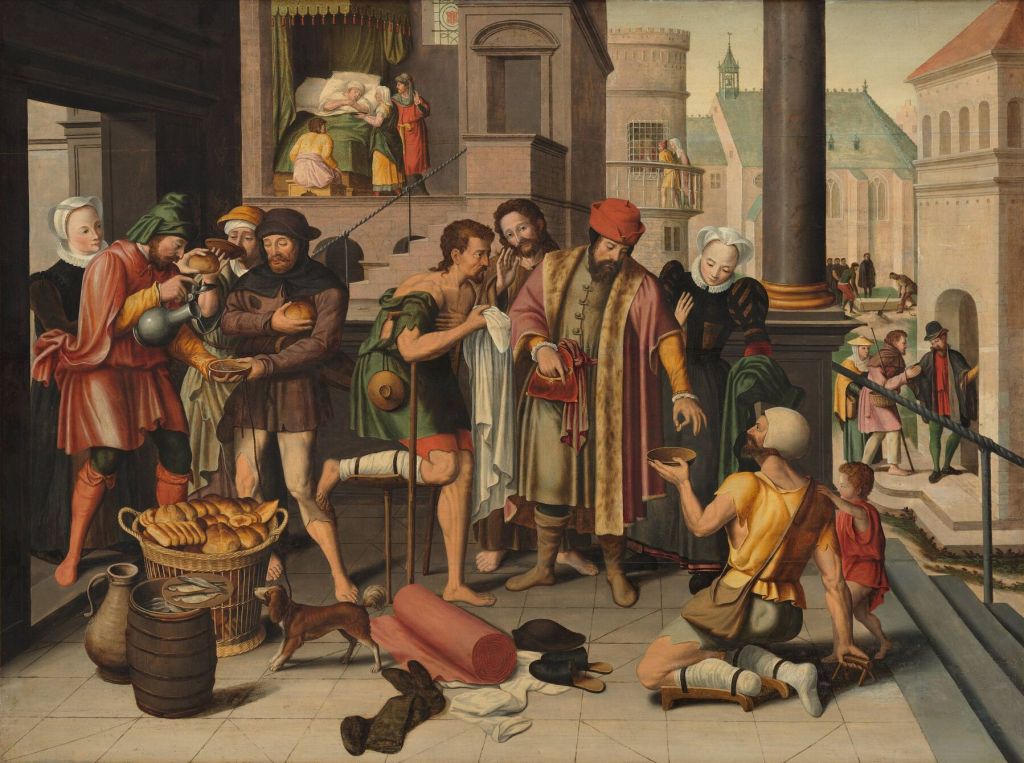
The Seven Corporal Works of Mercy by Unknown Dutch artist, 1580.

Nothing gets God’s hackles up more than unjust and unfair favoritism which is devoid of mercy and grace toward the poor. It all stinks to high heaven, and when God smells it, divine egalitarian power is not far behind.

It is the poor in spirit with no trust in stuff and ingenuity who will enter the kingdom of heaven. The humble person gives grace to another even though the person cannot offer something in return. It is easy to be merciful to people who have a deal with you about scratching each other’s backs. However, it is altogether a different thing to be gracious simply because it is the right thing to do and pleases the heart of God. 

God cares about the condition of our souls and not the balance of our bank accounts. Inattention to the poor and needy only betrays a heart of unjust favoritism – a materialistic heart full of greed. A 2012 Boston Globe article asked the following question: Does money change you?

The Globe article stated, “most people are convinced that gaining a lot of money … wouldn’t change who they are as people. Yet, a mounting body of research is showing, wealth can actually change how we think and behave—and not for the better. Rich people have a harder time connecting with others, showing less empathy to the extent of dehumanizing those who are different from them. They are less charitable and generous. They are less likely to help someone in trouble. And they are more likely to defend an unfair status quo. If you think you would behave differently in their place, meanwhile, you are probably wrong: These are not just inherited traits but developed ones. Money, in other words, changes who you are.”

The University of Minnesota’s Carlson School of Management found in their research that even the mere suggestion of getting more money makes people less friendly, less sensitive to others, and more likely to view some groups of people as inferior to others.  Another series of studies from the University of California at Berkley concluded that wealthier people tend to be less compassionate toward others in a bad situation than people from lower-class backgrounds. Their research concluded, “If you win the lottery and you want to avoid becoming an insensitive jerk, there is a simple solution: Give at least half the money away.” 

Some poor people, as in the days of the Apostle James, are willing to put up with being treated unfairly so they might get a piece of the rich person’s pie. Favoritism ignores the sin in others to gain something from them. God says that is stinking thinking.

Favoritism is flat out a violation of God’s law. The entire law is summed up in two commands: Love God and love neighbor. Favoritism violates our neighbor, and therefore, is sinful disobedience of God. Any needy human we encounter is our neighbor – no matter their social or economic status, their ethnicity, race, gender, or anything that identifies them as different. They are to be helped when we can do so.

We are to speak and act with mercy because we will eventually have to face the Judge. God is always watching us – every word and every action. Judge Jesus will respond to how we have treated each person we encountered and how we talked about other people when they were not around. We will all appear before Christ at the end of the age and must give an account of ourselves. (2 Corinthians 5:10)

Words are important, so they ought to be full of grace, seasoned with salt. Showing mercy instead of favoritism is the way love expresses itself.  Mercy is best given when we have first received it ourselves from God. A heart touched by the grace of the Lord Jesus is one which will stand in the judgment.

We rid ourselves of favoritism’s stench through the cleansing bath of God’s mercy in Jesus Christ.  There is grace available if we will receive it. God is the expert in transforming lives, renewing minds, and putting to death the pride of favoritism. The work is done with needed grace and compassionate mercy.

So, we are to make it our goal to be a grace-givers, to have willing hearts which seek to emulate the mercy of Christ. The bath of mercy and grace takes away the stank of prideful favoritism and leaves us with the sweet aroma of love, justice, peace, and joy in the Holy Spirit.

May it be so to the glory of God.

Psalm 119:49-56 – Night Reflection

Remember your promise to me;
    it is my only hope.
Your promise revives me;
    it comforts me in all my troubles.
The proud hold me in utter contempt,
    but I do not turn away from your instructions.
I meditate on your age-old regulations;
    O Lord, they comfort me.
I become furious with the wicked,
    because they reject your instructions.
Your decrees have been the theme of my songs
    wherever I have lived.
I reflect at night on who you are, O Lord;
    therefore, I obey your instructions.
This is how I spend my life:
    obeying your commandments. (NLT)

Insomnia happens to everyone, some more than others. We all have experienced the inability to sleep. Then, there are those persons who choose to arise in the middle of the night just to pray. Yes, monks do this, but there are common people who do, as well. In my own times of trying to get to sleep, I think about such persons. I especially and reflexively go to the psalms. Along with the psalmist, I reflect at night on the character and nature of the Lord.

The psalmist seems to be awake at night because he is frustrated and upset with people who both spurn wise instruction and direct their contempt at those trying to live according to God’s Law. Although insomnia might be the result of angry or unwanted feelings, maybe it is something else altogether. Perhaps the psalmist simply chose to be awake at night and do some theological reflection on God, others, and himself.

At various times in my life I have chosen to set my alarm for two o’clock in the morning to pray.  I know it may sound crazy to some. Yet, this discipline has taught me something valuable: God is Lord over all chronological time and every season. And I am a servant of God, not master. 

This nightly exercise of weaving my life around a set time of prayer has caused me to learn that I have spent far too much of my life trying to make time bend to my wishes. It is all really an illusion – that I can somehow control the clock. Time marches forward, seasons come and go, and we are a vapor which lasts only a moment.

Whether we find ourselves awake in the night because we cannot sleep, or intentionally choose to use the night for connecting with God, the wee hours of darkness afford us a unique opportunity to ponder the Lord’s promises and commands, attributes, and works. 

The next time you find yourself awake at night, try avoiding the television and a zombie-like state of hoping for sleep. Try using the night-time for thinking about the Lord in ways you might not have considered during the day. Pray. Reflect. Consider. In doing so, you may find a blessing of light within the dark.

Keep watch, dear Lord, with those who work, or watch, or weep this night, and give your angels charge over those who sleep. Tend the sick, Lord Christ; give rest to the weary, bless the dying, soothe the suffering, pity the afflicted, shield the joyous; and all for your love’s sake. Amen.

Psalm 119:49-56, NKJV

Exodus 23:10-13 – The Primacy of Rest

“Sow your land for six years and gather in its crops, but in the seventh year leave it alone and give it a rest so that your poor may eat from it. What they leave, let the wildlife have. Do the same with your vineyards and olive groves.

“Work for six days and rest the seventh so your ox and donkey may rest, and your servant and migrant workers may have time to get their needed rest.

“Listen carefully to everything I tell you. Don’t pay attention to other gods—don’t so much as mention their names. (MSG)

One reason poverty exists and seems to continue unabated, is that it is inextricably tied to rest. Perhaps that seems counter-intuitive. However, it is not. Where work is exalted to such a degree that rest creates feelings of guilt, there you will find an entire class of poor folk who labor tirelessly without making ends meet. Those with power and wealth who eschew and denigrate rest are typically the ones who take advantage of the less fortunate and stereotype them as lazy.

Scriptural rest is not a luxury. An honest biblical sabbath rest is a vital necessity. It is important enough that God lovingly encouraged it and divinely commanded a day of rest to happen for everyone each week and a year of rest every seven, including both creature and creation. There were to be no exceptions.

Perhaps the best way to illustrate what God was thinking when he ordained his people for intentional times of rest comes from my time in a prayer chapel.  One morning I set aside a four-hour block to “rest,” get away, and pray.  I will be honest that I marched into it with a personal agenda of what I wanted God to do.  I had my list of prayer items and my thoughts of how I believed God should work. I was ready for anything but rest. I came to wrestle. Silly me.

It did not take long into my forceful striving at God to see I was on a misguided adventure in missing the point. In my desire to see prayer requests answered, I lost sight of why I was there: To simply be in presence of God and enjoy Jesus – without all the laborious work, as if simple rest and enjoyment were not enough. 

In our daily work-a-day world we poke and prod, push, cajole, and finagle to move forward and get our way on all kinds of things. To separate ourselves from our typical routine takes something of a withdrawal, and it is downright hard. Maybe that’s why many individuals are so tired, cranky, and negative all the time – we find all kinds of reasons not to rest, and even when we do, we’re still trying to impose our will on God. Silly us.

We simply need Jesus – to know Christ, be with him, and experience the depths of our wondrous and gracious union with him. And that will be difficult, unless we obey the command given by God to rest.  To rest means to relinquish our plans and agendas, just for a time, and come into God’s presence and enjoy each other’s company.

Our compulsions for performance and perfection are culprits to rest. We want to do everything right. We long to pray right, talk right, be right and live right – instead of simply coming to Jesus like a little child. Perhaps we are so profoundly dissatisfied with so many things because we are discontent with Christ. Just maybe the best or right prayer to pray is that we all may be content together no matter the circumstances. Only then might we find that our burdens are light and our life easy.

Jesus modeled the life of rest for us. If there was anyone who did not need to pull away and rest it was Jesus, and yet he continually did so. If Jesus needed a sacred space and place to commune and enjoy the Father, then how much more do we need a solid sabbath rest and a place to do it? Jesus rested and prayed to connect with his heavenly Father. There was no multi-tasking, keeping abreast of social media, or juggling other responsibilities.  There was merely the pursuit of intimate rest.

If we fail to rest and avoid sabbath, then we are expressing our confidence that money, hard work, and individual talent are really all we need rather than God. Rest is only secondarily about refueling our depleted resources; it is primarily about connecting intimately with the divine and becoming aware of our true thoughts and feelings. 

Just as we need a special room and a certain bed for sleep, so we need a consistent place and time to enjoy God.  Proper spiritual hygiene, just like proper sleep and health hygiene, includes setting aside a place to daily rest, pray, and be with God.

Real spiritual and biblical rest only “works” when we realize we are imperfect – that we are helpless and need Jesus. Apart from the rise Christ, the blind cannot see, Lazarus remains dead, and I am lost in my sin. I cannot “do” life without Christ in me and with me.

Maybe this old world is not experiencing grace and peace because God’s people have not yet learned the necessity of rest. If we try and manufacture results instead of relying on the Lord for refreshment and renewal, the good things of life will be elusive. 

Enjoy Jesus today, my friends, tap into the Holy Spirit, and allow your rest to spur you to love and good deeds for the poor and underprivileged of this world.

Glory to God in the highest, and on earth peace to people of goodwill. Amen.

Psalm 19 – God Revealed

Yangshuo, China

The heavens proclaim the glory of God.
    The skies display his craftsmanship.
Day after day they continue to speak;
    night after night they make him known.
They speak without a sound or word;
    their voice is never heard.
Yet their message has gone throughout the earth,
    and their words to all the world.

God has made a home in the heavens for the sun.
It bursts forth like a radiant bridegroom after his wedding.
    It rejoices like a great athlete eager to run the race.
The sun rises at one end of the heavens
    and follows its course to the other end.
    Nothing can hide from its heat.

The instructions of the Lord are perfect,
    reviving the soul.
The decrees of the Lord are trustworthy,
    making wise the simple.
The commandments of the Lord are right,
    bringing joy to the heart.
The commands of the Lord are clear,
    giving insight for living.
Reverence for the Lord is pure,
    lasting forever.
The laws of the Lord are true;
    each one is fair.
They are more desirable than gold,
    even the finest gold.
They are sweeter than honey,
    even honey dripping from the comb.
They are a warning to your servant,
    a great reward for those who obey them.

How can I know all the sins lurking in my heart?
    Cleanse me from these hidden faults.
Keep your servant from deliberate sins!
    Don’t let them control me.
Then I will be free of guilt
    and innocent of great sin.

May the words of my mouth
    and the meditation of my heart
be pleasing to you,
    O Lord, my rock and my redeemer. (NLT)

I believe, along with the psalmist, that the bedrock reality of the world is God created the heavens and the earth.  Furthermore, God has given us very great and precious promises through a gracious law. All creation reflects the Lord’s wondrous character. The sun is a constant presence bringing light, warmth, and life to the earth – just like God. 

Everything in creation bears the mark of its Creator to such a degree that it is almost as if the creation itself speaks. Even at night, it’s as if our God keeps constant vigil over us, gently enveloping us in divine presence and protection.

If this were not enough, God has given people a perfect law with all its right precepts, clarity of commands, and truthful statutes. God’s law, like the Lord’s creation, reflects a gracious divine character. We were not left alone to fend for ourselves – to try and figure out everything about how-to live-in God’s big world. Like a caring and conscientious mother, the Lord has provided the Law, to provide us with sure footing and solid direction. The law of the Lord is so good that it is more valuable than gold, and more desirable than any food.

Since all this creation and law is freely available to us, it is a good thing to memorize and meditate on this very psalm. Perhaps take a few verses with you out for a leisurely walk in God’s good creation. Carefully reflect on them as you notice the grand scope of God’s vast sky, and the intricacies of God’s small details.  Let it all rise to a paean of praise and appreciation to the God who notices, has acted, and will intervene.

The laws of the Lord are true.

Different cultures have multiple words for things which are important to them. For example, in most Asian countries there are various words for “rice” depending upon which strain it is and in what manner it is cooked.  Rice is important to them. In America, we only have one word for “rice” no matter where it comes from or how it is prepared. Whereas the country of Indonesia might only have one generic word for “money,” we in the West have a plethora of terms for it: coins; bills; dollars; checks; debit accounts; stock; bonds; annuities, etc.  Americans have dozens of words for “money” because it is weaved into the fabric of our capitalistic way of life.

In today’s wonderful psalm, we encounter several words for “law:” testimony; precept; commandment; instruction; decree; and rule. So, a healthy way to approach God’s Holy Word is to pay careful attention to the various instructions and commands because they are important.

The law of God is to be as familiar to the Christian as Jesus and the Spirit. We need God’s guidance and direction to live rightly and with pleasure. When we look at the law with gratitude and seek to obey God through it, we will learn to avoid sin and lead a blameless life. Thus, to commit God’s Word to heart and to memory would be sage for every believer.

Most of life, as you well know, is lived in the mundane.  We drive and walk the same well-worn roads and paths; spend much time each day doing routine ordinary things; repeatedly say the same things to our kids, day after day; engage in ordinary chores; and, worship in predictable ways.  Excitement is certainly to be had, but it is more the exception than the rule, even in these days of pandemic and change. Patience, perseverance, and plodding comes with living wisely. It is the norm for realizing a thriving and flourishing spiritual life.

Psalm 19 is a celebration of God’s self-revelation.  Through both nature and law, God is made known to humanity. What is more, God’s moral and ethical teachings provide insight for living a good life for all persons everywhere.

Wisdom in the Old Testament is the combination of knowledge and practice. It is the application of God’s self-revelation to concrete situations in life.  We live wisely when we get to know the sovereign God of creation and use revealed mores and ethos as our guide in daily experiences.

We need God’s gracious revealed law. It is not just for theology nerds or spiritual eggheads; God’s law is for everyone – the learned and the unlearned.  Every one of us needs the guidance and direction of God’s Holy Word, and the careful application of it to all our circumstances.

You and I are shaped and formed as godly people as we allow God’s natural and written revelation to awash us and seep into our souls.  Reading this psalm out loud, slowly, and contemplatively, more than once, is an opportunity to let our common ordinary experiences transform us.

Psalm 19