A Divine Calling (Jeremiah 1:4-10)

The Prophet Jeremiah by Marc Chagall, 1960

The Lord gave me this message:

“I knew you before I formed you in your mother’s womb.
    Before you were born I set you apart
    and appointed you as my prophet to the nations.”

“O Sovereign Lord,” I said, “I can’t speak for you! I’m too young!”

The Lord replied, “Don’t say, ‘I’m too young,’ for you must go wherever I send you and say whatever I tell you. And don’t be afraid of the people, for I will be with you and will protect you. I, the Lord, have spoken!” Then the Lord reached out and touched my mouth and said,

“Look, I have put my words in your mouth!

Today I appoint you to stand up
    against nations and kingdoms.
Some you must uproot and tear down,
    destroy and overthrow.
Others you must build up
    and plant.” (New Living Translation)

“Don’t let anyone think less of you because you are young. Be an example to all believers in what you say, in the way you live, in your love, your faith, and your purity.”

St. Paul to St. Timothy (1 Timothy 4:12, NLT)

I write to you, young people,
    because you are strong
    and the word of God abides in you,
        and you have overcome the evil one. (1 John 2:14, NRSV)

Young Jeremiah had an unusual calling from the Lord. It wasn’t to reach thousands with a life-giving message of hope and encouragement; the call was to declare destruction to an unjust people who believed they were fine, thank you very much.

It was a calling that would have been a huge challenge for the most seasoned of veteran prophets. But God called the young Jeremiah. This was his first crack at being a prophet of the Lord; and it was a doozy of a call!

Yet, when it comes to God’s call, age really means nothing. That’s because the Lord equips whomever the Lord wants to empower. Young or old makes no difference. All that’s needed is a willingness to submit to the voice of divine calling.

And to Jeremiah’s credit, the lengthy prophecy bearing his name in the Bible is a testament to his sense of call and straightforward obedience to it.

There is, and always has been, a divine/human cooperative in the world. God, of course, could do everything without humanity’s assistance. But it’s never been that way. Throughout the entirety of Holy Scripture, the Lord calls and empowers people for service.

On the one hand, this may seem like some strange convergence which, on the surface, is sure to end in some screw-ups and failure. Yet, on the other hand, this cooperation between Creator and creature gives people, at the least, a sense of ownership in the world; and, at the most, a powerful opportunity to bless the world with divine gifts of speaking and service.

Although Jeremiah was called to (mostly) pronounce doom, it’s first and foremost a message of justice. The Lord is concerned for the common good of all persons, not just some. Yahweh is not about to be forever idle whenever certain segments of humanity go rogue and harm their fellow sisters and brothers with unjust ways.

The Prophet Jeremiah by Marc Chagall, 1968

What’s more, the Lord delights in using people whom society at large might deem less than usable.

Now remember what you were, my friends, when God called you. From the human point of view few of you were wise or powerful or of high social standing. God purposely chose what the world considers nonsense in order to shame the wise, and he chose what the world considers weak in order to shame the powerful. He chose what the world looks down on and despises and thinks is nothing, in order to destroy what the world thinks is important. (1 Corinthians 1:26-28, GNT)

If God can use a donkey to communicate a message, then it’s likely that the Lord can enable any person on earth to speak words of justice – no matter if they’re young, uneducated, or underprivileged – and make the older, educated, and privileged look like jack asses. (Numbers 22:22-35)

For Christians everywhere, every believer has been called by God to proclaim the gospel of grace. The Word has come to us in Christ, in the flesh (John 1:14). Jesus is the primary and ultimate revelation of God’s Word to us.

God has also set the Church apart to serve as proclaimers of God’s Word to the nations. The Great Commission and the Great Commandment summarize our call to ministry. (Matthew 22:37-40; 28:19-20)

Yahweh’s intentional purpose was for Jeremiah to proclaim God’s word. That’s also God’s intentional purpose for the Church; the Lord puts God’s words in the church’s mouth. Christians proclaim the Word, which we know most fully and experience most personally in Jesus Christ.

With our words, perspectives, attitudes, relationships, and actions, God’s Word flows through us to the world. As believers, we know that gospel proclamation will accomplish God’s purposes.

We trust that God is empowering us to effectively proclaim God’s words with effectiveness so that all the earth may be renewed and blessed.

Most High God, you knew each of us before we were ever born. And so, you know us better than we know ourselves. Your divine power is already there, deep within us. As you call forth that power, enable us to respond with submission, obedience, and willingness to speak words of justice, love, and grace to a world in need of hope and betterment, through Jesus Christ, the Word made flesh, in the strength of the Holy Spirit. Amen.

Mary’s Song of Praise (Luke 1:46b-55)

The Magnificat, a woodcut by Sr. Mary Grace Thul

Mary said,

“My heart praises the Lord;
    my soul is glad because of God my Savior,
    for he has remembered me, his lowly servant!
From now on all people will call me happy,
    because of the great things the Mighty God has done for me.
His name is holy;
    from one generation to another
    he shows mercy to those who honor him.
He has stretched out his mighty arm
    and scattered the proud with all their plans.
He has brought down mighty kings from their thrones,
    and lifted up the lowly.
He has filled the hungry with good things,
    and sent the rich away with empty hands.
He has kept the promise he made to our ancestors,
    and has come to the help of his servant Israel.
He has remembered to show mercy to Abraham
    and to all his descendants forever!” (Good News Translation)

It strikes me that Mary, instead of being full of worry and afraid of the future, and as an unmarried teen with child, is full of the Spirit and faith. Mary neither complained nor fretted for the nine months of her pregnancy; she praised God and was clear-headed about the grace shown to her.

Mary’s canticle gives us insight into the mystery of the incarnation: God chooses the weak, those of low esteem, and the powerless.

Mary was rather ordinary. She had no wealth. She possessed nothing which would cause anyone to pick her out of a crowd. Yet, she is the one chosen by God. And her wonderful response to grace demonstrated that there is so much more to any person than what we can see with our eyes and perceive through our earthly glasses of high positions and strength of personalities.

The mother of Jesus had the wisdom to discern that her situation typified the Lord’s egalitarian work of leveling the field. Mary’s pregnancy normalized the needs of all people. Her son, the Deliverer, would carry this understanding into his own life and ministry – declaring good news to the poor, comforting the brokenhearted, proclaiming freedom for captives, telling those who mourn that the time of the Lord’s favor has come.

Mary’s is the kind of song that has been sung by people of faith throughout the ages. It’s not only a song of faith but a declaration of resistance, in defiance of all evil powers which ignore the poor, such as Mary.

It was not a completely new sort of song; it’s in harmony with songs that other faithful followers of the Lord have sung in past generations.

Moses and Miriam sang a song to the Lord of freedom from powerful Egyptian bondage and oppression:

“I will sing to the Lord, because he has won a glorious victory;
    he has thrown the horses and their riders into the sea.
The Lord is my strong defender;
    he is the one who has saved me.
He is my God, and I will praise him,
    my father’s God, and I will sing about his greatness.
The Lord is a warrior;
    the Lord is his name.” (Exodus 15:1-3, 21, GNT)

Hannah, unable to conceive and have children, endured a long stretch of affliction from her rival – that is, until the Lord stepped in and opened her womb:

“No one is holy like the Lord;
    there is none like him,
    no protector like our God.
Stop your loud boasting;
    silence your proud words.
For the Lord is a God who knows,
    and he judges all that people do.
The bows of strong soldiers are broken,
    but the weak grow strong.
The people who once were well fed
    now hire themselves out to get food,
    but the hungry are hungry no more.
The childless wife has borne seven children,
    but the mother of many is left with none.
The Lord kills and restores to life;
    he sends people to the world of the dead
    and brings them back again.
He makes some people poor and others rich;
    he humbles some and makes others great.
He lifts the poor from the dust
    and raises the needy from their misery.
He makes them companions of princes
    and puts them in places of honor.
The foundations of the earth belong to the Lord;
    on them he has built the world. (1 Samuel 2:2-8, GNT)

Stained glass window of Hannah offering her son Samuel to the Lord by Phil Watkins

The psalmist declares his song about the Lord who turns the tables on the unfortunate and brings them privilege:

He always keeps his promises;
    he judges in favor of the oppressed
    and gives food to the hungry.

The Lord sets prisoners free
    and gives sight to the blind.
He lifts those who have fallen;
    he loves his righteous people.
He protects the strangers who live in our land;
    he helps widows and orphans,
    but takes the wicked to their ruin. (Psalm 146:6b-9, GNT)

God’s people throughout history have faced oppression. And, when in the teeth of that adversity, they have sung God’s songs of resistance against the evil powers of this world.

Along with Holy Scripture, let us also in these days of Advent just before Christmas Day, sing our traditional songs of resistance, deliverance, and hope:

“Come, Thou Long Expected Jesus”

By Charles Wesley

Come, thou long expected Jesus,
born to set thy people free;
from our fears and sins release us,
let us find our rest in thee.
Israel’s strength and consolation,
hope of all the earth thou art;
dear desire of every nation,
joy of every longing heart.

Born thy people to deliver,
born a child and yet a King,
born to reign in us forever,
now thy gracious kingdom bring.
By thine own eternal spirit
rule in all our hearts alone;
by thine all sufficient merit,
raise us to thy glorious throne.

“It Came upon the Midnight Clear” (vs.3-4)

By Edmund Sears

And ye, beneath life’s crushing load,
whose forms are bending low,
who toil along the climbing way
with painful steps and slow,
look now! for glad and golden hours
come swiftly on the wing.
O rest beside the weary road,
and hear the angels sing!

For lo! the days are hastening on,
by prophet seen of old,
when with the ever-circling years
shall come the time foretold
when peace shall over all the earth
its ancient splendors fling,
and the whole world send back the song
which now the angels sing.

“O Come, O Come, Emmanuel” (vs.1, 4, 6)

By J.M. Neale

O come, O come, Immanuel,
and ransom captive Israel
that mourns in lonely exile here
until the Son of God appear.

O come, O Branch of Jesse’s stem,
unto your own and rescue them!
From depths of hell your people save,
and give them victory o’er the grave.

O come, O Bright and Morning Star,
and bring us comfort from afar!
Dispel the shadows of the night
and turn our darkness into light.

Christ came to stand against sin, death, and the power of the Devil.

God is full of grace, mercy, and power to the powerless and the needy. The Lord has our backs. Perhaps if we all, both individually and corporately, continually used our words to identify and declare the great things God has done we would realize the consistent blessing of the Lord. 

As we near the night of our Lord’s birth, take some time to reflect on the ways God has been good to you in this Advent season, and like Mary, offer praise for each act of mercy. Mary exhibited no helplessness but had her heart calibrated to detect the grace of God when it was present – and to resist the injustice of this world.

Soli Deo Gloria

Repent! (Luke 3:1-18)

John the Baptist Preaching by Frank Brangwyn (1867-1956)

In the fifteenth year of the reign of Tiberius Caesar—when Pontius Pilate was governor of Judea, Herod tetrarch of Galilee, his brother Philip tetrarch of Iturea and Traconitis, and Lysanias tetrarch of Abilene—during the high-priesthood of Annas and Caiaphas, the word of God came to John son of Zechariah in the wilderness. He went into all the country around the Jordan, preaching a baptism of repentance for the forgiveness of sins. As it is written in the book of the words of Isaiah the prophet:

“A voice of one calling in the wilderness,
‘Prepare the way for the Lord,
    make straight paths for him.
Every valley shall be filled in,
    every mountain and hill made low.
The crooked roads shall become straight,
    the rough ways smooth.
And all people will see God’s salvation.’”

John said to the crowds coming out to be baptized by him, “You brood of vipers! Who warned you to flee from the coming wrath? Produce fruit in keeping with repentance. And do not begin to say to yourselves, ‘We have Abraham as our father.’ For I tell you that out of these stones God can raise up children for Abraham. The ax is already at the root of the trees, and every tree that does not produce good fruit will be cut down and thrown into the fire.”

“What should we do then?” the crowd asked.

John answered, “Anyone who has two shirts should share with the one who has none, and anyone who has food should do the same.”

Even tax collectors came to be baptized. “Teacher,” they asked, “what should we do?”

“Don’t collect any more than you are required to,” he told them.

Then some soldiers asked him, “And what should we do?”

He replied, “Don’t extort money and don’t accuse people falsely—be content with your pay.”

The people were waiting expectantly and were all wondering in their hearts if John might possibly be the Messiah. John answered them all, “I baptize you with water. But one who is more powerful than I will come, the straps of whose sandals I am not worthy to untie. He will baptize you with the Holy Spirit and fire. His winnowing fork is in his hand to clear his threshing floor and to gather the wheat into his barn, but he will burn up the chaff with unquenchable fire.” And with many other words John exhorted the people and proclaimed the good news to them. (New International Version)

John the Baptist was the sort of guy that people either loved or hated. When I think of John, I picture a hippy driving a Volkswagen bus with bumper stickers plastered everywhere with sayings like, “Get Right or Get Left,” “Turn or Burn,” “Repent or Regret,” “Jesus Is Coming to Take Over,” “Here Comes the Judge,” “Armageddon Outta Here!” and “Axe Me What’s Next.”

He tended toward seeing things as black and white. John wasn’t much of a gray area sort of dude.

Yet, no matter what one things of John the Baptist, he was affirmed by Jesus as doing exactly what he was supposed to do: Prepare for the coming of the Lord. (Matthew 3:13-17, 11:1-19)

And the best way to prepare, as John pointed out, is to repent.

Repentance is one of those big biblical words that sometimes gets lost as being archaic and out of touch – sort of like a hippy John the Baptist. Yet, without repentance, nobody becomes a Christian and no one lives a fruitful life following Jesus. 

To “repent” simply means to change our minds – to stop doing one thing, and to start doing another. 

Orthodox icon of John the Baptist

Throughout Holy Scripture, repentance means to stop sinning and start worshiping God. “Sin” and “worship” are also words that don’t get used a lot and tend to get relegated as antiquated language.

To “sin” is to say and do things which harm others, or to fail to say and do things which are helpful. (Deuteronomy 15:9; Proverbs 10:19; Romans 14:23; James 4:17; 1 John 3:4, 5:17)

To “worship” means to bend the knee, to submit and honor a deity. (Psalm 95:6; Matthew 4:8-10; Revelation 4:10, 5:14, 7:11, 11:16, 19:10,

The prophet Isaiah saw a vision of God in the temple, a self-revealing of the One true God that caused him to be completely unraveled with repentance.

The Apostle Peter saw the Lord Jesus in his immensity and power through a miraculous catch of fish. He then fell at the Lord’s feet and said, “Go away from me, Lord; I am a sinful man.” (Luke 5:8) 

John the Apostle had a vision of Jesus Christ in all his glory and heard his voice. John fell at the Lord’s feet as though dead. (Revelation 1:12-17) 

Ezekiel the prophet had a vision of God and saw the appearance of God’s glory. Then, he fell facedown. (Ezekiel 1:25-28) 

Even Daniel, perhaps the most righteous person of all time, saw a vision of God in all his glory and fell prostrate with his face to the ground, totally overwhelmed with God’s holiness and human sinfulness. (Daniel 8:15-18)

Methinks there is so much sin in the world and so much indifference in the church because people are not seeing a vision of a glorious and holy God. Because if they did, they would be completely beside themselves and see sin’s terrible foulness and degradation; they would repent from all the ways in which they have been apathetic and complacent in living their lives.

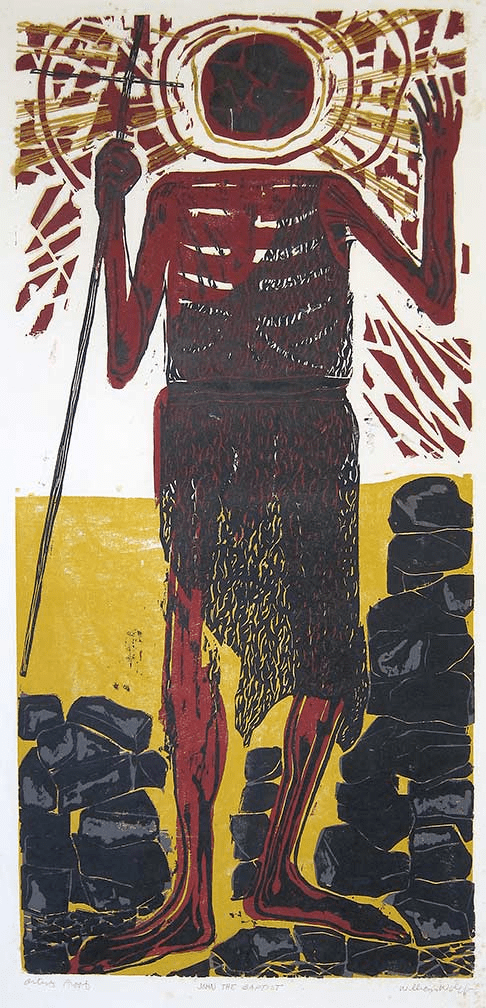
John the Baptist by William Wolff, 1968

We must, therefore, put ourselves in a position to see and hear God so that we can turn from all the obstacles that prevent us from experiencing Father, Son, and Spirit. 

And those hindrances to experiencing God are legion, including: 

  • Passiveness toward God’s Word and God’s creation, thus causing a lack of mindfulness and attention to the Holy Spirit.
  • Preoccupations and daydreams that prevents availability to the words and ways of Jesus.
  • Poverty of sleep, healthy habits, and an overall poor well-being that dulls the spiritual senses and prevents awareness of God.
  • Paucity of spiritual practices and disciplines that would put us in a position to experience a vision of God.

We must repent of all the ways we do not pay attention to God. The Lord is coming but we don’t perceive it.

  1. What, then, must we do to put ourselves in a position to see and hear God?
  2. In what ways might we corporately foster a sense of the holy God? 
  3. How will repentance fit into both our personal and corporate worship? 
  4. Have we identified and named the things that grieve the heart of God so that we can repent of them? 
  5. What is one action step you will take in response to this blog post?

None of us need to be like John the Baptist in order to be godly. We don’t have to eat locusts and be black-and-white thinkers. But we do all have to repent of the ways we make the road difficult by placing obstacles in the way of experiencing Jesus.

Most merciful God, we confess that we have sinned against you in thought, word, and deed, by what we have done, and by what we have left undone. We have not loved you with our whole heart; we have not loved our neighbors as ourselves. We are truly sorry and we humbly repent. For the sake of your Son Jesus Christ, have mercy on us and forgive us; that we may delight in your will, and walk in your ways, to the glory of your Name. Amen.

The Divine Warrior (Isaiah 59:15b-21)

The Lord looked and was displeased
    that there was no justice.

He saw that there was no one,
    he was appalled that there was no one to intervene;
so his own arm achieved salvation for him,
    and his own righteousness sustained him.
He put on righteousness as his breastplate,
    and the helmet of salvation on his head;
he put on the garments of vengeance
    and wrapped himself in zeal as in a cloak.
According to what they have done,
    so will he repay
wrath to his enemies
    and retribution to his foes;
    he will repay the islands their due.
From the west, people will fear the name of the Lord,
    and from the rising of the sun, they will revere his glory.
For he will come like a pent-up flood
    that the breath of the Lord drives along.

“The Redeemer will come to Zion,
    to those in Jacob who repent of their sins,”
declares the Lord.

“As for me, this is my covenant with them,” says the Lord. “My Spirit, who is on you, will not depart from you, and my words that I have put in your mouth will always be on your lips, on the lips of your children and on the lips of their descendants—from this time on and forever,” says the Lord. (New International Version)

The Lord inhabits a lot of roles as God: Creator and Sustainer, Father and Mother, Helper and Healer, Sovereign and King, Shepherd and Spirit, and much more. In today’s Old Testament lesson, we see God as the Divine Warrior and Redeemer.

Readers of the New Testament will pick up on the warrior language in Isaiah’s prophecy (Ephesians 6:10-20). The Divine Warrior readies for battle by putting on armor: a breastplate of righteousness and the helmet of salvation. The Lord prepares to intervene, to make war on injustice, because there are no earthly human warriors willing to eradicate unrighteousness, redeem the oppressed, and establish deliverance for the needy.

The “bystander effect,” or “bystander apathy,” is a social psychology term that refers to cases in which individuals do not offer any means of help to a victim when other people are present. In experiment after experiment over the past fifty years, social psychologists have found that the more bystanders there are, the less likely any one of them will help. 

For example, researchers Bibb Latané and Judith Rodin staged an experiment in 1969 around a woman in distress. 70% of the people who were alone called out or went to help the woman after they believed she had fallen and was hurt. Yet, when there were other people around, only 40% offered help.

The social psychologists found that individuals find it far too easy to stand with their hands in their pockets, whenever there are other people around that could help and do what is right and just. 

The Lord your God is with you, the Mighty Warrior who saves. (Zephaniah 3:17, NIV)

The Lord noticed that justice had disappeared. God was plenty displeased with the lack of justice – and became downright disgusted when no one was doing anything about it. 

“Rationalization is a process not of perceiving reality, but of attempting to make reality fit one’s emotions.”

Ayn Rand

The rationalizations for not becoming involved and avoiding the work of justice in the world are legion: 

  • “Someone else can do it better than me.” 
  • “But what if I screw up?”
  • “I don’t have time for this.”
  • “How could I possibly make any difference?”
  • “That’s not my job.”
  • “They made their own bed, now they can sleep in it.”
  • “I don’t know what to do.”

God puts the responsibility for ensuring that everyone has what they need to live and thrive on us. We truly are our brother’s and sister’s keeper.

So, let’s come back to the Divine Warrior image in the New Testament. Christians are to take up the armor of God, not only to protect themselves from evil, but also to fight the dark forces that keep people locked in systems of injustice. Read the following text from the perspective of ensuring justice for the common good of all people:

Finally, be strong in the Lord and in his mighty power. Put on the full armor of God, so that you can take your stand against the devil’s schemes.For our struggle is not against flesh and blood, but against the rulers, against the authorities, against the powers of this dark world and against the spiritual forces of evil in the heavenly realms. 

Therefore put on the full armor of God, so that when the day of evil comes, you may be able to stand your ground, and after you have done everything, to stand. Stand firm then, with the belt of truth buckled around your waist, with the breastplate of righteousness in place,and with your feet fitted with the readiness that comes from the gospel of peace. In addition to all this, take up the shield of faith, with which you can extinguish all the flaming arrows of the evil one. Take the helmet of salvation and the sword of the Spirit, which is the word of God. (Ephesians 6:10-20, NIV)

The under-privileged, the under-represented, the under-served, the disadvantaged, the deprived, the indigent, and many more groups of people exist because of ignorance and apathy toward their needs. Everyone, including you and me, need to own this and not rationalize why we cannot participate.

The prophet Isaiah lets us know that none of us are anonymous; we have all been given gifts as the people of God in order to serve the greater good. 

The Lord dispenses grace and glory primarily through active people who forsake being bystanders and respond to God’s call on their lives. 

Let’s not bring out the Divine Warrior because of our own negligence. Instead, let’s be attentive to justice, righteousness, and redemption. Perhaps then God will get a more positive press in the public square.

God of justice and righteousness, you care about the people of this world receiving the things they need to live and flourish in life. Inspire and empower all of your people, including me, to spread a spirit of service in our local communities, churches, workplaces, and everywhere we live and go, through Jesus Christ our Lord in the power of the Holy Spirit. Amen.