Like Father Like Son (John 5:19-29)

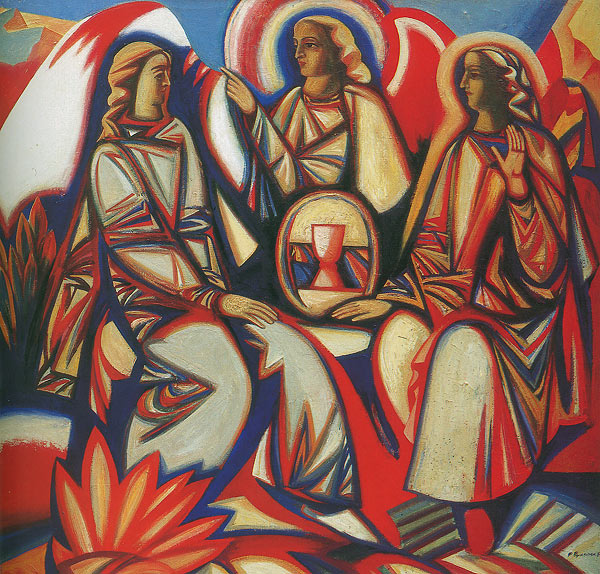
The Trinity, by Ukrainian painter Feodosiy Humeniuk, 1981

Jesus responded to the Jewish leaders: 

“I assure you that the Son can’t do anything by himself except what he sees the Father doing. Whatever the Father does, the Son does likewise. The Father loves the Son and shows him everything that he does. He will show him greater works than these so that you will marvel. 

As the Father raises the dead and gives life, so too does the Son give life to whomever he wishes. The Father doesn’t judge anyone, but he has given all judgment to the Son so that everyone will honor the Son just as they honor the Father. Whoever doesn’t honor the Son doesn’t honor the Father who sent him.

I assure you that whoever hears my word and believes in the one who sent me has eternal life and won’t come under judgment but has passed from death into life.

I assure you that the time is coming—and is here!—when the dead will hear the voice of God’s Son, and those who hear it will live. Just as the Father has life in himself, so he has granted the Son to have life in himself. He gives the Son authority to judge because he is the Human One.

Don’t be surprised by this, because the time is coming when all who are in their graves will hear his voice. Those who did good things will come out into the resurrection of life, and those who did wicked things into the resurrection of judgment.”

(Common English Bible)

So goes the parent, so goes the child. Sons look and act a great deal like their fathers. And there is no mistaking the resemblance between Father of the heavens and Son of the incarnation.

In Christianity, to see Jesus is to see God. To know Christ is to know the Lord. They are distinct, yet inextricably linked as one; each is differentiated from the other in personhood, yet united with the same divine substance.

The deity of the Father and the deity of the Son is one, equal in glory, co-eternal in majesty.

What the Father is, the Son is.

Uncreated, eternal, almighty, and sovereign is the Father; uncreated, eternal, almighty, and sovereign is the Son.

The Father and the Son are not two gods but one God.

There is only one Father; there is only one Son. Each is neither greater nor lesser than the other.

Whoever wants to be saved from guilt, shame, sin, death, and hell – and to be delivered from the injustice of the world, the failings of oneself, and the machinations of evil, should think about the Father and the Son and the Spirit, the Holy Trinity, one God.

– Athanasian Creed

So, why is all this creedal Christian doctrine of any importance? Why pay attention to such things?

Because there are many issues and problems in this world of great importance which must be addressed and dealt with. We need to have some idea of how to go about: 

  • Governing ourselves as a free people
  • Eradicating poverty and disease
  • Educating our children
  • Paying taxes
  • Providing excellent and cost effective healthcare for everyone
  • Dismantling racism
  • Seeking peaceful international relations
  • Building responsible and accountable local community relationships
  • Supporting small businesses
  • Helping workers make a decent contributive living
  • Loving our families and faith communities 

It is my unshakable conviction that all these issues, and many others, need more than our collective mental attention and physical resources; these problems also need spiritual resolutions and solutions.

Seasons, years, centuries, and millennia come and go. People are born, live, and die. Generations exist and then are no more. Civilizations rise and fall. Through it all and above it all is the person of Jesus.

Christ is alive. He brings breath from dust, beauty from ashes, order from chaos, stability from insecurity, dignity from disrespect, and meaning from uncertainty. Jesus gives life, abundant and to the full.
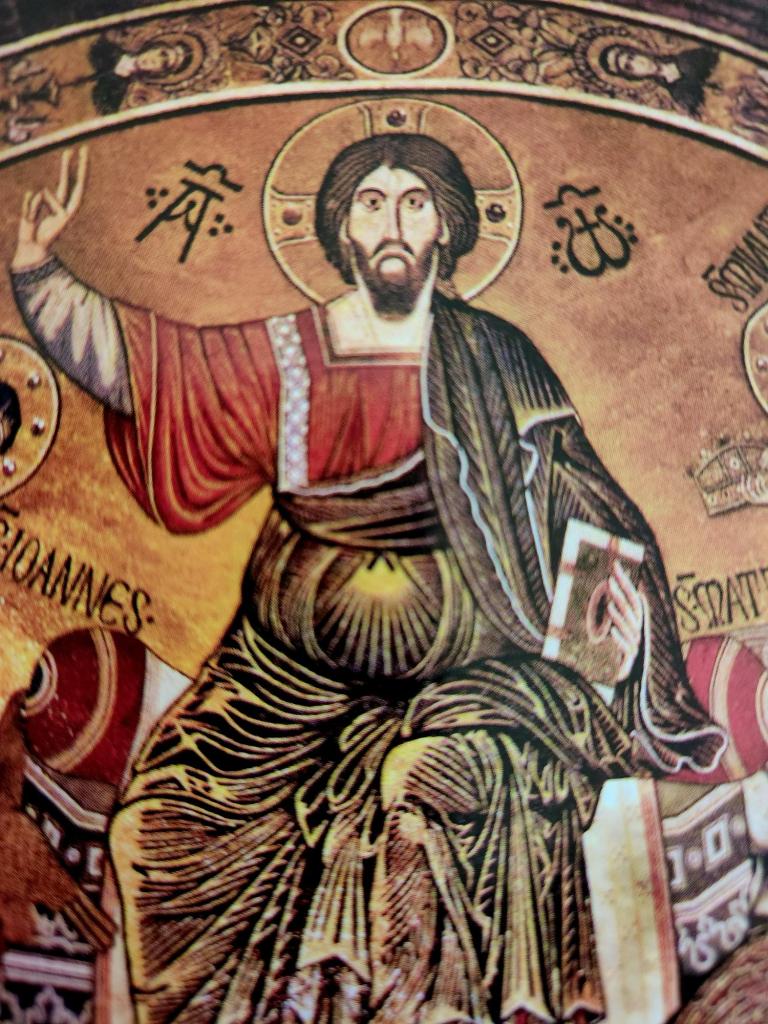
Christ the King, San Miniato al Monte Church, Florence, Italy

Today, this very moment, Christ is still on the throne of all creation. 

Human elections and institutions only have authority as given by Jesus, the Ruler of all.

Presently, Jesus is attentive and vigilant to people, actively interceding for us at the right hand of his Father in heaven. At this very moment, the Holy Spirit is the continuing presence of Christ on this earth, applying Christ’s redemption of humanity to the lives of millions. 

Sometimes we need to remember how important our spiritual resources are to living in this world – and to clarify what’s really of ultimate significance in this old broken world. 

My unwavering spiritual persuasion is this: People need the Lord. Therefore, it only makes good spiritual sense to live in ways that foster a connection with Jesus. 

This morning, I did what I do every morning – whether I’m sick or well, sad or happy, facing a busy day or a relaxed day – I began my day with Scripture reading, prayer, reflection, and gratitude. And I do it with the realization that Christ is King, that as the divine/human Lord of all, his:

  • authority is real
  • rule is benevolent
  • sovereignty is ubiquitous
  • reign is supreme
  • judgments are right and good
  • power is mighty enough to raise the dead

The Christian tradition holds that Jesus Christ is the exalted and glorified Son of God, the Sovereign authority over every dominion. The works of Jesus bear testimony to the cosmic reality that he is Lord of all. And, if that were not enough, Jesus shares his divine power with us, his people.

In the face of Christ’s majesty, the valid and appropriate response is sheer submission to Christ’s authority. 

Just as Jesus listened to the Father and obeyed the Father’s will, so we need to listen to Jesus and carry out his will. 

Just as Jesus enjoyed his relationship with the Father, so we are to bask in our wonderful relationship with Jesus. 

Since Jesus submitted to death on a cross and rose from the dead through God’s power, we now have access to that power by God’s grace through faith in Christ. And we are to use that divine power to take up our own cross and bear the great issues and problems of our day with all the spiritual resources granted to us in Christ Jesus.

Like Father, like Son. Like Christ, like Christians. May all followers of Jesus resemble their Lord in each word and in every way.

Almighty God, to you all hearts are open, all desires known, and from you no secrets are hid: Cleanse the thoughts of our hearts by the inspiration of your Holy Spirit, that we may perfectly love you, and worthily magnify your holy Name; through Christ our Lord. Amen.

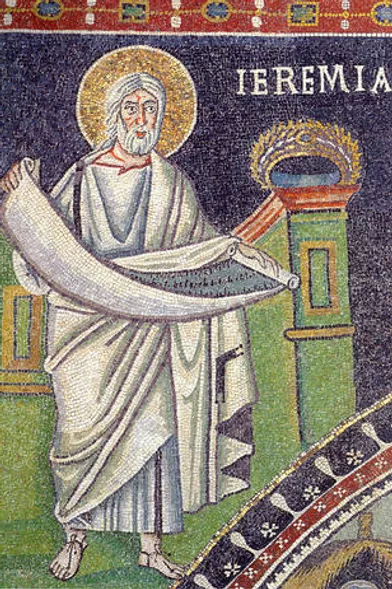
Speaking Truth to Power (Jeremiah 26:1-15)

The prophet Jeremiah, 6th century mosaic, Ravenna, Italy

Early in the rule of Judah’s King Jehoiakim, Josiah’s son, this word came from the Lord: The Lord proclaims: Stand in the temple courtyard and speak to all the people of the towns of Judah who have come to the temple to worship. Tell them everything I command you; leave nothing out. Perhaps they will listen, and each will turn from their evil ways. If they do, I will relent and not carry out the harm I have in mind for them because of the wrong they have done. 

So tell them, The Lord proclaims: If you don’t listen to me or follow the Instruction I have set before you—if you don’t listen to the words of the prophets that I have sent to you time and again, though you haven’t listened, then I will make this temple a ruin like Shiloh, and this city I will make a curse before all nations on earth.

The priests, the prophets, and all the people heard Jeremiah declare these words in the Lord’s temple. And when Jeremiah finished saying everything the Lord told him to say, the priests and the prophets and all the people seized him and said, “You must die! Why do you prophesy in the Lord’s name that ‘this temple will become a ruin like Shiloh, and this city will be destroyed and left without inhabitant’?” Then all the people joined ranks against Jeremiah in the Lord’s temple.

When the officials of Judah heard these things, they went up from the royal palace to the Lord’s temple and took their places at the entrance of the New Gate of the Lord’s temple. The priests and the prophets said to the officials and all the people: “This man deserves to die for prophesying against this city as you have all heard firsthand.”

Jeremiah said to all the officials and to all the people, “The Lord sent me to prophesy to this temple and this city everything you have heard. So now transform your ways and actions. Obey the Lord your God, and the Lord may relent and not carry out the harm that he’s pronounced against you. 

But me? I’m in your hands. Do whatever you would like to me. Only know for certain that if you sentence me to death, you and the people of this city will be guilty of killing an innocent man. The Lord has in fact sent me to speak everything I have said to you.” (Common English Bible)

When it comes to the spiritual and religious life, on the one hand, we hold the joy and contentment of divine connection and peace; and, on the other hand, we hold the sadness that many turn their backs on divine realities. In Christian terms, Jesus is both the cornerstone of faith and the stone which causes people to stumble and fall. (1 Peter 2:8)

Frankly, the Lord is not okay with cruel injustice, hollow worship, and inattention to both the divine and human. There is a way to make things right. But not everyone wants that. Systemic evil persists because there are always those who benefit from the current structures of power – and they care little about how it impacts those on the underbelly of their control.

Things may be going well for a large chunk of people. And, conversely, things may not be going well at all, for an even larger group of folks. Therefore, it is necessary to acknowledge that the world is not only good, but also quite broken. We must speak truth to power. I understand that this is no easy task, because rarely are things simply black and white, all good or all bad.

Jeremiah preaches in the temple gate, a woodcut by Unknown artist, 1886

In the prophet Jeremiah’s day, it was not that his opponents were pure evil with no acknowledgment of God. Rather, the problem was that the power brokers in Judah tried to keep a strict separation of religion from everything else; they were perfectly fine with God, that is, if the Lord would stay in the temple where he belonged.

But Jeremiah would have none of this sort of mentality and behavior. Keeping Yahweh out of matters of social justice, geopolitics, and institutional governance led to severe humanitarian problems. Jeremiah became God’s voice to a generation of people who ignored the divine in everything but religious ritual.

Bifurcating worship and work disconnects daily life from divine resources. Without God infused in all of life, a lack of grace fills the empty places. What’s more, the sovereign Lord can neither be silenced nor dismissed; God will find a way to accomplish peace and justice for the common good of everyone, and not just the few.

The heart of Jeremiah’s message was for king and people to be obedient in all of life, to recenter themselves around God’s law – not just the religious bits but the social ones, as well. Jeremiah did not proclaim something new. He was calling those in places of power and authority to a proper Torah observance.

The true needs and interests of our communities can never be addressed and lifted-up in the narrow self-serving interests of persons in power who turn a blind eye to anyone unlike them.

The needs and interests of our world lie in becoming who we were designed to be from the beginning: A people belonging to God, tapping into the deep reservoir of light and spirituality within us. It is to acknowledge the image of God inside us all.

We are to follow in the way of grace and truth. There is to be no division between the sacred and the secular because, for the Christian, Jesus is Lord of all.

We are to continually use our voice for both praise and prophecy, for shouting celebration to God and for speaking truth to power.

Holy God, the gracious Sovereign of all, we give you praise for your steadfast love toward us, your people. Keep us grounded in humility, sensitive to sin, attentive to that which is just and right, merciful in all things, pure in worship, and peace-loving through Christ our Lord in the strength of the Spirit. Amen.

Listen to the Prophets (Jeremiah 25:1-14)

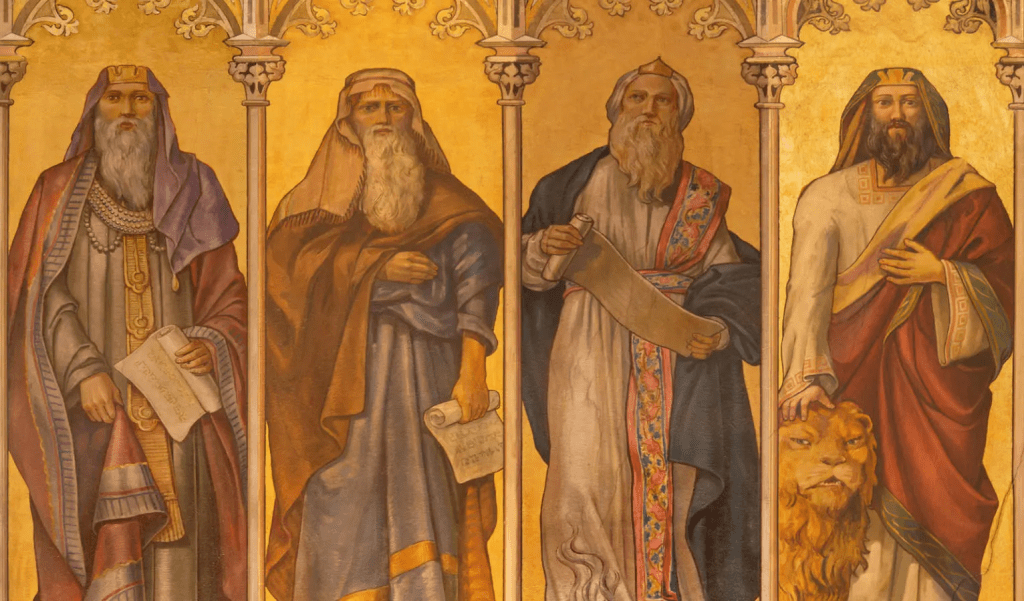
St. Nicholas Church fresco of the prophets Isaiah, Jeremiah, Ezekiel, and Daniel by Leopold Bruckner, Prešov, Slovakia

This is the Message given to Jeremiah for all the people of Judah. It came in the fourth year of Jehoiakim son of Josiah king of Judah. It was the first year of Nebuchadnezzar king of Babylon.

Jeremiah the prophet delivered the Message to all the people of Judah and citizens of Jerusalem:

From the thirteenth year of Josiah son of Amon king of Judah right up to the present day—twenty-three years it’s been!—God’s Word has come to me, and from early each morning to late every night I’ve passed it on to you. And you haven’t listened to a word of it!

Not only that but God also sent a steady stream of prophets to you who were just as persistent as me, and you never listened. They told you, “Turn back—right now, each one of you!—from your evil way of life and bad behavior and live in the land God gave you and your ancestors, the land he intended to give you forever. Don’t follow the god-fads of the day, taking up and worshiping these no-gods. Don’t make me angry with your god-businesses, making and selling gods—a dangerous business!

“You refused to listen to any of this, and now I am really angry. These god-making businesses of yours are your doom.”

The verdict of God-of-the-Angel-Armies on all this: “Because you have refused to listen to what I’ve said, I’m stepping in. I’m sending for the armies out of the north headed by Nebuchadnezzar king of Babylon, my servant in this, and I’m setting them on this land and people and even the surrounding countries. I’m devoting the whole works to total destruction—a horror to top all the horrors in history. And I’ll banish every sound of joy—singing, laughter, marriage festivities, genial workmen, candlelit suppers. The whole landscape will be one vast wasteland. These countries will be in subjection to the king of Babylon for seventy years.

“Once the seventy years is up, I’ll punish the king of Babylon and the whole nation of Babylon for their sin. Then they’ll be the wasteland. Everything that I said I’d do to that country, I’ll do—everything that’s written in this book, everything Jeremiah preached against all the godless nations. Many nations and great kings will make slaves of the Babylonians, paying them back for everything they’ve done to others. They won’t get by with anything.” God’s Decree. (The Message)

An ancient rabbi once said that we have two ears and one mouth so that we will listen twice as much as we talk. 

Listening with curious and focused attention is a forgotten skill and a lost art in Western society. 

Slick marketing, political punditry, and over-the-top speech all scream into the culture because there is such a dearth of listening. It seems many people are more concerned to make their opinions known than do any kind of deep listening to another.

No one seems to want to put in the work of discovering another’s true thoughts, feelings, and needs. Instead, we’d rather rant, play armchair quarterback, and make uninformed comments on things we don’t understand.

It’s really downright sad and tragic that we fail to listen to each other. And it is especially terrible when we do not listen to God. 

The Old Testament prophets exist because of a failure to listen. At the time of Jeremiah, not only did the people not hear; they refused to listen. They put their fingers in their ears and babbled “la-la-la-la-la.” So, it was only fitting that the Lord sent the people to Babylon.

This was not merely the inability to listen because they were overworked, too tired, or “hangry.” The problem was much deeper than that. For years, God kept up a steady stream of words, telling the people exactly what was expected. But they didn’t listen, on purpose. Like a parent speaking to an angsty teenager, it all went in one ear and out the other with nothing getting done.

God passionately desired the people to amend their evil ways. But they didn’t want to hear it. 

So, after years, even centuries of unfaithfulness, unrighteousness, and injustice, God’s patience came to its limit. Tragedy happened. The Babylonian Exile became a terrible and harsh reality.

If there is no deep listening to God and God’s Word to us, there will be deep repercussions. 

Listen, my friends: None of us can do the will of God if we don’t know what God wants. It takes listening. And listening takes focused attention. And focused attention requires a posture of humility. And humility requires being emptied of all pride and hubris. 

Apart from genuine listening with the intent to understand and alter actions accordingly, there will be no peace, no love, no grace. The space of inattention quickly fills with lazy ears, emotional heaviness, spiritual sickness, xenophobic suspicion, anxious fear, dark thoughts, angry rants, and a retreat into selfish caring for oneself. 

The beginning of wisdom and human flourishing starts with listening well. Paying attention through deep listening brings humility of heart, purification of pride, and love of God and neighbor.

Truly hearing the words of God leads to self-awareness, cries for God’s mercy, a knowledge of humanity, the study of Holy Scripture, and a familiarity with the Church’s long tradition of sound teaching.

Therefore, silence is vital for everyone. Prayer needs to be more about sitting still in solitude and silence in order to listen and much less about talking at God.

But if we insist on making more noise than a couple of skeletons dancing on a tin roof, we will eventually be those skeletons – without any substance and only good for the grave.

So, read the prophets. Listen to them. Pay attention to their message. And heed their warnings and exhortations. Your ears will be glad you did.

Holy Father and God of all, your speech goes out into all the earth. Your Word is there for us to hear if we will only but listen. 

Lord Jesus, let your words and your teachings penetrate so deeply into my soul that your loving ways come out of me in all I say and do.

Blessed Holy Spirit, help me to so listen to your inner voice that encouragement and forgiveness pours forth from the wellspring of a heart which is baptized in God’s Word. Amen.

Exiled (Jeremiah 52:12-30)

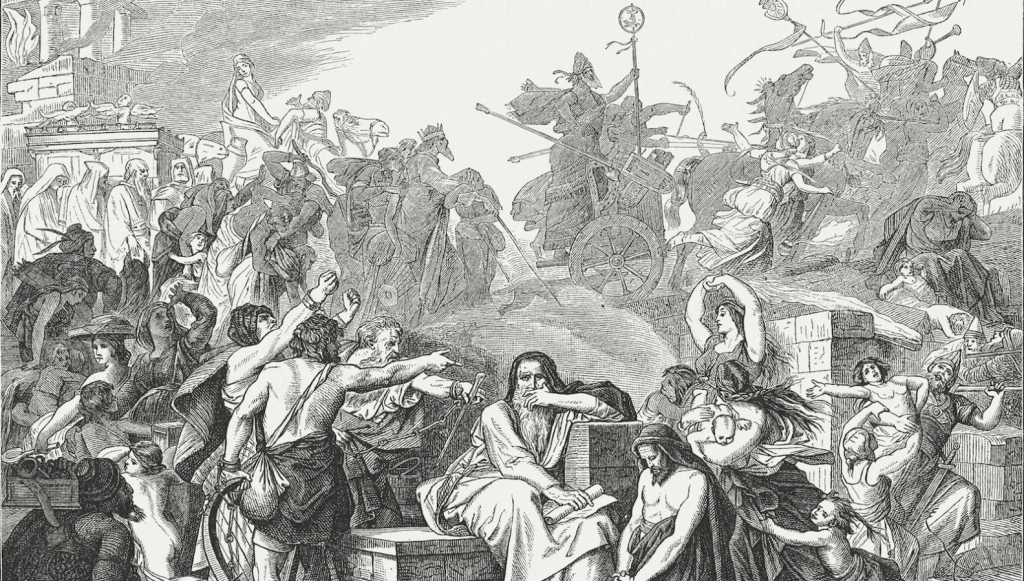
The Babylonian Exile by Jewish-German painter Eduard Bendemann (1811-1889)

In the nineteenth year of Nebuchadnezzar king of Babylon on the seventh day of the fifth month, Nebuzaradan, the king of Babylon’s chief deputy, arrived in Jerusalem. He burned the Temple of God to the ground, went on to the royal palace, and then finished off the city. He burned the whole place down. He put the Babylonian troops he had with him to work knocking down the city walls. Finally, he rounded up everyone left in the city, including those who had earlier deserted to the king of Babylon, and took them off into exile. He left a few poor dirt farmers behind to tend the vineyards and what was left of the fields.

The Babylonians broke up the bronze pillars, the bronze washstands, and the huge bronze basin (the Sea) that were in the Temple of God and hauled the bronze off to Babylon. They also took the various bronze-crafted liturgical accessories, as well as the gold and silver censers and sprinkling bowls, used in the services of Temple worship. The king’s deputy didn’t miss a thing. He took every scrap of precious metal he could find.

The amount of bronze they got from the two pillars, the Sea, the twelve bronze bulls that supported the Sea, and the ten washstands that Solomon had made for the Temple of God was enormous. They couldn’t weigh it all! Each pillar stood twenty-seven feet high with a circumference of eighteen feet. The pillars were hollow, the bronze a little less than an inch thick. Each pillar was topped with an ornate capital of bronze pomegranates and filigree, which added another seven and a half feet to its height. There were ninety-six pomegranates evenly spaced—in all, a hundred pomegranates worked into the filigree.

The king’s deputy took a number of special prisoners: Seraiah the chief priest, Zephaniah the associate priest, three wardens, the chief remaining army officer, seven of the king’s counselors who happened to be in the city, the chief recruiting officer for the army, and sixty men of standing from among the people who were still there. Nebuzaradan the king’s deputy marched them all off to the king of Babylon at Riblah. And there at Riblah, in the land of Hamath, the king of Babylon killed the lot of them in cold blood.

Judah went into exile, orphaned from her land.

3,023 men of Judah were taken into exile by Nebuchadnezzar in the seventh year of his reign.

832 from Jerusalem were taken in the eighteenth year of his reign.

745 men from Judah were taken off by Nebuzaradan, the king’s chief deputy, in Nebuchadnezzar’s twenty-third year.

The total number of exiles was 4,600. (The Message)

The Babylonian Exile by Fahri Aldin, 2017

Eventually, God’s words and decrees happen. It may take minutes. It might take centuries. But it will happen.

God promised destruction. It happened. The temple, the city walls, and the houses of Jerusalem were destroyed.

God decreed deportation of the people. It happened. Thousands of Jews were uprooted and moved to Babylon.

God foretold depression. It happened. The social and economic system of Judah collapsed.

God said there would be an occupation of Gentiles. It happened. The occupying force seized and confiscated the holy temple articles. They violated that which was sacred to Judah.

God repeatedly told the people that there would be a reckoning for the years of social injustice and religious infidelity. It happened. There was not just a deportation of persons; there were waves of removal.

The long prophecy of Jeremiah began with a proclamation of exile. It moved toward that exile. And then, in the end, the exile became reality.

Surely, it must have seemed to the citizens of Jerusalem that the end of the world was at hand. Their very identity as God’s people, as they had understood it for centuries, was now obliterated. Who are they now?

The Jewish exile changed forever their understanding of themselves and of God because they needed to reimagine what being the people of God really means without a place and without a temple.

God is both subject and object of all Holy Scripture, including the book of Jeremiah. Perhaps neglected in all the talk of exile is that the Lord was also cast-off, put away, and exiled. And rather than this being bad news, it becomes the good news that divine presence was right alongside the exiles.

In our darkest times, in the worst of circumstances, when all seems hopeless – there is a God who shows such solidarity with us that he is crucified and put to death so that we might live.

The Lord does not stand afar off from us but is beside us, even within us.

The sheer violation and agony of Good Friday and the depressive silence of Holy Saturday are the means of demonstrating the power of resurrection and new life.

We may be deported, depressed, and destroyed – exiled to a place we do not know and do not want to be. Yet, that is not the end of the story.

Exile is temporary. Mercy is forever. There cannot be a resurrection without a death. There must be suffering before there is glory.

Love wins. Every time.

God is Love. Thus, there is always hope….