Spiritual Support (Ezekiel 29:3-7)

Speak and say, The Lord God proclaims:

I’m against you, Pharaoh, Egypt’s king,
    great crocodile lurking
    in the Nile’s canals,
        who says, “The Nile is all mine;
        I made it for myself!”
I will set hooks in your jaws;
    I will make the fish from the Nile’s canals cling to your scales.
I will drag you out of the Nile’s canals,
    and also all the fish from the Nile’s canals
    clinging to your scales.
        I will fling you out into the desert,
        and also all the fish from the Nile’s canals.
You will fall on the open ground,
    and won’t be gathered or retrieved.

I’ve given you to the beasts of the earth
        and the birds in the sky for food.
Everyone living in Egypt will know that I am the Lord.

Because they were a flimsy crutch for the house of Israel—when they took you in hand, you would splinter and make their shoulders sore; when they leaned on you, you would break, bringing them to their knees. (Common English Bible)

“Relying on God has to begin all over again every day as if nothing yet had been done.”

C.S. Lewis

From where, and to whom, do we look to for support?

The Pharaoh of Egypt could open his mouth as wide as a crocodile, but he had no real strength – only talk and no bite – and talk is cheap, especially in the face of a sovereign God.

The Lord had little tolerance for Pharaoh’s bombast, so God decided to don the divine crocodile hunter hat and pull the old creature out of the Nile River.

The reeds that grow along the Nile in Egypt look something like bamboo. They appear as if they might make a decent staff or crutch, but the reeds are not good for that, and if used so, would shatter and put some significant splinters into your hand.

God was warning the Israelites against sizing up Egypt as a significant means of support, and then putting weight on them for help. The leadership of Jerusalem was trusting in Pharaoh and his Egyptian troops to rescue them from the Babylonian army.

But, as we know from history, the Babylonians soundly defeated the Egyptian soldiers. Pharaoh was no support, at all, and became a shattered crutch to Judah, just as God had warned.

We need to be careful about choosing our sources of support. There are a lot of unreliable means of help out there, that people turn to in life.

When going through tough times, we may believe that popularity and power, or alcohol and drugs, or wealth and position will help support us and get us through the hard situation. Yet, they all prove too weak and inadequate in the end.

God is able to carry a person through a crisis, so that we do not just survive it, but grow and thrive through it. We must continually be vigilant and wise to resist the temptation toward the shiny things in life which may draw us to depend upon unreliable things and people. We need God working through God’s people to help support us in a time of need.

Our help is in the name of the Lord,
    who made heaven and earth. (Psalm 124:8, NRSV)

One of the great Christian theologians of the twentieth century, the Protestant Swiss professor Karl Barth, believed that we are not fully human and fully supporting one another apart from:

  • mutual seeing and being seen
  • reciprocal speaking and listening
  • granting one another mutual assistance
  • doing everything with gratitude and gratefulness

Barth used the German term Mitmenschlichkeit (co-humanity) to communicate that we are human and supported with a trusted other person alongside us. In other words, human flourishing requires mutual giving and receiving. Only in relation to each other, including those in need, do we thrive as people.

Christianity is a dependence upon God and an inter-dependence on one another; it’s not an isolated independent venture. Adversity, hardship, and difficulty can become a symbiotic relationship between the care-seeker and the caregiver, within the foundation of Trinitarian love, expressed with grace and hope given by Jesus in the power of the Holy Spirit.

So, when we talk about spiritual support of another, it includes the following alliterated points:

  • Struggle. Enter another’s spiritual and emotional wrestling along with them, without succumbing to the impetus to change or fix, but to empathize, affirm, and validate emotions and experiences.
  • Share. Seek to be emotionally available and aware – to be present in another’s pain and wonderment, understanding that a person cannot go any deeper with me than I have gone with myself.
  • Story. Listen to the story that a person weaves about their own situation, background, family, support, religious milieu, as well as their personal spiritual and emotional world.
  • Salvation. Allow and give permission to the person to name and resolve their own struggle; because I am neither the Savior nor in the saving business, as if deliverance and freedom depended upon me.

“Do not let your hearts be troubled. Believe in God; believe also in me.”

Jesus to his disciples (John 14:1, NRSV)

Trust of another must be given carefully and wisely, not flippantly or thoughtlessly. And becoming a trusting person involves not only a willingness to do so, but also the presence to listen, the place to care, and the passion and commitment to do what is helpful, not hurtful.

Blessed God of support and strength, you have given me the shield of your salvation, and your right hand has supported me. Your divine help has gotten me through, and given me a wide place for my steps under me, so that my fee do not slip.

Gracious God, you have given me an example through the Lord Jesus that we must support the weak, remembering his words, “It is more blessed to give than to receive.” May it be so, in the strength given by the Holy Spirit, to your glory and honor. Amen.


God of the Living (Ezekiel 39:7-8, 21-29)

I will make sure that my people Israel know my holy name, and I will not let my name be disgraced any more. Then the nations will know that I, the Lord, am the holy God of Israel.”

The Sovereign Lord said, “The day I spoke about is certain to come….

The Lord said, “I will let the nations see my glory and show them how I use my power to carry out my just decisions. The Israelites will know from then on that I am the Lord their God. And the nations will know that the Israelites went into exile because of the sins which they committed against me. I turned away from them and let their enemies defeat them and kill them in battle. I gave them what they deserved for their uncleanness and their wickedness, and I turned away from them.”

The Sovereign Lord said, “But now I will be merciful to Jacob’s descendants, the people of Israel, and make them prosperous again. I will protect my holy name. When they are once more living in safety in their own land, with no one to threaten them, they will be able to forget how they were disgraced for having betrayed me. In order to show to the many nations that I am holy, I will bring my people back from all the countries where their enemies live. Then my people will know that I am the Lord their God. They will know this, because I sent them into captivity and now gather them and bring them back into their own land, not leaving even one of them behind. I will pour out my spirit on the people of Israel and never again turn away from them. I, the Sovereign Lord, have spoken.” (Good News Translation)

“God is trying to sell you something, but you don’t want to buy. This is what your suffering is: Your fantastic haggling, your manic screaming over the price!”

Hafiz, 14th century Persian mystic poet

A lot of folks struggle with their relationship with God in trying to make sense of the hard things they go through. Some interpret their troubles as a punishment from God. Others resign themselves to the difficulty and, at best, believe there must be some purpose to it all; and, at worst, simply state in defeat, “It is what it is.”

God most certainly does allow some awful things to happen. Although the Lord is not the author of the evil, God providentially bends all circumstances for the divine glory and for our benefit.

We may still cry out and insist, “But why must God do it this way? Isn’t there another path than the one I’m on?” It’s not bad to ask those questions. After all, the Lord Jesus himself cried out, “My Father, if it is possible, may this cup [of suffering] be taken from me. Yet not as I will, but as you will.” And, “My God, my God, why have you forsaken me?” (Matthew 26:39, 27:46, NIV)

In many ways, life is about detaching from all that hinders us from attaching to God. If we are mindful of this project, it’s likely we will realize a fulfilling connection with the divine. If, however, we lose sight of this, and become unaware of the vital relationship between God and humanity, then the Lord loves us enough to work on bringing us back into healthy relations.

It takes a lifetime of practice to let go and die to self.

And God will use every circumstance – both good and bad – to help us do that.

The Lord is glorified and shown forth as holy when we detach from all that is unhealthy and attach to everything that is just, right, and good.

God’s own Holy Spirit is the very person we need to guide us through each situation of our lives.

Typically, it is we ourselves who need to change, and not necessarily our circumstances. Yet, we too often fear change. The ego – the false self – hates change because it has bought into the belief that the outward projection of oneself to the world is the real thing (which it is not). Therefore, the ego tends to interpret each negative situation as an attack, rather than discerning that this might be the Lord getting at the inner heart of the person.

We must come to grips with the reality that one must change in order to love, and to love in order to change. Anytime we love someone or something else, we have died on some level; we let go of something so that we can grab hold of something else. The monkey who refuses to let go of the banana is trapped; the one who releases it grabs hold of freedom.

“Sin” is much less about moralistic religion, and much more about mistaking ourselves for someone we aren’t and not knowing to whom we belong. The ancient Israelites, whom the prophet Ezekiel addressed, had lost touch with who they are and whose they are. So, the Lord was determined to clarify it for them.

The realization of our true selves comes through love. And since God is love, knowing God enables us to regain our true essence.

The ego, although the necessary scaffolding for the emerging construction of the soul, must eventually be jettisoned. It would be weird if you erected a building, then kept up the façade. God is alive and deals with the living, and not the dead things around us.

Jesus said, “He’s not the God of the dead but of the living. In God’s sight all people are living.” (Luke 20:38, GW)

O Holy One, we call to you and name you as eternal, ever-present, and boundless in love. Yet there are times, O God, when we fail to recognize you in the dailyness of our lives. Sometimes shame clenches tightly around our hearts, and we hide our true feelings. Sometimes fear makes us small, and we miss the chance to speak from our strength. Sometimes doubt invades our hopefulness, and we degrade our own wisdom.

Holy God, in the daily round from sunrise to sunset, remind us again of your holy presence hovering near us and in us. Free us from shame and self-doubt. Help us to see you in the moment-by-moment possibilities to live honestly, to act courageously, and to speak wisdom. Amen.

The Age of the Spirit (Joel 2:18-29)

“Come, Holy Spirit,” by Mary Anne Durnin

The Lord was deeply concerned
about his land
    and had pity on his people.
In answer to their prayers
    he said,
“I will give you enough grain,
wine, and olive oil
    to satisfy your needs.
No longer will I let you
    be insulted by the nations.
An army attacked from the north,
but I will chase it
    into a scorching desert.
There it will rot and stink
from the Dead Sea
    to the Mediterranean.”

The Lord works wonders
    and does great things.
So tell the soil to celebrate
and wild animals
    to stop being afraid.
Grasslands are green again;
fruit trees and fig trees
    are loaded with fruit.
Grapevines are covered
    with grapes.

People of Zion,
celebrate in honor
    of the Lord your God!
He is generous and has sent
the autumn and spring rains
    in the proper seasons.
Grain will cover
    your threshing places;
jars will overflow
    with wine and olive oil.

I, the Lord your God,
will make up for the losses
    caused by those swarms
and swarms of locusts
    I sent to attack you.
My people, you will eat
    until you are satisfied.
Then you will praise me
for the wonderful things
    I have done.
Never again will you
    be put to shame.

Israel, you will know
    that I stand at your side.
I am the Lord your God—
    there are no other gods.
Never again will you
    be put to shame.

Later, I will give my Spirit
    to everyone.
Your sons and daughters
    will prophesy.
Your old men
    will have dreams,
and your young men
    will see visions.
In those days I will even give
my Spirit to my servants,
    both men and women. (Contemporary English Version)

Fresco of the prophet Joel in the Altlerchenfelder Church, Vienna, Austria

We are in the wake of Pentecost Day. But it ought not to have come as a surprise. There were prophetic rumblings of the Spirit’s future tornadic activity, long before the time of Jesus.

The prophet Joel, along with all the Old Testament prophets, had both a message of grace and of judgment. And so, this prophetic book falls naturally into those two parts.

Within the first part of the prophecy, Joel speaks of a terrible locust plague that came over Israel as a judgment from God. The people had strayed from their spiritual and religious ways of covenant with God. The locusts, destroying every plant in their path, reflected the people’s lack of spiritually thriving and growing in grace. They, too, were vulnerable to destruction. They needed to repent and to return to their God.

Yet, the Lord’s anger lasts only a moment, but God’s mercy and blessing endure forever. So, words of grace were offered to the people. There is a time coming, Joel insisted, when God will pour out the divine Spirit far and wide to bless the people and contend with the nations who oppose the covenant community.

Put another way, the first part of the prophecy describes how God fought against God’s own people, to bring them back to their spiritual senses. And the second part of the prophecy describes how the Lord will fight against the nations who fight against God and God’s people.

The people’s affections and allegiance became attached to other things rather than God. So, the Lord sent an army of locusts to oppose them, to challenge their milquetoast and half-hearted attempts at following divine instructions.

Joel foresaw two things coming as the great Day of the Lord approaches: a great outpouring of the Holy Spirit; and a terrible time of divine judgment. 

Let’s take a few things to heart as a response to Joel’s prophecy:

Be aware of God’s purpose in history

From grasshopper swarms to world-wide judgment, to the dissolving of sun and moon—God’s purpose is to reveal divine glory to all the world.

“You will know that I am in the midst of Israel,
        and that I am the Lord your God—no other exists;
        never again will my people be put to shame.” (Joel 2:27, CEB)

“Father, the hour has come; glorify your Son so that the Son may glorify you.” Jesus (John 17:1, NRSV)

Stay close to the Lord

Don’t wander from God. But, if you do, the Lord will spend all kinds of energy in bringing us back and restoring us.

“But even now,” declares the Lord,
“return to me with all your heart—
with fasting, crying, and mourning.” (Joel 2:12, GW)

And the God of all grace, who called you to his eternal glory in Christ, after you have suffered a little while, will himself restore you and make you strong, firm and steadfast. (1 Peter 5:10, NIV)

Change the inside, not the outside

Repentance and faith are to be a way of life, and not simply a one time event. The way we present ourselves on the outside is a projection of what we want others to see. But God sees the heart, so we must go there and focus on the inner person.

Don’t rip your clothes
    to show your sorrow.
Instead, turn back to me
    with broken hearts.
I am merciful, kind, and caring.
I don’t easily lose my temper,
    and I don’t like to punish. (Joel 2:13, CEV)

Endure what you suffer as being a father’s punishment; your suffering shows that God is treating you as his children. Was there ever a child who was not punished by his father? If you are not punished, as all his children are, it means you are not real children, but bastards. In the case of our human fathers, they punished us and we respected them.

How much more, then, should we submit to our spiritual Father and live! Our human fathers punished us for a short time, as it seemed right to them; but God does it for our own good, so that we may share his holiness. When we are punished, it seems to us at the time something to make us sad, not glad. Later, however, those who have been disciplined by such punishment reap the peaceful reward of a righteous life. (Hebrews 12:7-11, GNT)

Earnestly seek the outpouring of the Holy Spirit

On the Day of Pentecost, the Apostle Peter said that the coming of the Holy Spirit was a fulfillment of Joel’s prophecy (Acts 2:16). That was just the beginning of the blessing. The Holy Spirit is still operative and active in the church and the world. The prophecy is far from complete.

In reply to those who were concerned about others prophesying and thereby possibly challenging authority, Moses said:

“Are you concerned what this might do to me? I wish the Lord would give his Spirit to all his people so everyone could be a prophet.” (Numbers 11:29, CEV)

And those who observed and heard the Spirit being poured out, exclaimed with slack jawed amazement:

“Aren’t these all Galileans? How come we’re hearing them talk in our various mother tongues?

Parthians, Medes, and Elamites;
Visitors from Mesopotamia, Judea, and Cappadocia,
    Pontus and Asia, Phrygia and Pamphylia,
    Egypt and the parts of Libya belonging to Cyrene;
Immigrants from Rome, both Jews and proselytes;
Even Cretans and Arabs!

“They’re speaking our languages, describing God’s mighty works!” (Acts 2:7-11, MSG)

The age of the Spirit is here. It hasn’t gone away. So, let’s pursue the spiritual life with all the energy given us, to the glory and praise of God. Amen.

Get Rid of Grumbling (Numbers 16:41-50)

Grumbling broke out the next day in the community of Israel, grumbling against Moses and Aaron: “You have killed God’s people!”

But it so happened that when the community got together against Moses and Aaron, they looked over at the Tent of Meeting and there was the Cloud—the Glory of God for all to see.

Moses and Aaron stood at the front of the Tent of Meeting. God spoke to Moses: “Back away from this congregation so that I can do away with them this very minute.”

They threw themselves face down on the ground.

Moses said to Aaron, “Take your censer and fill it with incense, along with fire from the Altar. Get to the congregation as fast as you can: make atonement for them. Anger is pouring out from God—the plague has started!”

Aaron grabbed the censer, as directed by Moses, and ran into the midst of the congregation. The plague had already begun. He put burning incense into the censer and atoned for the people. He stood there between the living and the dead and stopped the plague.

Fourteen thousand seven hundred people died from the plague, not counting those who died in the affair of Korah. Aaron then went back to join Moses at the entrance to the Tent of Meeting. The plague was stopped. (The Message)

grum-bled, grum-bling, grum-ble:

  • to murmur or mutter in discontent; complain sullenly
  • an expression of discontent; complaint; unhappy murmur; growl.

Out of all the bad things in this old world, grumbling and murmuring aren’t typically at the top of our list of heinous sins. Yet, they’re bad. The reason grumbling needs squelching is because complaining is like a gateway drug – start using it and it will surely lead to worse things, unless stopped.

A surefire way to divide a community of people is by grumbling and complaining. This was the deliberate tool of Korah – a Levite who was angling for more power and authority amongst the Israelites in their sojourn in the desert. His stirring up rebellion through constant complaints was a high-handed sin, meant to undercut Moses as the leader.

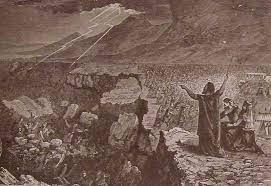
The revolt he incited resulted in a dramatic intervention of God in causing the earth to open up and swallow Korah and the rebels. The Lord has a zero tolerance policy toward satanic plans of upending godly leadership and replacing it with a lust for power.

The Punishment of Korah, Holman Illustrated Bible, 1890

Unfortunately, this was not the end of the story. Aftershocks of grumbling erupted around the community. And it was dealt with by God with the same sort of wrath that Korah experienced. A plague broke out and many more died.

So, why all the death? This was far more than a bunch of malcontents who were griping about how things were going. It was an assault against the Lord – in the same way Lucifer once brought rebellion to heaven. In both cases, swift action was taken.

Please keep in mind that we need a nuanced understanding of complaining, grumbling, and arguing. A great deal of complaining is an expression of grief, of pushing back against the hurt. There’s also the grumbling that comes because everybody else is doing it. But then there is the sort of grumbling that is intended to topple God as the authority and place oneself in that position. That’s the nasty sort which will get one in a heap of trouble.

I once had a parishioner, several years back, who continually complained about me. More than that, he seemed to be always trying to get others to join him in his constant grumbling. I certainly tried to be as meek as Moses. Whether that happened, or not, I’m not sure.

It got bad enough that one Sunday, the grumbler invited me to come outside after church and settle things “like men,” which meant with fisticuffs. Oy.

About a month later, the man was standing in his driveway, then fell straight over. He was dead before he even hit the pavement. I’ll leave it to you for an interpretation. I’ll also say that, obviously, the grumbling and rebellion stopped.

The people’s grumbling and revolt against Moses was tantamount to rebelling against God.

Grumbling is not okay. Whenever folks dig in and complain in order to overturn something or someone which the Lord has established, their plans for destruction get turned in on themselves. In other words, what happens to themselves is what they were planning all along for another.

The New Testament author of Hebrews picked up this tone of grumbling from the ancient Israelites, and offered a warning to his own contemporary audience:

“Today, if you hear his voice,
    do not harden your hearts
as you did in the rebellion,
    during the time of testing in the wilderness,
where your ancestors tested and tried me,
    though for forty years they saw what I did.
That is why I was angry with that generation;
    I said, ‘Their hearts are always going astray,
    and they have not known my ways.’
So I declared on oath in my anger,
    ‘They shall never enter my rest.’ ”

See to it, brothers and sisters, that none of you has a sinful, unbelieving heart that turns away from the living God. (Hebrews 3:8-12, NIV)

The author also provided some simple yet profound exhortation for keeping grumbling and murmuring at bay:

But encourage one another daily, as long as it is called “Today,” so that none of you may be hardened by sin’s deceitfulness. (Hebrews 3:13, NIV)

Encouragement is the daily practice which prevents a hard heart and soul rot – the very things which lead a person to begin complaining and rebelling.

If there is no encouragement, complaints will take root. And if complaints take root, bitterness begins to grow. And if bitterness begins to grow, it will feed itself on grudge-bearing. And if grudge-bearing persists, it will have very unpleasant results.

See to it that no one falls short of the grace of God and that no bitter root grows up to cause trouble and defile many. (Hebrews 12:15, NIV)

So, let us cultivate the fruit of the Spirit, and put aside the shameful deeds of darkness. Let us look for ways to encourage one another, rather than tearing down each other. Let us:

Fix our eyes on Jesus, the pioneer and perfecter of faith. For the joy set before him he endured the cross, scorning its shame, and sat down at the right hand of the throne of God. Consider him who endured such opposition from sinners, so that you will not grow weary and lose heart. (Hebrews 12:2-3, NIV)

Holy God, you work in us to will and to act in order to fulfill your good purpose. Help us to do everything without grumbling or arguing, so that we may become blameless and pure, without fault in a warped and crooked generation, through Jesus Christ our Lord, in the power of the Holy Spirit. Amen.