Integrity In All Things (Proverbs 11:3-13)

The Narrow Road, by Debbie Clark

Integrity guides the virtuous,
    but dishonesty ruins the treacherous.
Riches don’t help in the day of wrath,
    but righteousness rescues from death.
The righteousness of the innocent makes their path straight,
    but the wicked fall in their wickedness.
Those who do right are saved by their righteousness,
    but the untrustworthy are caught by their own desires.
When the wicked die, their hope perishes.
    Yes, any hope based on money perishes.
The righteous are saved from distress,
    and the wicked take their place.
The godless destroy their neighbors by their words,
    but the righteous are saved by their knowledge.
When the righteous succeed, a city rejoices;
    when the wicked perish, there are shouts of joy.
A city is honored by the blessing of the virtuous;
    it is destroyed by the words of the wicked.
Whoever despises their neighbor lacks sense;
    a sensible person keeps quiet.
A slanderer walks around revealing secrets,
    but a trustworthy person keeps a confidence. (Common English Bible)

Integrity appears to be in short supply these days. No matter whether it’s a church, a corporation, an institution, organization, or governmental administration, it only takes one person in authority who is without integrity to ruin the whole enterprise.

This is why it is so important to never normalize bad behavior and bad speech. It will do no good to simply say, “Well, that’s just the way he is.” Everyone, no matter who they are, must be held accountable for their words and actions. And if we choose to let the unvirtuous person continue in their lack of integrity, then we ourselves become complicit in their unjust activity.

What the unrighteous person fails to realize, is that watching out for number one and taking advantage of others will eventually come back to bite them. The unscrupulous rich person will lose their wealth. The unjust person will come face to face with what their injustice has done. The slanderous person shall be unmasked and seen by all for what they truly are.

The Teacher of Proverbs informs us that evildoers will suffer in their wickedness; whereas the righteous shall be rewarded. Everyone eventually receives what they deserve – whether it’s the righteous or the wicked.

This sort of karmic sense of justice happens both in this life and the life to come. Those who do and say whatever they want, without any integrity, undergo a double-suffering: They’re tormented now in the present, and likely into the future; that is, unless they undergo some Scrooge-like transformation.

The suffering of the wicked is caused by their own stupid foolish choices without any direct intervention by God. God’s law, much like the natural law of gravity, has consequences if you choose to disrespect it. In that sense, the wicked also suffer divine condemnation.

The Lord favors good people,
    but he condemns schemers. (Proverbs 12:2, CEB)

Even though the wicked prosper, by no means is it permanent. And although the righteous are deeply disturbed and troubled by the constant lies and evil machinations of wicked persons, they shall realize a world that is just, right, and good. Injustice and unrighteousness are temporary.

The evil person will surely not go unpunished,
    but the children of the righteous will escape. (Proverbs 11:21, CEB)

It may drive us batty to see that evil is having its way, and that the wicked are doing quite nicely for themselves, but the Teacher seeks to comfort the righteous with the reality that it will not always be this way.

Stolen bread is sweet,
    but afterward the mouth is full of gravel. (Proverbs 20:17, CEB)

We know we’re living in an upside-down messed-up world because the righteous too often suffer and the wicked too often prosper. But it won’t last.

It’s important we remain honest and above board – no matter the circumstances. Whether its in business dealings, leadership, family relations, community involvement, or political activity, its imperative to be a person of integrity without any hint of duplicity.

Dishonesty may get the wicked person where they want to go in the short term, but it has a devastating price to pay. Deals with the devil always do.

Better a little with righteousness
    than great profits without justice. (Proverbs 16:8, CEB)

The Lord is a just God. That means God does more than show justice in all things; justice is a part of God’s very character and makeup. God cannot be unjust because God is Justice with a capital “J.”

Its way above our pay-grade to seek retribution and revenge on another. Exacting judgment belongs to God, and not you nor me.

Don’t say, “I’ll repay the evildoer!”
    Wait for the Lord, and he will save you. (Proverbs 20:22, CEB)

In the past several months, I have largely abandoned social media and electronic conversations with others. There is too much of the godless (cloaked in godly language) destroying their neighbor with their angry words and ignorant misinformation. I don’t want to get sucked into that vortex of ridiculousness. I’ll let the Lord deal with them. I have bigger fish to fry than to get involved in unhelpful and often harmful communication.

I rather choose to focus my time, effort, and words on reminding myself and others of the need for integrity in all things; always remaining prudent; and practicing self-awareness. When Christ returns, I’d like him to find me patiently waiting in quiet trust – instead of spewing a bunch of nasty vitriol that is consistent with Satan, not God.

For me, Proverbs isn’t simply a nice book of the Bible to read. Rather, it is vital knowledge to internalize and learn from. Without the wisdom of Proverbs, I’m undone and adrift. I need these short pity statements of experiential truth to help me understand how to talk and act in this fallen world.

This is why its important to read Proverbs slowly, carefully, prayerfully; to meditate upon these wise statements; and to reflect on putting them into practice. Integrity in everything – both speech and action – will serve us well, now and forever.

Wise God, may divine wisdom shape my thoughts, decisions, and actions each day as I seek to live by the Spirit. Lead me into all truth as I submit wise teaching; and to You as my Counselor and Guide; through Christ my Lord. Amen.

Divine Judgment and Human Judgmentalism (Luke 21:20-24)

Jesus Wept Over It, by Enrique Simonet, 1892

“When you see Jerusalem surrounded by armies, then know that its desolation has come near. Then those in Judea must flee to the mountains, and those inside the city must leave it, and those out in the country must not enter it, for these are days of vengeance, as a fulfillment of all that is written. Woe to those who are pregnant and to those who are nursing infants in those days! For there will be great distress on the earth and wrath against this people; they will fall by the edge of the sword and be taken away as captives among all nations, and Jerusalem will be trampled on by the nations, until the times of the nations are fulfilled. (New Revised Standard Version)

Judgment is coming… and is already here…

To be more specific, God’s judgment is coming; and humanity’s judgmentalism is already here.

Because of our judgmental spirits, we ought not be surprised that the judgment of God will be here soon.

I cannot get through a day – barely an hour – without hearing judgmental statements coming from another’s mouth. And sometimes, it’s my own mouth.

Judgmentalism is rife. It’s everywhere. And there’s no way to escape it. In a “normal” day (if there is such a thing for me) I hear all sorts of statements, without even trying to hear them. And when I do, I usually have a thought about it (in the parentheses):

  • “They did it because they don’t care about anything.” (And you don’t seem to give a rat’s rear end about understanding why they did it.)
  • “They deserved all the bad stuff they received.” (And you don’t?)
  • “The only reason they got the job to begin with is because of their connections.” (I didn’t realize that you are all-seeing, like God)
  • “You don’t know what you’re talking about!” (Maybe, but neither do you.)
  • “The rain is terrible.” (That’s your assessment. But it isn’t the local farmer’s assessment of the rain. He thinks it’s wonderful.)

Judgmentalism is the tendency to make quick and excessively critical judgments of others, especially moral judgments which characterize another’s thinking or way of being as immoral, unethical, monstrous, and/or harmful.

Our human judgmentalism of one another tends to detract from the sort of judgment we ought to be paying attention to.

Ultimately, none of us sits as Judge to arbitrate what who deserves punishment, or not. That is the job of Judge Jesus. So, when the true judge speaks, it behooves us to listen and follow through with what he (Christ) says about upcoming divine judgment.

When Jesus said his words of Jerusalem’s impending destruction, he was making it clear that these would be days of God’s vengeance, of divine judgment against the people. It would not last forever, because the wrath of God never does.

Yet, judgment is imminent. God will not let times of injustice, unrighteousness, and hatred last without end.

Therefore, Jesus was warning his disciples, and all who would follow him, about how they are to live while they await the end of all things.

We are not to be led astray, and be fooled by anyone who claims the name of Christ, yet lives like a devil. Unfortunately, some will foolishly succumb to falsehood. Everyone will suffer in some way.

Believers are to be watchful and prayerful. This is not passivity on our part, but actively putting a great deal of energy into becoming wise and interceding on behalf of others.

If we cannot sit still in silence, in contemplative prayer, for even 20 minutes, then we have a problem. It will be quite difficult to discern the good, right, and just.

If we cannot go half the day without making a judgmental statement about another person, then we have an addiction which needs to be broken.

If we continue to have reasons why we cannot (and therefore will not) read or listen to Holy Scripture, especially the New Testament Gospels of Jesus, then we are likely following someone else other than Christ.

If we keep moaning about the state of the world, the problems in our families, and all the local issues of our communities, then it is imperative that we come back to examining the words and ways of Jesus and deal with our own junk, instead lamenting everyone else’s.

If you know how to prepare for a zombie apocalypse, a new movie that’s coming out, or a birthday party for someone, but don’t have any idea about how to make life preparations for a coming disaster (let alone your own eventual death) then the last thing that ought to be happening is judging another person for anything at all.

You’ve got some work to do to get ready for the coming of Christ.

“Let us be alert to the season in which we are living. It is the season of the Blessed Hope, calling for us to cut our ties with the world and build ourselves on this One who will soon appear. He is our hope—a Blessed Hope enabling us to rise above our times and fix our gaze upon Him.”

A.W. Tozer

It’s possible that you may want to judge me for saying not to be judgmental. It’s happened more than once in my life. Yet, if we can learn to distinguish between the person and the behavior, then we can deal with unjust behavior, and leave any condemnation of the person to God.

If ever we struggle to know what to do, one can never go wrong with showing grace.

Gracious God, I repent for being quick to pass judgement both in speech and thought. For every time my words or actions of judgment and condemnation have hurt someone, I repent. Lord, I pray that I will not focus on the faults or shortcomings of others. Help me to see others through the eyes of grace. Amen.

The Trumpets of Judgment (Revelation 8:6-9:12)

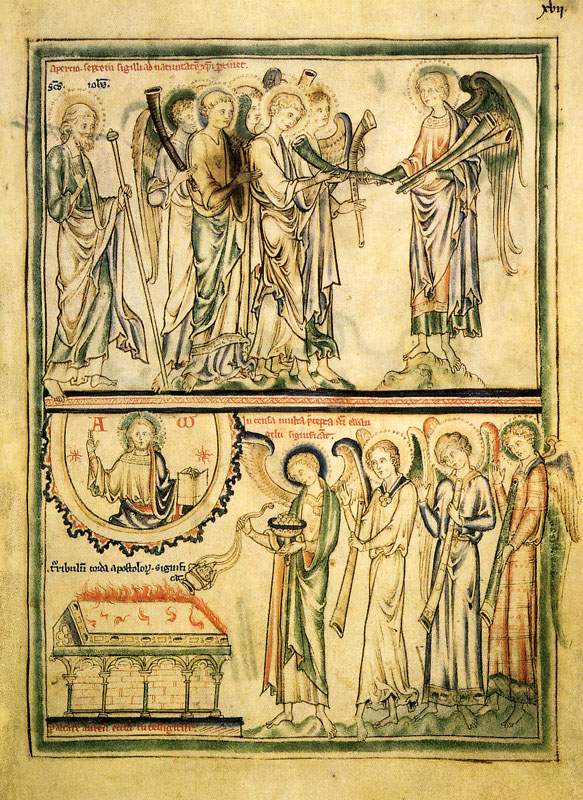
The seven angels with seven trumpets, and the angel with a censer, c. 1020 C. E.

Then the seven angels who had the seven trumpets prepared to sound them.

The first angel sounded his trumpet, and there came hail and fire mixed with blood, and it was hurled down on the earth. A third of the earth was burned up, a third of the trees were burned up, and all the green grass was burned up.

The second angel sounded his trumpet, and something like a huge mountain, all ablaze, was thrown into the sea. A third of the sea turned into blood, a third of the living creatures in the sea died, and a third of the ships were destroyed.

The third angel sounded his trumpet, and a great star, blazing like a torch, fell from the sky on a third of the rivers and on the springs of water—the name of the star is Wormwood. A third of the waters turned bitter, and many people died from the waters that had become bitter.

The fourth angel sounded his trumpet, and a third of the sun was struck, a third of the moon, and a third of the stars, so that a third of them turned dark. A third of the day was without light, and also a third of the night.

As I watched, I heard an eagle that was flying in midair call out in a loud voice: “Woe! Woe! Woe to the inhabitants of the earth, because of the trumpet blasts about to be sounded by the other three angels!”

The fifth angel sounded his trumpet, and I saw a star that had fallen from the sky to the earth. The star was given the key to the shaft of the Abyss. When he opened the Abyss, smoke rose from it like the smoke from a gigantic furnace. The sun and sky were darkened by the smoke from the Abyss. And out of the smoke locusts came down on the earth and were given power like that of scorpions of the earth. 

They were told not to harm the grass of the earth or any plant or tree, but only those people who did not have the seal of God on their foreheads. They were not allowed to kill them but only to torture them for five months. And the agony they suffered was like that of the sting of a scorpion when it strikes. During those days people will seek death but will not find it; they will long to die, but death will elude them.

The locusts looked like horses prepared for battle. On their heads they wore something like crowns of gold, and their faces resembled human faces. Their hair was like women’s hair, and their teeth were like lions’ teeth. They had breastplates like breastplates of iron, and the sound of their wings was like the thundering of many horses and chariots rushing into battle. They had tails with stingers, like scorpions, and in their tails they had power to torment people for five months. They had as king over them the angel of the Abyss, whose name in Hebrew is Abaddon and in Greek is Apollyon (that is, Destroyer).

The first woe is past; two other woes are yet to come. (New International Version)

Angels receiving seven trumpets, c. 1255 C.E.

Woah; this isn’t exactly some light bedtime reading. It has to do with the end of all things, with God’s judgment upon the earth. Seven angels with seven trumpets are about to sound them with disastrous results. The last three trumpets are also referred to as the three woes upon the earth.

The first four trumpets are bad, yet not nearly as terrible as the last three. The first four affect the natural world and one-third of the earth; whereas the last three directly impact the earth’s inhabitants and affect the entire world.

As hard as it may be to accept biblical readings like today’s, God is not only the author of abundant flourishing, but also of devastating destruction. And it’s in direct answer to the prayers of the saints. (Revelation 8:3)

Although hail and blood remind the biblical student of the plagues of judgment in ancient Egypt before the great exodus of Israelites, it’s the fire that does damage to the trees and grass of the earth. A third of the earth’s land resources are completely burned up.

The second angel blowing the second trumpet results in a great mountain being hurled into the sea. This is reminiscent, for those familiar with the Gospels, of Jesus stating that one with a small amount of faith can command a mountain to be thrown into the sea, and it will be done. (Mark 11:23)

Going back into the Old Testament, in the giving of the Law on the mountain, and with the disobedience of the people at the foot of the mountain, Mount Sinai was ablaze with fire and the glory of God. The New Testament scene in Revelation appears to be something of a Mount Sinai taken up and thrown into the sea – signifying that the grace of Christ has supplanted the curse of the law.

As a result of the second trumpet, a third of all the great oceans are destroyed.

Although C.S. Lewis gave the name “Wormwood” to a fictional agent of Satan, the Wormwood here is a messenger of God, a star that falls from the sky as a result of the third trumpet blown. A third of all the earth’s drinkable water becomes bitter because of the star – which seems to be a link to previous times of judgment from God:

“I will make them eat bitter food
    and drink poisoned water,
because from the prophets of Jerusalem
    ungodliness has spread throughout the land.” (Jeremiah 23:15, NIV)

“They have followed the stubbornness of their hearts; they have followed the Baals, as their ancestors taught them.” Therefore this is what the Lord Almighty, the God of Israel, says: “See, I will make this people eat bitter food and drink poisoned water. (Jeremiah 9:14-15, NIV)

There’s nothing that falls from the sky with the blast of the fourth trumpet. Yet a third of the sun, moon, and stars are dimmed. This is a portent that something worse is about to happen – which is what the “eagle” [vulture] announces against the earth’s inhabitants.

Another star falls to the earth, but with even more disaster than the previous star – opening a pit in the heart of the earth. Smoke comes billowing out, darkening the sun. Then, locusts with the stinging power of scorpions, come upon the land.

Rather than humans having authority to trample on snakes and scorpions, these demonic insects carry the ability and the authority to harm humanity – much like the great locust horde of judgment during the time of the prophet Joel (Joel 2:1-11). The difference with John’s Apocalypse is that these are a demonic host with Apollyon the Destroyer leading them.

The previous judgments were from above; this first woe is from below – connecting the powers of death, destruction, and the grave together with the force of evil. It’s a time of sheer torture; a traumatic five months of horrendous agony.

Conclusion

None of these terrible scenes of judgment are meant to scare the hell out of anybody and put the fear of heaven into them. Instead, the New Testament book of Revelation (also known as the Apocalypse of John) is meant for devoted believers in Jesus to be encouraged that an end is coming. They can persevere in following Jesus because it will be worth it.

The hardships, difficulties, and persecutions experienced – for following the words and ways of Jesus – will not last; a time is coming soon when God will judge the living and the dead. Evil will be dealt its final blow. And we will enter a realm of unending peace with the God for whom we have given our all.

Therefore, since we are receiving a kingdom that cannot be shaken, let us be thankful, and so worship God acceptably with reverence and awe, for our “God is a consuming fire.” (Hebrews 12:28-29; Deuteronomy 4:24)

May the Lord answer you in the day of trouble!
    The name of the God of Jacob protect you!
May he send you help from the sanctuary
    and give you support from Zion.
May he remember all your offerings
    and regard with favor your burnt sacrifices. Selah

May he grant you your heart’s desire
    and fulfill all your plans. Amen. (Psalm 20:1-4)

Dealing with Denial (Jeremiah 32:1-9, 36-41)

The Lord spoke to me in the tenth year that Zedekiah was king of Judah, which was the eighteenth year that Nebuchadnezzar was king of Babylonia. At that time, the Babylonian army had surrounded Jerusalem, and I was in the prison at the courtyard of the palace guards. Zedekiah had ordered me to be held there because I told everyone that the Lord had said:

I am the Lord, and I am about to let the king of Babylonia conquer Jerusalem. King Zedekiah will be captured and taken to King Nebuchadnezzar, who will speak with him face to face. Then Zedekiah will be led away to Babylonia, where he will stay until I am finished with him. So, if you people of Judah fight against the Babylonians, you will lose. I, the Lord, have spoken.

Later, when I was in prison, the Lord said:

Jeremiah, your cousin Hanamel, the son of your uncle Shallum, will visit you. He must sell his field near the town of Anathoth, and because you are his nearest relative, you have the right and the responsibility to buy it and keep it in the family.

Hanamel came, just as the Lord had promised. And he said, “Please buy my field near Anathoth in the territory of the Benjamin tribe. You have the right to buy it, and if you do, it will stay in our family.”

The Lord had told me to buy it from Hanamel, and so I did. The price was 17 pieces of silver, and I weighed out the full amount on a scale….

Jeremiah, what you said is true. The people of Jerusalem are suffering from hunger and disease, and so the king of Babylonia will be able to capture Jerusalem.

I am angry with the people of Jerusalem, and I will scatter them in foreign countries. But someday I will bring them back here and let them live in safety. They will be my people, and I will be their God. I will make their thoughts and desires pure. Then they will realize that, for their own good and the good of their children, they must worship only me. They will even be afraid to turn away from me. I will make an agreement with them that will never end, and I won’t ever stop doing good things for them. With all my heart I promise that they will be planted in this land once again. (Contemporary English Version)

Denial is a powerful mental force.

Disaster was about to befall Jerusalem and its inhabitants. Few were prepared for what was ahead. But they should have been ready. That’s because the prophet Jeremiah repeatedly told the king and the people about their need to live in justice and righteousness.

The dominant belief within the city was that judgment would never come to them. The people looked at their covenant with the Lord, and the presence of the temple, as some sort of rabbit’s foot or insurance policy that would keep invading armies at bay.

But they were in denial about what was actually occurring. The people lived as they wanted, giving Yahweh some temple time and a bit of worship, but then turned around and also worshiped other gods. Furthermore, they exploited the poor, took advantage of the needy, and engaged in unscrupulous business practices. So, the prophet Jeremiah was given a message by God to the people:

I brought you here to my land,
    where food is abundant,
but you made my land filthy
    with your sins.
The priests who teach my laws
    don’t care to know me.
Your leaders rebel against me;
your prophets
    give messages from Baal
    and worship false gods….

You, my people, have sinned
    in two ways—
you have rejected me, the source
    of life-giving water,
and you’ve tried to collect water
in cracked and leaking pits
    dug in the ground. (Jeremiah 2:7-8, 14, CEV)

The message was repeatedly ignored, along with warnings of judgment, if the people did not change their errant ways. The city’s denial was palpable, holding the false belief that the Babylonians could never take them, and that God was on their side.

Pay attention, people of Judah! Change your ways and start living right, then I will let you keep on living in your own country. Don’t fool yourselves! My temple is here in Jerusalem, but that doesn’t mean I will protect you. I will keep you safe only if you change your ways and are fair and honest with each other. Stop taking advantage of foreigners, orphans, and widows. Don’t kill innocent people. And stop worshiping other gods. Then I will let you enjoy a long life in this land I gave your ancestors. (Jeremiah 7:3-7, CEV)

The antidote to denial is acceptance – not necessarily accepting that a situation is okay, fine, or right – but that the situation is actually there; it’s true, and I’ve got to face it as it is, and not as I want it to be.

The Babylonians were at the city gate. Yet, even then, Jeremiah was getting the stiff arm from King Zedekiah and was in prison for preaching sedition. Nobody wanted to face the music – that a funeral dirge was about to play. But they needed to own up to what was happening and why they were in such a position.

It’s a sad scene. It’s hard to watch, whenever others refuse to listen, knowing what will happen if they keep to their denial. There were some things Jeremiah did and didn’t do when he was in this awkward and precarious position.

Jeremiah did not:

  • Give up and/or shut up. He didn’t give in to the temptation of being frustrated, throwing up his hands, and walking away; and he didn’t adopt their denial and stop talking.
  • Manipulate by resorting to shaming the people, or using Machiavellian tactics to force or leverage repentance out of them.
  • Say, “I told you so!” In fact, he did just the opposite; he grieved and lamented the unchanged hearts and the destruction which did happen.

Jeremiah did:

  • Connect with both God and the people. He was able to differentiate himself from the situation, while at the same time, remaining connected as a voice to the people.
  • Accept his role as prophet. He took responsibility for himself and his own particular calling – and nothing more than that. He focused on what needed to be said and done in the moment, and left the rest to God.
  • Kept living his life. He went and bought a relative’s field, keeping the land in the family, knowing he was still going to have a life after such devastation.

The Lord, as the Good Shepherd, isn’t going to herd cats – so we must follow as the sheep who trust in the Lord’s voice and actions, to say and do what we most need to hear and obey.

Just and right God, you invite us to give ourselves in service to others, equipped with justice and righteousness. Be with me as I choose each day to reflect your divine presence in our world. Give me the courage and generosity to respond to your love, and to your call. May all your people speak your message with bravery, humility, and skill. Open the minds and hearts of those in denial — that they may accept you and your words. Amen.