Luke 6:1-5 – Lord of the Sabbath

One Sabbath Jesus was going through the grainfields, and his disciples began to pick some heads of grain, rub them in their hands and eat the kernels. Some of the Pharisees asked, “Why are you doing what is unlawful on the Sabbath?”

Jesus answered them, “Have you never read what David did when he and his companions were hungry? He entered the house of God, and taking the consecrated bread, he ate what is lawful only for priests to eat. And he also gave some to his companions.” Then Jesus said to them, “The Son of Man is Lord of the Sabbath.” (New International Version)

We Christians tend to be rather hard on the Pharisees. Yet, most of them, much like us, were just trying to uphold their understanding of God’s commands. They wanted to do God’s will. And so did Jesus.

The problem in the New Testament Gospels is that Jesus and some of the Pharisees (not all of them, e.g., Nicodemus) were at loggerheads about how to view and interpret the Law. Jesus wanted them to see the purpose of the law, the heart and spirit of the law, and who was the lord of the law. For Jesus, many of the Pharisees were spiritually blind. They either would not or could not discern who Jesus was and what he was all about.

So, when we refer to spiritual blindness, let’s have a bit of humility about it. Although for the Apostle Paul, a dramatic event happened in which the scales of blindness (both physically and spiritually) fell from his eyes, most folks have a gradual ability to see, an awakening which requires a process of time and growing awareness. This was true of Christ’s original disciples. They believed, yet their faith was an extended process over three years. It wasn’t until after Christ’s resurrection and Pentecost that their faith became complete.
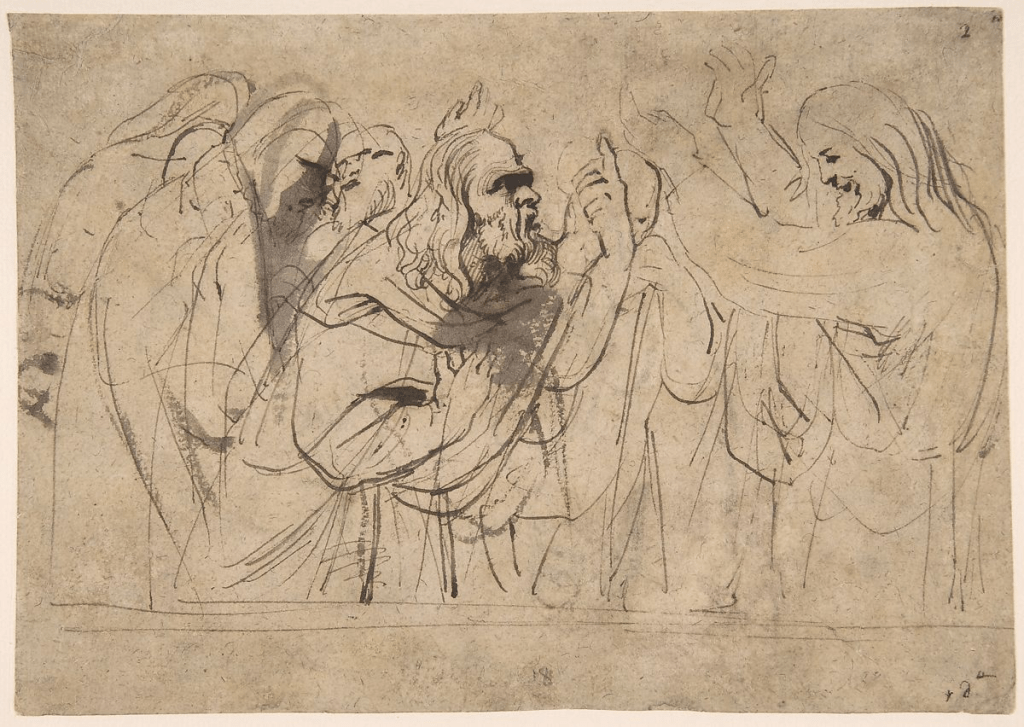
Christ and the Pharisees by Belgian artist Anthony van Dyck (1599-1641)

Jesus didn’t like it that those who should know better, those persons for whom the light of God’s truth ought to be clear and present, were in darkness. When leaders are blind, then we have the blind leading the blind, and nobody finds the door of God’s kingdom.

Many of the Pharisees in the New Testament, most of the heretics in the early church, and some of the spiritual phonies of today are actually not charlatans, that is, they are not deliberately trying to deceive or lead others astray; they are not trying to keep people out of God’s kingdom – they think they are doing the right thing when they are actually leading others astray. 

One of the eye-opening realities I discovered, when I first began studying church history, is that the early heresies condemned at the church councils were doctrines promoted and put forth by men who were not evil bad people – they were just sincerely misguided. They thought they were helping the church better understand the nature of God and Christ, when in fact they were promoting unhealthy doctrine – unintentionally closing the door of God’s kingdom to some people. 

And later when I worked on my master’s thesis in nineteenth century American religious history, I read hundreds of sermons from southern preachers before the American Civil War. I learned that they had a biblical defense for the institution of black chattel slavery. Many of them were pastors of large churches and led many people to Christ, that is, white people. They were slamming the door of God’s kingdom in the faces of African-Americans, and teaching others to do the same.
We can unwittingly slam the door of God’s kingdom in the faces of people when we say God’s grace is for all and then turn around and avoid particular people; or whenever we have explicit written statements or rules that exclude people from serving or being served; or when we bind people to human traditions and practices instead of Holy Scripture. 

The seven deadly words of the Church, believing it is doing the Lord’s will, is, “We’ve-never-done-it-that-way-before… We cannot have somebody out in the field picking heads of grain and rubbing them in their hands. That’s reaping; it’s work; and you can’t do that on the Sabbath.”

Never mind that there are people trying to eat or attempting to enter the kingdom of God. So, we lose sight that the Law was meant to benefit people, to help them thrive and flourish, to lead them into the grace and knowledge of God. The Law gets turned on its head by becoming a heavy burden to carry instead of an easy yolk which brings freedom.

No matter the issue, the last word to everything is grace, God’s grace in Jesus Christ.  

Just as the priest in David’s day was gracious in giving him and his men the consecrated bread meant only for the priests, so Jesus was gracious in giving himself, the Bread of Life, for the benefit of the whole world.

For the Christian, the Law points to Christ, who is the Law’s fulfillment. Now, we carry one another’s burdens, and in doing so, we fulfill the Law of Christ.

O God the Holy Spirit, Sanctifier of the faithful: Make us holy through your abiding divine presence. Enlighten the minds of your people more and more with the light of the everlasting Gospel. Bring erring souls to the knowledge of our Savior Jesus Christ; and those who are walking in the way of life, keep them steadfast in faith to the end.

Give patience to the sick and afflicted and renew them in body and soul. Guard those who are strong and prosperous from forgetting you. Increase in us your many gifts of grace and make us all fruitful in good works. This we ask, O blessed Spirit, whom with the Father and the Son we worship and glorify, one God, world without end. Amen.

Luke 12:32-40 – Don’t Be Afraid to Give

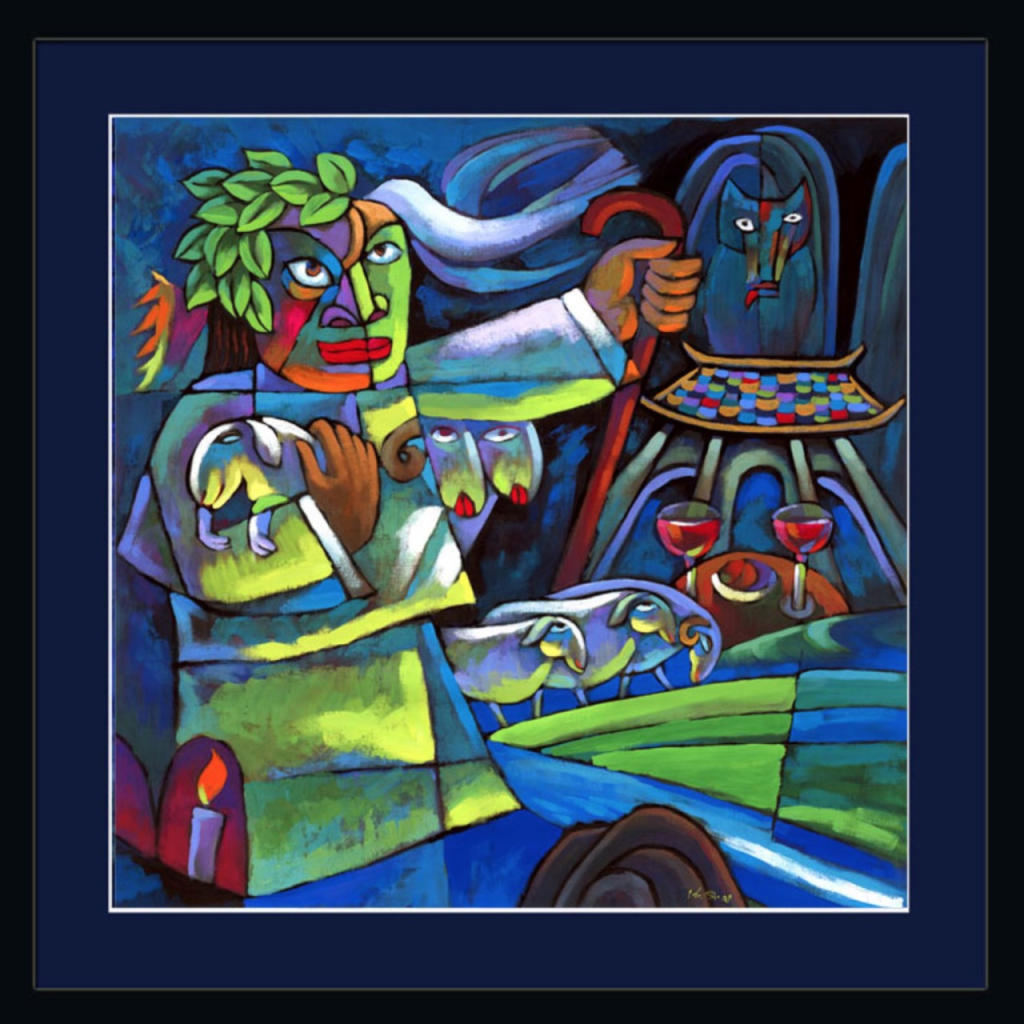
The Good Shepherd by He Qi

“Do not be afraid, little flock, for your Father has been pleased to give you the kingdom. Sell your possessions and give to the poor. Provide purses for yourselves that will not wear out, a treasure in heaven that will never fail, where no thief comes near, and no moth destroys. For where your treasure is, there your heart will be also.

“Be dressed ready for service and keep your lamps burning, like servants waiting for their master to return from a wedding banquet, so that when he comes and knocks they can immediately open the door for him. It will be good for those servants whose master finds them watching when he comes. Truly I tell you, he will dress himself to serve, will have them recline at the table and will come and wait on them. It will be good for those servants whose master finds them ready, even if he comes in the middle of the night or toward daybreak. But understand this: If the owner of the house had known at what hour the thief was coming, he would not have let his house be broken into. You also must be ready, because the Son of Man will come at an hour when you do not expect him.” (New International Version)

The most oft repeated command in all of Holy Scripture is, “Do not be afraid.” The Lord says it 365 times. It seems like we are meant to be reminded of this every day of the year.

The particular stating of the phrase by Jesus is in the context of money and possessions. Christ is telling his disciples to not fear about personal resources. Since we have a kingdom inheritance, we ought to freely give what we have to the poor without fear of being in need ourselves.

And it isn’t something we ought to procrastinate about – because the Lord could return at any time; and he doesn’t want to have to go looking for us underneath a pile of money and possessions in order to find us.

“Inaction breeds doubt and fear. Action breeds confidence and courage. If you want to conquer fear, do not sit home and think about it. Go out and get busy.”

Dale Carnegie

Fear is a real thing. Fear, at its core, is being afraid of losing what we have and getting hurt. Fear can be a helpful emotion, meant to protect us and keep us safe from harm. The problem, however, is that our fears can lead us to some unhealthy behaviors such as:

  • Vilifying another, afraid that others I don’t know or who are different from me might harm me, my family, or my community.
  • Hiding my emotions, afraid my weaknesses or failures will be exposed or exploited.
  • Serving others compulsively, afraid that I won’t have worth, meaning, or purpose without helping.
  • Achieving or winning, afraid that I will be irrelevant or unwanted, if I lose.
  • Smiling and being upbeat, afraid of facing and feeling the deep sadness within me.
  • Procrastinating projects, tasks, or conversations, afraid of being disliked or rejected.

“Fear is the path to the Dark Side. Fear leads to anger, anger leads to hate, hate leads to suffering.”

Yoda

All of those unhealthy practices keeps us at arm’s distance from the poor and needy. Getting close to poor folk creates fear with some people, that is, being afraid they might hurt me, or afraid that they will get my money.

“Fear keeps us focused on the past or worried about the future. If we can acknowledge our fear, we can realize that right now we are okay.”

Thich Nhat Hanh

Faith is the opposite of fear. Faith tethers itself to the promises of God and frees us to be generous. And faith allows us to confidently minister and build relationships with all kinds of people, especially the poor and needy.

One of the great preachers in church history, St. John Chrysostom (the fourth century Bishop of Constantinople) lived in a large city full of both rich and poor. He lamented the large class difference between them. He said this about poverty and wealth:   

“To deprive is to take what belongs to another; for it is called deprivation when we take and keep what belongs to others.  By this we are taught then when we do not show mercy, we will be punished just like those who steal.  For our money is the Lord’s, however we may have gathered it.  If we provide for those in need, we shall obtain great plenty. 

This is why God has allowed you to have more, not for you to waste on… indulgence, but for you to distribute to those in need….  If you are affluent, but spend more than you need, you will give account of the funds which were entrusted to you… for you obtained more than others have, and you have received it, not to spend it for yourself, but to become a good steward for others as well.”

“Whenever you see anyone longing for many things, esteem him of all persons the poorest, even though he possess all manner of wealth; again, when you see one who does not wish for many things, judge him to be of all persons most affluent, even if he possess nothing. For by the condition of our mind and spirit, not by the quantity of our material wealth, should it be our custom to distinguish between poverty and affluence.”

The point that Jesus makes of selling possessions and giving to the poor is not to elevate poverty over wealth – or the poor over the rich – but rather to lift generosity as a significant mark of the Christian life.

In the same way, the watchfulness Jesus commands is not an anxious hand-wringing anticipation of the apocalypse. Instead, it is an eager expectation of God’s final act of doing away with all injustice forever.

In other words, Jesus is extoling a faith that frees us to be generous; enables us to leave fear, worry, and anxiety behind; and that creates in us confidence about how the future is all going to shake-out in the end.

The Lord’s Table is meant to remind us that God is hospitable and generous.

Communion together is meant to show us that we are not alone in faith.

And the Eucharist allows us to celebrate a future we know is coming, that as often as we eat and drink the elements of bread and cup, we proclaim the Lord’s death until he returns to judge the living and the dead.

Like the feeding of the 5,000, there is plenty of bread for all – and the cup will never run dry. That’s because the Lord we serve is a God of abundance. And when we are near to such a generous God, we feel safe and secure, and are able to freely share what we have with others – without fear and without panicking that there isn’t enough. There’s always enough because God is enough.

Generous and gracious God, You came to honor the least, the forgotten, the overlooked and the misjudged. You came to give first place to the last, those left behind, and those who are misunderstood and undervalued. You came to give a warm welcome to the lost, the abandoned, and the destitute.

Help us to be your ears to listen to their cries. Help us to be your voice speaking out love and acceptance. Help us to be your feet walking beside those in need. Help us to be your hands to clothe, feed and shelter them. You came for the least, the lost and last of this world. Lord, hear our prayer. Amen.

Psalm 50:1-8, 22-23 – The Beauty in Brokenness

The Almighty God, the Lord, speaks;
    he calls to the whole earth from east to west.
God shines from Zion,
    the city perfect in its beauty.

Our God is coming, but not in silence;
    a raging fire is in front of him,
    a furious storm around him.
He calls heaven and earth as witnesses
    to see him judge his people.
He says, “Gather my faithful people to me,
    those who made a covenant with me by offering a sacrifice.”
The heavens proclaim that God is righteous,
    that he himself is judge.

“Listen, my people, and I will speak;
    I will testify against you, Israel.
    I am God, your God.
I do not reprimand you because of your sacrifices
    and the burnt offerings you always bring me….

“Listen to this, you that ignore me,
    or I will destroy you,
    and there will be no one to save you.
Giving thanks is the sacrifice that honors me,
    and I will surely save all who obey me.” (Good News Translation)

In the beginning, all of creation was a vessel filled with divine light. Then, it broke, and the shards of holiness were strewn across the earth. Those broken pieces are all around us. Sometimes, maybe oftentimes, we don’t see them because of our own darkness.

Ever since, the Lord has been on a mission, bending down, carefully looking for the broken shards, finding them, and picking them up. From east to west, God has been gathering together everyone on earth – the broken yet divinely lighted humans.

A major theme throughout the entirety of Holy Scripture is that God is reaching all kinds of people all over the world. Indeed, the Bible is a long unfolding drama of redemption in which the Lord does whatever it takes to restore a fundamentally broken world.

“Kintsugi” (literally, in English, “golden joinery”) is a centuries-old Japanese art form of repairing broken pottery with gold. Instead of rejoining broken ceramic pieces with a clear camouflaged adhesive, the kintsugi technique uses a special lacquer dusted with powdered gold. After restoration, beautiful seams of gold glint in the obvious cracks of the ceramic vessel. This also means that every restored ceramic piece has a unique appearance; no two of them are the same.

The Lord is presently in the divine workshop, putting broken shards of humanity together. And God isn’t trying to hide or disguise the cracks and flaws; it’s just the opposite: God celebrates the artifact by emphasizing it’s fractures and breaks. As it turns out, the restoration which the Lord employs brings the vessel to even greater beauty than it originally enjoyed. It’s the transformation of a new existence from the old.

The deepest yearning in every human soul is to become whole again, to return to their spiritual source, to experience belonging and union with the Beloved.

Amidst the human pain all around us, and within us, we can observe the sacred light, and turn in the direction of beauty. We can hear the call of God to respond with gratitude and thanksgiving, instead of relying upon some physical or monetary sacrifice to suffice our spiritual obligations.

We are here to participate with God in redeeming that which is broken. The sacrificial activity that honors the Lord, and gathers the strewn shards, is a grateful heart with lips that speak thankfulness. Humanity can only see the power of God to save and restore, whenever us jars of clay practice gratitude and obedience to the Lord.

The world’s observation of a perfect vessel is not what draws anyone to faith. Rather, it is seeing an imperfect vessel, put together with a divine glue of gold, the cracks visible and showing for all to notice. Perfectionism is repellent to most folk; it smacks of others attempting to appear something they are not; it’s disingenuous and insincere.

Imperfection, however, speaks of being genuine and real; it brings solidarity with others; it relates and seeks to connect. Observing broken pieces put back together through God’s kintsugi communicates that suffering can be changed into beauty.

Today’s psalm is a reminder for us to stay optimistic when things fall apart and to celebrate the flaws and missteps of life. It teaches us that, when God breaks and destroys, this is not necessarily a mark of judgment. It lets us know that we can be calm when all falls apart. It reminds us that the fragility of humanity is not ugly but beautiful. It reminds us that amidst so much complexity, there is simple beauty all around us, if we will but seek and see.

In a world that has a hard time accepting all the breaks, scars, and imperfections of life, there is a God who is undisturbed by it all. The Lord gently, patiently, and skillfully puts us back together again so that a beautiful transformation of heart and life results.

The Lord said to me, “My grace is sufficient for you, for my power is made perfect in weakness.” Therefore, I will boast all the more gladly about my weaknesses, so that Christ’s power may rest on me. That is why, for Christ’s sake, I delight in weaknesses, in insults, in hardships, in persecutions, in difficulties. For when I am weak, then I am strong. (2 Corinthians 12:9-10, NIV)

Grant us, O God, not to be anxious about earthly things but to love things heavenly and, even now, while we are placed among things that are passing away, to hold fast to those that shall endure; through Christ our Lord, Amen.

Mark 10:17-22 – Jesus Intervenes

Eastern Orthodox mural of Jesus and the rich man

As Jesus started on his way, a man ran up to him and fell on his knees before him. “Good teacher,” he asked, “what must I do to inherit eternal life?”

“Why do you call me good?” Jesus answered. “No one is good—except God alone. You know the commandments: ‘You shall not murder, you shall not commit adultery, you shall not steal, you shall not give false testimony, you shall not defraud, honor your father and mother.’”

“Teacher,” he declared, “all these I have kept since I was a boy.”

Jesus looked at him and loved him. “One thing you lack,” he said. “Go, sell everything you have and give to the poor, and you will have treasure in heaven. Then come, follow me.”

At this the man’s face fell. He went away sad because he had great wealth. (New International Version)

We are all addicts. 

We all have our own sin addictions which keep us stuck in guilt and shame.

We may not all struggle with the same sin. Yet we all have some besetting sin(s) that we must be weaned off of. The most pervasive addiction found in Holy Scripture is neither substance abuse nor alcohol – it is the addiction to wealth and money.

Maybe your initial response was of someone else, besides yourself: “I don’t have as much money as____” or, “So-and-so has a real problem with that!” Those statements are what we call, in terms of addiction, denial. 

In truth, all of us are in some sort of denial about how much we really trust in paychecks, bank accounts, investments, and owning material stuff. I’m no exception. I own more books than I’ll be able to read in a lifetime, and yet, I tend to believe I don’t have enough of them.

Even the poor can have an addiction wealth and money by thinking about it and wishing for it to an unhealthy degree, as if wealth is the thing that will ultimately make them happy.

People in denial rarely have any idea how much they are hurting others, themselves, and God.  In fact, the consistent witness of the early church fathers is that the sheer accumulation of stuff is the same as stealing from the poor. 

Because of denial, people need an intervention. They need to be jolted back to their senses. Intervention is a gift. Someone cares enough about the person to intervene. Yet, interventions don’t always work. The person can choose to walk away and refuse to change.

Jesus did a gracious intervention with a rich young man. The man was addicted to wealth and money, but he didn’t see it. In fact, he thought he was quite godly and spiritual. It’s a sad story because the man walks away untransformed by his encounter with Jesus and did not accept the gracious invitation to follow the Lord. 

Chinese depiction of Jesus and the rich man, 1879

The man simply did not see himself as hopeless and desperately needing to change. He held to his denial.

The man approached Jesus with a question: “What must I do to inherit eternal life?” Whereas I would probably get all excited about being asked a question like this and launch into some long-winded gospel answer, Jesus immediately picked up on the attitude and the need behind the question. 

What must I do to get? It’s almost as if the man wants to acquire eternal life like he would acquire wealth. “I am a successful businessman with plenty of money, and a respected citizen with lots of wealth – now I want to be a success with God, as well.” 

The question may have been sincere, yet it was misguided. Eternal life is not spiritual real estate for an upwardly mobile person to acquire and possess. The man seems to believe he can purchase eternal life, as if everyone has their price, even God. “After all,” he may have been reasoning, “I have gotten everything else in life, so why not obtain eternal life?”

Jesus questioned the question. He went after the underlying assumption of doing something good to obtain eternal life. The fact of the matter is that the man cannot do anything. He can’t because only God is good. Jesus points him to God by changing the action from getting to entering. And he changed the language from a market acquisition to entering into a journey.

Jesus was inviting the man to walk with him.

Eternal life is a journey of faith in the God who is good, and not a transaction to get it. And, we too, must be careful not to treat eternal life as if it were a transaction, as if we must get a person to sign on the dotted line through a “sinner’s prayer” or some other formula that will seal the deal for eternal life. 

Instead, eternal life is a walk of obedience with God and his commands.

Jesus responded to the rich man with the Ten Commandments, specifically the ones which focus on human relationships. Jesus wanted him to realize that the path into the kingdom of God and eternal life goes through and not around how we treat our fellow human beings.

Christ and the Rich Young Ruler by Heinrich Hofmann, 1889

The Lord sought to expose the impossibility of continuing in life on the rich man’s terms. The guy just could not imagine what he might be lacking. So, Jesus helped him out. Christ gave him some major interventional language…. Sell. Give. Follow.

Sell everything. Give to the poor. Come, follow me.

One cannot simply add Jesus to their life, like adding a new car or a new fishing rod. Rather, one’s heart must change in order to accommodate real, genuine eternal life. 

Jesus offered the rich man someone to be, rather than something to get

It’s one thing to give from what you have; it’s another thing to surrender your life and all you have. 

In the New Testament Gospels, there are no easy conversations with Jesus. He gets personal in every encounter and gets under everybody’s skin. Christ doesn’t settle with superficial small talk when there are people whose hearts are little more than idol factories. 

Jesus never leaves us alone, because there is always the invitation to “Come, follow me.”

Christ exposed the wealthy man’s divided loyalties – he was trying to serve both God and money. But he would have to choose between the two. 

And that is our choice, as well. 

The question for us is not, “Am I completely devoted to money?” Instead, the question from our Gospel story today is, “Am I trying to serve God while maintaining a moonlighting job with the world?” 

God wants from us an undivided heart; the Lord desires absolute allegiance.

Jesus is looking for those who are poor in spirit, who recognize their great need for God – instead of believing that they are okay and just need to add a little Jesus to their lives. 

God is looking for spiritual beggars who understand their desperate situation and don’t practice denial by sugar-coating their actual spiritual state.

Like a drunkard who won’t give up his vodka; like a sex addict who won’t give up strip clubs or emotional affairs; or like a workaholic who just can’t come home; the rich man would not give up his disordered love for money and possessions. 

So, Jesus did an intervention. 

The Lord Jesus didn’t ask everybody to do exactly as he called the rich man to do. He didn’t ask the very wealthy Zacchaeus to do it, and he didn’t tell Peter to sell his fishing business. 

But Jesus does tell us to do something which seems impossible. Yet, where the impossible exists, so exists grace.

Blessed Lord, you have taught us that all our doings without loving generosity are worth nothing. Send your Holy Spirit and pour into our hearts your gift of love, the true bond of peace and of all virtues, without which whoever lives is counted dead before you. Grant this for the sake of your only Son Jesus Christ, who lives and reigns with you, in the unity of the Holy Spirit, one God, now and forever. Amen.