Get a Different Perspective (Isaiah 29:1-12)

Woe to you, Ariel, Ariel,
    the city where David settled!
Add year to year
    and let your cycle of festivals go on.
Yet I will besiege Ariel;
    she will mourn and lament,
    she will be to me like an altar hearth.
I will encamp against you on all sides;
    I will encircle you with towers
    and set up my siege works against you.
Brought low, you will speak from the ground;
    your speech will mumble out of the dust.
Your voice will come ghostlike from the earth;
    out of the dust your speech will whisper.

But your many enemies will become like fine dust,
    the ruthless hordes like blown chaff.
Suddenly, in an instant,
    the Lord Almighty will come
with thunder and earthquake and great noise,
    with windstorm and tempest and flames of a devouring fire.
Then the hordes of all the nations that fight against Ariel,
    that attack her and her fortress and besiege her,
will be as it is with a dream,
    with a vision in the night—
as when a hungry person dreams of eating,
    but awakens hungry still;
as when a thirsty person dreams of drinking,
    but awakens faint and thirsty still.
So will it be with the hordes of all the nations
    that fight against Mount Zion.

Be stunned and amazed,
    blind yourselves and be sightless;
be drunk, but not from wine,
    stagger, but not from beer.
The Lord has brought over you a deep sleep:
    He has sealed your eyes (the prophets);
    he has covered your heads (the seers).

For you this whole vision is nothing but words sealed in a scroll. And if you give the scroll to someone who can read, and say, “Read this, please,” they will answer, “I can’t; it is sealed.” Or if you give the scroll to someone who cannot read, and say, “Read this, please,” they will answer, “I don’t know how to read.” (New International Version)

Reading the Bible may sometimes feel like a weird Catch-22. We’re supposed to read, observe, and obey the contents of Holy Scripture; yet there is so much within it that we often just plain don’t understand – and even are not going to understand, at least on this side of heaven.

For many people, this is maddening. It may even cause them to throw up their hands and say that God is some mad scientist who merely tinkers and experiments with people like mice in laboratory.

I understand how some could think that way. The Lord comes along and does a mysterious dance of proclaiming judgment, then pivoting quickly around to assure deliverance. Reading through any prophetic book of the Old Testament is likely to make our heads spin with questions and our hearts to reel. No matter how you slice it, there are a lot of difficult passages in Holy Scripture.

So, I invite you to take a few differing perspectives.

First, if God is a Being who is infinitely higher and greater – the Creator who has made all things – then we are the creatures who are neither privy to all God’s reasonings nor even able to understand such a Being who is other than us.

Second, it seems we rarely even attempt to try and see things from God’s angle. We see our own situations, many of them confusing, and we wonder why the Lord doesn’t just step in and fix all the crud. However, none of us has the full picture, as God does – which is why we are continually invited to pray for wisdom, to see our life, relationships, and circumstances from a divine perspective. (James 1:2-5)

The prophet Isaiah, along with the other prophets, proclaims a double message of judgment and deliverance. Indeed, it appears there is a continual rhythm of identifying guilt and giving grace throughout a large chunk of the Old Testament.

And that is perhaps where we need to pay attention. People have a great predilection for saying and doing things (or failing to say and do things) which bring guilt. Our guilty actions and inactions are not okay; they cannot simply be dismissed as stuff that people do, as if we were just silly folks who don’t know any better.

Maybe we would like to view God as some geriatric grandfather who lets everyone do what they want, but that’s not the God we get in the Bible.

No, our words and actions have real impact and consequences for others. And the Lord is a real force to contend with, for whom we cannot escape nor ignore for long.

In Isaiah’s day, the people were called to account for their abject callousness toward their fellow humanity. God’s commands all have to do with living in harmony with creation. Chaos, disorder, and systemic evil result whenever the creature rebels against the Creator by trying to be a little god of their own making – taking the perspective of using people rather than serving them.

The Lord will have none of it; God will intervene. Hence, the judgment portions of Scripture. Yet, because God is gracious and loving, the judgment doesn’t last forever; mercy takes hold and overwhelms the guilty sinner.

If we could understand everything God does or doesn’t do, then God wouldn’t be God. But the very fact that God is mysterious, and in some ways unknowable, tells us that there is indeed a God.

Our task is not to take over God’s job because the Lord isn’t doing what we want. Our mandate is to reflect the image of God placed within us by loving the Lord and loving our neighbor as ourselves.

Yes, we are all guilty of a great many things. Yet, grace always has the last word, and not judgment. This, then, gives way to a life of gratitude that has learned to sync one’s heart with the heart of God.
Catch-22’s are certainly maddening… if we are truly in one to begin with. It could be that we just haven’t yet gained a different perspective on our situation, learned to accept it, and made the choice to live in harmony with the world as it is, rather than the world as we think it ought to be.

Most merciful God, we confess that we have sinned against you in thought, word, and deed, by what we have done, and by what we have left undone. We have not loved you with our whole heart; we have not loved our neighbors as ourselves. We are truly sorry and we humbly repent. For the sake of your Son Jesus Christ, have mercy on us and forgive us; that we may delight in your will, and walk in your ways, to the glory of your Name. Amen.

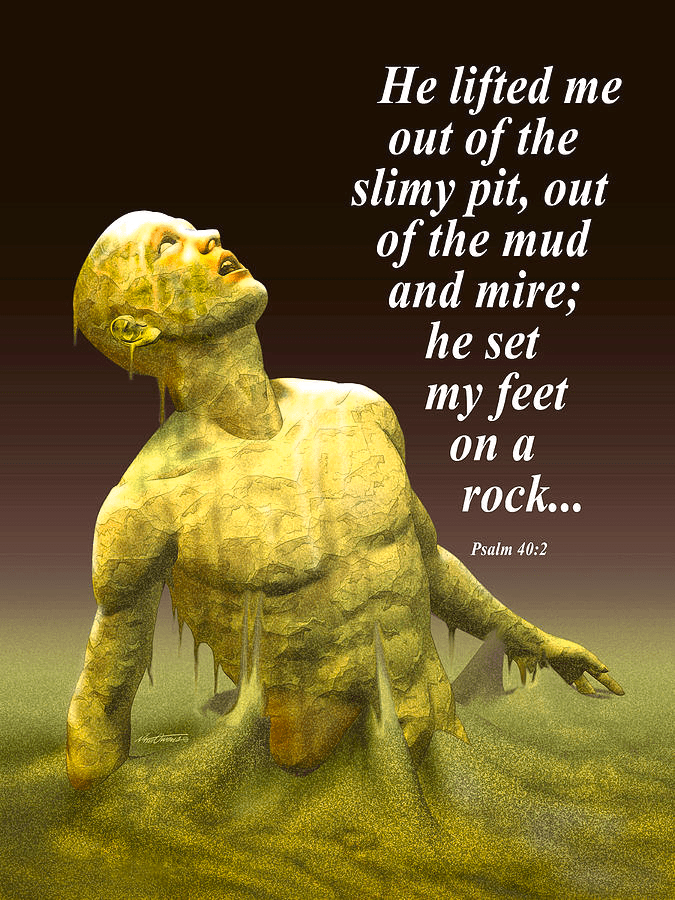
Out of the Slimy Pit (Psalm 40:1-11)

He Lifted Me by Nate Owens

I put all my hope in the Lord.
    He leaned down to me;
    he listened to my cry for help.
He lifted me out of the pit of death,
    out of the mud and filth,
    and set my feet on solid rock.
        He steadied my legs.
He put a new song in my mouth,
    a song of praise for our God.
Many people will learn of this and be amazed;
    they will trust the Lord.
Those who put their trust in the Lord,
    who pay no attention to the proud
    or to those who follow lies,
    are truly happy!

You, Lord my God!
    You’ve done so many things—
    your wonderful deeds and your plans for us—
        no one can compare with you!
    If I were to proclaim and talk about all of them,
        they would be too numerous to count!
You don’t relish sacrifices or offerings;
    you don’t require entirely burned offerings or compensation offerings—
    but you have given me ears!
So I said, “Here I come!
    I’m inscribed in the written scroll.
    I want to do your will, my God.
    Your Instruction is deep within me.”
I’ve told the good news of your righteousness
    in the great assembly.
    I didn’t hold anything back—
        as you well know, Lord!
I didn’t keep your righteousness only to myself.
    I declared your faithfulness and your salvation.
I didn’t hide your loyal love and trustworthiness
    from the great assembly.

So now you, Lord—
    don’t hold back any of your compassion from me.
Let your loyal love and faithfulness always protect me. (Common English Bible)

Every follower of the Lord has a powerful story of God’s grace in lifting them out of a slimy pit experience. 

We live in a profoundly broken world; and no one is exempt from its effects upon us. Whether physical problems, emotional trials, or relational hardships, there is always something going on in our lives – with the added pull toward trusting in things other than God. 

The temptation to say unjust words and do unjust actions is always over-promised and under-delivered. 

It’s easy to get sucked-in to poor decisions and be stuck in an empty hole with seemingly no way out. We often find ourselves slipping into a slimy pit because of our own bad decisions, as well as by no fault of our own. 

Living in a fallen world means that we inevitably experience troubles and hardships.

So, what do we do if we find ourselves in a slimy pit?

Look for Hope

David, the psalmist, waited patiently for the Lord. With great expectation, he fully anticipated God to act on his behalf. The sort of patience he practiced was an intense waiting – a waiting filled with longing and expectant hope, a patience that kept looking and praying and seeking.

The reason believers in Jesus keep hoping beyond hope is that we know that God is ultimately the One who delivers from the pit. 

But what if you have been looking for deliverance from the slimy pit experience and you have not seen it come to pass? 

Expectantly expect God to act. Wait patiently. Do not give up. Keep praying and watching. Like the father in the story of the prodigal son, keep looking out the window, waiting for the son to return, and picture the deliverance coming – because our waiting is not in vain.

flickr.com/photos/joshtinpowers

The psalmist, David, was eventually delivered. The Lord leaned down to him. God listened and lifted him. The Lord God set him on a firm place to stand and put a new song in his mouth. 

This was not only a personal matter for David; it was also an occasion that other people needed to know about.

Look for God

We all must finally come to the end of ourselves and look up. Whenever the deliverance doesn’t come quickly, we may look to other people or things to give us the freedom we long for. It’s easy to become impatient and begin searching for answers in everything else but God. 

Yet, if we will let patient hope have its way, we are blessed when we trust in the Lord.

In all my years of churchgoing as a kid, I had never read my Bible. But God was gracious to me. I remembered all those sermons I heard about Jesus. I gained a newfound sense of my own inner darkness, as well as the desire to read God’s Word. And God saved me. 

My circumstances did not change, but I did. My loneliness turned to joy; my aimlessness turned into purpose; and my selfishness became a deep concern for others. My heart had been black, and what God did to change it was nothing less than miraculous.

Look Within

The person who looks for hope and seeks God is also a person who looks into their own heart and there finds the attitude which God will bless. 

Blessing does not come from great sacrifice, but by syncing one’s heart with the heart of God. 

The Lord cares little about how much money or stuff you have, or how many sacrifices were made for God; that’s because God wants your heart, your mind, your will, and your emotions. In other words, God wants you! 

And God desires you because the Lord made you with a heart that beats for the same things God cares about: justice, mercy, and humility.

If you and I will but look within at the very spirit God has put within us, we shall find resources beyond what we can ask or think.

Look to Bless Others

We possess more than a personal faith which is to benefit ourselves; we also have an equal responsibility to bless the community with our experiences of what God has done in our lives. 

The telling of stories about what God has done for us is a necessary part of building up the church and helping others move forward in faith, hope, and love.

The psalmist proclaimed his testimony in the great assembly, that is, publicly. This isn’t about standing behind a microphone in front of lots of people; it’s about being so touched by God that we cannot keep our mouths shut about the Lord’s deliverance on our behalf.

So, let’s not shelve the idea of giving testimony to others as if it were only for pastors, missionaries, or other very religious people. 

When a person decides to play hockey in -20 degrees below zero weather, we might think that person is a little crazy;  but, hey, we reason, if they love hockey that much, more power to them. 

We must not think about Christianity in the same way, that if a person is passionate about Jesus and desires to tell others about what God has done for them, more power to them; just don’t expect me to go out in the cold and do that because it isn’t my thing. 

Christianity is a life, not a hobby; it’s about humble service, and not a means to look respectable; it cannot be reduced to a few practices, such as church attendance or putting money in an offering plate.

Christianity is a relationship with God through Jesus. Try looking at marriage as simply showing up for supper and paying the bills and see how far that gets you.

Look to Get Lost to Get Found

We may become obsessed with getting out of our slimy pit of illness, infirmity, pain, adversity, hardship, or discord. If that happens, we will likely lose our proper focus.

Instead, get lost in the wonder of God. The Lord does wondrous things when we are immersed in God’s wonders.

“Any of you who try to save the life you have will lose it. But you who give up your life for me will find true life.” Jesus (Matthew 16:25, ERV)

New life comes from a change of heart, not a change of circumstances. Wherever there is a firm reliance on God; a glad obedience to God; and a readiness to give testimony to God’s actions, then we are living into the spirit of today’s psalm.

Lamb of God, who takes away the sins of the world, have mercy on us.
Lamb of God, who takes away the sins of the world, grant us your peace. Amen.

Mary’s Song of Praise (Luke 1:46b-55)

The Magnificat, a woodcut by Sr. Mary Grace Thul

Mary said,

“My heart praises the Lord;
    my soul is glad because of God my Savior,
    for he has remembered me, his lowly servant!
From now on all people will call me happy,
    because of the great things the Mighty God has done for me.
His name is holy;
    from one generation to another
    he shows mercy to those who honor him.
He has stretched out his mighty arm
    and scattered the proud with all their plans.
He has brought down mighty kings from their thrones,
    and lifted up the lowly.
He has filled the hungry with good things,
    and sent the rich away with empty hands.
He has kept the promise he made to our ancestors,
    and has come to the help of his servant Israel.
He has remembered to show mercy to Abraham
    and to all his descendants forever!” (Good News Translation)

It strikes me that Mary, instead of being full of worry and afraid of the future, and as an unmarried teen with child, is full of the Spirit and faith. Mary neither complained nor fretted for the nine months of her pregnancy; she praised God and was clear-headed about the grace shown to her.

Mary’s canticle gives us insight into the mystery of the incarnation: God chooses the weak, those of low esteem, and the powerless.

Mary was rather ordinary. She had no wealth. She possessed nothing which would cause anyone to pick her out of a crowd. Yet, she is the one chosen by God. And her wonderful response to grace demonstrated that there is so much more to any person than what we can see with our eyes and perceive through our earthly glasses of high positions and strength of personalities.

The mother of Jesus had the wisdom to discern that her situation typified the Lord’s egalitarian work of leveling the field. Mary’s pregnancy normalized the needs of all people. Her son, the Deliverer, would carry this understanding into his own life and ministry – declaring good news to the poor, comforting the brokenhearted, proclaiming freedom for captives, telling those who mourn that the time of the Lord’s favor has come.

Mary’s is the kind of song that has been sung by people of faith throughout the ages. It’s not only a song of faith but a declaration of resistance, in defiance of all evil powers which ignore the poor, such as Mary.

It was not a completely new sort of song; it’s in harmony with songs that other faithful followers of the Lord have sung in past generations.

Moses and Miriam sang a song to the Lord of freedom from powerful Egyptian bondage and oppression:

“I will sing to the Lord, because he has won a glorious victory;
    he has thrown the horses and their riders into the sea.
The Lord is my strong defender;
    he is the one who has saved me.
He is my God, and I will praise him,
    my father’s God, and I will sing about his greatness.
The Lord is a warrior;
    the Lord is his name.” (Exodus 15:1-3, 21, GNT)

Hannah, unable to conceive and have children, endured a long stretch of affliction from her rival – that is, until the Lord stepped in and opened her womb:

“No one is holy like the Lord;
    there is none like him,
    no protector like our God.
Stop your loud boasting;
    silence your proud words.
For the Lord is a God who knows,
    and he judges all that people do.
The bows of strong soldiers are broken,
    but the weak grow strong.
The people who once were well fed
    now hire themselves out to get food,
    but the hungry are hungry no more.
The childless wife has borne seven children,
    but the mother of many is left with none.
The Lord kills and restores to life;
    he sends people to the world of the dead
    and brings them back again.
He makes some people poor and others rich;
    he humbles some and makes others great.
He lifts the poor from the dust
    and raises the needy from their misery.
He makes them companions of princes
    and puts them in places of honor.
The foundations of the earth belong to the Lord;
    on them he has built the world. (1 Samuel 2:2-8, GNT)

Stained glass window of Hannah offering her son Samuel to the Lord by Phil Watkins

The psalmist declares his song about the Lord who turns the tables on the unfortunate and brings them privilege:

He always keeps his promises;
    he judges in favor of the oppressed
    and gives food to the hungry.

The Lord sets prisoners free
    and gives sight to the blind.
He lifts those who have fallen;
    he loves his righteous people.
He protects the strangers who live in our land;
    he helps widows and orphans,
    but takes the wicked to their ruin. (Psalm 146:6b-9, GNT)

God’s people throughout history have faced oppression. And, when in the teeth of that adversity, they have sung God’s songs of resistance against the evil powers of this world.

Along with Holy Scripture, let us also in these days of Advent just before Christmas Day, sing our traditional songs of resistance, deliverance, and hope:

“Come, Thou Long Expected Jesus”

By Charles Wesley

Come, thou long expected Jesus,
born to set thy people free;
from our fears and sins release us,
let us find our rest in thee.
Israel’s strength and consolation,
hope of all the earth thou art;
dear desire of every nation,
joy of every longing heart.

Born thy people to deliver,
born a child and yet a King,
born to reign in us forever,
now thy gracious kingdom bring.
By thine own eternal spirit
rule in all our hearts alone;
by thine all sufficient merit,
raise us to thy glorious throne.

“It Came upon the Midnight Clear” (vs.3-4)

By Edmund Sears

And ye, beneath life’s crushing load,
whose forms are bending low,
who toil along the climbing way
with painful steps and slow,
look now! for glad and golden hours
come swiftly on the wing.
O rest beside the weary road,
and hear the angels sing!

For lo! the days are hastening on,
by prophet seen of old,
when with the ever-circling years
shall come the time foretold
when peace shall over all the earth
its ancient splendors fling,
and the whole world send back the song
which now the angels sing.

“O Come, O Come, Emmanuel” (vs.1, 4, 6)

By J.M. Neale

O come, O come, Immanuel,
and ransom captive Israel
that mourns in lonely exile here
until the Son of God appear.

O come, O Branch of Jesse’s stem,
unto your own and rescue them!
From depths of hell your people save,
and give them victory o’er the grave.

O come, O Bright and Morning Star,
and bring us comfort from afar!
Dispel the shadows of the night
and turn our darkness into light.

Christ came to stand against sin, death, and the power of the Devil.

God is full of grace, mercy, and power to the powerless and the needy. The Lord has our backs. Perhaps if we all, both individually and corporately, continually used our words to identify and declare the great things God has done we would realize the consistent blessing of the Lord. 

As we near the night of our Lord’s birth, take some time to reflect on the ways God has been good to you in this Advent season, and like Mary, offer praise for each act of mercy. Mary exhibited no helplessness but had her heart calibrated to detect the grace of God when it was present – and to resist the injustice of this world.

Soli Deo Gloria

Persevere Through Adversity (Psalm 129)

Painting of Jerusalem by Alex Levin

From my earliest youth my enemies have persecuted me.
    Let all Israel repeat this:
From my earliest youth my enemies have persecuted me,
    but they have never defeated me.
My back is covered with cuts,
    as if a farmer had plowed long furrows.
But the Lord is good;
    he has cut me free from the ropes of the ungodly.

May all who hate Jerusalem
    be turned back in shameful defeat.
May they be as useless as grass on a rooftop,
    turning yellow when only half grown,
ignored by the harvester,
    despised by the binder.
And may those who pass by
    refuse to give them this blessing:
“The Lord bless you;
    we bless you in the Lord’s name.” (New Living Translation)

The Jewish people know a thing or two about perseverance through suffering; they’ve been enduring it for millennia. If we let them, they can show us a better way of facing adversity.

It seems to me that we modern Gentiles could learn from our Jewish brothers and sisters. We Westerners tend toward burying the past, putting things behind us, and forgetting all the bad things which occurred back there. But the Psalms, a wonderful depository of Jewish thought and practice, will have none of that approach.

Today’s Psalm comes from a group known as the “Psalms of Ascent.” (Psalms 120-134) These were sung by ancient Jewish worshipers as they made the journey up to Jerusalem for the Feast of Tabernacles.

As the pilgrims walked together on their ascent to the great city, the experience of collectively singing and worshiping made the people feel united in joy, purpose, and sorrow. Remembering was central to that sense of solidarity.

The Jewish people have been attacked by countless enemies, not only throughout the Old Testament, but also throughout their long history. Empires tend to not like Jews because Jews hold to their own set of laws and worship practices – which seem to always come into conflict with what some Emperor, Dictator, or Tyrant wants. So, they try to be rid of Jews, like plowing a field to break up the stubborn hard ground of Yahweh worship. The Jewish people end up being treated, literally, like dirt.

“The attempt to eliminate the people of God was an attempt to eradicate the presence of God from the human situation. The fact that after Auschwitz the Jewish people still lives and can still affirm its faith is the most powerful testimony that God still lives.”

Rabbi Jonathan Sacks, Crisis and Covenant

God will deliver… eventually. Whether Jew or Christian, there will always be enemies to the faith. And sadly, the history of Christianity includes their own brand of persecuting Jews. *Sigh*

Haters, the Psalm hopes, will be like grass in shallow soil: They may sprout quickly, but will also wither quickly and blow away to be gone forever.

The evil of this fallen world is terrible and ugly; but it isn’t permanent. Therefore, we need patience and perseverance through the suffering and adversity to realize the deliverance.

And as much as aggressive bullies try to wipe out those not conforming to their ways, the Lord simply brings in a harvest of righteousness, despite it all.

Even though the Psalms of Ascent were written long ago by people living in a time and place very different from ours, yet they express the emotions we all feel, which makes them helpful for our journey through life, as well.

Although none of us delights in persecution, pain, and struggle, we can take the stance of embracing our hard circumstances because suffering produces perseverance; perseverance, character; and character, hope. And hope does not put us to shame, since love is the force that binds the world together. (Romans 5:3-8)

“When two friends climb a hill, the hill seems less steep than if they climbed it alone.”

Sherri Mandell

Oftentimes, it is inside the pain that we begin to become one with our own vulnerable humanity. And that humble humanity is where great courage, great creativity, and great work germinates within our spirits and cultivates the ground of this world, growing to produce faith, hope, and love.

Everyone facing adversity knows how hard it is to keep going without seeing the goal. Like the farmer, we must expectantly wait till the harvest. There is nothing we can do to speed up the process and go straight from planting to harvest. It takes time and plenty of patience. Grumbling and complaining about how long it is taking will not make it go any faster.

Perseverance in the face of hardship is a major pathway to realizing a holy life. Consider the ancient prophets:

  • Jeremiah was faithful to proclaim God’s message yet was thrown into a cistern and left for dead. Yet, he was delivered from it. (Jeremiah 38:1-28)
  • Micaiah was faithful to declare truth to King Zedekiah, who then promptly imprisoned him, even though the king asked for God’s message. (1 Kings 22:24-27)
  • Daniel was faithful to pray consistently to the one true God and was thrown into the lion’s den to be killed. But the Lord saved him. (Daniel 6:1-28)

The prophets all suffered for doing the right thing and did not waver in their commitment to the Lord. Through their troubles they learned to trust God and draw near to the Lord. The adversity strengthened, not weakened, their faith.

What’s more, consider the Old Testament character of Job, who is Exhibit A of perseverance through grinding hardship. Job had it all; and he lost it all… except his faith. Job tenaciously held onto righteousness, despite his awful physical, mental, emotional, and spiritual pain. And he eventually came through it, restored and whole.

We are to keep going in our faith and not give up – and the Psalms of Ascent can help us in our endurance.

The soul would have no rainbow if the eyes had no tears. We live in a time when we will either sink or swim – there is no in-between. God’s celestial shore is within sight; don’t miss it by getting discouraged by all the fog. 

Hang in there, my friend. There is good reason to do so.