Delight in God’s Word (Psalm 119:41-48)

Lord, give me your unfailing love,
    the salvation that you promised me.
Then I can answer those who taunt me,
    for I trust in your word.
Do not snatch your word of truth from me,
    for your regulations are my only hope.
I will keep on obeying your instructions
    forever and ever.
I will walk in freedom,
    for I have devoted myself to your commandments.
I will speak to kings about your laws,
    and I will not be ashamed.
How I delight in your commands!
    How I love them!
I honor and love your commands.
    I meditate on your decrees. (New Living Translation)

Christians often refer to the Bible as “God’s Word.” By that reference is meant that God has graciously given a self-revelation to us through the Holy Scriptures. 

The Jewish people refer to the first five books of the Old Testament as the Law of the Lord or the Torah. They understand God as a great, high and holy Being, who graciously accommodates and communicates to us on our level by giving the Law. 

Just as a parent coos and babbles and speaks in a very different way to a baby in a crib, so God speaks to us in a manner that we can understand divine care, concern, and love for us. Just as an infant cannot understand an adult conversation taking place, so God is a divine being well above our comprehension. We have no ability to understand anything God says unless the Lord graciously and lovingly bends down to speak to us on our level.

God’s Law, the Torah, was the curriculum for Israel’s religious instruction. The Law of the Lord is meant to be a behavior pattern, to be embodied in the lives of God’s people through both teachers and parents who learn God’s Word and, in turn, pass it along to others. Both those within the faith, such as children, and those outside of the faith, such as aliens or immigrants, can have a guide for how to live in the world.

God’s Law is an extension of God’s grace. And we can gratefully accept the grace of God expressed in God’s Word. We have the opportunity to ingest it, eat it, reflect on it, and dwell with it, in order to know God and be the sort of people God who can bless the world.

There are several Hebrew language words that come from the root word of Law, or Torah.  A teacher is a “moreh.” A parent is a “horeh.” Parents and teachers are to be living guides in the way of God’s Word. What’s more, the Hebrew word for teaching is “yarah.” 

So, in other words, the moreh’s and the horeh’s are to yarah the Torah. Parents and teachers are to point and lead others into the ways of the Lord. And how do they do this?…

Hear, O Israel: The Lord our God, the Lord is one. Love the Lord your God with all your heart and with all your soul and with all your strength. These commandments that I give you today are to be on your hearts. Impress them on your children. Talk about them when you sit at home and when you walk along the road, when you lie down and when you get up. Tie them as symbols on your hands and bind them on your foreheads. Write them on the doorframes of your houses and on your gates. (Deuteronomy 6:4-9, NIV)

God’s Law (God’s Word) is to be as familiar to us as our back door; it is to be in front of us all the time. We might put a modern spin on the Deuteronomy passage to help us understand our privilege when it comes to God’s Word:

Attention, Church! God, our God! God the one and only! Love God, your God, with your whole heart: love God with all that is in you; love God with all you’ve got! 

Write these commandments that I’ve given you today on your hearts. Get them inside of you and then get them inside your children. 

In order to do this, talk about God’s Word at home when you are eating supper together, and when you are working or playing with each other. 

Start your day with God’s Word when you get up, and end your day with God’s Word when you go to bed at night. Put God’s Word on your refrigerator, and your car’s dashboard; have it on your smartphones, and let it be available to you anywhere, anytime. Use every opportunity you have to incessantly chatter about God’s Holy Word.

Someone may say, “That’s pretty radical – I don’t need to do all that!” Then I would say you are missing out on living a blessed life, because people are blessed when they walk according to God’s Word and keep God’s Law in front of them, seeking God with all their heart. 

Eleanor Turnbull, a veteran missionary to Haiti, collected and translated some simple but powerful prayers of the Christians who live in the Haitian mountains. Here are four prayers that they pray every day – and take note of their high view of God, and their longing to know God’s Word: 

  1. “Our Great Physician, Your word is like alcohol. When poured on an infected wound, it burns and stings, but only then can it kill germs. If it doesn’t burn, it doesn’t do any good.” 
  2. “Father, we are all hungry baby birds this morning. Our heart-mouths are gaping wide, waiting for you to fill us.” 
  3. “Father, a cold wind seems to have chilled us. Wrap us in the blanket of your Word and warm us up.” 
  4. “Lord, we find your Word like cabbage. As we pull down the leaves, we get closer to the heart. And as we get closer to the heart, it is sweeter.”

Let’s not be so busy, pre-occupied, or worried that we push God’s Word to the margins of our lives as only something for our discretionary time. 

Instead, let’s commit ourselves, like the psalmist, to learning and loving God’s commands and decrees.

Let’s be intentional about connecting with the God who has so graciously given us a guide for grateful living. 

Let’s lay solid plans to catechize people into the basics of faith and holy living. 

May your efforts both honor God and build up Christ’s Church. Amen.

Exiled (Jeremiah 52:12-30)

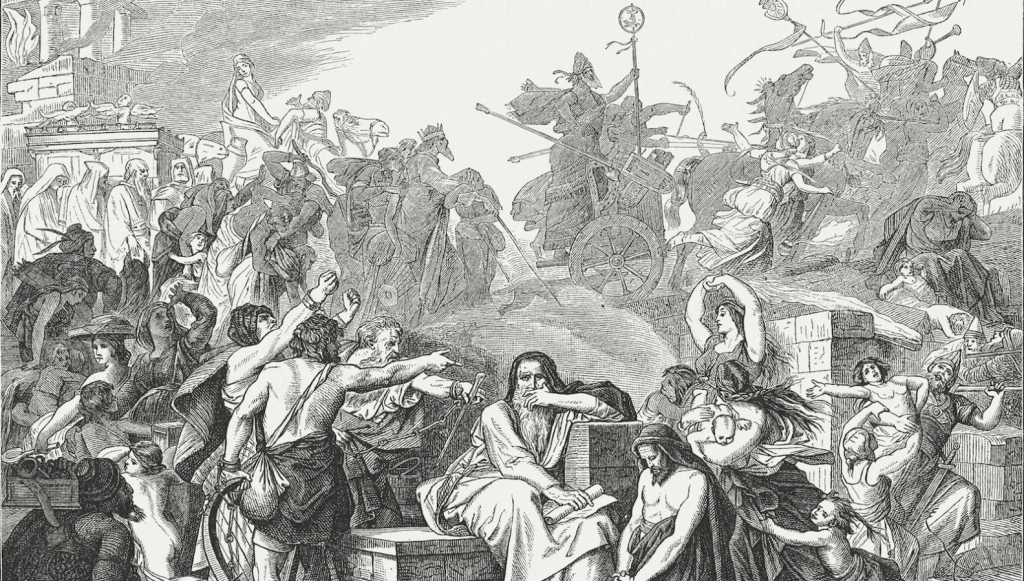
The Babylonian Exile by Jewish-German painter Eduard Bendemann (1811-1889)

In the nineteenth year of Nebuchadnezzar king of Babylon on the seventh day of the fifth month, Nebuzaradan, the king of Babylon’s chief deputy, arrived in Jerusalem. He burned the Temple of God to the ground, went on to the royal palace, and then finished off the city. He burned the whole place down. He put the Babylonian troops he had with him to work knocking down the city walls. Finally, he rounded up everyone left in the city, including those who had earlier deserted to the king of Babylon, and took them off into exile. He left a few poor dirt farmers behind to tend the vineyards and what was left of the fields.

The Babylonians broke up the bronze pillars, the bronze washstands, and the huge bronze basin (the Sea) that were in the Temple of God and hauled the bronze off to Babylon. They also took the various bronze-crafted liturgical accessories, as well as the gold and silver censers and sprinkling bowls, used in the services of Temple worship. The king’s deputy didn’t miss a thing. He took every scrap of precious metal he could find.

The amount of bronze they got from the two pillars, the Sea, the twelve bronze bulls that supported the Sea, and the ten washstands that Solomon had made for the Temple of God was enormous. They couldn’t weigh it all! Each pillar stood twenty-seven feet high with a circumference of eighteen feet. The pillars were hollow, the bronze a little less than an inch thick. Each pillar was topped with an ornate capital of bronze pomegranates and filigree, which added another seven and a half feet to its height. There were ninety-six pomegranates evenly spaced—in all, a hundred pomegranates worked into the filigree.

The king’s deputy took a number of special prisoners: Seraiah the chief priest, Zephaniah the associate priest, three wardens, the chief remaining army officer, seven of the king’s counselors who happened to be in the city, the chief recruiting officer for the army, and sixty men of standing from among the people who were still there. Nebuzaradan the king’s deputy marched them all off to the king of Babylon at Riblah. And there at Riblah, in the land of Hamath, the king of Babylon killed the lot of them in cold blood.

Judah went into exile, orphaned from her land.

3,023 men of Judah were taken into exile by Nebuchadnezzar in the seventh year of his reign.

832 from Jerusalem were taken in the eighteenth year of his reign.

745 men from Judah were taken off by Nebuzaradan, the king’s chief deputy, in Nebuchadnezzar’s twenty-third year.

The total number of exiles was 4,600. (The Message)

The Babylonian Exile by Fahri Aldin, 2017

Eventually, God’s words and decrees happen. It may take minutes. It might take centuries. But it will happen.

God promised destruction. It happened. The temple, the city walls, and the houses of Jerusalem were destroyed.

God decreed deportation of the people. It happened. Thousands of Jews were uprooted and moved to Babylon.

God foretold depression. It happened. The social and economic system of Judah collapsed.

God said there would be an occupation of Gentiles. It happened. The occupying force seized and confiscated the holy temple articles. They violated that which was sacred to Judah.

God repeatedly told the people that there would be a reckoning for the years of social injustice and religious infidelity. It happened. There was not just a deportation of persons; there were waves of removal.

The long prophecy of Jeremiah began with a proclamation of exile. It moved toward that exile. And then, in the end, the exile became reality.

Surely, it must have seemed to the citizens of Jerusalem that the end of the world was at hand. Their very identity as God’s people, as they had understood it for centuries, was now obliterated. Who are they now?

The Jewish exile changed forever their understanding of themselves and of God because they needed to reimagine what being the people of God really means without a place and without a temple.

God is both subject and object of all Holy Scripture, including the book of Jeremiah. Perhaps neglected in all the talk of exile is that the Lord was also cast-off, put away, and exiled. And rather than this being bad news, it becomes the good news that divine presence was right alongside the exiles.

In our darkest times, in the worst of circumstances, when all seems hopeless – there is a God who shows such solidarity with us that he is crucified and put to death so that we might live.

The Lord does not stand afar off from us but is beside us, even within us.

The sheer violation and agony of Good Friday and the depressive silence of Holy Saturday are the means of demonstrating the power of resurrection and new life.

We may be deported, depressed, and destroyed – exiled to a place we do not know and do not want to be. Yet, that is not the end of the story.

Exile is temporary. Mercy is forever. There cannot be a resurrection without a death. There must be suffering before there is glory.

Love wins. Every time.

God is Love. Thus, there is always hope….

Psalm 19 – God Revealed

Yangshuo, China

The heavens proclaim the glory of God.
    The skies display his craftsmanship.
Day after day they continue to speak;
    night after night they make him known.
They speak without a sound or word;
    their voice is never heard.
Yet their message has gone throughout the earth,
    and their words to all the world.

God has made a home in the heavens for the sun.
It bursts forth like a radiant bridegroom after his wedding.
    It rejoices like a great athlete eager to run the race.
The sun rises at one end of the heavens
    and follows its course to the other end.
    Nothing can hide from its heat.

The instructions of the Lord are perfect,
    reviving the soul.
The decrees of the Lord are trustworthy,
    making wise the simple.
The commandments of the Lord are right,
    bringing joy to the heart.
The commands of the Lord are clear,
    giving insight for living.
Reverence for the Lord is pure,
    lasting forever.
The laws of the Lord are true;
    each one is fair.
They are more desirable than gold,
    even the finest gold.
They are sweeter than honey,
    even honey dripping from the comb.
They are a warning to your servant,
    a great reward for those who obey them.

How can I know all the sins lurking in my heart?
    Cleanse me from these hidden faults.
Keep your servant from deliberate sins!
    Don’t let them control me.
Then I will be free of guilt
    and innocent of great sin.

May the words of my mouth
    and the meditation of my heart
be pleasing to you,
    O Lord, my rock and my redeemer. (NLT)

I believe, along with the psalmist, that the bedrock reality of the world is God created the heavens and the earth.  Furthermore, God has given us very great and precious promises through a gracious law. All creation reflects the Lord’s wondrous character. The sun is a constant presence bringing light, warmth, and life to the earth – just like God. 

Everything in creation bears the mark of its Creator to such a degree that it is almost as if the creation itself speaks. Even at night, it’s as if our God keeps constant vigil over us, gently enveloping us in divine presence and protection.

If this were not enough, God has given people a perfect law with all its right precepts, clarity of commands, and truthful statutes. God’s law, like the Lord’s creation, reflects a gracious divine character. We were not left alone to fend for ourselves – to try and figure out everything about how-to live-in God’s big world. Like a caring and conscientious mother, the Lord has provided the Law, to provide us with sure footing and solid direction. The law of the Lord is so good that it is more valuable than gold, and more desirable than any food.

Since all this creation and law is freely available to us, it is a good thing to memorize and meditate on this very psalm. Perhaps take a few verses with you out for a leisurely walk in God’s good creation. Carefully reflect on them as you notice the grand scope of God’s vast sky, and the intricacies of God’s small details.  Let it all rise to a paean of praise and appreciation to the God who notices, has acted, and will intervene.

The laws of the Lord are true.

Different cultures have multiple words for things which are important to them. For example, in most Asian countries there are various words for “rice” depending upon which strain it is and in what manner it is cooked.  Rice is important to them. In America, we only have one word for “rice” no matter where it comes from or how it is prepared. Whereas the country of Indonesia might only have one generic word for “money,” we in the West have a plethora of terms for it: coins; bills; dollars; checks; debit accounts; stock; bonds; annuities, etc.  Americans have dozens of words for “money” because it is weaved into the fabric of our capitalistic way of life.

In today’s wonderful psalm, we encounter several words for “law:” testimony; precept; commandment; instruction; decree; and rule. So, a healthy way to approach God’s Holy Word is to pay careful attention to the various instructions and commands because they are important.

The law of God is to be as familiar to the Christian as Jesus and the Spirit. We need God’s guidance and direction to live rightly and with pleasure. When we look at the law with gratitude and seek to obey God through it, we will learn to avoid sin and lead a blameless life. Thus, to commit God’s Word to heart and to memory would be sage for every believer.

Most of life, as you well know, is lived in the mundane.  We drive and walk the same well-worn roads and paths; spend much time each day doing routine ordinary things; repeatedly say the same things to our kids, day after day; engage in ordinary chores; and, worship in predictable ways.  Excitement is certainly to be had, but it is more the exception than the rule, even in these days of pandemic and change. Patience, perseverance, and plodding comes with living wisely. It is the norm for realizing a thriving and flourishing spiritual life.

Psalm 19 is a celebration of God’s self-revelation.  Through both nature and law, God is made known to humanity. What is more, God’s moral and ethical teachings provide insight for living a good life for all persons everywhere.

Wisdom in the Old Testament is the combination of knowledge and practice. It is the application of God’s self-revelation to concrete situations in life.  We live wisely when we get to know the sovereign God of creation and use revealed mores and ethos as our guide in daily experiences.

We need God’s gracious revealed law. It is not just for theology nerds or spiritual eggheads; God’s law is for everyone – the learned and the unlearned.  Every one of us needs the guidance and direction of God’s Holy Word, and the careful application of it to all our circumstances.

You and I are shaped and formed as godly people as we allow God’s natural and written revelation to awash us and seep into our souls.  Reading this psalm out loud, slowly, and contemplatively, more than once, is an opportunity to let our common ordinary experiences transform us.

Psalm 19

Psalm 119:105-112 – Light for the Journey

Your Word is a Light

Your word is a lamp to guide my feet 
    and a light for my path. 
I’ve promised it once, and I’ll promise it again: 
    I will obey your righteous regulations. 
I have suffered much, O Lord; 
    restore my life again as you promised. 
Lord, accept my offering of praise, 
    and teach me your regulations. 
My life constantly hangs in the balance, 
    but I will not stop obeying your instructions. 
The wicked have set their traps for me, 
    but I will not turn from your commandments. 
Your laws are my treasure; 
    they are my heart’s delight. 
I am determined to keep your decrees 
    to the very end. (NLT) 

Two qualities which stand out to me in these verses are the psalmist’s attitude and affection. This is a person who is determined to hold onto God’s Word because it is his heart’s delight. Yes, our attitudes and our affections are meant to be like a hand in a glove. It is our attitudes which help us to push through the pain to realize better days. And it is our affections which drive us forward, allowing us to experience joy in the present moment as we await our hope of ultimate deliverance. 

Commitments are fluid, always moving – which means they need to be continually rehearsed and refreshed. We are constantly either fulfilling our promises or reneging on them. There is really no such thing as a one-time vow. Commitments must have reinforcement from our attitudes and our affections. Otherwise, they languish on the trash heap of good intentions. This is one reason why the psalms are designed for constant use. 

It is important to have spiritually healthy habits ensconced in our lives well before any suffering and hard times roll in. If we have been nourished and supported by a daily sustenance of God’s Word, then we have both a breadth and a depth of robust theology to draw upon when the going gets rough. In addition, the sheer force of habit brings us back again and again to the treasure chest of divine instruction which informs our decisions and illuminates the treacherous road ahead. 

All the psalms are designed to reframe our own difficult situations. Even and especially when a person’s life hangs in the balance, we have the opportunity of viewing such hard and awkward circumstances through the window of the psalmist. Although circumstances change and we never quite know what to expect, God’s Word remains as our ballast and our rock. Divine love and morality are unchanging. Jesus Christ is the same yesterday, today, and forever. The Spirit is always with us, through each wave of hardship. 

Life is a continual journey, an exploration into the unknown of the future. The path is shadowy and unclear. We are unsure of what is just around the bend. Yet, God’s Word is like a never-ending flashlight helping us navigate forward. Maybe Jesus had this psalm in mind when he said:  

“I am the light of the world. Whoever follows me will never walk in darkness but will have the light of life.” (John 8:12, NRSV) 

In the Christian tradition, the Word is embodied in Jesus Christ so that he is both example and fulfillment of all God’s promises. Within today’s psalm, a sequence of four metaphors runs through these verses: my feet (light for my feet to walk in the way of God); my mouth (deliberate verbal commitment to God’s words); my hands (doing God’s will despite the circumstances); and my heart (desiring God’s decrees and commands).

With Jesus as Word and Light we have a constant companion walking alongside us for the journey; we have an intercessor who takes our wordy or malformed prayers and presents them before our heavenly Father; we use our hands by observing the Master who washed the feet of others; and, our hearts find their rest in the One who loved us and gave himself for us. 

In sum, our attitudes and affections are transformed into sustainable faith for the long journey; our hope is made sure through the promises of God; and, our love finds a resting place in the person of Jesus. Faith, hope, and love are the shoes which enable us to walk the long hard road uphill, as well as absorbing the shock as we run with abandon downhill – into the loving arms of God. 

soap

Let us come to Holy Scripture and liberally digest its life-giving message. I encourage you to find what works best for you in developing helpful spiritual habits. In reading the Bible, I often take the following approach using the acronym S.O.A.P…. 

Scripture 

  • Open your Bible and slowly, meditatively, read the portion of Scripture in your reading plan for today.
  • Write the reference of what you read in a journal along with the date.
  • As you read, ask God’s Spirit to highlight the verse(s) that speak to your life and write it in your journal.

Observation 

  • Make observations about what you just read and write them in your journal.
  • Think about: What is going on? What is the context?  Who are the people being spoken to? What is the background or setting for this verse?
  • Paraphrase and write this scripture down in your journal, in your own words.
  • What do you think God is saying to you in this scripture?

Application 

  • Personalize what you have read by asking yourself how it relates to your life right now.
  • Ask yourself how you can apply what you just read to your own life and write it in your journal.
  • Ask yourself how your life will be different or changed as a result of God speaking to you in this Scripture.

Prayer 

  • Write out a prayer to God in your journal.
  • Your prayer should relate to the verse that you highlighted. It could be asking for help, thanking God, etc. Write down what your heart desires to say to God in response to his Word.

May the words of your mouth, the meditations of your heart, the work of your hands, and the movement of your feet be to the glory of Jesus Christ. Amen.