I lift up my eyes to the hills— from where will my help come? My help comes from the Lord, who made heaven and earth.
He will not let your foot be moved;
he who keeps you will not slumber.
He who keeps Israel
will neither slumber nor sleep.
The Lord is your keeper;
the Lord is your shade at your right hand.
The sun shall not strike you by day,
nor the moon by night.
The Lord will keep you from all evil;
he will keep your life.
The Lord will keep
your going out and your coming in
from this time on and forevermore. (NRSV)
This is my favorite psalm. I have read and mulled it over so many times that it is almost second nature for me to draw from its rich theological statement about God when times are difficult. This is a psalm designed for worship – to be used by God’s people through song and prayer. A community without Psalm 121 near to its heart is a group of people in danger. Yet, with it, there is a continual sense of security, confidence, and hope.
Psalms are meant to be spoken aloud and repeated. So, here is another version:
I look to the hills!
Where will I find help?
It will come from the Lord,
who created the heavens
and the earth.
The Lord is your protector,
and he won’t go to sleep
or let you stumble.
The protector of Israel
doesn’t doze
or ever get drowsy.
The Lord is your protector,
there at your right side
to shade you from the sun.
You won’t be harmed
by the sun during the day
or by the moon at night.
The Lord will protect you
and keep you safe
from all dangers.
The Lord will protect you
now and always
wherever you go. (CEV)
This beautiful majestic psalm can be used for any and every occasion. So, I often use it within hospital visits, counseling in a wide array of situations, and for my own personal edification. It seems to me that one cannot possibly overuse this psalm. The psalm was originally used for ascending the hill into Jerusalem, anticipating meeting with God. Just like a lover who looks forward to meeting his beloved and thinking about how wonderful she is, so the psalmist looks with adoring affection on the God he is about to encounter.
Here is yet another version of this wonderful psalm:
I look up to the mountains—
does my help come from there?
My help comes from the Lord,
who made heaven and earth!
He will not let you stumble;
the one who watches over you will not slumber.
Indeed, he who watches over Israel
never slumbers or sleeps.
The Lord himself watches over you!
The Lord stands beside you as your protective shade.
The sun will not harm you by day,
nor the moon at night.
The Lord keeps you from all harm
and watches over your life.
The Lord keeps watch over you as you come and go,
both now and forever. (NLT)
The psalm is rich with a theology of grace, watch care, and loving attention. This is a God who is powerful and merciful, a God able to help and desiring to do so. In a world which seems so often distant and unaffected by the divine, this is a psalm to utter repeatedly in every situation of life so that the truth of the Lord is grafted deep into the soul. In each unwanted circumstance the psalm can be spontaneously used as an immediate prayer, and with every anticipated event it can provide the words to address the most pressing of needs. Let the words resonate within you as people created in the image of God, connecting with him on both the cerebral and visceral levels of your life in this last version:
I will lift up my eyes to the hills—
From whence comes my help?
My help comes from the Lord,
Who made heaven and earth.
He will not allow your foot to be moved;
He who keeps you will not slumber.
Behold, He who keeps Israel
Shall neither slumber nor sleep.
The Lord is your keeper;
The Lord is your shade at your right hand.
The sun shall not strike you by day,
Nor the moon by night.
The Lord shall preserve you from all evil;
He shall preserve your soul.
The Lord shall preserve your going out and your coming in
From this time forth, and even forevermore. (NKJV)
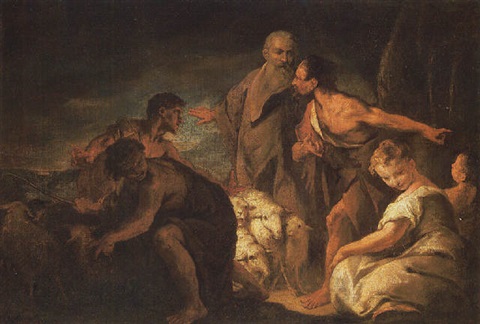
Jacob and Laban by Italian painter Nicola Grassi (1682-1748)
On the third day Laban was told that Jacob had fled. Taking his relatives with him, he pursued Jacob for seven days and caught up with him in the hill country of Gilead. Then God came to Laban the Aramean in a dream at night and said to him, “Be careful not to say anything to Jacob, either good or bad.”
Jacob had pitched his tent in the hill country of Gilead when Laban overtook him, and Laban and his relatives camped there too. Then Laban said to Jacob, “What have you done? You’ve deceived me, and you’ve carried off my daughters like captives in war. Why did you run off secretly and deceive me? Why didn’t you tell me, so I could send you away with joy and singing to the music of timbrel and harp? You didn’t even let me kiss my grandchildren and daughters goodbye. You have done a foolish thing.I have the power to harm you; but last night the God of your father said to me, ‘Be careful not to say anything to Jacob, either good or bad.’ Now you have gone off because you longed to return to your father’s household. But why did you steal my gods?”
Jacob answered Laban, “I was afraid, because I thought you would take your daughters away from me by force. But if you find anyone who has your gods, that person shall not live. In the presence of our relatives, see for yourself whether there is anything of yours here with me; and if so, take it.” Now Jacob did not know that Rachel had stolen the gods.
So, Laban went into Jacob’s tent and into Leah’s tent and into the tent of the two female servants, but he found nothing. After he came out of Leah’s tent, he entered Rachel’s tent. Now Rachel had taken the household gods and put them inside her camel’s saddle and was sitting on them. Laban searched through everything in the tent but found nothing.
Rachel said to her father, “Don’t be angry, my lord, that I cannot stand up in your presence; I’m having my period.” So, he searched but could not find the household gods.
Jacob was angry and took Laban to task. “What is my crime?” he asked Laban. “How have I wronged you that you hunt me down? Now that you have searched through all my goods, what have you found that belongs to your household? Put it here in front of your relatives and mine and let them judge between the two of us.
“I have been with you for twenty years now. Your sheep and goats have not miscarried, nor have I eaten rams from your flocks. I did not bring you animals torn by wild beasts; I bore the loss myself. And you demanded payment from me for whatever was stolen by day or night. This was my situation: The heat consumed me in the daytime and the cold at night, and sleep fled from my eyes. It was like this for the twenty years I was in your household. I worked for you fourteen years for your two daughters and six years for your flocks, and you changed my wages ten times. If the God of my father, the God of Abraham, and the Fear of Isaac, had not been with me, you would surely have sent me away empty-handed. But God has seen my hardship and the toil of my hands, and last night he rebuked you.” (NIV)
Jacob’s in-law issues did not magically disappear when he sneaked out of town with his entire family. I am glad God is faithful and acts on our behalf even when we are fearful with little faith. Far too often we do the right thing in the wrong way. It is far too easy to run away from people we don’t like. Yet, it is rarely so simple. Sometimes we plain need divine intervention to deal with people in our lives.
To Jacob’s credit, he obeyed God and headed back to the land of Canaan. However, he did it in a deceitful way which avoided confrontation. Out of fear of facing his father-in-law Laban and the worry of what might happen, Jacob got out of Dodge. It seems Jacob’s wife Rachel also acted out of fear by taking her father’s idols. Fear can cause us to have some skewed ideas and do some stupid things which get us in trouble.
“According to most studies, people’s number one fear is public speaking. Number two is death. Death is number two. Does that sound right? This means to the average person, if you go to a funeral, you’re better off in the casket than doing the eulogy.” –Jerry Seinfeld
Laban found out what was going on with Jacob and was anything but a happy camper. He went after the upstart Jacob with gusto and finally caught up to him. Despite having the power and ability to deal severely with Jacob, Laban backs off because Jacob finally found his voice and took his father-in-law to task. Embedded in Jacob’s rehearsal of their relationship is the God who intervened and took care of Jacob when Laban didn’t.
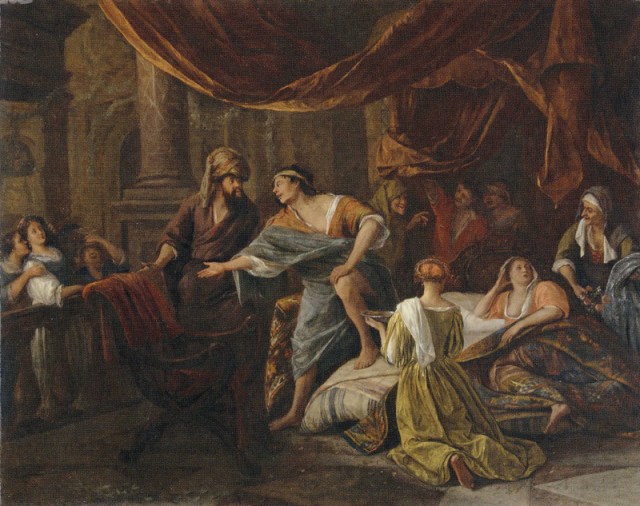
Jacob Confronts Laban by Dutch painter Jan Steen, 1669
The lengthy dialogue between Jacob and Laban was a power struggle: Laban wanted to keep the status quo authority as family head over Jacob’s family; but Jacob asserted himself as having his own distinct household. In the end, they ended-up on equal footing because of God’s intervention. Whereas Laban had his own intentions for Jacob and his family, God had other plans. It was God who enriched Jacob with a wealth of flocks and herds, even as he was being oppressed and intimidated by Laban.
The same God, who was with Jacob, is with you and me:
God is with us through difficulty, oppression, and injustice.
Now, it is commendable if, because of one’s understanding of God, someone should endure pain through suffering unjustly. But what praise comes from enduring patiently when you have sinned and are beaten for it? But if you endure steadfastly when you’ve done good and suffer for it, this is commendable before God. (1 Peter 2:19-20, CEB)
God does not give up on his people. We Christians are often living contradictions, like Jacob, who acknowledge God and give him glory but at the same time act out of fear and insecurity. Out of the compost of human sin, the sovereign God accomplishes his will.
Christ died for us when we were unable to help ourselves. We were living against God, but at just the right time Christ died for us… while we were still sinners, and by this God showed how much he loves us. (Romans 5:6, 8, ERV)
God cares both about what we do, and about why and how we do it. Ethics is the difference between morality and legality; and, between what I ought to do, and what is required of me. Jacob did what was demanded of him by God; yet, he did it out of fear along with unwise methods.
Anything that is not done in faith is sin. (Romans 14:23b, GW)
God’s intervention is needed. Without divine help, we are hopelessly lost. Furthermore, we continue to need God so we can deal with the unpredictable attempts of others to control us and push us into a mold outside of trusting in God.
Give all your worries to God because he cares about you. (1 Peter 5:7, NCV)
God instills confidence in us. After twenty hard years of service, Jacob returned to the land of Canaan prosperous and more confident in God than ever. Jacob’s trials with Laban gave him a growing sense of dependence on God. Jacob struggled, suffered, and endured – and came out the stronger for it.
You know that when your faith is tested, your endurance has a chance to grow. So, let it grow, for when your endurance is fully developed, you will be perfect and complete, needing nothing. (James 1:3-4, NRSV)
God loves us enough to not always give us an easy out because he is concerned for our walk of faith and our education in grace. So, may you discover the intervening God and exercise trust through those times when others give you a hard time.
God, grant me the serenity to accept the things I cannot change, the courage to change the things I can, and the wisdom to know the difference. Living one day at a time, enjoying one moment at a time; accepting hardship as a pathway to peace; taking, as Jesus did, this sinful world as it is, not as I would have it; trusting that You will make all things right if I surrender to Your will; so that I may be reasonably happy in this life and supremely happy with You forever in the next.Amen. –The Serenity Prayer by Reinhold Niebuhr, 1951
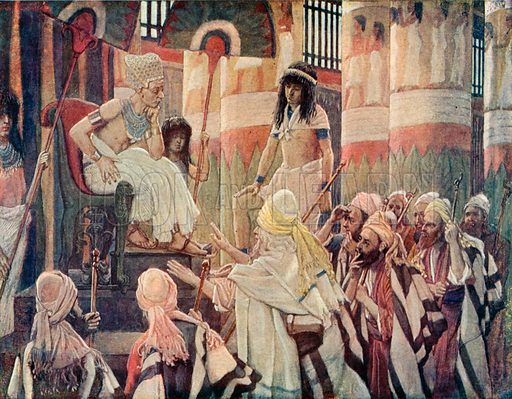
Joseph presents Jacob and his brothers to Pharaoh by French artist James Jacques Joseph Tissot (1836-1902)
And God spoke to Israel in a vision at night and said, “Jacob! Jacob!”
“Here I am,” he replied.
“I am God, the God of your father,” he said. “Do not be afraid to go down to Egypt, for I will make you into a great nation there. I will go down to Egypt with you, and I will surely bring you back again. And Joseph’s own hand will close your eyes.”
Then Jacob left Beersheba, and Israel’s sons took their father Jacob and their children and their wives in the carts that Pharaoh had sent to transport him. So, Jacob and all his offspring went to Egypt, taking with them their livestock and the possessions they had acquired in Canaan. Jacob brought with him to Egypt his sons and grandsons and his daughters and granddaughters—all his offspring.
These are the names of the sons of Israel (Jacob and his descendants) who went to Egypt:
Reuben the firstborn of Jacob. The sons of Reuben: Hanok, Pallu, Hezron and Karmi.
The sons of Simeon: Jemuel, Jamin, Ohad, Jakin, Zohar and Shaul the son of a Canaanite woman.
The sons of Levi: Gershon, Kohath and Merari.
The sons of Judah: Er, Onan, Shelah, Perez and Zerah (but Er and Onan had died in the land of Canaan).
The sons of Perez: Hezron and Hamul.
The sons of Issachar: Tola, Puah, Jashub and Shimron.
The sons of Zebulun: Sered, Elon and Jahleel.
These were the sons Leah bore to Jacob in Paddan Aram, besides his daughter Dinah. These sons and daughters of his were thirty-three in all.
The sons of Gad: Zephon, Haggi, Shuni, Ezbon, Eri, Arodi and Areli.
The sons of Asher: Imnah, Ishvah, Ishvi and Beriah. Their sister was Serah. The sons of Beriah: Heber and Malkiel.
These were the children born to Jacob by Zilpah, whom Laban had given to his daughter Leah—sixteen in all.
The sons of Jacob’s wife Rachel:
Joseph and Benjamin. In Egypt, Manasseh and Ephraim were born to Joseph by Asenath daughter of Potiphera, priest of On.
The sons of Benjamin: Bela, Beker, Ashbel, Gera, Naaman, Ehi, Rosh, Muppim, Huppim and Ard.
These were the sons of Rachel who were born to Jacob—fourteen in all.
The son of Dan: Hushim.
The sons of Naphtali: Jahziel, Guni, Jezer and Shillem.
These were the sons born to Jacob by Bilhah, whom Laban had given to his daughter Rachel—seven in all.
All those who went to Egypt with Jacob—those who were his direct descendants, not counting his sons’ wives—numbered sixty-six persons. With the two sons who had been born to Joseph in Egypt, the members of Jacob’s family, which went to Egypt, were seventy in all.
Now Jacob sent Judah ahead of him to Joseph to get directions to Goshen. When they arrived in the region of Goshen, Joseph had his chariot made ready and went to Goshen to meet his father Israel. As soon as Joseph appeared before him, he threw his arms around his father and wept for a long time.
Israel said to Joseph, “Now I am ready to die, since I have seen for myself that you are still alive.”
Then Joseph said to his brothers and to his father’s household, “I will go up and speak to Pharaoh and will say to him, ‘My brothers and my father’s household, who were living in the land of Canaan, have come to me. The men are shepherds; they tend livestock, and they have brought along their flocks and herds and everything they own.’ When Pharaoh calls you in and asks, ‘What is your occupation?’ you should answer, ‘Your servants have tended livestock from our boyhood on, just as our fathers did.’ Then you will be allowed to settle in the region of Goshen, for all shepherds are detestable to the Egyptians.”
Joseph went and told Pharaoh, “My father and brothers, with their flocks and herds and everything they own, have come from the land of Canaan and are now in Goshen.” He chose five of his brothers and presented them before Pharaoh.
Pharaoh asked the brothers, “What is your occupation?”
“Your servants are shepherds,” they replied to Pharaoh, “just as our fathers were.” They also said to him, “We have come to live here for a while, because the famine is severe in Canaan and your servants’ flocks have no pasture. So now, please let your servants settle in Goshen.”
Pharaoh said to Joseph, “Your father and your brothers have come to you, and the land of Egypt is before you; settle your father and your brothers in the best part of the land. Let them live in Goshen. And if you know of any among them with special ability, put them in charge of my own livestock.”
Then Joseph brought his father Jacob in and presented him before Pharaoh. After Jacob blessed Pharaoh, Pharaoh asked him, “How old are you?”
And Jacob said to Pharaoh, “The years of my pilgrimage are a hundred and thirty. My years have been few and difficult, and they do not equal the years of the pilgrimage of my fathers.” Then Jacob blessed Pharaoh and went out from his presence.
So, Joseph settled his father and his brothers in Egypt and gave them property in the best part of the land, the district of Rameses, as Pharaoh directed. Joseph also provided his father and his brothers and all his father’s household with food, according to the number of their children. (NIV)
Jacob Blesses Pharaoh by Welsh artist Owen Jones, 1869
God likes fulfilling his promises to us – even and especially when we are in Egypt – in the world. Sometimes we work too hard at avoiding the world and creating heaven on earth right now. God knew what the Israelites would face: four-hundred years of slavery in Egypt. Yet, God sent them anyway. Often, the people of God grow more in times of trial and hardship, than in times of plenty and peace.
The trip to Egypt included everyone in Israel. There is a genealogical list of those who made the journey because God fulfills his promises through people. These are the folks who would carry on accomplishing the will of God. Joseph and Jacob, the son, and the father, are reunited. Joseph diplomatically planned where the gang would live and work because Egyptians looked down on shepherds. Much like the ancient Israelites, we must navigate a world that is okay with us being in it yet not okay with us in the middle of things.
In the Old Testament, Egypt represents the world. It is interesting God sent his people to live there. God seeks to create a people for his Name who are distinct from Egypt, yet, live among the people of the world. There is a continual tension for God’s people to be holy and unique, not assimilating into the world’s mold; and, yet, at the same time, God wants them to have a constant engagement and interaction with the world. Therefore, two extremes are to be avoided: to focus solely on being a holy people through complete severance from the world as much as possible; and, to seek relevance in the culture through wholesale jettison of distinctiveness so that the sacred and the secular are connected.
God safeguards a distinct people so that they will be a preservative in the world. Godly people are neither to live in a vacuum, cut off from the world altogether, nor to be wed to the world so that the two are indistinguishable. We live in a fundamentally broken world in need of the peace and grace of spiritual people within it. The Church has had to struggle with how to live in the world for two-thousand years. We have the advantage of drawing from a rich Christian history. For there is nothing we face now which has not been faced by the church before.
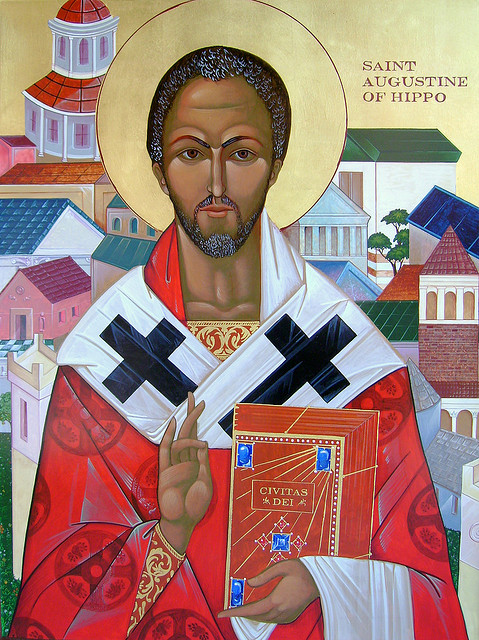
Saint Augustine wrote his seminal work, City of God, in about 413 C.E. The Roman empire had fallen, and pagans were blaming the Church because Christianity had become wed to the state. The people of God were unsure how to proceed. So, Augustine sought to help Christians think about how to live in a post-Christian society.
Augustine’s work is lengthy and quite in-depth, so, the following is a brief distilling of his main arguments. For Augustine, there are four essential institutions: two visible institutions; and, two invisible institutions:
The Church – is a divinely established institution, designed to lead people to God.
The State – is a political institution, adhering to political virtues to establish the peace.
The City of Heaven – is made up of those predestined for salvation.
The City of the World – is made up of those destined for eternal damnation.
We must pursue the City of Heaven, which for Augustine, is the pursuit of justice and righteousness. Augustine gave a clarion call for people to choose which city they will pursue, especially because many tended to blur the distinctions between the visible institutions of church and state.
Augustine’s conclusion is that the purpose of history is to show the unfolding of God’s plan. This involves fostering the City of Heaven and filling it with worthy citizens. Therefore, the fall of Rome, a visible city so important to the people of Augustine’s day, was not near as important to the invisible God.
Maintaining an eternal perspective can help us today. The collapse of jobs, the scourge of a racialized society, the loss of life due to COVID-19, and injustice are significant events and circumstances – important enough to consider deeply how those issues will be handled. Augustine called out the people of his day for ignoring invisible spiritual solutions for the great problems among them.
Returning to the book of Genesis, a question arises: Will the Israelites become a nation through assimilation with Egypt and its institutions, or will they maintain their distinction as God’s people by relying on God’s covenant promises? There are no easy answers to living in the world. However, it is important we struggle with how to get along in it.
God is the principal actor in the created world. God chooses to use his people as instruments of blessing to it. Joseph’s wisdom and diplomacy, given by God, turned potentially catastrophic situations into times of prosperity. God, too, will use us as dispensers of wisdom – applying truth to concrete situations for the betterment of all involved.
Joseph handled the delicate situation of his brothers being shepherds while all shepherds were detestable to Egyptians. Joseph brought the two worlds together through artful negotiation between the interests of both Pharaoh and the Israelites. He created a win/win scenario by setting up his brothers to help Pharaoh with his own needs in caring for livestock. In the end, all parties were satisfied because Joseph maintained a focus on needs instead of only advocating one side.
Rather than getting bogged down in promotion of methods and means, a sage approach is to maintain a focus on needs – which requires careful listening and a stance of empathy. Then, we can work toward prosperity for all instead of hardening into reified positions. A lot of problems in the church, work, society, and family can be turned to blessing if we seek the wisdom that comes from God.
May the Lord bless you and keep you; and, make his face shine on you and be gracious to you. May the Lord turn his face toward you and give you peace. Amen.
“The tent of testimony was with our ancestors in the wilderness. Moses built it just as he had been instructed by the one who spoke to him and according to the pattern he had seen. In time, when they had received the tent, our ancestors carried it with them when, under Joshua’s leadership, they took possession of the land from the nations whom God expelled. This tent remained in the land until the time of David. God approved of David, who asked that he might provide a dwelling place for the God of Jacob. But it was Solomon who built a house for God. However, the Most High does not live in houses built by human hands. As the prophet says,
Heaven is my throne,
and the earth is my footstool.
‘What kind of house will you build for me,’ says the Lord,
‘or where is my resting place?
Didn’t I make all these things with my own hand?’
“You stubborn people! In your thoughts and hearing, you are like those who have had no part in God’s covenant! You continuously set yourself against the Holy Spirit, just like your ancestors did. Was there a single prophet your ancestors did not harass? They even killed those who predicted the coming of the righteous one, and you have betrayed and murdered him! You received the Law given by angels, but you haven’t kept it.” (CEB)
In the doldrums of summer’s heat and humidity and the uncertainties of what is to come in the autumn season, it is a good time to remind ourselves of where we are in the Christian Year. When a long and difficult season comes upon us, whether in secular or sacred time, it may be far too easy to lose sight of what is important. We have come through Advent, Christmas, Epiphany, Lent, and Easter, as well as Pentecost. With the giving of the Spirit, we have entered Ordinary Time. A healthy way of remembering this period in time is that, in this longest season of the Church Calendar, it is the ordinary vocation of each Christian and every Church to grow in Christ and share the good news of Jesus with the world.
Yet, we forget. The vicissitudes of this life and a penchant for hand wringing can easily take our eyes off our calling from the sovereign God. Like the ancient Israelites for whom Stephen railed against in our New Testament lesson for today, we might become stubborn, hard-headed, and inflexible. We get lost in doing things our own way to the neglect of what God wants. When that happens, there is damage to God’s people, God’s name, and God’s law. Rather than tongues being used for praising the Lord and encouraging others, God’s prophets who are calling us to holiness are verbally decapitated. Ironically, those who speak and act in the name of the Lord are resisting him.
Every time individuals and groups of people believe they have piously figured everything out, they will soon find themselves fighting against God. The Lord of All has not called us to figure out every mystery and nail down each uncertainty. Those who claim to have done it are living in a delusional world. Perhaps they will eventually discover how large and immense God really is – much bigger than our puny thoughts and misguided practices.
How then shall we live? What are we to do? Let go of our illusions of power and privilege. Submit afresh to the Lord for whom we must bow in all things. If we can do that, then we are well on our way to seeing the only true God in all his immensity. Humble ourselves under the mighty hand of God and set aside self-righteous pride so that he may exalt and honor us at the appropriate time of his choosing, not ours (1 Peter 5:6). Take up our holy calling as Christ’s ambassadors, having become new people and knowing the reconciling power of the cross, through the proper spiritual tools of faith, hope, and love (2 Corinthians 5:17-21; 1 Corinthians 13).
The following practices can help us become more spiritually flexible and open to the Spirit’s work:
Stretch your faith muscle. Physical muscles which get little to no use will atrophy – which is why people who are confined to bed or with limitations need physical therapists to help work the muscles. Spiritually, if we are rarely or never in positions which work our faith muscle, then that faith will diminish and eventually atrophy. Faith is not static, but dynamic. It needs to be worked.
Breathe deeply. Proper breathing is essential in using our bodies. The same is true spiritually. Fear, worry, and anxiety cause us to have shallow breathing and unable to think straight. When we are amped-up about something, focus on doing some breath prayers, i.e. breathing in saying, “More of you,” and breathing out saying, “Less of me.”
Avoid extreme positions. A hyper-extended muscle will tear and cause a lot of damage. An acceptance of limitations and an awareness of our body’s true capacity prevents us from trying to do something our body simply cannot do. Our faith will not support extreme positions which alienate people and put God to the test.
Move more. Getting in bodily shape does not have to be dramatic and involve triathlons (but, hey, if you can work your way up to it, more power to you!). Most of us simply need to get out of our chairs and move a bit more and we would be a lot healthier. Faith is mostly lived in the mundane daily decisions of life. Consistently taking small steps of faith each day will go a long way toward our spiritual health and vitality – not to mention helping us see a big God at work.
Listen, do not ignore. It is always best to listen to your body— only push it as far as it can handle, even if it is little by little. Many people would be better served if they would just listen to their gut and the spirit God put within them – rather than pushing themselves and others beyond what they can handle. Behind the attempt at doing too much is typically an issue of wanting the kind of control God possesses.
To do the will of God, we must have a growing awareness and knowledge of a huge unlimited God and a small limited self. This will take loosening up on the stubbornness and opening to greater flexibility. In doing so, we bless both God and the world, while discovering our true calling. And, we might just discover the largeness of grace operating in our lives.
Holy God, heaven is your throne and the earth your footstool. You cannot be kept within any one church or any single place. You are much too big for that! Forgive me for my small thoughts of you and my weak faith. I humble myself before you so that you can live in and through me for the sake of Jesus. Amen.








 Rev. Tim Ehrhardt