The Bethlehem Candle of Love (Luke 2:1-7)

In those days Caesar Augustus issued a decree that a census should be taken of the entire Roman world. (This was the first census that took place while Quirinius was governor of Syria.) And everyone went to their own town to register.

So Joseph also went up from the town of Nazareth in Galilee to Judea, to Bethlehem the town of David, because he belonged to the house and line of David. He went there to register with Mary, who was pledged to be married to him and was expecting a child. While they were there, the time came for the baby to be born, and she gave birth to her firstborn, a son. She wrapped him in cloths and placed him in a manger, because there was no guest room available for them. (New International Version)

The Christian season of Advent is a time of preparation and expectant waiting for the promised Savior. Each Sunday this month, we will focus on the theme of the Advent candle for that day. Today, we look at the Bethlehem candle, love. Next week, we consider joy, then peace, and on Christmas Day, light.

Advent Love

Jesus was born in Bethlehem and placed in a humble manger, a feeding trough, because of love. The Lord was quite literally conceived in love – a love which originated within the Trinity of Father, Son, and Spirit, and mediated through a virgin, Mary, whose own love for God enabled her to raise the Messiah in love. The world revolves on the axis of love. Without love, we do not exist. With love, there is deliverance, there is a Savior. It’s all about love, my friends, and always has been from the beginning….

God’s Love

God’s loving plan for us started, not with the incarnation, but with the very first act of creation. Out of nothing, and out of sheer love, humanity was created in God’s own image. Since God is Love, we were made to receive love and give love. (Genesis 1:26-30)

However, the first humans, Adam and Eve, began to doubt the truth of God’s goodness and love for them. And so, they disobeyed their Creator, believing that God was withholding love from them.

Yet, despite humanity’s fall into sin, God’s loving mercy did not abandon them altogether. God did not destroy Eve and Adam. Even as they began to experience the serious consequences of their sin, God made a promise of future redemption: that Eve’s own offspring would one day crush the head of the serpent who tempted them. (Genesis 3:15)

God’s Loving Plan

The Lord had no intention of simply leaving people in their wretched state of separation and rebellion. God promised that Abraham’s descendants would be a blessed people who, in turn, would bless the world. (Genesis 12:2-3)

God foretold of the One, born of a virgin, who would free the captives, bear our transgressions, suffer in our place, redeem people, and usher in a peace unlike anything ever known.

Though the mountains be shaken
    and the hills be removed,
yet my unfailing love for you will not be shaken
    nor my covenant of peace be removed,”
    says the Lord, who has compassion on you. (Isaiah 54:10, NIV)

The Bible is a long, extended, and unfolding drama of redemption spanning several centuries. Even though the plan of redemption takes time, God lovingly walks with people through their suffering, temptation, loss, grief, and trials.

The Nativity by Japanese artist Sadao Watanabe (1913-1996)

When the Lord heard the cries of the ancient Israelites under their cruel yoke of slavery, God led them out of Egypt (Exodus 3:18). When the Jews were exiled from their land, God reminded them of the ongoing plan of redemption:

But now thus says the Lord,
    he who created you, O Jacob,
    he who formed you, O Israel:
Do not fear, for I have redeemed you;
    I have called you by name; you are mine.
When you pass through the waters, I will be with you,
    and through the rivers, they shall not overwhelm you;
when you walk through fire you shall not be burned,
    and the flame shall not consume you.
For I am the Lord your God,
    the Holy One of Israel, your Savior.
I give Egypt as your ransom,
    Cush and Seba in exchange for you. (Isaiah 43:1-3, NRSV)

For generations, God has remained faithful to people even when they doubt and have weak faith; and even though they question God’s motives and power and turned away from the Lord. The plan of God is simply an extension of the character of God:

They refused to obey and were not mindful of the wonders that you performed among them, but they stiffened their necks and appointed a leader to return to their slavery in Egypt. But you are a God ready to forgive, gracious and merciful, slow to anger and abounding in steadfast love, and you did not forsake them. (Nehemiah 9:17, NRSV)

Love Is with Us

Revisiting the big picture of God’s love for people during Advent helps us understand the significance of the first advent, the coming of a Savior. The incarnation of Christ is the hinge of a larger story of God’s good love and redemption for us. Love, incarnated in the form of a vulnerable baby, came to fulfill a promise God made centuries before.

Christ was truly God.
But he did not try to remain
    equal with God.
Instead he gave up everything
    and became a slave,
when he became
    like one of us.

Christ was humble.
He obeyed God and even died
    on a cross. (Philippians 2:6-8, CEV)

The motivation for the first advent of Jesus, the incarnation of Christ, was because of love:

For God so loved the world that He gave His only begotten Son, that whoever believes in Him should not perish but have everlasting life. (John 3:16, NKJV)

True love is God’s love for us, not our love for God. He sent his Son as the way to take away our sins. (1 John 4:10, ERV)

Advent Love Is Our Calling

In remembering that first advent, we know that a new era of God’s restoration has been ushered in. And we await a second advent when Christ returns to judge the living and the dead. Now, living in between these two advents, God’s people are called to love others as Christ has loved us and gave himself for us.

“‘Love the Lord your God with all your heart, with all your soul, and with all your mind.’ This is the greatest and the most important commandment. The second most important commandment is like it: ‘Love your neighbor as you love yourself.’ The whole Law of Moses and the teachings of the prophets depend on these two commandments.” (Matthew 22:37-40, GNT)

This Advent season, let us ask how we can love God and love our neighbor more fully, so that we might fulfill the call of Jesus Christ.

Let us pray with the encouragement of Scripture (adapted from 1 John 4:7-12):

Loving God, help us to love each other since love comes from You. We understand that everyone who loves is born again and experiences a relationship with You. The person who refuses to love doesn’t know the first thing about You, because You, God, are Love itself—no one can know You if they don’t know love.

Merciful God, we give you unending thanks that You showed Your love for us by sending Your only Son into the world so that we might live through him. While we were still sinners, Christ died for us; and that is the kind of love You are all about—not that we once upon a time loved God, but that You loved us and sent the Son as a sacrifice to clear away our sins and the damage they’ve done to our relationship with You.

Gracious God, since You loved us like this, we pray that You will enable us to love each other. No one has seen You, ever. But if we love one another, You will dwell deeply within us, and love becomes complete in us. May it be so, to the glory of Jesus Christ in whose Name we pray. Amen.

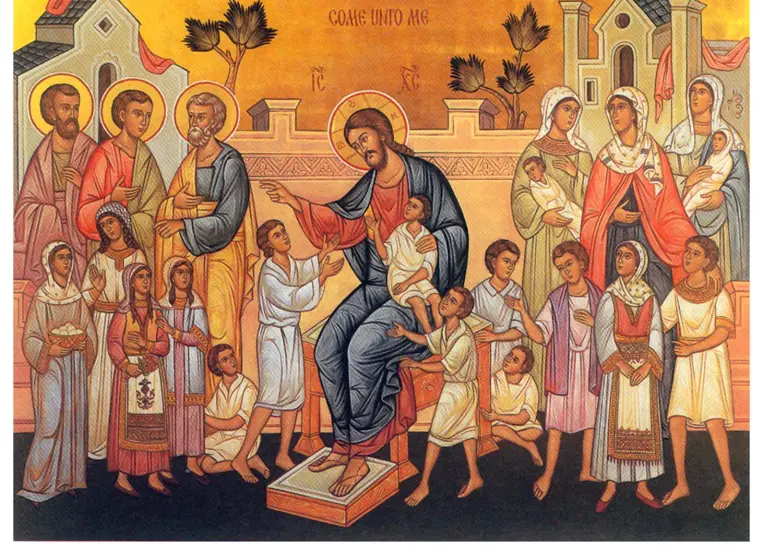
Let the Little Children Come (Luke 18:15-17)

People were also bringing babies to Jesus for him to place his hands on them. When the disciples saw this, they rebuked them. But Jesus called the children to him and said, “Let the little children come to me, and do not hinder them, for the kingdom of God belongs to such as these. Truly I tell you, anyone who will not receive the kingdom of God like a little child will never enter it.” (New International Version)

I happen to believe that kids are closer to the kingdom of God than most adults.

Us big people have developed a lot of baggage over the years. And all that stuff tends to obscure God’s kingdom and the light of Christ within us.

Kids, however, especially small children, still haven’t discerned any veil between the seen and unseen worlds. They freely move between them both without any problem.

So, of course, Jesus wanted to be around children. If he had any homesickness at all, I’m sure the presence of kids made him feel at home more than anywhere else on this earth.

Jesus is our Immanuel, God with us.

The kingdom of God is here within us.

The disciples of Jesus had some difficulty with Christ’s branding of the message because it was not exclusive enough for them. They wanted limits on the us part.

Kids are part of that mass of people that God is with. Children deserve as much or more attention than adults. More than simply saying that we care about kids, we need to be like Jesus. He let the children come to him and was intolerant of anyone preventing kids from doing so.

Since the disciples were, ironically, still living in a small world, they rebuked those who brought little children to Jesus.

We aren’t specifically told why the disciples rebuked the adults bringing children to Jesus. Maybe the children were making a lot of noise and were being a nuisance in the middle of Jesus’ teaching. Perhaps the disciples had Jesus on a tight time schedule and this bringing kids to Christ thing was causing a delay. It could be that the disciples simply saw children as an interruption to the “important” work of ministry. 

I tend to think that the disciples simply failed to appreciate the children. The dominate view of kids in the ancient world was to see them as potential adults. Kids were pretty low on the ladder of society. The disciples likely saw no reason for children to be involved in what was happening.

The babies and toddlers and small children were brought so that Jesus might place his hands on them and pray for them. That still seems to me to be the best reason to bring kids to Jesus. 

“This story teaches us that Christ does not receive only those who voluntarily come to Him of a holy desire and moved by faith, but also those who might not yet be old enough to realize how much they need His grace….  From this we gather that His grace reaches to this age of life also….  It would be cruel to exclude that age from the grace of redemption.”

John Calvin

“Jesus does not only save repentant adults; he also saves dependent children and all those whom we think are incompetent to respond to Jesus.”

Frederick Dale Bruner

Jesus flat out rebuked his disciples for hindering the little children from coming to him. He wanted just the opposite of what was taking place. Why? Because the kingdom of heaven belongs to such little people as these. 

As mentioned, children were at the bottom of the societal pecking order in the ancient world. Their place in that society was to be respectful and quiet, to speak only when spoken to, and to never interrupt an adult.

Yet, Jesus took the time to touch them and pray for them. He invited this interruption to his schedule. Christ bluntly told his disciples that they were the ones being the hindrance, not the kids.

I baptize all sorts of people, including kids and babies. Why? Because in baptism, I recognize that the smallest ones among us can come to this holy sacrament. I understand that in baptism the Holy Spirit begins and initiates the process of salvation that will take that little one from infancy to adulthood and eventual death. I discern that, ideally, the child grows to live into their baptism by recognizing by faith that Jesus died and rose from the dead and grants grace and forgiveness to all who come to him. 

In that process of salvation, of coming to know Jesus, we have the sacrament of the Lord’s Table to strengthen our faith and demonstrate to us that the saving work of Jesus that has been accomplished. It is a Table of grace for all the members of Christ’s Church. 

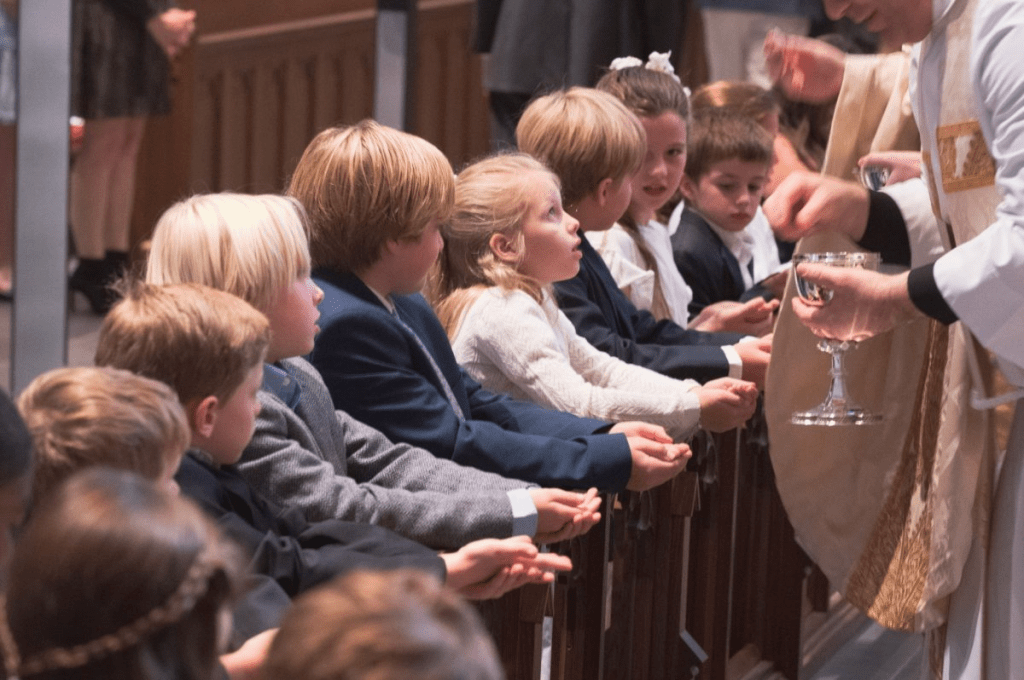
In my Reformed Christian tradition, we believe that Jesus is not physically, but spiritually present at the Table.  Because Jesus is present, we are able to receive the grace available to us as Christ’s members. So why, in light of this reality, and the words and practice of Jesus toward children, would we ever hinder and prevent the smallest members among us from participating at the Table?

Here’s a thought: If Jesus himself were serving communion in a church, and a group of 2-year-old children came toddling up to the Table to see Jesus, would you stop them from doing so? Or much like the disciples, would you rebuke those bringing children to Jesus?

As for me, I’d rather not be rebuked by my Lord.

Jesus gave children the three gifts they most need: time, touch, and prayer. Parenting and teaching are holy vocations, and we have the wonderful privilege of bestowing these same gifts on our children, grandchildren, and students.

Time, touch, and prayer are ways we bless children. And, what’s more, as God’s children, we are all to approach Jesus and spend time with him, allow him to touch us, and interact with him through prayer. 

May we all have the humility to bend down at eye level to the littlest among us so that we and others will know that the kingdom of God is among us.

Matthew 10:16-25 – The Place of Trouble

“I am sending you out like sheep among wolves. Therefore, be as shrewd as snakes and as innocent as doves. Be on your guard; you will be handed over to the local councils and be flogged in the synagogues. On my account you will be brought before governors and kings as witnesses to them and to the Gentiles. But when they arrest you, do not worry about what to say or how to say it. At that time, you will be given what to say, for it will not be you speaking, but the Spirit of your Father speaking through you.
 
“Brother will betray brother to death, and a father his child; children will rebel against their parents and have them put to death. You will be hated by everyone because of me, but the one who stands firm to the end will be saved. When you are persecuted in one place, flee to another. Truly I tell you, you will not finish going through the towns of Israel before the Son of Man comes.
 
“The student is not above the teacher, nor a servant above his master. It is enough for students to be like their teachers, and servants like their masters. If the head of the house has been called Beelzebub, how much more the members of his household! (New International Version)
 
Take a moment to let this statement from Jesus sink-in: “I am sending you out like sheep among wolves”… 
 
To name the obvious: A pack of wolves will attack a flock of sheep because a wolf is a hunter, and a sheep is the prey. In short, wolves eat sheep.
 
So, when Jesus said this to a group of guys who are familiar with rural metaphors, they clearly got the message: The Lord is putting us in a place of danger. We are at risk. We could lose our lives.
 
From the mere human perspective, Christ’s words to his disciples are outlandish. Here we have a group of people who are following Jesus. But they likely didn’t sign-up for this! Perhaps they began to think their Lord was a bit off his rocker. Maybe he ate a piece of moldy bread or a leftover fish that didn’t agree with him.
 
Sometimes, followers of Jesus Christ completely lose sight that he was a troublemaker and warned us about trouble in the world. 
 
It’s not that Jesus was intentionally pressing everyone’s buttons; he was just being himself, and that sent a whole lot of people, at the worst, gnashing their teeth and caballing to kill him; and, at the least, causing them to question why they are even paying attention to him. 
 
Then, when you throw into the mix that Jesus also tended to get all up into people’s grill and confront them with bold assertions that they can only be rightly related to God through himself, on his terms, there ends up being a large chunk of folks who simply walk away, believing Christian discipleship isn’t for them.
 
Yet, Jesus wasn’t presenting something brand new. He was lifting up a truth which has been with God’s people throughout the ages: God never promises to keep us from trouble.
 
In fact, the Lord does just the opposite: He promises we will face a great deal of trouble because of our spiritual commitments. However, there is a further promise: God will be with us through the trouble, and not apart from it. We don’t even need to worry about what to say because God’s very Spirit will speak for us.
 
This is one reason why Jesus describes himself as the Good Shepherd who cares for the sheep. Yes, Jesus is sending out his disciples like vulnerable sheep among ravenous wolves. However, he forever stands as the divine sentinel, watching over the flock, keeping them safe, going after the strays, and challenging the predators.
 
We may be in a difficult place of trouble, yet Jesus is present with us by means of the Holy Spirit. We do not fear and instead live with confidence in the middle of hard circumstances because God is with us. And if God is with us and God loves us, nothing can separate us from our Lord – no matter how cunning and intimidating that big old wolf is.
 
Therefore, we should expect opposition and trouble. There are going to be times that we unintentionally disrupt and upset our families, our co-workers, and those around us. 
 
It’s not that we are trying to be obnoxious or malicious; it’s just that by simply loving Jesus and seeking to follow him, we are going to upset some people – and, as Christians, we need to be okay with that reality. 
 
Facing trouble is really not the worst thing to be experienced; to be separated from God is the most terrible thing that could ever happen to us.
 
My friends, it is okay to rock the boat, shake the tree, upset the fruit basket, stir the pot, and make waves if you are doing it because you are committed to God’s will and you are truly living into the words and ways of Jesus. 
 
Because Jesus faced a great deal of trouble, opposition, and suffering, he is able to help us through our own overwhelming stuff.
 
So, count the cost. Give your life away. In doing so, you will actually find it – and find that you are saved and safe.
 
Holy God, you are jealous for your Name to be honored and adored. My life is yours. Use it for your glory in this fallen world. If trouble and persecution occur, I’ll consider it a privilege to suffer for Jesus and an opportunity for the Holy Spirit to show up. Amen.

Exodus 40:16-38 – No Matter Where We Go, God Is with Us

Israel Encamped Roundabout the Tabernacle in the Wilderness of Sinai
John W. Kelchner (1866-1942)

Moses followed the Lord’s instructions. And on the first day of the first month of the second year, the sacred tent was set up. The posts, stands, and framework were put in place, then the two layers of coverings were hung over them. The stones with the Ten Commandments written on them were stored in the sacred chest, the place of mercy was put on top of it, and the carrying poles were attached. The chest was brought into the tent and set behind the curtain in the most holy place. These things were done exactly as the Lord had commanded Moses.

The table for the sacred bread was put along the north wall of the holy place, after which the bread was set on the table. The lampstand was put along the south wall,then the lamps were attached to it there in the presence of the Lord. The gold incense altar was set up in front of the curtain, and sweet-smelling incense was burned on it. These things were done exactly as the Lord had commanded Moses.

The curtain was hung at the entrance to the sacred tent. Then the altar for offering sacrifices was put in front of the tent, and animal sacrifices and gifts of grain were offered there. The large bronze bowl was placed between the altar and the entrance to the tent. It was filled with water, then Moses and Aaron, together with Aaron’s sons, washed their hands and feet. In fact, they washed each time before entering the tent or offering sacrifices at the altar. These things were done exactly as the Lord had commanded Moses.

Finally, Moses had the curtains hung around the courtyard and at the entrance.

Suddenly the sacred tent was covered by a thick cloud and filled with the glory of the Lord. And so, Moses could not enter the tent. Whenever the cloud moved from the tent, the people would break camp and follow; then they would set up camp and stay there, until it moved again. No matter where the people traveled, the Lord was with them. Each day his cloud was over the tent, and each night a fire could be seen in the cloud. (Contemporary English Version)

There is no place we can go where God is not.

The presence of God is an overarching theme, not only of the book of Exodus, but of the entire Bible.

In the beginning, God created the heavens and the earth, and formed man and woman as the apex of divine creative work. Humans alone bear the stamp of God’s image and likeness. People were created to be with God. 

Sadly, however, humanity took their own path, apart from God, and fell into the suffering of guilt, shame, and misplaced love. 

“No one can hide so that I can’t see him,” declares the Lord.
“I fill heaven and earth!” declares the Lord.

Jeremiah 23:24, GW

Ever since the fall of humanity from their majestic position with the Lord, God has been on a determined, yet patient, mission to restore, reconcile, and reclaim lost humanity so that they can be together again. The Lord longs for people to find their way back to the peace and rest of the garden.

God chose Abraham and set apart his descendants, the Hebrews, to be a people and a kingdom of priests, to reverse the curse. 

The Lord chose Moses to free the people from bondage, giving them laws and commandments to communicate that the divine presence is among them. For the ancient Hebrews, God was like a pillar of cloud, a sentinel watching over them. 

Eventually, in the fullness of time, when it was ripe for the promised Savior to come, God sent the Son, the Lord Jesus, the “Immanuel,” meaning “God with us.”

Jesus lived a holy life, died a cruel death on our behalf to atone for all guilt and shame. Christ rose from death so that people might experience new life and once again connect with God and enjoy the divine presence forever. The Lord Jesus ascended to heaven, and now watches over us, interceding on our behalf. 

And that’s not all; until Christ comes again to this earth, to judge the living and the dead, God’s Holy Spirit has been sent to be the continuing presence of Jesus for this present time. The Spirit is with God’s people, always.

There is no place you can go where the Spirit of God is not already there.

It just doesn’t matter where we are located geographically; it doesn’t matter if we screw up; and doesn’t matter what kind of situation we find ourselves in. The truth of the matter is this: God is with us. Nothing can separate us from the love of God in Christ. 

God’s eyes are on human ways,
   and he sees all their steps.

Job 34:21, CEB

There are no guarantees in this life that things will turn out well, or that everything will go our way, just because we are believers. In fact, we are promised the opposite – that there will be suffering and hardship. Yet, what makes all the difference for the believer, is that we have the abiding presence of God with us.

The Lord has gone to the greatest lengths possible to make relational connection happen. And it is the persistent and pervasive presence of God that enables God’s people to face and endure all things with faith and confidence.

No matter where we travel, God is with us.

Ever-present God, your grace and mercy overwhelm the universe. Thank you for your constant and abiding love, even in the midst of hate and violence. Enable me to always live in awareness of this reality so that my life might confidently follow you anytime and anywhere; through Jesus Christ, my Lord, in the power of the Holy Spirit. Amen.