How Jesus Prayed (John 17:1-11)

After Jesus said this, he looked toward heaven and prayed:

“Father, the hour has come. Glorify your Son, that your Son may glorify you. For you granted him authority over all people that he might give eternal life to all those you have given him. Now this is eternal life: that they know you, the only true God, and Jesus Christ, whom you have sent. I have brought you glory on earth by finishing the work you gave me to do. And now, Father, glorify me in your presence with the glory I had with you before the world began.

“I have revealed you to those whom you gave me out of the world. They were yours; you gave them to me and they have obeyed your word. Now they know that everything you have given me comes from you. For I gave them the words you gave me and they accepted them. They knew with certainty that I came from you, and they believed that you sent me. I pray for them. I am not praying for the world, but for those you have given me, for they are yours. 

All I have is yours, and all you have is mine. And glory has come to me through them. I will remain in the world no longer, but they are still in the world, and I am coming to you. Holy Father, protect them by the power of your name, the name you gave me, so that they may be one as we are one.” (New International Version)

Prayer can be described in many ways. Yet, at it’s heart, prayer is simply talking to God. Jesus had taught his disciples early in his ministry about how to pray (The Lord’s Prayer). Now he demonstrates the way to pray, also revealing the heart of God in the process. Our prayers reflect our values and what is truly in our hearts. As Jesus offers his petitions to the Father, let’s notice what they are, and so, align our own hearts with the heart of God.

First Petition: Glorify God

Jesus prayed that he himself would be glorified, so that then he might turn right around and glorify the Father in heaven. This is a great lesson for all who pray – that we seek to receive in order to give.

All of life is dependent upon rhythms of receiving and giving. We breathe in and breathe out in a consistent flow. If that doesn’t happen, we have major health issues. Jesus promised that he would send the Spirit of God to help us breathe spiritually.

And so, it’s important that we routinely inhale the Holy Spirit so that we may exhale the virtues of love, joy, peace, patience, kindness, goodness, faithfulness, gentleness, and self-control for the benefit of the church and the blessing of the world.

Please never forget that we are stewards of the grace given to us by God. That means our purpose is not for avarice (to hoard the spiritual resources so generously given to us) but to receive, so that we can give. And God’s grace is inexhaustible; we shall never run out of offering peace and reconciliation to the world. That, my friends, is how we glorify God and show God’s Name as holy. (Matthew 6:9)

Two Groups and Three Givings

            Jesus mentions two groups: The Father and Son; and the World and Church. And he prays that the Father will give in three distinct ways:

  1. The Father gave the Son authority over all humanity. Jesus truly has the whole world in his hands. And when the Son has a hold of people, there’s no snatching them out. Jesus is not a hired hand; he is the hand of God. Since Jesus is in charge, we can be fully confident that every single member of the human race will be treated with respect in this life and with fairness on Judgment Day.
  2. The Father has given Jesus a second group of people out of the whole of humanity: the Church. Both the World and the Church are in Christ’s hands. Jesus has other sheep who are not yet in the fold. He is presently, by means of the Holy Spirit, gathering them into his divine sheep pen. There are two groups and three givings; but there is only One Shepherd and one Flock. And this one Flock of Christ is to be a kingdom of priests to serve the interests of the entire world. (1 Peter 2:9-10)
  3. The Church has been given the gift of Jesus by the Father. The Flock has received life – abundant and everlasting life. This by no means implies that we are in some sort of holding pattern until Christ returns to take us to be with him. Rather, now we are to be busy giving the world the gift of grace we ourselves have received. Life – real life, true life – is to know the Father and the Son.

God is glorified when we take up the mission given to us by Jesus:

  • We are called by God for a reason: to do justice, to love mercy, and to walk humbly with our God (Micah 6:8)
  • We are given a purpose of bearing witness to what God has done for us in Christ Jesus (Acts 1:8)
  • We are commissioned to make disciples from all nations, all ethnicities, and every sort of people (Matthew 28:19)
  • We are commanded to do it all through love of God and neighbor (Mark 12:28-31)

Second Petition: Protect the Church

Why does Jesus pray for our protection? So that we might be one as the Father and Son are one – and will not fragment and be scattered without any relation to each other.

Here are a couple of simple observations: this prayer of Jesus is not yet answered; and if Jesus can have unanswered prayer for two thousand years, maybe we ought to cut ourselves (and others!) a bit of slack on not getting our own prayers answered.

When we consider the Church throughout the world, we see that various Christian traditions just plain don’t like each other, and even accuse one another of not being Christians at all! And, what’s more, a chunk of the Church seems to be abusive.

Whether it’s Roman Catholicism and the sad story of the priest sexual abuse, or the steady stream of stories about Protestant Evangelical pastors who do the same and use their authority for personal and selfish advantage, there is plenty of awful crud out there.

And what the world sees, far too often, is a profound lack of grace – which brings us back to what we need to be doing to begin with: receiving grace so that we can give it to others. If this is not at the heart of our prayers (and apparently isn’t for many Christians) then we ought not be surprised whenever the world wants nothing to do with Christianity.

Unity is important to Jesus; it ought to be important to us. We need to work at it and work toward it. As God is One, so are God’s people to be one.

Unity does not mean:

  • one cultural expression (i.e. American)
  • the same personality (i.e. extroverted)
  • Christendom (i.e. the Church holding political power)

Unity does involve:

  1. being one in our basic mindset (humble, merciful, holy, peaceful)
  2. being one in purpose (glorifying God)

Therefore if you have any encouragement from being united with Christ, if any comfort from his love, if any common sharing in the Spirit, if any tenderness and compassion, then make my joy complete by being like-minded, having the same love, being one in spirit and of one mind. Do nothing out of selfish ambition or vain conceit. Rather, in humility value others above yourselves, not looking to your own interests but each of you to the interests of the others. In your relationships with one another, have the same mindset as Christ Jesus. (Philippians 2:1-5, NIV)

The Church, the people of God, are to be protected and kept safe from fragmenting into mere special interest groups who only care about their particular pet convictions or projects. Instead, we are to take a step back and see the big forest of Christianity and appreciate all the various trees within it. The Gospel of Jesus Christ is preserved and secured whenever we keep this unity of Christ in the middle of everything, and let go of everything else as being a test of Christian unity (e.g. personal convictions, church dogma and confessional statements).

Conclusion

So, what does this all mean for us? Pray. Talk to God. And talk to God about the same things that Jesus prayed about while he was here on this earth. We might discover that many of the issues we care about will resolve themselves if we simply pray as Jesus has modeled for us.

O God, the Father of our Lord Jesus Christ, our only Savior, the Prince of Peace: Give us grace to set aside and let go of all dissension and division in Christ’s Church. Take away all hatred and prejudice, and everything that hinders us from unity and harmony.

As there is but one Body, and one Spirit, and one hope of our calling, one Lord, one faith, one baptism, one God and Father of us all; so may all your people be of one heart, and of one soul, united in one holy bond of truth and peace, and of faith and love, with one mind and one mouth glorifying you, through Jesus Christ our Lord. Amen.

Comfort For Those with Troubles (2 Corinthians 1:1-11)

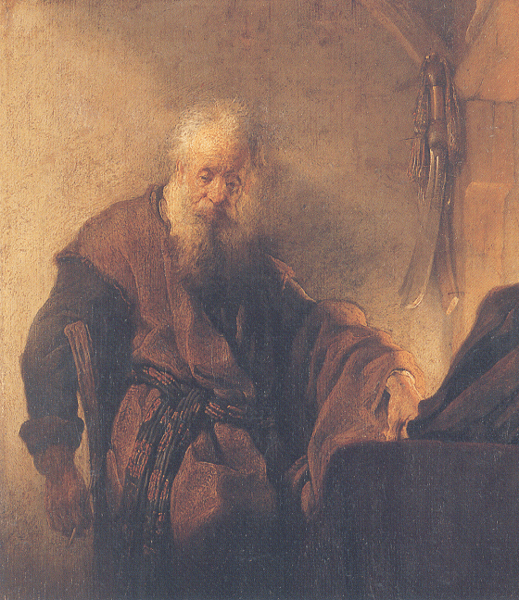
St. Paul, by Rembrandt Harmenszoon van Rijn, 1657

Paul, an apostle of Christ Jesus by the will of God, and Timothy our brother,

To the church of God in Corinth, together with all his holy people throughout Achaia:

Grace and peace to you from God our Father and the Lord Jesus Christ.

Praise be to the God and Father of our Lord Jesus Christ, the Father of compassion and the God of all comfort, who comforts us in all our troubles, so that we can comfort those in any trouble with the comfort we ourselves receive from God. 

For just as we share abundantly in the sufferings of Christ, so also our comfort abounds through Christ. If we are distressed, it is for your comfort and salvation; if we are comforted, it is for your comfort, which produces in you patient endurance of the same sufferings we suffer. And our hope for you is firm because we know that just as you share in our sufferings, so also you share in our comfort.

We do not want you to be uninformed, brothers and sisters, about the troubles we experienced in the province of Asia. We were under great pressure, far beyond our ability to endure, so that we despaired of life itself. Indeed, we felt we had received the sentence of death.

But this happened that we might not rely on ourselves but on God, who raises the dead. He has delivered us from such a deadly peril, and he will deliver us again. On him we have set our hope that he will continue to deliver us, as you help us by your prayers. Then many will give thanks on our behalf for the gracious favor granted us in answer to the prayers of many. (New International Version)

You probably didn’t sign-up for trouble.

Although varying from person to person and from group to group, all of us experience trouble in this world.

The Apostle Paul experienced a lot of trouble throughout his Christian life:

Five times I received from the Jews the forty lashes minus one. 

Three times I was beaten with rods, once I was pelted with stones, three times I was shipwrecked, I spent a night and a day in the open sea, I have been constantly on the move.

I have been in danger from rivers, in danger from bandits, in danger from my fellow Jews, in danger from Gentiles; in danger in the city, in danger in the country, in danger at sea; and in danger from false believers. 

I have labored and toiled and have often gone without sleep; I have known hunger and thirst and have often gone without food; I have been cold and naked. Besides everything else, I face daily the pressure of my concern for all the churches. (2 Corinthians 11:24-28, NIV)

Why didn’t Paul get cynical or jaded by his awful troubles?

What was the secret to Paul’s incredible resilience in the face of such trouble?

How did Paul get through all of that nasty trouble?

Paul, in my opinion, was the consummate Christian. He is the model missionary, mentor, pastor, and caregiver. Yet, it wasn’t his superior giftedness or dogged personality which got him through the tough times.

The Apostle persevered through trouble without succumbing to despondency by receiving help.

Let’s be honest: Most people would rather give than receive – and that is a good thing. Yet, what isn’t a good thing is continual caregiving without yourself receiving care.

We cannot expect to help others without accepting it ourselves. 

The caregiving Christian needs to be vigilant about practicing selfcare and understanding their limitations. One must not pretend to be super-spiritual, with unlimited super-strength and super-compassion, extended to others 24/7 with super-skill. It’s neither realistic, nor smart. 

Caregivers, and not only care recipients, need to accept comfort from both God and others.

“We must accept our vulnerability and limitations in regard to others.  We cannot expect to help others without accepting it ourselves.”

Mother Teresa

The word dominating today’s New Testament lesson is “comfort.” It’s used by Paul ten times in these verses. Comfort involves both speech and action, words and deeds. For comfort to happen, someone comes alongside another and helps them with both loving actions and encouraging words.

We can only give what we have – which means that if we want to continue helping and caring for others, there will need to be continual healthy rhythms of receiving comfort yourself. We provide for others from the largess of grace given to us by the God of abundance.

Sometimes people get stuck in their grief. The troubles have caused such a change and loss that they need help getting out. And the way people get unstuck and resolve their troubles, is through telling their story – which requires someone else to listen. 

St. Paul, by Rembrandt, 1630

Through my own experience of trouble, as well as helping others through their trouble (and sometimes being a troublemaker!) I have developed a checklist of things to do, to allow, and to keep in mind as a caregiver:

  • Live a balanced life. Live in the tension between caring for others and caring for self – without assigning any judgment, shame, or guilt to any of it.
  • Learn to trust other people. You aren’t the only person on earth who can care for the people you care for. Let them contribute so that you can take have a respite.
  • Make a list of needs and concerns. Do this both for yourself and those you care for. Delete those needs that you personally cannot meet. Of the remaining needs, determine the ones for which you are primarily responsible, then, decide which ones are the most important.
  • Contact your Pastor. That’s what he/she is there for. Reach out. You aren’t in a John Wayne movie or an episode of the Lone Ranger. By the way, you know they’re fictional characters, right?
  • Carry your own backpack. Other people have their own backpacks to carry filled with troubles and responsibilities. Although you can help shoulder their load, taking the weight completely off is Christ’s job, not yours. What’s more, don’t fill your own backpack with rocks that leave you with a crushing weight. Be realistic and confident in what you can and ought to do, as well as what you cannot and should not do.
  • Listen to others. Trusted family members and friends usually see the signs of stress in your life before you do. When they speak up, give them your attention. They know what they’re talking about.
  • Accept help. The fast track to bitterness and burnout is refusing the assistance of others who can give you a break in your constant caregiving.
  • Involve others. There are individuals willing and ready to participate if you would just inform them as to what would be helpful.
  • Talk to a therapist. We all get overwhelmed in particular seasons of life. If caregiving has become a compulsion, then take one hour per week to meet with a good therapist or counselor to talk through things in your life.
  • Delegate. Delegate. Delegate. Then, delegate some more.
  • Recharge your soul. Find personal time for yourself daily. Engage in things that feed your spirit and energize your inner person.
  • Don’t waste your time and energy. Some people aren’t going to understand what you’re doing and why you’re doing it; and they don’t really want to understand. And it is not our job to make them understand.
  • Don’t manipulate others. A common temptation is to try and force family, friends, and faith communities to do what we want them to do, whenever we are heavy into ministry. Instead, focus on your own responsibilities and don’t worry about everybody else’s.

God always has a listening ear. The Lord knows grief better than all of us. Jesus understands trouble. In Christ, hope is kindled, care is received, and comfort abounds.

May you, by faith, enter into abundant life – despite the circumstances – so that your overwhelming trouble is transformed into overflowing comfort. Amen.

Acts 2:1-21 – The Day of Pentecost

When Pentecost Day arrived, they were all together in one place. Suddenly a sound from heaven like the howling of a fierce wind filled the entire house where they were sitting. They saw what seemed to be individual flames of fire alighting on each one of them. They were all filled with the Holy Spirit and began to speak in other languages as the Spirit enabled them to speak.

There were pious Jews from every nation under heaven living in Jerusalem. When they heard this sound, a crowd gathered. They were mystified because everyone heard them speaking in their native languages. They were surprised and amazed, saying, “Look, aren’t all the people who are speaking Galileans, every one of them? How then can each of us hear them speaking in our native language? Parthians, Medes, and Elamites; as well as residents of Mesopotamia, Judea, and Cappadocia, Pontus and Asia, Phrygia and Pamphylia, Egypt and the regions of Libya bordering Cyrene; and visitors from Rome (both Jews and converts to Judaism), Cretans and Arabs—we hear them declaring the mighty works of God in our own languages!” They were all surprised and bewildered. Some asked each other, “What does this mean?” Others jeered at them, saying, “They’re full of new wine!”

Peter stood with the other eleven apostles. He raised his voice and declared, “Judeans and everyone living in Jerusalem! Know this! Listen carefully to my words! These people aren’t drunk, as you suspect; after all, it’s only nine o’clock in the morning! Rather, this is what was spoken through the prophet Joel:

In the last days, God says,
I will pour out my Spirit on all people.
    Your sons and daughters will prophesy.
    Your young will see visions.
    Your elders will dream dreams.
    Even upon my servants, men and women,
        I will pour out my Spirit in those days,
        and they will prophesy.
I will cause wonders to occur in the heavens above
    and signs on the earth below,
        blood and fire and a cloud of smoke.
The sun will be changed into darkness,
    and the moon will be changed into blood,
        before the great and spectacular day of the Lord comes.
And everyone who calls on the name of the Lord will be saved. (Common English Bible)

The Holy Spirit is the distinguishing mark of the believer in Jesus Christ.

Therefore, since the Spirit is given, the main responsibility of Christians is to receive. 

Christianity is distinctive in this sense – it is primarily a religion of receiving. The Christian life is lived by the power of the Holy Spirit, and not in our own strength. The function of faith is to receive what grace offers. 

We are saved and sanctified by grace alone through faith. God lives in and through us by means of the Spirit. The miraculous and the supernatural cannot, obviously, be done by any human person.  It can, however, be accomplished through the power of the Holy Spirit.

People tend to put a lot of pressure on themselves to be a certain way and to do certain things. The result? Tiredness. Discouragement. Imbalance. Lots of giving. Little receiving.

Christianity is not chiefly about giving but receiving. The Christian life is about putting oneself in a position to receive through prayer and humility. In Christianity, the opposite of receiving is not giving – it’s pride. 

Maybe this kind of talk makes you uncomfortable. I’m not talking about being passive or lazy. I’m highlighting the need of receiving grace from God by means of the Holy Spirit. Then, the Spirit to work in and through us. 

Jesus said we would do greater works than even he himself with the advent of the Spirit! (John 14:12-14)

The question then becomes: Will we let God be God? Will we allow the Spirit to do work in us?

The Spirit is elsewhere described in Holy Scripture as a gentle presence, an encourager, counselor, and comforter. Yet, not here at Pentecost – the Spirit is portrayed like a violent wind and an unusual fire.

The Holy Spirit on the Day of Pentecost was not some gentleman caller entering politely when invited. Instead, the Spirit appears more like a drunken sailor who bursts into the room and causes a big ruckus. There’s nothing subtle about the Spirit at Pentecost. The Spirit is electric, bombastic, and volcanic, causing a huge scene and upheaving the status quo.

Because of Pentecost, Christians are marked and defined by God’s Spirit living within them and being full of the Spirit. God wants to pour out the Spirit on all kinds of people to overflowing so that what comes out of them is “prophecy.” 

The prophet Joel and the Apostle Peter do not intend the word “prophecy” to mean predicting the future. Rather, they are referring to inspired speech coming from a heart overflowing with the Spirit. 

Just as an inebriated person says and does things they would not typically say or do because they are filled with alcohol, so the person filled with God’s Spirit says things and does things they would not typically say or do because their inspiration and courage come as a result of God within them.

Thus, we must cast off the unholy spirits of inebriation and receive the Holy Spirit of God.

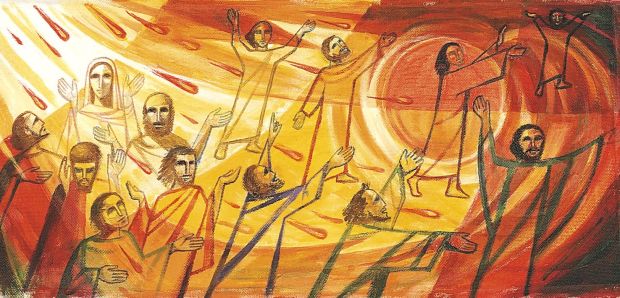
Descent of the Holy Spirit at Pentecost mosaic by Anna Wyner

God sobered-up the little band of Christ followers from learners to practitioners, sending them into the world with a mission.

Being on a mission from God is not really about ability; it’s about being filled and sent. 

First time parents may read and learn all they can about parenting before their child is born. Yet, when that little bundle comes into the world, and the hospital puts this kid in your arms and sends you out, you feel inadequate for the task. Parenting becomes a kind of supernatural affair where you pray and learn on the fly, finding out that you need something beyond yourself to get anywhere in raising this screaming, pooping, sleeping person who depends completely on you for everything. 

God sends us into the world to make disciples. And we may feel very inadequate for the task. However, this has more to do with receiving the Spirit. The Spirit comes looking to turn our lives upside-down with new life in Jesus Christ. 

Pentecost means that the Spirit came to shake things up and accomplish among God’s people what they could never do on their own.

Everyone who calls on the name of the Lord will be saved. 

The Church in the New Testament was not a country club for people to simply enjoy the perks of membership.  The community of the redeemed, the Church, is actually more like a place where the people seem drunk because they are all talking with inspired speech from the Holy Spirit. 

Maybe we don’t need to be saved in the sense that we have already called on the name of the Lord concerning forgiveness in Christ. Yet, maybe we need to call on the name of the Lord to be delivered from our misguided attempts to see the Christian life as a pleasant affair.

Perhaps we need deliverance from disordered priorities and misguided loves. We may need to be saved from ourselves so that we are open to the Holy Spirit with palms up receiving from God whatever it is the Spirit wants to do in and through us, rather than telling God how we think things ought to go. 

Prayer, then, is more about receiving the Spirit and God’s purposes for us rather than giving God an earful and expecting the Lord to bless our plans.

Pentecost is the launching pad of the church’s mission – it was explosive because the Spirit is a kind of wild man who fills people up to overflowing so that what comes out of them is inspired speech and missional actions.

If a language barrier cannot stop the Spirit from operating, then how much more can God transform us and use us in the lives of those around us?

Joel’s prophecy, quoted by Peter, is only partially fulfilled. Events have been set in motion by Pentecost for the complete fulfillment of God’s justice. So, there’s some urgency for people to fill their vacuous souls with the grace freely offered to them in Christ.

The outpouring of the Spirit is a sign: The end is near. And the generous giving of the Spirit is inclusive – there is room for all kinds of people. Through the Spirit, God saves all who call on the name of the Lord.

Today is not just another day on the calendar. It is the Day of Pentecost! 

Just as marriages occasionally need a spark and a fire and a fresh wind, so we need the Holy Spirit to breathe on us, comfort us, and inspire us.

May we be filled with the Spirit as we anticipate what our God will do now, and in the years to come.

Spirit of the living God, through the reading and proclamation of the Word, may you refresh our spirits, reshape our desires, recreate our hearts, and reform our ways so that we will shine with your enduring glory, through Jesus Christ, our risen and ascended Lord. Amen. 

Psalm 72 – Justice and Righteousness

Give the king your justice, O God,
    and your righteousness to a king’s son.
May he judge your people with righteousness,
    and your poor with justice.
May the mountains yield prosperity for the people,
    and the hills, in righteousness.
May he defend the cause of the poor of the people,
    give deliverance to the needy,
    and crush the oppressor.

May he live while the sun endures,
    and as long as the moon, throughout all generations.
May he be like rain that falls on the mown grass,
    like showers that water the earth.
In his days may righteousness flourish
    and peace abound, until the moon is no more.

May he have dominion from sea to sea,
    and from the River to the ends of the earth.
May his foes bow down before him,
    and his enemies lick the dust.
May the kings of Tarshish and of the isles
    render him tribute,
may the kings of Sheba and Seba
    bring gifts.
May all kings fall down before him,
    all nations give him service.

For he delivers the needy when they call,
    the poor and those who have no helper.
He has pity on the weak and the needy,
    and saves the lives of the needy.
From oppression and violence he redeems their life;
    and precious is their blood in his sight.

Long may he live!
    May gold of Sheba be given to him.
May prayer be made for him continually,
    and blessings invoked for him all day long.
May there be abundance of grain in the land;
    may it wave on the tops of the mountains;
    may its fruit be like Lebanon;
and may people blossom in the cities
    like the grass of the field.
May his name endure forever,
    his fame continue as long as the sun.
May all nations be blessed in him;
    may they pronounce him happy.

Blessed be the Lord, the God of Israel,
    who alone does wondrous things.
Blessed be his glorious name forever;
    may his glory fill the whole earth.
Amen and Amen.

The prayers of David son of Jesse are ended. (New Revised Standard Version)

Today’s psalm is a prayer of King David – beseeching the Lord to help him rule with justice and righteousness – because G-d is just and right in all divine dealings with humanity.

“Justice” in the Old Testament is neither fairness nor the good being rewarded and the wicked punished. Rather, justice (Hebrew משפט, pronounced “mish-pot”) in its most basic sense is caring for the poor. A society is “just” to the degree in which every person has enough for the basic necessities of life and is lifted up as persons worthy of care and respect.

So, the way in which David measured his kingly rule was not by how big of an army he had, or how much gold there was in the royal treasury. Rather, a successful rule for David was measured by whether the interests of the poor were defended and provided for.  

A similar word to justice, “righteousness,” is neither some sort of smug godliness nor a sense of superior piety. Instead, righteousness (Hebrew צדקה pronounced “zed-a-ka”) is a relational term of being in sync with G-d and G-d’s ways. It works itself out in a philanthropic spirit of giving what is needed – both physically and spiritually – through acts of mercy such as forgiveness, debt relief, friendship, charity, etc.

Together, justice and righteousness are concerned for giving needed resources with a compassionate spirit of relationship. It seeks to meet the holistic needs of underprivileged people.

Psalm 72 is read in this Christian liturgical season of Christmas (December 25-January 5) because the celebration of the Christ child entering humanity gives great hope for the poor, the needy, the indigent, and all those who struggle to daily survive grinding situations of hardship and adversity.

This is why, when Jesus announced his earthly ministry, he made it clear the nature of that work would be upholding and extending justice and righteousness:

“The Spirit of the Lord is upon me,
    because he has anointed me
        to bring good news to the poor.
He has sent me to proclaim release to the captives
    and recovery of sight to the blind,
        to let the oppressed go free,
to proclaim the year of the Lord’s favor.” (Luke 4:18-19, NRSV)

The least, the lost, the lonely, and the lame have a champion – a Divine Advocate who will take up their cause and ensure they are treated as deserving human beings, with adequate care of both body and soul. Done properly, our living a just and right life requires we share compassion and empathy along with the monetary and physical resources.

“Whoever gives justice to the poor with a sour expression and in a surly manner, even if he gives a thousand gold pieces, loses his merit. One should instead give cheerfully and joyfully and empathize with him in his sorrow.”

Maimonides (1138-1204, C.E.)

Both the hand and the heart are always involved in biblical justice and righteousness. That way both the giver and the recipient benefit. Whereas the poor receive money or other material assistance, the donor receives the merit of sharing in G-d’s work.

So then, righteousness and justice involve giving assistance with the hand as well as encouragement with the mouth so that needs are met with no residual bitterness of heart.

Each of you should give what you have decided in your heart to give, not reluctantly or under compulsion, for God loves a cheerful giver. And God is able to bless you abundantly, so that in all things at all times, having all that you need, you will abound in every good work. As it is written:

“They have freely scattered their gifts to the poor;
    their righteousness endures forever.” (2 Corinthians 9:7-9, NIV)

May you know the joy and celebration of both giving and receiving with a grateful heart, attuned to the blessings of a generous G-d who stands behind it all.