
Christ’s Beatitudes (Matthew 5:1-12)

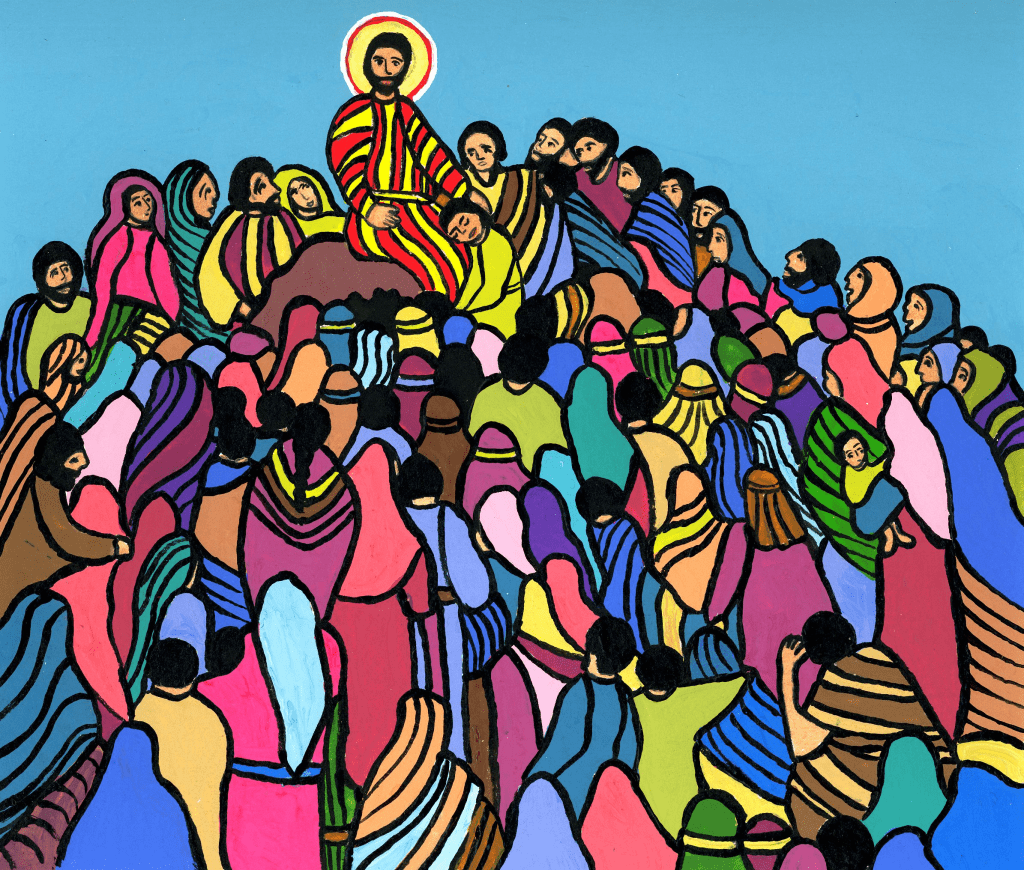
Sermon on the Mount by Gisele Bauche

When Jesus saw the crowds, he went up the mountain, and after he sat down, his disciples came to him. And he began to speak and taught them, saying:

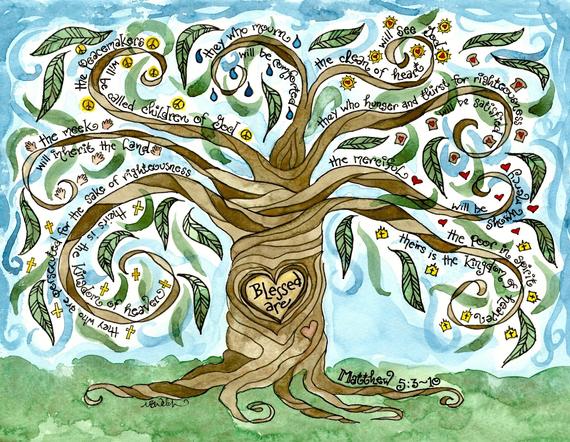
“Blessed are the poor in spirit, for theirs is the kingdom of heaven.

“Blessed are those who mourn, for they will be comforted.

“Blessed are the meek, for they will inherit the earth.

“Blessed are those who hunger and thirst for righteousness, for they will be filled.

“Blessed are the merciful, for they will receive mercy.

“Blessed are the pure in heart, for they will see God.

“Blessed are the peacemakers, for they will be called children of God.

“Blessed are those who are persecuted for the sake of righteousness, for theirs is the kingdom of heaven.

“Blessed are you when people revile you and persecute you and utter all kinds of evil against you falsely on my account. Rejoice and be glad, for your reward is great in heaven, for in the same way they persecuted the prophets who were before you. (New Revised Standard Version)

God’s Law (The Ten Commandments) was given on a mountain. That Law was restated and reframed on a mountain by Jesus in his Sermon on the Mount.

I believe that arguably one of the most important and impactful portions of Holy Scripture are the Beatitudes of Jesus, which serve as the foundation to all of Christ’s teaching.

Christ’s Beatitudes are not simply a random collection of pithy phrases from Jesus on what constitutes approval and blessing from God. They intentionally build upon each other and describe the nature of true righteousness.

The Poor in Spirit

Spiritual poverty, not wealth, is the spiritual base to the Christian life. Most of the original crowd listening to Jesus thought they were on the outside of the kingdom, on the margins of true religion. But Jesus told them they have a place in God’s reign as poor and pitiable people.

To be “poor in spirit” is to be a spiritual beggar who recognizes they have nothing to offer God. It is seeing oneself, one’s sin, and one’s life as spiritually bankrupt apart from God.

Beggars have neither the leverage nor the ability to strike deals with anybody; and so, they do one thing: beg continually.

The proud person would never be caught begging for anything. Yet, the humble spiritual beggar constantly prays because they need God. They discern that without God there is no hope. The kingdom of heaven belongs to the penitent and not to the proud.

The Mourners 

Mourning is the emotional response of acknowledging one’s spiritual poverty. 

Grief and lament have a central place in Christian theology and life. To avoid it, work around it, or short-circuit its process is to refuse Christ; there is no righteousness apart from mourning over sin. Crying, weeping, and even intense tears are important and necessary.

To experience personal grief over one’s sins and the sins of the church and the world is a Beatitude of Jesus. You neither need position, power, privilege, nor pedigree to be a mourner. All can mourn. This is the door by which we enter the kingdom of God.

The Meek

A meek and gentle spirit is the result of realizing poverty of spirit and practicing lament.

At the heart of what it means to be meek is a spirit of non-retaliation. Whenever we are flat on our backs before God, there is no place to look but up. Thus, there is no ability to look down on others.

To be meek is to be broken and moldable before God. A meek person takes personal responsibility for their attitudes and actions. The meek have no need to retaliate, even when egregiously wronged, because they fully entrust themselves to God alone who judges the living and the dead.

Ironically, brokenness is the path to righteous wholeness.

The Hungry and Thirsty

Only those who know their poverty of spirit, personally grieve over sin, and are gentle, end up longing for righteousness.

The desire for righteousness is a recognition that without God I will not make it. I cannot be righteous without Jesus. Simply put, righteousness is a right relationship with God and others.

Those who hunger and thirst for God’s righteousness know they cannot make things right by themselves; they need God’s help.

If we think we can live most days of our lives without God, we do not yet know true righteousness. People who understand their great need for Jesus are easy to spot. They crave and devour God’s Word as their daily food; and they cannot stop blabbering on about Jesus.
There are three practices of living that arise from being filled with God’s righteousness: mercy, purity, and peacemaking. These Beatitudes cannot be conjured up by our own will; instead, they organically grow within us and are freely expressed because of what God is doing in our lives.

You cannot force them any more than you can force a stalk of corn to grow on your terms. Rather, you work with the unforced rhythms of God’s grace and allow righteousness to take root in you.

Down below in the soil, spiritual poverty, mourning, and humility germinate. Then, when the plant breaks the soil and flowers, it produces mercy, purity, and peace-making.

The Merciful 

Mercy begins with a heart that seeks to be generous; it is a loving response to someone or a group of people in misery. We accept them and help them because we ourselves have been there.

The merciful person looks for ways to come alongside others and help, rather than pile expectations and burdens on others without mentoring them in the ways of God.

The Pure In Heart

Purity also results from true righteousness. A stalk of corn might look good, but if you shuck it and it’s filled with worms, it’s not worth much. Legalistic righteousness is concerned to look good; it’s obsessed with performance, perfection, and possessions.

Conversely, the righteousness of God fills our hungry hearts and makes us pure and holy, set apart for good use.

The Peacemakers 

Those who make peace intentionally put themselves in the middle of trouble because they want to live righteously with the mercy and purity that God has provided for them.

Peace is realized through peacemakers. It seems we all desire peace, and yet, peacemakers are hard to come by. It’s a tough gig. To achieve peace, one must first be at peace with God and self – which is why we need the cross of Jesus Christ.

The Persecuted 

Living righteously, as presented by Jesus, tends to bring persecution; and the persecuted consider it a small price to pay for realizing God’s justice in the world.

Folks who are offended by even slight criticisms are usually the ones who are privileged and in power. They have not yet learned the ways of Jesus. Pettiness is nothing more than a sign of unrighteousness.

Yoking up with Jesus, following him, and living into his words and ways has always been risky and dangerous. The Beatitudes of Jesus are not characteristics that lead to power, prestige, or possessions, but likely just the opposite.

“The Beatitudes, spoken with the community of Jesus’ disciples in view, are paradoxes – the standards of the world are turned upside down as soon as things are seen in their right perspective, which is to say, in terms of God’s values, so different from those of the world. It is precisely those who are poor in worldly terms, those thought of as lost souls, who are truly fortunate ones, the blessed, who have every reason to rejoice and exult in their suffering. The Beatitudes are promises resplendent with the new image of the world and humanity inaugurated by Jesus.”

Pope Benedict XVI

Truly righteous persons become living Beatitudes; they are walking, talking blessings to the world. They abide with Christ and are witnesses to a subversive, yet wonderful, way of life, where the last are first and the greatest are the least.

O Lamb of God, that takes away the sins of the world, have mercy upon me.

O Lamb of God, that takes away the sins of the world, have mercy upon me.

O Lamb of God, that takes away the sins of the world, grant me your peace.

Less Is More (Luke 17:5-10)

The apostles said to the Lord, “Increase our faith!”

He replied, “If you have faith as small as a mustard seed, you can say to this mulberry tree, ‘Be uprooted and planted in the sea,’ and it will obey you.

“Suppose one of you has a servant plowing or looking after the sheep. Will he say to the servant when he comes in from the field, ‘Come along now and sit down to eat’? Won’t he rather say, ‘Prepare my supper, get yourself ready and wait on me while I eat and drink; after that you may eat and drink’? Will he thank the servant because he did what he was told to do? So, you also, when you have done everything you were told to do, should say, ‘We are unworthy servants; we have only done our duty.’” (New International Version)

You and I do not need control. Authority and power belong to God. And we are not God.

You and I need faith. And, since we belong to God, who is the ultimate authority and controls all things, we already have it.

You already have what you need: Jesus. There is no need to hustle and cajole for something you do not need.

Jesus tells his disciples two parables designed to reorient their thinking and their lives around God, and not around the typical worldly tools of power and authority.

We find self-control something very hard. We’d rather have plain old control.

In the 1990s, The Department of Transportation set aside $200 million dollars for research and testing of an automated Highway System. The plan was that this system would relieve traffic problems by placing all cars that entered the highway on “super cruise control,” allowing them to move in unison as they traveled in heavily congested cities.  

Such travel would be made possible by using special magnets embedded in the asphalt every four feet, which would transfer signals between the vehicles and a main computer system.  

Steering, acceleration and braking would be controlled by sensors, computer navigation systems and cameras along the side of the road. Control would be returned to drivers as they exited the highway.  According to the technology manager of the project, “The only thing we can’t do yet is get people to comfortably trust the system. It’s not a technology issue.”

The grace of God in Jesus Christ is our fail-safe system designed to put us in “super cruise control” when dealing with circumstances and relating to people. There is just one difficulty with the system: Getting people to comfortably trust it.

The real problem is that we prefer to retain control of life’s steering wheel, even though it is this tendency that drives us to discontentment and endless relational conflict. Rather than insisting on doing life our way, we need Jesus to take the wheel.

And the irony to all this is that we already have what we so desperately seek.

Just a little bit of Jesus makes a large impact on the world.

            Our Lord’s entire kingdom movement looked as insignificant as a mustard seed. Christ’s little band of disciples were, at best, a motley crew of very human characters who vacillated between faith and doubt; they spent as much time arguing amongst themselves as they did engaging in ministry. Yet, it was these same people who ended up turning the world upside-down.

            The insignificant and small looking mustard seed eventually becomes a world-sheltering tree. In the same way, a barbaric, bloody, seemingly insignificant cross became the means of changing the world.

            We, even though imperfect and small, can become, with Jesus in us, a healing force for the world. Little is much when God is in it. Although Gideon believed he needed to be in charge of a large army to defeat Israel’s enemies, God whittled his soldiers down to just 300, against a force described as an army with men as many as the sand on the seashore. Victory was no problem. Gideon already had what he needed: God. (Judges 7:1-25)

Never underestimate the potency of our little bit of ministry with Jesus animating it. Our…

Kind words spoken in the name of Jesus…

Hidden prayers uttered silently behind closed doors…

Secret giving in which the right hand doesn’t know what the left is doing…

Gentleness in the face of violence…

Humility in the midst of pride…

Mercy given instead of judgment…

Peacemaking wherever frustration exists…

These and so much more, when energized by Jesus, becomes a mighty force for good and change in this old fallen world.

Yet so many Christians think they need all kinds of power, authority, and control – then mountains can be moved, trees uprooted, and things can happen.

With this misguided notion, we too easily succumb to the temptations of winning success, spinning a superior self-image, and pinning down power to get what we want and need.

However, we already have what we need, Jesus, and we do not need what he has – power and authority; we just need him.

The Lord Jesus has shown us the way in this. In Christ’s incarnation, he emptied himself and became like one of us – eschewing the typical power dynamics of the world. At the beginning of his ministry, Jesus spends 40 days in the desert fasting – making himself empty.

And at the end of that time, the devil came to Christ and tempted him in the very same ways we are tempted (Matthew 4:1-11):

Satan: “You need to be successful.”

Jesus: “Nope, don’t need that.”

Satan: “Well, you definitely need to be on the right religious track.”

Jesus: “Get out of my face. I don’t need to play that game.”

Satan: “It’s simple. You can do your Father’s will with the tools of power I have.”

Jesus: “I’m not going there. I don’t need your sort of help.”

In submitting to his Father’s plan and will, Jesus showed us the way to live as his followers.

We, too, have to stare the same three temptations in the eye: the belief that I need to be successful, to be right, and to have everything under control.

The truth, however, is just the opposite. In actuality, we need to be poor in spirit, powerless,  and humble – not full of strength and control.

Jesus said, “My grace is sufficient for you, for my power is made perfect in weakness.” And Paul responded, “Therefore, I will boast all the more gladly about my weaknesses, so that Christ’s power may rest on me. That is why, for Christ’s sake, I delight in weaknesses, in insults, in hardships, in persecutions, in difficulties. For when I am weak, then I am strong.” (2 Corinthians 12:9-10, NIV)

In reality, we need to be open and vulnerable – not spinning a self-image which projects strength, authority, and power.

 In your relationships with one another, have the same mindset as Christ Jesus:

Who, being in very nature God,
    did not consider equality with God something to be used to his own advantage;
rather, he made himself nothing
    by taking the very nature of a servant,
    being made in human likeness.
And being found in appearance as a man,
    he humbled himself
    by becoming obedient to death—
        even death on a cross! (Philippians 2:5-8, NIV)

We need to be meek and gentle – just like our Lord – not puffing our chests out with a show of strength and authority.

Jesus said, “Come to me, all you who are weary and burdened, and I will give you rest.Take my yoke upon you and learn from me, for I am gentle and humble in heart, and you will find rest for your souls. For my yoke is easy and my burden is light.” (Matthew 11:28-30, NIV)

Less is truly more. Only those who have nothing to prove and nothing to protect can receive Christ. And Jesus himself will lead us on this path of self-emptying.

We already have Jesus. Therefore, we already have everything we need. Even a smidgeon of Christ is more than enough for us. What we may think we need – to win at success, to spin a narrative of rightness, and to pin down control through power and authority – amounts to nothing in the kingdom of God.

Instead, what we really need is to walk in the way of Jesus – to be weak through self-emptying, to leak out our pride and embrace humility and vulnerability, and to be meek by having a gentle spirit.

Being a servant is a good thing. And being a servant of the Lord Jesus Christ – the author and perfecter of our faith – is the only vocation we need. With Jesus, less is more.

Almighty and everlasting God, we are far too often influenced by what others think of us. We pretend to be in control, with it, in charge, and strong. Prevent us from trying to attract attention. Don’t let us gloat over praise on one hand or be discouraged by criticism on the other. Nor let us waste time weaving imaginary situations in which the most heroic, put together, and powerful person present is me. Rather, show us how to be humble of heart, just like your Son, our Lord, Jesus Christ, who with you and the Holy Spirit are one God, now and forever. Amen.

Galatians 6:1-16 – Fulfill the Law of Christ

Brothers and sisters, if someone is caught in a sin, you who live by the Spirit should restore that person gently. But watch yourselves, or you also may be tempted. Carry each other’s burdens, and in this way you will fulfill the law of Christ. If anyone thinks they are something when they are not, they deceive themselves. Each one should test their own actions. Then they can take pride in themselves alone, without comparing themselves to someone else, for each one should carry their own load. Nevertheless, the one who receives instruction in the word should share all good things with their instructor.

Do not be deceived: God cannot be mocked. A man reaps what he sows. Whoever sows to please their flesh, from the flesh will reap destruction; whoever sows to please the Spirit, from the Spirit will reap eternal life. Let us not become weary in doing good, for at the proper time we will reap a harvest if we do not give up. Therefore, as we have opportunity, let us do good to all people, especially to those who belong to the family of believers.

See what large letters I use as I write to you with my own hand!

Those who want to impress people by means of the flesh are trying to compel you to be circumcised. The only reason they do this is to avoid being persecuted for the cross of Christ. Not even those who are circumcised keep the law, yet they want you to be circumcised that they may boast about your circumcision in the flesh. May I never boast except in the cross of our Lord Jesus Christ, through which the world has been crucified to me, and I to the world. Neither circumcision nor uncircumcision means anything; what counts is the new creation. Peace and mercy to all who follow this rule—to the Israel of God. (New International Version)

It’s all about grace. God’s grace. Not rules. Not a list of principles to live by. Not judgment. Not punishment or penance. Grace – amazing, wonderful, scandalous grace.

The Law of Christ is to help each other in our troubles, no matter what.

Overwhelming physical, mental, emotional, and spiritual burdens can become even more heavy through failing to live up to someone’s or some group’s unwritten list of rules. “Keep a stiff upper lip.” “Everything is possible for those who love God.” “Stay positive.” “Just have faith and trust God.” Or someone’s silence…. These and hundred other phrases communicate to people with crushing spiritual and emotional loads that they will have to carry them alone.

The letter to the Galatian believers spells out what is to truly characterize Christian interactions, and what it means to walk in the Spirit. Believers in Jesus are to emulate the behavior of Christ, the ultimate burden-bearer, who came to restore sinners, not condemn them. We have a responsibility to rescue, renew, and revitalize persons who have lost their way. We are our brother’s and our sister’s keeper.

Someone caught in the crosshairs of a bad decision, or ensnared by making a wrong step, who is now in over their heads, needs help. In such a case, we are to restore, not punish. The person’s wound needs spiritual cauterizing. The broken spirit needs to be set back into place to heal properly.

The tone and the attitude which we do this important work of restoring people is through gentleness (meekness). We are to have a mindset and a heart stance which understands there is no moral superiority with me. I could easily be that person in need of restoration.

With a gentle spirit, we discern no one is above falling into the same trouble. We, too, are ethically and morally vulnerable. So, the church has a corporate responsibility to bear one another’s burdens.

There are other people who, through no fault of their own, find themselves in over their heads, too. Their physical struggles, mental health challenges, the emotional weight of hard circumstances, and their broken spirits require others to help shoulder the load so that the weighted-down person is not crushed.

Burden-bearing is the work of everyone and not a select few. You and I are to take responsibility for our own backpack of stuff – our own actions and attitudes. A mature spiritual community of people are able to distinguish those loads which individuals must bear for themselves, and those burdens where help is sorely needed. We are accountable to carry our own backpack. And we are also accountable before Christ to share our load with others when it becomes too heavy to carry.

If we choose not to allow others to assist us when we need it, then we will reap what we sow – we’ll feel the full weight and consequences of our silence. The planting and harvesting metaphor isn’t just for those who have engaged in wrongdoing. It is also for those who don’t put any seeds in the ground to begin with. They shouldn’t expect a harvest, at all.

Grace lived out in real experiences knows when to get under a load and help carry it. And grace also knows when to be kind to self and share the heavy burden with others who can help shoulder it for a bit. This is a Christianity which relies on the enablement of the Spirit, made possible by Christ, who carried our crushing weight of guilt and shame for us.

“Come to me, all you who are weary and burdened, and I will give you rest. Take my yoke upon you and learn from me, for I am gentle and humble in heart, and you will find rest for your souls. For my yoke is easy and my burden is light.”

Jesus (Matthew 11:28-30, NIV)

Motives matter. The interior life of a person is important. Life is neither a mere getting things done nor doing what is needed on the exterior. A house may be beautiful and orderly on the outside, with careful landscaping, a manicured lawn, and attractive appearance – yet on the inside it might be disorderly, full of relational discord, and completely discombobulated.

The exterior life of a person is also important. But it’s only half the person. And, unlike God who sees the heart, we aren’t always privy to what’s going on inside someone. Folks who are enamored with outward displays of spirituality and righteousness tend to be compulsive about maintaining appearances – for both themselves, and everyone else.

Policing outward forms of righteousness through clear identifiable means is really nothing more than old fashioned judging of one another. It’s antithetical to grace. And it smacks of the snooty superiority of Star-Bellied Sneetches.

Rather than a star on the belly, in the Apostle Paul’s day it was circumcision. Those who had it were “in” and those without it were “out.” Never mind the interior life. A hard outward boundary of righteousness was established by false teachers who made the Christian life easy by simply holding to readily observable forms, like circumcision.

It wasn’t that circumcision was a bad thing. The issue was making it a necessary part of the Christian life. Not circumcised? Not a Christian, insisted the false teachers. In other words, one had to become Jewish before becoming a Christian. I can picture the Apostle Paul doing a  face palm, saying, “Oy vey.”

For the Christian, one must be vigilant not to exaggerate baptism. On the one hand, I would argue far too many believers underestimate the significance and importance of baptism. Flippantly making it a personal choice, as if the individual is in complete control of one’s own salvation, is not only wrongheaded – it’s downright blasphemous.

Yet, on the other hand, a preoccupation with getting a person, especially a child, baptized, as if the world might end if it doesn’t happen, betrays the same problem as Paul faced with circumcision in the first century.

The proper approach, it seems to me, is to embrace the full spectrum of Christianity – both outward and inward – the whole person. And Paul addresses this by anticipating a question of the Galatian congregation: What, then, is of central importance?

The answer is: a new creation. To be transformed by the power of the Spirit is what really counts. The grace of God in Christ, applied to a person, brings a change to inner motives and attitudes, as well as outer behavior through loving actions.

We must always keep in mind that the sign points to the substance. It would be weird if I were traveling to Milwaukee on I-94 and pulled over on the interstate next to the sign marking the city is ahead, crawl all over it, and say, “I’m here!”

The overall thrust of Paul’s letter to the Galatians is that they were debasing the true worship of God into an outward show, honoring Christ with their lips but not holding him in their hearts through carrying one another’s burdens.

Christianity is fundamentally not about what we do for God but what God has done for us in Jesus Christ. It is divine grace which saves people. We belong to God. Just as we neither chose our own parents nor the time when we were born, so also, before we chose God, God chose us. We don’t “born again” ourselves; God does the rebirthing.

Since salvation is solely the work of God in us, there is zero reason to boast about the circumstances of our new birth and becoming a new creation in Christ. We didn’t save ourselves. It would be like getting a COVID-19 vaccine and then bragging about how we personally stopped the pandemic.

Instead, we are to bear the spiritual marks of Christ’s crucifixion on our inner selves. No one is saved because they deserve it but simply because they need saving. That’s what grace truly is – and that’s how we are to live toward one another.

Merciful God, you are our Burden-Bearer. Awaken our hearts to remember your love. Open our eyes to see your grace. Stir up hope in those who are overwhelmed with sorrow and fear. Teach them to place their burdens at your feet as an offering — a sacrifice well-pleasing to you. Teach us all to allow others to help us in our time of need, through Jesus Christ our Lord, who with you and the Holy Spirit are one God, now and forever. Amen.

1 Timothy 3:1-9 – Be, Not Just Do

Photo by Krivec Ales on Pexels.com

Here is a trustworthy saying: Whoever aspires to be an overseer desires a noble task. Now the overseer is to be above reproach, faithful to his wife, temperate, self-controlled, respectable, hospitable, able to teach, not given to drunkenness, not violent but gentle, not quarrelsome, not a lover of money. He must manage his own family well and see that his children obey him, and he must do so in a manner worthy of full respect. (If anyone does not know how to manage his own family, how can he take care of God’s church?) He must not be a recent convert, or he may become conceited and fall under the same judgment as the devil. He must also have a good reputation with outsiders, so that he will not fall into disgrace and into the devil’s trap.

In the same way, deacons are to be worthy of respect, sincere, not indulging in much wine, and not pursuing dishonest gain. They must keep hold of the deep truths of the faith with a clear conscience. (New International Version)

For the Church everywhere, Jesus Christ is to form and inform everything we do – including leadership.

This is why character formation is at the core of being an elder and a deacon in Christ’s Church – because the elder’s ministry of oversight, shepherding, and discernment of God’s will comes from the inner resources of knowing Christ; and a deacon’s ministry of outreach and service comes from a close walk of faith with Jesus, who desires to work through those individuals. 

Church leaders are to be the light of Jesus to their congregations. It is a high calling. The Apostle Paul gave to the Church seven requirements of Christian morality and seven requirements of a daily walk for leaders. Together, these fourteen requirements are the basis for Christian leaders so that the responsibility of the Church’s mission might be kept on track of bringing people to Jesus and bringing those who know Jesus to know him better.

The first set of seven requirements have to do with the morals of the person. A church leader is to:

1) Be trustworthy. Have a good reputation in both the church and the world

2) Be devoted in the marriage relationship (This doesn’t mean that a church leader must be married, because then even Jesus wouldn’t qualify as a church leader!)

3) Be clear-minded, even-keeled, and consistent

4) Be self-controlled (and not controlling others)

5) Be brave, possessing moral courage, through speaking truth with grace and not being a complainer

6) Be a friend of strangers through practicing hospitality

7) Be an able teacher, gently and carefully instructing others in a way that builds them up and does not tear them down 

The second set of seven requirements have to do with the ethical conduct of the person in everyday life. A church leader is to: 

1) Be sober and not a drunkard, conducting oneself in all moderation

2) Be respectable and not given to anger outbursts and constantly carrying a chip on their shoulder about something

3) Be gentle with everyone and in all situations

4) Be cordial and foster healthy relations, and not always picking a fight about something

5) Be generous and not thinking about the all-mighty dollar in every decision

6) Be caring in the family and give rules with relationship, so as to curb rebellion in a child

7) Be mature and not a novice in the faith so that those outside the church can see there is something wonderfully different about the way things are handled and done among those who profess Jesus Christ.

In addition to this, we have seven related requirements for deacons: 

1) Be dignified in every kind of relation, a person worthy of respect

2) Be sincere and not double-tongued, saying one thing to one person and something different to another

3) Be moderate in all things, especially when it comes to drink

4) Be benevolent and altruistic, and not greedy for either stuff or attention

5) Be holy and pure, keeping very close to faith in Christ with a good heart

6) Be a servant who is able to handle attention without falling apart

7) Be faithful, keeping promises and vows, especially in marriage and with family

God calls and sets apart individuals for service so that the Divine presence might be manifested among the people. Jesus Christ wants the church to be built up through faithful service. Notice what today’s New Testament lesson does not say about church leaders:

  • Be a listener to complaints.

Do everything without complaining or arguing (Philippians 2:14, ERV)

  • Be a representative of the people. Nowhere in Scripture do we find church leaders are supposed to operate like an American form of democracy. Instead of being representatives of the people to do their will, church leaders are rather representatives of God to the people so that God’s will is done in all things. 

Guard yourselves and God’s people. Feed and shepherd God’s flock—his church, purchased with his own blood—over which the Holy Spirit has appointed you as leaders. (Acts 20:28, NLT)

  • Be ingenious. Church leaders are not called to be the smartest, most creative, and best idea people in the room. They are to be servants, leading others in prayer, outreach, and acts of mercy.

I have a special concern for you church leaders. I know what it’s like to be a leader, in on Christ’s sufferings as well as the coming glory. Here’s my concern: that you care for God’s flock with all the diligence of a shepherd. Not because you have to, but because you want to please God. Not calculating what you can get out of it but acting spontaneously. Not bossily telling others what to do, but tenderly showing them the way. (1 Peter 5:1-3, MSG)

These requirements of Holy Scripture are not just for leaders; they are to be sought after by every member of God’s holy Church. We are all together to aspire to the highest of ideals of Christ in the way we operate in the church and in the world. 

Let no debt remain outstanding except the continuing debt to love one another (Romans 13:8). Godly leaders help us to maintain that biblical mandate.

Now may the God of peace, who through the blood of the eternal covenant brought back from the dead our Lord Jesus, that great Shepherd of the sheep, equip you with everything good for doing his will, and may he work in us what is pleasing to him, through Jesus Christ, to whom be glory for ever and ever. Amen. (Hebrews 13:20-21, NIV)