Jacob’s Dream (Genesis 28:10-22)

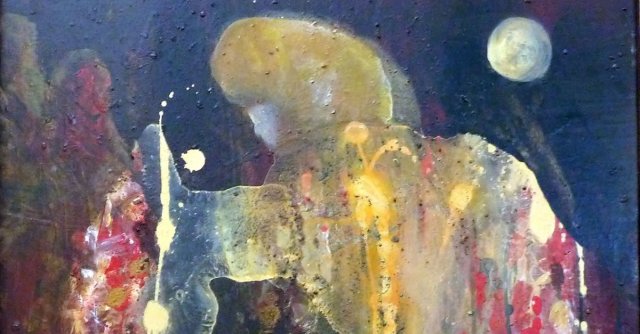
Jacob’s Ladder by Darius Gilmont

Jacob left the town of Beersheba and started out for Haran. At sunset he stopped for the night and went to sleep, resting his head on a large rock. In a dream he saw a ladder that reached from earth to heaven, and God’s angels were going up and down on it.

The Lord was standing beside the ladder and said:

I am the Lord God who was worshiped by Abraham and Isaac. I will give to you and your family the land on which you are now sleeping. Your descendants will spread over the earth in all directions and will become as numerous as the specks of dust. Your family will be a blessing to all people. Wherever you go, I will watch over you, then later I will bring you back to this land. I won’t leave you—I will do all I have promised.

Jacob woke up suddenly and thought, “The Lord is in this place, and I didn’t even know it.” Then Jacob became frightened and said, “What a frightening place! It must be the house of God and the gateway to heaven.”

When Jacob got up early the next morning, he took the rock that he had used for a pillow and stood it up as a place of worship. Then he poured olive oil on the rock to dedicate it to God, and he named the place Bethel. Before that it had been named Luz.

Jacob solemnly promised God, “If you go with me and watch over me as I travel, and if you give me food and clothesand bring me safely home again, you will be my God. This rock will be your house, and I will give back to you a tenth of everything you give me.” (Contemporary English Version)

“Dreams are impartial, spontaneous products of the unconscious psyche, outside the control of the will. They are pure nature; they show us the unvarnished, natural truth, and are therefore fitted, as nothing else is, to give us back an attitude that accords with our basic human nature when our consciousness has strayed too far from its foundations and run into an impasse.

Carl Jung, Collected Works, Vol. 10

Not all unconscious dreams are the same, any more than all conscious experiences are alike.

Some dreams are not much more than a thing which occurs while we’re sleeping; they’re akin to the tedious or pedantic things we do while awake. Yet, other dreams are loaded with symbolic significance and have complex patterns of organization and relating.

However, all dreams which we carry with us into conscious waking – no matter whether mundane or extraordinary – are telling us a similar message: “Hey! Pay attention to this!”

In other words, our unconscious brains are usually aware of what we need more than our conscious minds; and dreams become the vehicle by which our unconscious alerts our conscious selves of something we need to focus upon.

Jacob’s Ladder by Ben Avram

Jacob needed to pay attention to something that he was not consciously aware of. Before his dream, Jacob had left home at the behest of his aging father. Mom and Dad wanted Jacob to have a good wife, so they sent him off to a specific place to find one.

Now, mind you, Jacob was a mama’s boy; he stuck close to home and was attached to his mother. Off on his first outing away from familiar confines, Jacob would have been understandably anxious and fearful. Although he had the blessing of his parents, Jacob’s unconscious self knew he also needed the blessing of almighty God.

So, the Lord showed up in a dream. To Jacob’s credit, he paid attention by acknowledging the importance of the dream. Jacob also made the Lord a promise that he would give back a tenth of anything and everything he acquired because of God’s blessing.

I wonder: How many times do you and I fail to acknowledge that the Lord’s presence is in the very place we are? Maybe our dreams are trying to tell us something – that the God of all things, including dreams, is with us in our own particular place and situation.

It can be frightening to be in a new place or new situation that you’ve never been in before. Yet, there is no place any of us can go where God is not already there.

You have looked deep
into my heart, Lord,
    and you know all about me.
You know when I am resting
    or when I am working,
and from heaven
    you discover my thoughts.

You notice everything I do
    and everywhere I go.
Before I even speak a word,
    you know what I will say,
and with your powerful arm
you protect me
    from every side.
I can’t understand all of this!
Such wonderful knowledge
    is far above me.

Where could I go to escape
from your Spirit
    or from your sight?
If I were to climb up
to the highest heavens,
    you would be there.
If I were to dig down
to the world of the dead
    you would also be there.

Suppose I had wings
like the dawning day
    and flew across the ocean.
Even then your powerful arm
    would guide and protect me.
Or suppose I said, “I’ll hide
in the dark until night comes
    to cover me over.”
But you see in the dark
because daylight and dark
    are all the same to you. (Psalm 139:1-12, CEV)

The Lord is with you. Your dreams have already confirmed it.

O God, give me strength for this day, and not to turn coward in the face of difficulty or duty. Let me not lose faith in other people. Keep my heart pure and caring, free from all ingratitude or meanness. Open wide the eyes of my soul so that I may see the good in all things. Grant me today a new vision of your truth; and for tonight, may the Lord Jesus be in my dreams so that I might awake again and serve him in joy and gladness, in the power of the Holy Spirit. Amen.

Promise and Pilgrimage (Genesis 12:1-7)

The Lord said to Abram,

“Leave your land,
your relatives,
and your father’s home.
Go to the land that I will show you.
I will make you a great nation,
I will bless you.
I will make your name great,
and you will be a blessing.
I will bless those who bless you,
and whoever curses you, I will curse.
Through you every family on earth will be blessed.”

So Abram left, as the Lord had told him, and Lot went with him. Abram was 75 years old when he left Haran. Abram set out for Canaan. He took along his wife Sarai, his nephew Lot, and all the possessions they had accumulated and the servants they had acquired in Haran.

They arrived in Canaan, and Abram traveled through the land to the oak tree belonging to Moreh at Shechem. At that time the Canaanites were in the land. Then the Lord appeared to Abram and said, “I’m going to give this land to your descendants.” So he built an altar there to the Lord, who had appeared to him. (God’s Word Translation)

Abram (later having a name change to “Abraham”) knew quite a lot about new beginnings.

It isn’t every day that the Lord comes along and completely upends a person’s life. Abram had lived his entire life in the same city, Ur, in Chaldea (present day Iraq). By all accounts, Abram was completely fine living where he was living. He had neither the ambition nor need to leave his home city.

The Lord, however, had other plans for Abram. And they were radical plans. This was no rearranging of the furniture; it was a wholesale life-altering change. Ur was an important cosmopolitan city, a trade center, located at a pivotal point where the Tigris and Euphrates Rivers run into the Persian Gulf. Thus, Ur was a wealthy city, the citizens enjoying a level of comfort unknown in other parts of Mesopotamia.

Actor Eddie Albert as the out of place city lawyer trying to make it in the country on “Green Acres” which aired on CBS from 1965-1971

So, Abram being called to move from the city and go to some unknown place in the west would be something like growing up in Manhattan, New York and being called by God to head for Brewster, Nebraska – which is pretty much in the middle of nothing. It makes “Green Acres” look like a night out at the opera.

The Lord’s First Promise to Abram

It wasn’t all unknown change; there was a promise attached to the call. Having every family on earth blessed through you is a really big promise. There was a lot riding on Abram’s response.

Perhaps there was some pushback on Abram’s end of things. But we don’t have any record of it if it even happened. Instead, we get a simple statement telling us that he left, just as the Lord told him to do.

Lest we think Abram had some incredible relationship with the Lord before this call came, we need to think again:

“This is what the Lord God of Israel says: Long ago your ancestors, Terah and his sons Abraham and Nahor, lived on the other side of the Euphrates River and served other gods. But I took your ancestor Abraham from the other side of the Euphrates River. I led him through all of Canaan and gave him many descendants.” (Joshua 24:2-3, GW)

The One true God wasn’t even on Abram’s radar. He was merrily serving the pagan gods of Sumer, seemingly without a care in the world. It wasn’t as if Abram was bored watching old reruns of “Green Acres” and wishing for a change. And it sure wasn’t because he was attuned to knowing anything about Yahweh.

Whatever went down between Abram and the Lord was likely so compelling that Abram left willingly and without any pushback.

The Lord’s Second Promise to Abram

To travel from Ur of the Chaldees to the land of Canaan is an approximate distance of 800 miles. That’s slow going when you’re traveling in a caravan by donkey and camel. It took a while to get to the land that the Lord had in mind for Abram.

Once there, God gave Abram another promise: The land that he reached will be his home, the new land, the Promised Land. It would be yet another 500+ years before Abram’s descendants took full possession of that land and the promise realized.

Abram had a lot of time to consider and reflect on the Lord’s calling and promises. And that is precisely why pilgrimage is so very important. Yes, the destination is significant; yet it is the journey itself that really matters.

Pilgrimage

Those who put their strength in you are truly happy;
    pilgrimage is in their hearts. (Psalm 84:5, CEB)

Abram journeys into the unknown by Yoram Raanan

The way of pilgrimage is for all, like Abram, who walk in faith and patience, awaiting the fulfillment of God’s promises.

By faith Abraham obeyed when he was called to go out to the place which he would receive as an inheritance. And he went out, not knowing where he was going. 

By faith he dwelt in the land of promise as in a foreign country… for he waited for the city which has foundations, whose builder and maker is God…. Therefore from one man, and him as good as dead, were born as many as the stars of the sky — innumerable as the sand which is by the seashore.

These all died in faith, not having received the promises, but having seen them afar off were assured of them, embraced them and confessed that they were strangers and pilgrims on the earth. 

For those who say such things declare plainly that they seek a homeland. And truly if they had called to mind that country from which they had come out, they would have had opportunity to return. But now they desire a better, that is, a heavenly country. Therefore God is not ashamed to be called their God, for He has prepared a city for them. (Hebrews 11:8-16, NKJV)

Each day, we have the opportunity to be pilgrims, walking by faith, exercising patient hope, persevering in love for one’s fellow humanity.

Just because we live in a microwave society which values speed and customer service above all else, doesn’t mean our religion has to follow suit. The best things in life are slow in coming; they require a great deal of blood, sweat, and tears.

Go ahead and enjoy an episode or two of “Green Acres;” just remember to listen when the Lord calls and go to make disciples of all nations.

All-powerful God, you always show mercy toward those who you love, and you are never far away for those who seek you. Be with your servants on this pilgrimage and guide their way in accord with your will. Amen.

The Blessing (Genesis 17:15-22)

By American artist Julie Lonneman

God said to Abraham, “Don’t call your wife by the name Sarai anymore. Instead, her name is Sarah [Princess]. I will bless her, and I will also give you a son by her. I will bless her, and she will become a mother of nations, and kings will come from her.” Immediately, Abraham bowed with his face touching the ground. He laughed as he thought to himself, “Can a son be born to a hundred-year-old man? Can Sarah, a ninety-year-old woman, have a child?” Then Abraham said to God, “Why not let Ishmael be my heir?”

God replied, “No! Your wife Sarah will give you a son, and you will name him Isaac [He Laughs]. I will make an everlasting promise to him and his descendants. I have heard your request about Ishmael. Yes, I will bless him, make him fertile, and increase the number of his descendants. He will be the father of 12 princes, and I will make him a great nation. But I will make my promise to Isaac. Sarah will give birth to him at this time next year.” When God finished speaking with Abraham, he left him. (God’s Word Translation)

Life can only be lived with faith. We all believe in something, in someone. It’s just a matter of what or whom we place our faith in. Whomever we direct our faith, that is where we give our allegiance and obedience.

As for Abraham and his wife Sarah, they had their faith in the God who called them from Ur of the Chaldees. They demonstrated their belief by doing exactly what the Lord said to do – they went West to the land God would show them. (Genesis 12:1-5)

Abraham and Sarah listened to God and acted accordingly.

I don’t want to cross over into TMI territory (Too Much Information) yet I want us to consider what had to take place when the Lord tells the old couple they will have a baby next year. Here’s where the faith and action comes in: It is highly unlikely that a 100-year-old man and a 90-year-old woman were sexually active. But the Lord essentially told them to get going on conceiving a child. So, they did!

I can’t speak for Abraham and Sarah, but I know as a grandfather that I am really glad I don’t have to raise kids anymore. It makes me exhausted just thinking about it, at my age, so I’ve got to believe it crossed their minds, too. Maybe that’s why Abraham sort of pleaded with God to let Ishmael be the son of promise; the reality of being responsible for a newborn was maybe the last thing on old Abe’s mind.

But faith they had, as the New Testament attests:

Even when Sarah was too old to have children, she had faith that God would do what he had promised, and she had a son. Her husband Abraham was almost dead, but he became the ancestor of many people. In fact, there are as many of them as there are stars in the sky or grains of sand along the seashore. (Hebrews 11:11-12, CEV)

Genuine belief results in decisive action. At Abraham and Sarah’s age, sex may likely have seemed a safety hazard. Yet, they were submissive to God’s plan that divine promises would come through Isaac – who was indeed born the next year, just as the Lord said.

Abraham and Sarah by Marc Chagall, 1956

All this is consistent with the names “Abraham” and “Sarah.” Names were (and still are in most of the world) important identifiers of personal character – particularly toward what sort of person one would become.

God made a name change for the old couple. “Abram,” meaning “exalted father,” was changed to “Abraham,” “father of many nations.” “Sarai” was altered to “Sarah,” yet both names have the same meaning: “Princess.” (Genesis 17:3-8, 15-16)

The change of names was meant to communicate the promise of divine blessing from God for the future. All the world will be blessed through the covenant made with Abraham. Sarah’s alteration of name, though only in form and not substance, brought to the fore that Sarah, too, had a special purpose along with her husband in blessing the world.

Today, this blessing is still unfolding. Throughout all history, since the time of Abraham and Sarah over four millennia ago (c.2100 B.C.E.), the divine ripples of God’s covenant with them have moved across the earth.

Their progeny, through Isaac, the son of the promise, the Jewish people, continue to exist as arguably the most resilient group on the planet. We, especially Christians and Muslims, owe a great debt to the Jews for persevering in faith for such a long stretch of time. They have much to teach us, if we have ears to hear and hearts receptive.

Since the time of Christ, the blessing has extended well beyond the physical descendants of Abraham and Sarah:

Is this blessedness only for the circumcised [Jews] or also for the uncircumcised [Gentiles]? We have been saying that Abraham’s faith was credited to him as righteousness. Under what circumstances was it credited? Was it after he was circumcised, or before? It was not after, but before! And he received circumcision as a sign, a seal of the righteousness that he had by faith while he was still uncircumcised. 

So then, Abraham is the father of all who believe but have not been circumcised, in order that righteousness might be credited to them. And he is then also the father of the circumcised who not only are circumcised but who also follow in the footsteps of the faith that our father Abraham had before he was circumcised….

Therefore, the promise comes by faith, so that it may be by grace and may be guaranteed to all Abraham’s offspring—not only to those who are of the law but also to those who have the faith of Abraham. He is the father of us all. As it is written: “I have made you a father of many nations.” He is our father in the sight of God, in whom he believed—the God who gives life to the dead and calls into being things that were not.

Against all hope, Abraham in hope believed and so became the father of many nations, just as it had been said to him, “So shall your offspring be.” Without weakening in his faith, he faced the fact that his body was as good as dead—since he was about a hundred years old—and that Sarah’s womb was also dead. 

Yet he did not waver through unbelief regarding the promise of God but was strengthened in his faith and gave glory to God, being fully persuaded that God had power to do what he had promised. This is why “it was credited to him as righteousness.” The words “it was credited to him” were written not for him alone, but also for us, to whom God will credit righteousness—for us who believe in him who raised Jesus our Lord from the dead. He was delivered over to death for our sins and was raised to life for our justification. (Romans 4:9-12, 16-25, NIV)

May you know the depth and breadth of your faith, that it stretches far beyond this time and place. And may the blessing of God almighty – Father, Son, and Spirit – be upon you and remain with you, now and forever. Amen.

The Effects of the Fall (Genesis 6:11-22)

The Flood of Noah by Majd Ramadan, 2014

In God’s sight, the earth had become corrupt and was filled with violence. God saw that the earth was corrupt because all creatures behaved corruptly on the earth.

God said to Noah, “The end has come for all creatures, since they have filled the earth with violence. I am now about to destroy them along with the earth, so make a wooden ark. Make the ark with nesting places and cover it inside and out with tar. This is how you should make it: four hundred fifty feet long, seventy-five feet wide, and forty-five feet high. Make a roof for the ark and complete it one foot from the top. Put a door in its side. In the hold below, make the second and third decks.

“I am now bringing the floodwaters over the earth to destroy everything under the sky that breathes. Everything on earth is about to take its last breath. But I will set up my covenant with you. You will go into the ark together with your sons, your wife, and your sons’ wives. From all living things—from all creatures—you are to bring a pair, male and female, into the ark with you to keep them alive. From each kind of bird, from each kind of livestock, and from each kind of everything that crawls on the ground—a pair from each will go in with you to stay alive. Take some from every kind of food and stow it as food for you and for the animals.”

Noah did everything exactly as God commanded him. (Common English Bible)

The entire world is profoundly broken. 

Everywhere, people are messed-up. In one breath they can tell you they’re sorry for another’s abuse or violence against you, then turn right around and say some irrational nonsense and terribly insensitive things to you.

It doesn’t matter where you go – whether school, work, home and even church, there is institutional brokenness. Individual persons, and the human structures and systems they put in place, all contain elements of bondage instead of freedom. It doesn’t take a religious person to observe that there’s such a thing as sin.

Holy Scripture’s description of this sad reality goes all the way back to a story about the fall of humanity into sin and rebellion. Satan, the devil, led the original persons, Adam and Eve, into disobedience of God. Satan tempted Eve to doubt whether God really had her best interests at mind; to question the truthfulness of God’s Word; and, to wonder about the wisdom of listening to God (Genesis 3:1-5). Adam just flat out chose to disobey God, and, so, the entire world changed (Genesis 3:16-17). 

Immediately, everything was different in the world and with people. The choice to disobey God brought feelings of fear and shame; a loss of fellowship with God; hiding from God; a bent to pervert the truth; the propensity for the genders to try and dominate each other; expulsion from the garden; and physical death (Genesis 3:7-24). 

And the unholy tools people used against one another were violent and corrupt. People thought nothing of oppressing each other, abusing one another, attacking others – both verbally and physically. Rape, assault, theft, and murder became daily experiences. That’s some downright icky stuff. 

No wonder the world is messed up.

God saw that human evil was out of control. People thought evil, imagined evil—evil, evil, evil from morning to night. God was sorry that he had made the human race in the first place; it broke his heart. God said, “I’ll get rid of my ruined creation, make a clean sweep: people, animals, snakes and bugs, birds—the works. I’m sorry I made them.” (Genesis 6:5-7, MSG)

Noah was the only guy on the face of the earth for whom the Lord saw any good. And it was enough good worth saving. Yet, people are still in the nasty habit of turning on each other, like a bunch of sharks with blood in the water.

Unfortunately, the fall of humanity still affects us all. It has brought not only physical death, but spiritual death. That means we are alienated from God, in rebellion, and enslaved to our own passions and desires (Isaiah 1:2-6; Romans 2:14-15; Ephesians 2:1-3). 

We are also alienated from one another by having continual bents toward discord, suspicion, and jealousy instead of love and trust (Romans 1:29-31; James 3:14-16). 

We are even alienated and totally out of touch with ourselves by either loving ourselves as gods or hating ourselves with an inordinate emotional masochism (Philippians 2:21; 2 Timothy 3:2-4). In short, we are selfish people who experience separation from God, others, and self.

If this is the true reality of humanity, then it is awfully depressing, discouraging, and damaging. And we know it’s true because we’ve all been both victims and victimizers. So, who then, will rescue us from this horrific death? 

Thanks be to God who has given us the victory through our Lord Jesus Christ (Romans 7:24-25; 1 Corinthians 15:57). 

The good news is that, through the death and resurrection of Jesus, the curse has been reversed. Christ has restored us to our original place of fellowship with God. He is the way, the truth, and the life. In Christ, there is hope for humanity (John 14:6). 

To live in freedom, therefore, involves knowledge, honesty, and sincere decisions of faith and love whereby truth is applied to life.

Just as the world needed a thorough purging of evil through a cleansing worldwide flood, so we need a bath of grace, to be completely awash with the love of God in Christ, to have all the crud of evil scrubbed from our soul. And this is precisely what Christian baptism symbolizes.

Jesus offered himself for us so that we might live without violence and no longer be separated from God, others, and self. He has brought us reconciliation. In him we have been blessed with every spiritual blessing (2 Corinthians 5:16-19; Ephesians 1:3; 2 Peter 1:3).

In Christianity, the purpose of ministry is to come alongside people trapped in their awful cycles of brokenness and communicate good news of grace and forgiveness with both words and actions.

Although the world is terribly askew, God has demonstrated his love for us in that, while we were still violent and corrupt sinners, Christ died for us (Romans 5:8). 

We needed a Savior. God provided One. 

Are you in touch with the ways you are separated from God, others, and self? 

Are you aware of the ways in which your church or faith community has an unhealthy separation from the world? 

In what ways can you apply the love of God to broken people and systems in your community? What will it take to reach them?

Sin, guilt, shame, rebellion, disobedience, and violence need not define us. We can do better.

Almighty God, we have sinned against you, through our own fault, in thought, and word, and deed, and in what we have left undone. For the sake of your Son, our Lord Jesus Christ, forgive us all our offenses; and grant that we may serve you in newness of life, to the glory of your Name. Amen.