Be Generous (Mark 12:41-44)

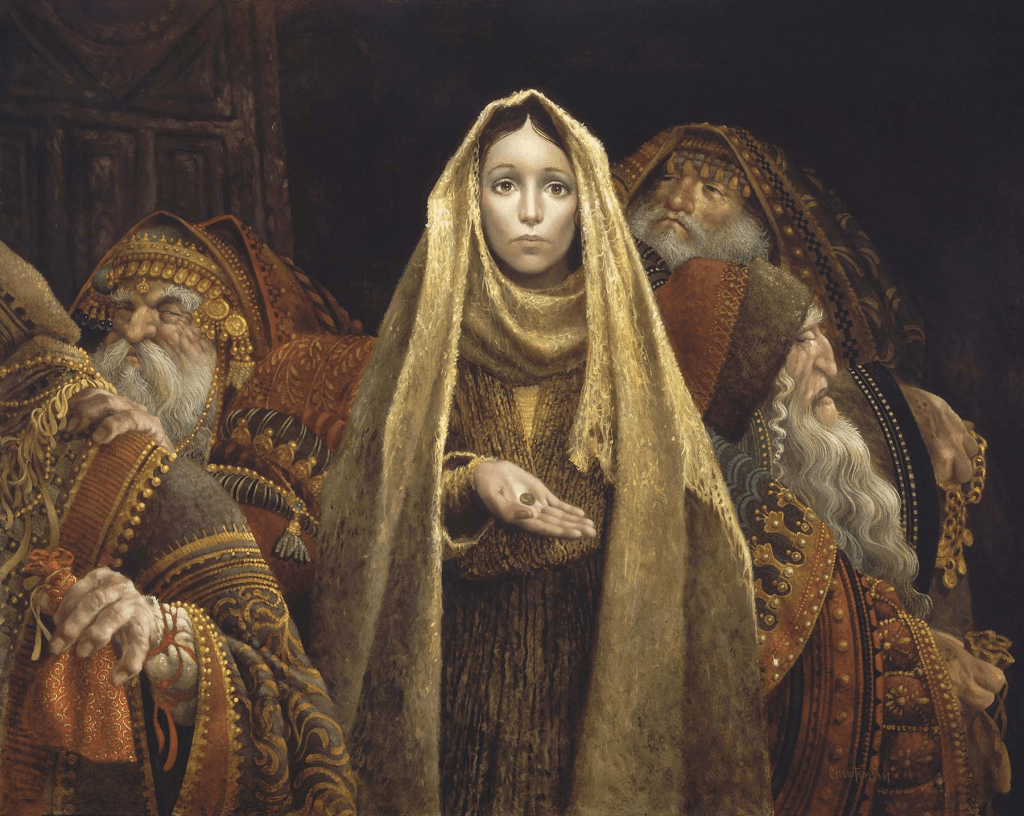
The Widow’s Mite by James Christensen

Jesus sat down opposite the place where the offerings were put and watched the crowd putting their money into the temple treasury. Many rich people threw in large amounts. But a poor widow came and put in two very small copper coins, worth only a few cents.

Calling his disciples to him, Jesus said, “Truly I tell you; this poor widow has put more into the treasury than all the others. They all gave out of their wealth; but she, out of her poverty, put in everything—all she had to live on.” (New International Version)

Money. Can’t live without it; can’t live with it. *Sigh*

If there’s a litmus test of one’s true benevolence and spirituality, it’s how money is handled and/or mishandled. And it isn’t as cut-and-dried as giving large sums of it away.

In today’s short Gospel lesson, the offerings of rich people were unimpressive to Jesus. To him, their big donations are insignificant.

On the other hand, a poor widow’s measly offering is validated as a rich contribution. In giving everything, Jesus holds up the widow as an example for us to follow.

This raises a natural and interesting question: Does this mean everyone should give everything they have? Maybe. Maybe not. Yet perhaps the very question betrays how we tend to think about money – that it’s ours, we earned it, and we can do whatever we want with it.

But the fact of the matter is that we really own nothing. We are merely stewards, entrusted with using that which has been graciously given to us by God. The Lord is the owner of it all. It was never really ours to begin with.

Taken from this perspective, anything we hold onto and refuse to let go, no matter how large or small, is a form of theft. We have taken something that doesn’t belong to us. We aren’t satisfied with being stewards; we want to be owners and masters.

What you do with your money shows your allegiance to the true Owner of it. If it belongs to Caesar, well then, go ahead and give it to him. And if it belongs to God, then there isn’t an issue in distributing money in ways which benefit humanity and uplift the poor.

The widow knew that her money, what little of it she had, belonged to God. She seemed to understand that God’s values are very different from earthly values. The kingdom of heaven expects us to hold all things, money included, with open hands. Whereas the kingdoms of this world fully expect that people will hold their money with tight fists – which is why we have so many layers of cybersecurity around our assets.

Money is a means to an end and not the end itself. It is the means to ensure the welfare of the common good of all persons. It’s a tool to shape a better society, built not on the backs of the poor, but for the benefit of the needy so that everyone can participate fully in the community.

To build a petty kingdom and become master of a small world is nothing more than stealing from God and withholding resources where they are needed.

And to make things more complicated and challenging, in today’s world, time is money. It’s easy to write a check, transfer some funds, or allocate some resources for others. However, it is never easy to grace people with the gift of time. Relational connection takes time and effort – the kind of time many people believe they do not have. Yet, time also belongs to God, and it is to be stewarded with care, just like our money.

The Poor Widow’s Offering by Unknown artist

Let’s come back to the poor widow. After all, she is our example of true generosity.

In ancient Israel, those in poverty were not required to give. So, whenever the poor did so, they simply gave because they believed in the need to maintain all it took for the worship of God to happen. The widow was under no compulsion to give anything, let alone everything she had. She seemed to understand what the Apostle Paul discovered later:

The person who sows sparingly will also reap sparingly, and the person who sows generously will also reap generously. Each one of you should give just as he has decided in his heart, not reluctantly or under compulsion, because God loves a cheerful giver. And God is able to make all grace overflow to you so that because you have enough of everything in every way at all times, you will overflow in every good work. (2 Corinthians 9:6-8, NET)

A spirit of generosity is to be ubiquitous throughout Christianity. It is a spirit that doesn’t let the left hand know what the right hand is giving (Matthew 6:3). A generous spirit rightly discerns that where your treasure is, there your heart will be also (Matthew 6:21).

And the guide of altruistic giving is savvy to the reality that the accumulation of money often leads to the love of money. So, the generous person keeps temptation at bay by withholding love toward things so that love can be lavishly given to people. For some people, eager for money, have wandered from the faith and pierced themselves with many griefs. (1 Timothy 6:10)

Like the poor widow, we are to put our hope in God, who richly provides everything for our enjoyment.

Eternal God, we pray that stewardship will be our way of life. We acknowledge You as the source of all we have and all we are.

Loving Creator, help us to place You first in our lives by being prayerful, loving, and caring for our families neighbors in need, and by becoming less preoccupied with material things.

Sovereign Lord, help us to hear your call to be good stewards, caretakers, and managers of all your gifts by sharing them for your purposes. May Your priorities be our priorities. May we have an active and generous faith.

Blessed God, help us to serve the Church, our communities, and our world with Your good and gracious gifts; and with joyful and grateful heart, through Jesus Christ our Lord. Amen.


Luke 12:32-40 – Don’t Be Afraid to Give

The Good Shepherd by He Qi

“Do not be afraid, little flock, for your Father has been pleased to give you the kingdom. Sell your possessions and give to the poor. Provide purses for yourselves that will not wear out, a treasure in heaven that will never fail, where no thief comes near, and no moth destroys. For where your treasure is, there your heart will be also.

“Be dressed ready for service and keep your lamps burning, like servants waiting for their master to return from a wedding banquet, so that when he comes and knocks they can immediately open the door for him. It will be good for those servants whose master finds them watching when he comes. Truly I tell you, he will dress himself to serve, will have them recline at the table and will come and wait on them. It will be good for those servants whose master finds them ready, even if he comes in the middle of the night or toward daybreak. But understand this: If the owner of the house had known at what hour the thief was coming, he would not have let his house be broken into. You also must be ready, because the Son of Man will come at an hour when you do not expect him.” (New International Version)

The most oft repeated command in all of Holy Scripture is, “Do not be afraid.” The Lord says it 365 times. It seems like we are meant to be reminded of this every day of the year.

The particular stating of the phrase by Jesus is in the context of money and possessions. Christ is telling his disciples to not fear about personal resources. Since we have a kingdom inheritance, we ought to freely give what we have to the poor without fear of being in need ourselves.

And it isn’t something we ought to procrastinate about – because the Lord could return at any time; and he doesn’t want to have to go looking for us underneath a pile of money and possessions in order to find us.

“Inaction breeds doubt and fear. Action breeds confidence and courage. If you want to conquer fear, do not sit home and think about it. Go out and get busy.”

Dale Carnegie

Fear is a real thing. Fear, at its core, is being afraid of losing what we have and getting hurt. Fear can be a helpful emotion, meant to protect us and keep us safe from harm. The problem, however, is that our fears can lead us to some unhealthy behaviors such as:

  • Vilifying another, afraid that others I don’t know or who are different from me might harm me, my family, or my community.
  • Hiding my emotions, afraid my weaknesses or failures will be exposed or exploited.
  • Serving others compulsively, afraid that I won’t have worth, meaning, or purpose without helping.
  • Achieving or winning, afraid that I will be irrelevant or unwanted, if I lose.
  • Smiling and being upbeat, afraid of facing and feeling the deep sadness within me.
  • Procrastinating projects, tasks, or conversations, afraid of being disliked or rejected.

“Fear is the path to the Dark Side. Fear leads to anger, anger leads to hate, hate leads to suffering.”

Yoda

All of those unhealthy practices keeps us at arm’s distance from the poor and needy. Getting close to poor folk creates fear with some people, that is, being afraid they might hurt me, or afraid that they will get my money.

“Fear keeps us focused on the past or worried about the future. If we can acknowledge our fear, we can realize that right now we are okay.”

Thich Nhat Hanh

Faith is the opposite of fear. Faith tethers itself to the promises of God and frees us to be generous. And faith allows us to confidently minister and build relationships with all kinds of people, especially the poor and needy.

One of the great preachers in church history, St. John Chrysostom (the fourth century Bishop of Constantinople) lived in a large city full of both rich and poor. He lamented the large class difference between them. He said this about poverty and wealth:   

“To deprive is to take what belongs to another; for it is called deprivation when we take and keep what belongs to others.  By this we are taught then when we do not show mercy, we will be punished just like those who steal.  For our money is the Lord’s, however we may have gathered it.  If we provide for those in need, we shall obtain great plenty. 

This is why God has allowed you to have more, not for you to waste on… indulgence, but for you to distribute to those in need….  If you are affluent, but spend more than you need, you will give account of the funds which were entrusted to you… for you obtained more than others have, and you have received it, not to spend it for yourself, but to become a good steward for others as well.”

“Whenever you see anyone longing for many things, esteem him of all persons the poorest, even though he possess all manner of wealth; again, when you see one who does not wish for many things, judge him to be of all persons most affluent, even if he possess nothing. For by the condition of our mind and spirit, not by the quantity of our material wealth, should it be our custom to distinguish between poverty and affluence.”

The point that Jesus makes of selling possessions and giving to the poor is not to elevate poverty over wealth – or the poor over the rich – but rather to lift generosity as a significant mark of the Christian life.

In the same way, the watchfulness Jesus commands is not an anxious hand-wringing anticipation of the apocalypse. Instead, it is an eager expectation of God’s final act of doing away with all injustice forever.

In other words, Jesus is extoling a faith that frees us to be generous; enables us to leave fear, worry, and anxiety behind; and that creates in us confidence about how the future is all going to shake-out in the end.

The Lord’s Table is meant to remind us that God is hospitable and generous.

Communion together is meant to show us that we are not alone in faith.

And the Eucharist allows us to celebrate a future we know is coming, that as often as we eat and drink the elements of bread and cup, we proclaim the Lord’s death until he returns to judge the living and the dead.

Like the feeding of the 5,000, there is plenty of bread for all – and the cup will never run dry. That’s because the Lord we serve is a God of abundance. And when we are near to such a generous God, we feel safe and secure, and are able to freely share what we have with others – without fear and without panicking that there isn’t enough. There’s always enough because God is enough.

Generous and gracious God, You came to honor the least, the forgotten, the overlooked and the misjudged. You came to give first place to the last, those left behind, and those who are misunderstood and undervalued. You came to give a warm welcome to the lost, the abandoned, and the destitute.

Help us to be your ears to listen to their cries. Help us to be your voice speaking out love and acceptance. Help us to be your feet walking beside those in need. Help us to be your hands to clothe, feed and shelter them. You came for the least, the lost and last of this world. Lord, hear our prayer. Amen.

Luke 5:1-11 – Surprised by Generosity

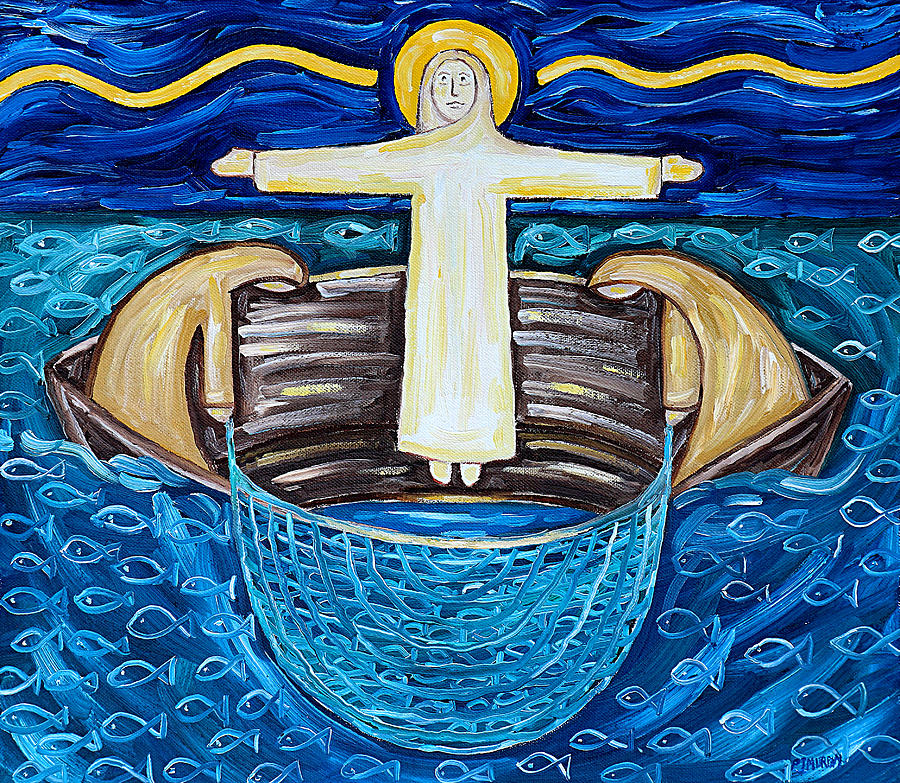
The Miraculous Catch of Fish by Patrick J. Murphy

One day Jesus was standing beside Lake Gennesaret when the crowd pressed in around him to hear God’s word. Jesus saw two boats sitting by the lake. The fishermen had gone ashore and were washing their nets. Jesus boarded one of the boats, the one that belonged to Simon, then asked him to row out a little distance from the shore. Jesus sat down and taught the crowds from the boat. When he finished speaking to the crowds, he said to Simon, “Row out farther, into the deep water, and drop your nets for a catch.”

Simon replied, “Master, we’ve worked hard all night and caught nothing. But because you say so, I’ll drop the nets.”

So, they dropped the nets, and their catch was so huge that their nets were splitting. They signaled for their partners in the other boat to come and help them. They filled both boats so full that they were about to sink. When Simon Peter saw the catch, he fell at Jesus’ knees and said, “Leave me, Lord, for I’m a sinner!” Peter and those with him were overcome with amazement because of the number of fish they caught. James and John, Zebedee’s sons, were Simon’s partners and they were amazed too.

Jesus said to Simon, “Don’t be afraid. From now on, you will be fishing for people.” As soon as they brought the boats to the shore, they left everything and followed Jesus. (Common English Bible)

One of the most fundamental characteristics of God is generosity. God’s benevolent nature defines the divine stance toward humanity. This may not seem overly remarkable. Yet, when the infinite holiness of God intersects with the prideful arrogance of sinful people, gracious generosity is the unpredictable and amazing result.

Many people on planet earth have been raised with a god who is aloof and something of an old cranky curmudgeon. Such a god gets easily angry and zaps people with lightning or some natural disaster. It is no wonder so many persons have fled from belief in God.

Can we, however, entertain the notion that the Creator God of the universe is quite the opposite of the perpetually upset deity?

In Jesus, we have displayed for us what the basic disposition of the Divine truly is.

On one occasion, Peter (a guy who could raise the ire of most gods) was going about his business, fishing in the Sea of Galilee. Having not yet encountered Jesus, yet stopping to listen to his words, Peter ended up having this uninvited stranger literally get in the boat with him.

There was something remarkably different and compelling about Jesus since Peter did not immediately toss him out. Such a calm, confident, and gracious nature – nothing like Peter had expected. So, here is this ordinary fisherman face-to-face with the Christ of God. 

Jesus told Peter to put the boat out and cast the nets. Peter, an experienced fisherman and knowledgeable about the water, knew for certain that he would not catch anything. But, out of deference to Jesus, he did so, anyway. The result was such a large catch of fish that the nets nearly broke from the weight.

The Great Catch by John August Swanson (1938-2021)

Peter’s response is instructive. He fell at the feet of Jesus in a profound sense of his own smallness and sinfulness. Next to Jesus. Peter saw how little faith he really had. He rightly discerned that he did not deserve such generosity from Jesus, an overflowing abundance given to him despite his unbelief. 

In the face of such grace, in the vortex of an incredible mercy, having seen the generosity of God directed squarely at him, Peter left it all behind to follow Jesus.

So, here we have the nature and character of God before us. No perturbed deity. No exasperated god ready to raise a storm and toss the boat over with Peter in it. No, Jesus, the Son of God, does not operate that way. There is no strong-arming people into faith. God’s tactics steer clear of base manipulation through guilt, or mind-twisting others through shaming them. 

Instead, God is beautifully and simply present with people – showing grace and generosity in places where one would least expect to find it. 

If confronted with such love, what would you do?

Early in my life, I viewed God as some eternally bored deity who would occasionally get out his divine BB gun and shoot people in the rear, just for something to do. God, in my understanding, cared nothing for the real lived experiences of people on earth.

But much like Peter of old, Jesus showed up unannounced in my life. And what I found was like Peter – a kind, benevolent Being who showered such generous love on me that my heart was immediately captured. I have never looked back since.

We intuitively know, down deep in our gut, in the very marrow of our bones, when genuine Love is among us. Generously true Love immediately connects with the deepest needs of our lives. No evangelist must convince us with offering free gold crosses or promised blessings. None of that matters when Love incarnate is present, when the great God of all is among us.

Peace, hope, and faith are the results of the divine loving presence. They cannot be conjured or ginned up through excessive asceticism or extreme discipline. Love is a gift. Love is a person. And it is given generously and graciously from the One whose very nature is charitable and hospitable.

Praise be to God!

Gracious God, you sent your Son to me even though I was neither looking for him nor expecting anything from him. Thank you for breaking-in to my life so that I could break-out for you with glory, honor, and praise.  Amen

1 Timothy 3:1-9 – Be, Not Just Do

Photo by Krivec Ales on Pexels.com

Here is a trustworthy saying: Whoever aspires to be an overseer desires a noble task. Now the overseer is to be above reproach, faithful to his wife, temperate, self-controlled, respectable, hospitable, able to teach, not given to drunkenness, not violent but gentle, not quarrelsome, not a lover of money. He must manage his own family well and see that his children obey him, and he must do so in a manner worthy of full respect. (If anyone does not know how to manage his own family, how can he take care of God’s church?) He must not be a recent convert, or he may become conceited and fall under the same judgment as the devil. He must also have a good reputation with outsiders, so that he will not fall into disgrace and into the devil’s trap.

In the same way, deacons are to be worthy of respect, sincere, not indulging in much wine, and not pursuing dishonest gain. They must keep hold of the deep truths of the faith with a clear conscience. (New International Version)

For the Church everywhere, Jesus Christ is to form and inform everything we do – including leadership.

This is why character formation is at the core of being an elder and a deacon in Christ’s Church – because the elder’s ministry of oversight, shepherding, and discernment of God’s will comes from the inner resources of knowing Christ; and a deacon’s ministry of outreach and service comes from a close walk of faith with Jesus, who desires to work through those individuals. 

Church leaders are to be the light of Jesus to their congregations. It is a high calling. The Apostle Paul gave to the Church seven requirements of Christian morality and seven requirements of a daily walk for leaders. Together, these fourteen requirements are the basis for Christian leaders so that the responsibility of the Church’s mission might be kept on track of bringing people to Jesus and bringing those who know Jesus to know him better.

The first set of seven requirements have to do with the morals of the person. A church leader is to:

1) Be trustworthy. Have a good reputation in both the church and the world

2) Be devoted in the marriage relationship (This doesn’t mean that a church leader must be married, because then even Jesus wouldn’t qualify as a church leader!)

3) Be clear-minded, even-keeled, and consistent

4) Be self-controlled (and not controlling others)

5) Be brave, possessing moral courage, through speaking truth with grace and not being a complainer

6) Be a friend of strangers through practicing hospitality

7) Be an able teacher, gently and carefully instructing others in a way that builds them up and does not tear them down 

The second set of seven requirements have to do with the ethical conduct of the person in everyday life. A church leader is to: 

1) Be sober and not a drunkard, conducting oneself in all moderation

2) Be respectable and not given to anger outbursts and constantly carrying a chip on their shoulder about something

3) Be gentle with everyone and in all situations

4) Be cordial and foster healthy relations, and not always picking a fight about something

5) Be generous and not thinking about the all-mighty dollar in every decision

6) Be caring in the family and give rules with relationship, so as to curb rebellion in a child

7) Be mature and not a novice in the faith so that those outside the church can see there is something wonderfully different about the way things are handled and done among those who profess Jesus Christ.

In addition to this, we have seven related requirements for deacons: 

1) Be dignified in every kind of relation, a person worthy of respect

2) Be sincere and not double-tongued, saying one thing to one person and something different to another

3) Be moderate in all things, especially when it comes to drink

4) Be benevolent and altruistic, and not greedy for either stuff or attention

5) Be holy and pure, keeping very close to faith in Christ with a good heart

6) Be a servant who is able to handle attention without falling apart

7) Be faithful, keeping promises and vows, especially in marriage and with family

God calls and sets apart individuals for service so that the Divine presence might be manifested among the people. Jesus Christ wants the church to be built up through faithful service. Notice what today’s New Testament lesson does not say about church leaders:

  • Be a listener to complaints.

Do everything without complaining or arguing (Philippians 2:14, ERV)

  • Be a representative of the people. Nowhere in Scripture do we find church leaders are supposed to operate like an American form of democracy. Instead of being representatives of the people to do their will, church leaders are rather representatives of God to the people so that God’s will is done in all things. 

Guard yourselves and God’s people. Feed and shepherd God’s flock—his church, purchased with his own blood—over which the Holy Spirit has appointed you as leaders. (Acts 20:28, NLT)

  • Be ingenious. Church leaders are not called to be the smartest, most creative, and best idea people in the room. They are to be servants, leading others in prayer, outreach, and acts of mercy.

I have a special concern for you church leaders. I know what it’s like to be a leader, in on Christ’s sufferings as well as the coming glory. Here’s my concern: that you care for God’s flock with all the diligence of a shepherd. Not because you have to, but because you want to please God. Not calculating what you can get out of it but acting spontaneously. Not bossily telling others what to do, but tenderly showing them the way. (1 Peter 5:1-3, MSG)

These requirements of Holy Scripture are not just for leaders; they are to be sought after by every member of God’s holy Church. We are all together to aspire to the highest of ideals of Christ in the way we operate in the church and in the world. 

Let no debt remain outstanding except the continuing debt to love one another (Romans 13:8). Godly leaders help us to maintain that biblical mandate.

Now may the God of peace, who through the blood of the eternal covenant brought back from the dead our Lord Jesus, that great Shepherd of the sheep, equip you with everything good for doing his will, and may he work in us what is pleasing to him, through Jesus Christ, to whom be glory for ever and ever. Amen. (Hebrews 13:20-21, NIV)