Law and Gospel (Galatians 3:6-14)

Nativity by He Qi

The Scriptures say that God accepted Abraham because Abraham had faith. And so, you should understand that everyone who has faith is a child of Abraham. Long ago the Scriptures said God would accept the Gentiles because of their faith. This is why God told Abraham the good news that all nations would be blessed because of him. This means everyone who has faith will share in the blessings given to Abraham because of his faith.

Anyone who tries to please God by obeying the Law is under a curse. The Scriptures say, “Everyone who doesn’t obey everything in the Law is under a curse.” No one can please God by obeying the Law. The Scriptures also say, “The people God accepts because of their faith will live.”

The Law isn’t based on faith. It promises life only to people who obey its commands. But Christ rescued us from the Law’s curse, when he became a curse in our place. This is because the Scriptures say that anyone who is nailed to a tree is under a curse. And because of what Jesus Christ has done, the blessing promised to Abraham was taken to the Gentiles. This happened so that by faith we would be given the promised Holy Spirit. (Contemporary English Version)

We are just a day away from the Nativity of the Lord, Christmas Eve, the night Christians everywhere observe the birth of Christ.

And just two days from now Christians throughout the world will have a grand celebration of Christ’s incarnation – God breaking into this old fallen world to be with us and redeem us.

Many will be show up at a church worship service on that day, perhaps especially because Christmas Day falls on a Sunday, in the year of 2022. All might be in the same place; yet they’re there for different reasons.

Some come to the worship service because that’s what they have done every Sunday throughout the year – and they wouldn’t think of being anywhere else.

Others choose to be a part of the gathering because they enjoy the specialness of the day, the beauty of the celebration, and the traditions which surround it all.

There are also those who show up because the season has been hard; while others may bask in the joy of Christmas, they’re just looking for something positive to get them through for a while.
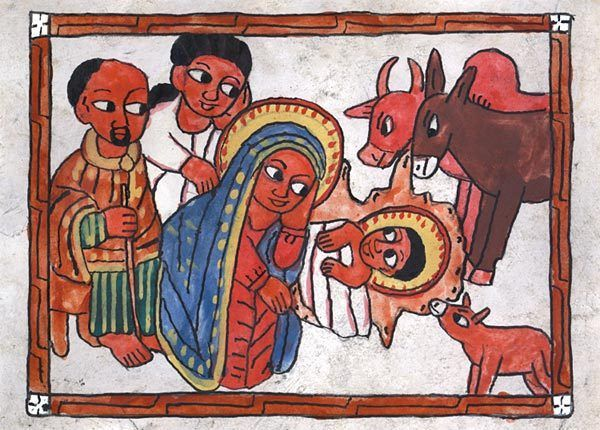
Ethiopian Orthodox icon of the Nativity of the Lord

And then there are those who enter the day for none of the previous mentioned reasons. No, they simply show up because they feel it is their duty to do so, or at the least, because they might receive some special spiritual Brownie points from God. In other words, they gather with the rest with the sheer motivation of Law.

Such an approach illustrates the “curse” of the Law. The Law itself is not bad. But if the rest of the equation isn’t factored into life, Law becomes a hard taskmaster and keeps the law-keeper in a terrible bondage without any delight to go with the duty.

People also need Gospel, the good news which fulfills all the requirements and demands of Law. Law is good, but by itself, apart from Gospel, it becomes an insidious tool of evil.

Whereas Law focuses solely on what we do, Gospel homes in on why we do it.

Law bosses us around and tells us what to do. Gospel frees us to embrace the spirit of Law to love God and neighbor.

It doesn’t take faith to obey the rules and regulations of Law. Gospel, however, can only be realized, internalized, and lived by faith.

It takes faith to receive grace and forgiveness – and to give it. Faith requires an acceptance of spiritual realities. It is the key to tapping into the power of love in the universe.

By faith, people throughout history, like Abraham, have listened with spiritual ears to the God of all. They step out, not merely because of Law, but because they rely on divine promises. Such faith enables them to wait patiently for the coming of eternal forces to take permanent residence on earth. Law can’t do that; only Gospel can.

Faith in the Bible is a complete trust in God, in who God is and what God has done. Because God has demonstrated faithfulness through steadfast love, people are gifted with faith to know the Lord and exhibit love through good works. 

God Is with Us by Hanna Varghese

In Christianity, the height of faith is to place one’s life completely in God’s hands, believing in the person and work of Jesus Christ.

Jesus said, “I assure you that if you have faith the size of a mustard seed, you could say to this mountain, ‘Go from here to there,’ and it will go. There will be nothing that you can’t do.” (Matthew 17:20, CEV)

The size of faith isn’t the issue – it’s in whom that faith is placed. The littlest of faith in Jesus can have massive results, whereas the biggest of faith in someone who cannot get you to where you need to go, is useless.

Outward rituals and observance of Law have their place; but they don’t deliver anyone from sin, death, or hell. Only faith can do that.

If you are a follower of Christ Jesus, it makes no difference whether you are circumcised or not. All that matters is your faith that makes you love others. (Galatians 5:6, CEV)

It’s one thing to be kind and love others during a holiday season; it’s quite another thing to have that be your default character throughout the entire year. Love for a season comes merely from Law. But Love for a lifetime grows from the rich soil of the Gospel.

And it’s the Gospel of Jesus Christ which we celebrate and give thanks.

Gracious God, we thank you for sending your Son. Even before we loved you, you loved us and gave us the gift of faith. Help us to love one another and to see all people in the same way you do – to love them even when they don’t love us back. Enable us by your Spirit to show continual love throughout the entire year, for the sake of Jesus Christ our Savior. Amen.

Galatians 3:23-29 – A Ministry of Equals

Before the coming of this faith, we were held in custody under the law, locked up until the faith that was to come would be revealed. So, the law was our guardian until Christ came that we might be justified by faith. Now that this faith has come, we are no longer under a guardian.

So, in Christ Jesus you are all children of God through faith, for all of you who were baptized into Christ have clothed yourselves with Christ. There is neither Jew nor Gentile, neither slave nor free, nor is there male and female, for you are all one in Christ Jesus. If you belong to Christ, then you are Abraham’s seed, and heirs according to the promise. (New International Version)

So far, this year…

we have journeyed through Advent to see the Christ child…

followed the light of Epiphany with Jesus as the light of the world…

traveled in Lent to see ourselves in the light of Christ…

experienced Holy Week with the crucifixion, death, and resurrection of Jesus Christ…

exulted in the spiritual victory of Easter(tide)…

observed the Lord’s ascension to heaven…

and celebrated the incredible giving of the Holy Spirit to us as believers in and followers of Jesus.

Now…

we have entered the longest Christian season of the year: Ordinary Time or Proper Time.

Armed with the redemptive events of Jesus and with the Spirit as our Teacher, Guide, and Advocate, it is the ordinary ministry and proper life of every Christian to utilize our identity and belonging to spiritually grow and mature in Christ – and spread the seeds of the Gospel everywhere we go. This is simply the normative behavior of every Christian.

We are to bring…

faith, hope, and love to a world in need of God’s grace and peace – a world so often characterized by the chaos of hate, conflict, war, and unrest…

connection where there is disconnection, restoration where there is fragmentation, and inclusion wherever there is exclusion.

Ever since…

the fall of humanity, people have had the predilection to organize themselves in groups that keep them distinct from other groups. Whether it is high school peer groups or office politics; whether class warfare or church cliques; there has always existed a tendency to think better about the groups we identify with, and to look down and believe the worst about those we don’t understand or just don’t like.

But Jesus…

is the person who changes it all. Faith in Christ makes each of us equal with each other, whether Jew or a Greek, in bondage or in freedom, a man or a woman. The cross of Christ not only brought deliverance from sin, death, and hell; the work of Jesus Christ ushered-in a new egalitarian society.

I’m not sure the English translations of the Apostle Paul’s phrasing to the Galatian Church truly capture his passion about this issue. For Paul, Christ’s cross has done so much more than bring personal salvation; it has completely eradicated prejudice, discrimination, and division. 

Therefore…

the Church is to be the one place on earth where divisions no longer exist. It is to be a foretaste of heaven. The Church is to be a new society, a community of the redeemed, based in equity, diversity, and inclusion, from every people group, race, ethnicity, and gender.

Together as one, just as God is One, the Church lives the kingdom values of Christ’s words and ways in a fragmented and chaotic world.

Since then…

the ground is level at the cross, we are to live into our Christian unity with humble attitudes and loving actions. To do otherwise is to be immature. We (hopefully) expect kids to be kids and not be like adults. They need teaching, training, and tutoring to learn. When kids grow up and get into adulthood, we then expect them act like an adult. If they continue in childish behavior, they are immature.

Many adult Christians are still stuck in spiritual childhood. The evidence of this is seen in trying to stratify church society into insiders and outsiders, those who have always been in the church and newcomers who haven’t, or the committed servants and the lax pew sitters, or the givers and the takers, or the theological conservatives and theological liberals.

Rather than…

all of that dividing of people, our spiritual energy, powerfully given to us by the Spirit, is to be placed with living into the egalitarian society inaugurated by Jesus (and Paul). Not taking women’s leadership seriously, or avoiding relationships with the poor, or being xenophobic, or excluding gays, all come from a place of immaturity. It is childish behavior. And Jesus expects better.

Embracing an egalitarian society neither means we are all the same nor should act alike. The diverse backgrounds and experiences of people help make a rich mosaic of support for one another in the Body of Christ.

Being egalitarian means…

all people are created in the image and likeness of God – no exceptions. All persons, therefore, deserve morally equal treatment, respect, and justice. A just and good Christian ethic ensures all believers are handled with love, given sound instruction, and are free to explore their gifts and abilities within the church.

Pursuing equality means more than acknowledging our differences and saying we include others. We need the further step of becoming curious about other cultures, ethnicities, races, and peoples of all kinds.

We need curiosity…

about class differences, health disparities, and political views. It is good for us to actively seek to learn about things like gerrymandering and why its so important; or about what white privilege is and why that’s a big deal; or about mental illness or poverty or crime or any issue that impacts the human condition around us.

In other words, we become curious simply because, as Christians, we care about people.

The Church is…

at its heart, is a community of equals. Thus, the Church, as an egalitarian community, must actively reject racism, sexism, and all forms of discrimination while purposefully seeking ways to create and maintain a unified community without divisions.

Jesus reached out…

to the misfits and marginalized in society who were suffering from political, cultural, gender, and religious oppression and discrimination. The community of persons Christ formed included people of all ages and backgrounds. Children were welcome. Women sat down with men to learn and became active participants alongside one another.

Christ’s conversation with the Samaritan woman at the well, the parable of the good Samaritan, and the healing of the Canaanite woman’s daughter, all illustrate that ministry is to reach beyond our own familiar group. In short, Jesus practiced a radical hospitality. He loved and welcomed the stranger.

We Christians…

would do well to emulate our Lord, as well as take our cues on ministry from Paul, who grounded both his theory and practice of Christian mission and service in a Trinitarian theology of equals.

Gracious God, you have abolished barriers through the redemption of Christ. Prevent me from erecting walls that would divide and use me to be a bridge so that others may experience equality in Jesus. Amen.

Galatians 3:15-22 – Law and Grace

Brothers and sisters, let me take an example from everyday life. Just as no one can set aside or add to a human covenant that has been duly established, so it is in this case. The promises were spoken to Abraham and to his seed. Scripture does not say “and to seeds,” meaning many people, but “and to your seed,” meaning one person, who is Christ. What I mean is this: The law, introduced 430 years later, does not set aside the covenant previously established by God and thus do away with the promise. For if the inheritance depends on the law, then it no longer depends on the promise; but God in his grace gave it to Abraham through a promise.

Why, then, was the law given at all? It was added because of transgressions until the Seed to whom the promise referred had come. The law was given through angels and entrusted to a mediator. A mediator, however, implies more than one party; but God is one.

Is the law, therefore, opposed to the promises of God? Absolutely not! For if a law had been given that could impart life, then righteousness would certainly have come by the law. But Scripture has locked up everything under the control of sin, so that what was promised, being given through faith in Jesus Christ, might be given to those who believe. (New International Version)

If the Apostle Paul were living in our day, I’m pretty sure he could have his own reality show, if he wanted. Paul is a terribly interesting man. Within church circles, his adventures are legendary. 

One of the most interesting things about Paul is his piercing intellect and flawless rhetoric. Today’s New Testament lesson has Paul taking on a Galatian heresy. Maybe we could call it “Law and Grace: SFU (Special Faith Unit).”  

The folks who were holding to the law were reminded by Paul that the promise to Abraham was a contract or covenant made by God that was binding, permanent, and divinely ratified. The law, on the other hand, was not – it was designed to be in effect for a specific amount of time, temporary, and only bound the people of God until the promise was fulfilled in Christ.

So, why in the world was there a law to begin with if it is no longer in effect? 

Paul said the law was added because of transgressions. It was as if God’s people were precocious and disobedient little children who needed some firm boundaries and rules in order to keep them safe and lead them to the time when they would grow to maturity. 

My friends, stop thinking like children. Think like mature people and be as innocent as tiny babies.

1 Corinthians 14:20, CEV

With the arrival of adulthood, there is no longer any need for the law.

The law was never designed to be permanent. So, when Christians cling to a rules-based faith, they are showing their immaturity. They need to grow up and embrace the permanent reality of living in the Spirit. 

Although you should have been teachers by now, you need someone to teach you an introduction to the basics about God’s message. You have come to the place where you need milk instead of solid food. Everyone who lives on milk is not used to the word of righteousness, because they are babies. But solid food is for the mature, whose senses are trained by practice to distinguish between good and evil. (Hebrews 5:12-14, CEB)

We must press on toward spiritual maturity, not being simpletons who embrace the law as if it were the actual faith itself. Instead, we need to pursue an adult faith – one which is thoroughly permeated and bathed in grace.

Grace is the permanent and pervasive reality that governs everything Christians are to do and say. Grace cannot be earned, only accepted, not achieved, but only given by God. 

Until we can grasp this fundamental truth of Christianity, the Christian life will never make sense. Only until we release our expectations of rules and let go of our orienting around law will we discover the liberation of a grace-filled existence.

Jesus said, “In a word, what I’m saying is, Grow up. You’re kingdom subjects. Now live like it. Live out your God-created identity. Live generously and graciously toward others, the way God lives toward you.” (Matthew 5:48, MSG)

We spread the message about Christ as we instruct and teach everyone with all the wisdom there is. We want to present everyone as mature Christian people.

Colossians 1:28, GW

The believer’s task is to grow in the grace and knowledge of our Lord Jesus. That happens not through the law but by grace – utilizing the God given gifts of faith, hope, and love.

Gracious God, you saved me through Christ alone by faith alone. Now help me to live by grace alone as the highest and greatest truth operative in the universe and in the kingdom of God. Amen.

Galatians 3:23-29 – A Ministry of Equals

Until the time when we were mature enough to respond freely in faith to the living God, we were carefully surrounded and protected by the Mosaic law. The law was like those Greek tutors, with which you are familiar, who escort children to school and protect them from danger or distraction, making sure the children will really get to the place they set out for.

But now you have arrived at your destination: By faith in Christ, you are in direct relationship with God. Your baptism in Christ was not just washing you up for a fresh start. It also involved dressing you in an adult faith wardrobe—Christ’s life, the fulfillment of God’s original promise.

In Christ’s family there can be no division into Jew and non-Jew, slave and free, male and female. Among us you are all equal. That is, we are all in a common relationship with Jesus Christ. Also, since you are Christ’s family, then you are Abraham’s famous “descendant,” heirs according to the covenant promises. (The Message)

Ever since the fall of humanity, people have had the predilection to organize themselves in groups that keep them distinct from other groups. Whether it is high school peer groups or office politics; whether class warfare or church cliques; there has always existed a tendency to think better about the groups we identify with, and to look down and believe the worst about those we don’t understand or just don’t plain like.

Jesus is the person who changes it all. Faith in Christ Jesus is what makes each of us equal with each other, whether Jew or a Greek, in bondage or in freedom, a man or a woman. The cross of Christ not only brought deliverance from sin, death, and hell; the work of Jesus Christ ushered-in a new egalitarian society.

I’m not sure the English translations of the Apostle Paul’s phrasing to the Galatian Church can truly capture his emphatic pathos about this issue. For Paul, Christ’s cross has done so much more than bring personal salvation; it has completely eradicated prejudice, discrimination, and division. 

Therefore, the Church is to be the one place on earth where divisions no longer exist. It is to be a foretaste of heaven. The Church is to be a new society, a community of the redeemed, based in equity, diversity, and inclusion, from every people group, race, ethnicity, and gender. Together as one, just as God is One, the Church lives the kingdom values of Christ’s words and ways in a fragmented world.

Since the ground is level at the cross, we are to live into Christian unity with a humble attitude and loving actions. To do otherwise is to be immature. We (hopefully) expect kids to be kids and not be like adults. They need teaching, training, and tutoring to learn. When kids grow up and get into adulthood, we then expect them to be like an adult. If they continue in childish behavior, they are immature.

Many adult Christians are still stuck in spiritual childhood. The evidence of this is seen in trying to stratify church society into insiders and outsiders, those who have always been in the church and newcomers who haven’t, the committed servants and the lax pew sitters.

Rather than all of that dividing of people, energy is to be placed with living into the egalitarian society inaugurated by Jesus (and Paul). Not taking women’s leadership seriously, avoiding relationships with the poor, and being xenophobic all come from a place of immaturity. It is childish behavior. Jesus expects better.

Embracing an egalitarian society neither means we are all the same nor should act alike. The diverse backgrounds and experiences of people help make a rich mosaic of support for one another in the Body of Christ.

Being egalitarian means all people are created in the image and likeness of God – no exceptions. All persons, therefore, deserve morally equal treatment, respect, and justice. A just and good Christian ethic ensures all believers are handled with love, given sound instruction, and are free to explore their gifts and abilities within the church.

Church, at its heart, is a community of equals. Thus, the church, as an egalitarian community, must actively reject racism, sexism, and all forms of discrimination while purposefully seeking ways to create and maintain a unified community without divisions.

Jesus reached out to the misfits and marginalized in society who were suffering from political, cultural, gender, and religious oppression and discrimination. The community of persons Christ formed included people of all ages and backgrounds. Children were welcome. Women sat down with men to learn and became active participants alongside one another.

Christ’s conversation with the Samaritan woman at the well, the parable of the good Samaritan, and the healing of the daughter of the Canaanite woman, all illustrate that ministry is to reach beyond our own familiar group. In short, Jesus practiced a radical hospitality.

Christians would do well to emulate their Lord, as well as take their cues on ministry from Paul, who grounded both his theory and practice in a Trinitarian theology of equals.

Gracious God, you have abolished barriers through the redemption of Christ.  Prevent me from erecting walls that would divide and use me to be a bridge so that others may experience equality in Jesus.  Amen.