

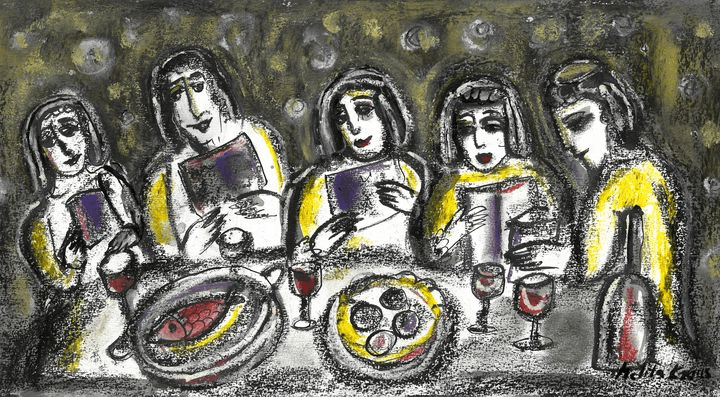
The Lord said to Moses and Aaron in the land of Egypt, “This month shall mark for you the beginning of months; it shall be the first month of the year for you. Tell the whole congregation of Israel that on the tenth of this month they are to take a lamb for each family, a lamb for each household. If a household is too small for a whole lamb, it shall join its closest neighbor in obtaining one; the lamb shall be divided in proportion to the number of people who eat of it.
Your lamb shall be without blemish, a year-old male; you may take it from the sheep or from the goats. You shall keep it until the fourteenth day of this month; then the whole assembled congregation of Israel shall slaughter it at twilight. They shall take some of the blood and put it on the two doorposts and the lintel of the houses in which they eat it.
They shall eat the lamb that same night; they shall eat it roasted over the fire with unleavened bread and bitter herbs. Do not eat any of it raw or boiled in water but roasted over the fire, with its head, legs, and inner organs. You shall let none of it remain until the morning; anything that remains until the morning you shall burn with fire.
This is how you shall eat it: your loins girded, your sandals on your feet, and your staff in your hand, and you shall eat it hurriedly. It is the Passover of the Lord. I will pass through the land of Egypt that night, and I will strike down every firstborn in the land of Egypt, from human to animal, and on all the gods of Egypt I will execute judgments: I am the Lord. The blood shall be a sign for you on the houses where you live: when I see the blood, I will pass over you, and no plague shall destroy you when I strike the land of Egypt….
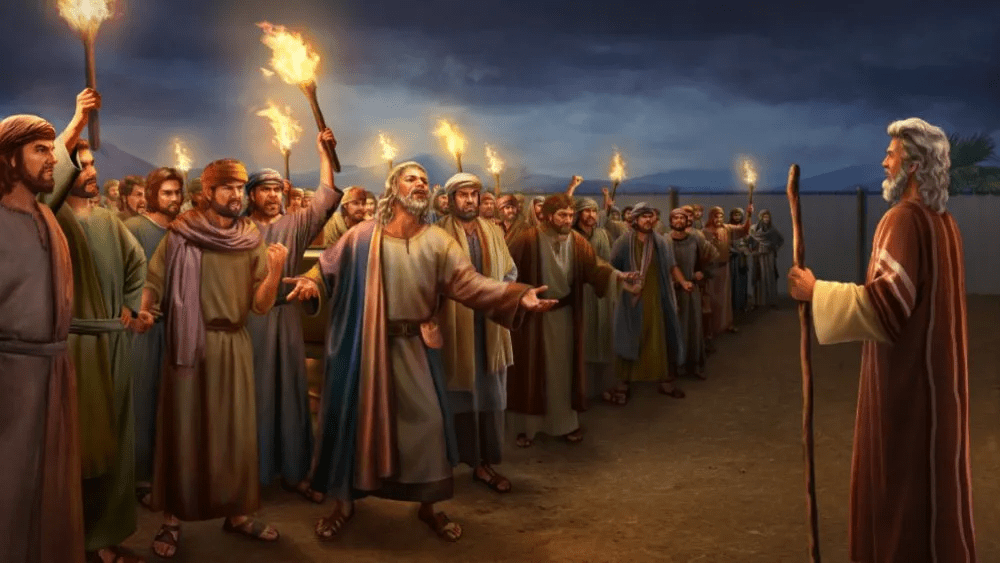
Then Moses called all the elders of Israel and said to them, “Go, select lambs for your families, and slaughter the Passover lamb. Take a bunch of hyssop, dip it in the blood that is in the basin, and touch the lintel and the two doorposts with the blood in the basin.
None of you shall go outside the door of your house until morning. For the Lord will pass through to strike down the Egyptians; when he sees the blood on the lintel and on the two doorposts, the Lord will pass over that door and will not allow the destroyer to enter your houses to strike you down.
You shall observe this as a perpetual ordinance for you and your children. When you come to the land that the Lord will give you, as he has promised, you shall keep this observance. And when your children ask you, ‘What does this observance mean to you?’ you shall say, ‘It is the Passover sacrifice to the Lord, for he passed over the houses of the Israelites in Egypt when he struck down the Egyptians but spared our houses.’ ” And the people bowed down and worshiped.
The Israelites went and did just as the Lord had commanded Moses and Aaron; so they did. (New Revised Standard Version)

Today’s story of Passover is the highlight of Jewish history concerning both God’s judgment and God’s justice. It is a continual reminder that God is concerned with the divine Name; with his people; and with providing them what they need.
The Lord’s tenth and final plague against the Egyptians was the ultimate judgment of taking their firstborn children. At the same time, the Lord extended great justice to the Israelites by removing the oppressive obstacles which hindered them from having their basic human needs met.
Both God’s judgment and God’s justice were to be annually remembered through rituals established by God. These remembrance rituals of Passover are meant to be brought perpetually to Jewish minds, so that they will maintain a high view of Gods’ Name, and also never be a nation who acts like the Egyptians.
Passover and Exodus constituted a new beginning and new life for Israel. Slaughtering the Passover lamb was the start of liberation for the people; along with the eating of unleavened bread. Both the blood of the lamb, and the absence of leaven, together communicated freedom to the Israelites from God.
Even today, nearly four millennia later, Passover is still celebrated amongst the Jewish community as a great festival of freedom. The primary ritual in this celebration is the seder, an evening meal which involves eating several symbolic foods.
The purpose of coming together to eat special foods is to relive the experience of the Exodus from Egypt. It is a time of passing down the people’s communal memory, as well as reflecting upon God’s divine redemption for them.
The Passover rituals are the root of Christianity’s celebration of communion at the Table. For Christians, the final seder meal of Jesus and his disciples at the Last Supper in the Upper Room is remembered and relived, so that believers may contemplate the Cross of Christ as the ultimate divine redemption.
Table fellowship for both religions – Judaism and Christianity – has a central place in ritual remembrance. God is acknowledged and praised as the great Liberator from oppression. Justice is memorialized. Past events are remembered in order to live justly and rightly in the present.
Deliverance of people from both physical and spiritual slavery is a grand theme throughout all of Holy Scripture. People of freedom are never to let themselves again be placed in bondage. The New Testament puts the matter this way:
For freedom Christ has set us free. Stand firm, therefore, and do not submit again to a yoke of slavery. (Galatians 5:1, NRSV)
The yearning for freedom from oppression and injustice lies within the breast of every human on this earth. It’s why people will go out of their way to use whatever means they have of standing against abusive powers.
It is more than ironic that there are people today who espouse themselves as Christian, yet are hell-bent on using whatever means they have to oppress and abuse others into submission. Such persons are not demonstrating care for the Name of God, especially not the Name of Jesus Christ. Instead, they have another agenda – one that has nothing to do with liberation and freedom.
This is one big reason why we need rituals. Rituals keep us remembering the things we need to remember, and help us forget the things we need to forget.
Earthly power is not the summum bonum of life. Rather, real power is Love. Again, quoting the Apostle Paul from the Book of Galatians:
For you were called to freedom, brothers and sisters, only do not use your freedom as an opportunity for self-indulgence, but through love become enslaved to one another. For the whole law is summed up in a single commandment, “You shall love your neighbor as yourself.” If, however, you bite and devour one another, take care that you are not consumed by one another. (Galatians 5:13-15, NRSV)
Indeed, all that really counts for us in this life is “faith expressing itself through love.” (Galatians 5:6)
Remembering true freedom, and it’s real cost, through established rituals, is perhaps the best way of ensuring that the oppression and injustice of empires like Egypt and Rome do not happen in our present day.
Therefore, if we lose connection with important and seminal events of the past without ritual remembrance, we are setting ourselves up for terrible injustice to occur.
We are better than that. Redemption and remembrance can help show us the way.
Great God of all justice, righteousness, and redemption: Continue to break the yoke of Pharaoh in our time, and forever shatter the bonds of human oppression.. Hasten the Day when we shall all be free, at the coming of your Son, our Lord, Jesus Christ, who with you and the Holy Spirit are one God, now and forever. Amen.





 Rev. Tim Ehrhardt