Seven Christian Virtues

            The Christian life is a struggle, a wrestling match of putting off bad behavior, and putting on good behavior.  Like a set of dirty clothes, we take them off and put on new clothes (Ephesians 4:14-5:20).  We must do both, putting off and putting on.  It does no good to take off dirty clothes and stand there naked.  Neither does it make any sense to just put clean clothes on over your dirty ones.
The seven deadly sins of lust, gluttony, greed, sloth, anger, envy, and pride are bad habits of vice which darken the heart.  From them springs the evil behavior of the world. We must put them aside.  In their place we are to put on the seven heavenly virtues of purity, self-control, generosity, diligence, forgiveness, kindness, and humility.
1.      Purity
 
The insatiable habit of committing mental adultery needs to be replaced with purity of heart.  The pure of heart seek to better themselves through confession, repentance, and accountability.  One reason many people do not experience victory over their lust is that they confess and repent without allowing themselves to be held accountable by a wise spiritual mentor or a safe small group of people.
“Create in me a pure heart, O God, and renew a steadfast spirit within me.” (Psalm 51:10, NIV)
 
“Keep watch on yourself, lest you too be tempted.  Bear one another’s burdens, and so fulfill the law of Christ.” (Galatians 6:1-2, ESV)
 
“Blessed are the pure in heart, for they shall see God.” (Matthew 5:8, NIV)
 
2.     Self-Control
 
The glutton overindulges to the point of addiction.  He needs self-control.  Self-control is to engage in the good things of life in moderation, learning to say “no” before it’s too late.  Notice this is self-control, not others-control.  The way to gain mastery over yourself is not through controlling other people.  It’s tempting to blame others for our gluttony, but the path forward is through taking small steps of personal courage and faith.  Lent is the perfect season to intentionally plan to put aside one vice or besetting sin in your life.
“Better a patient person than a warrior, one with self-control than one who takes a city.” (Proverbs 16:32, NIV)
 
“For the Spirit God gave us does not make us timid, but gives us power, love and self-discipline.” (2 Timothy 1:7, NIV)
 
“Control yourselves and be careful! The devil, your enemy, goes around like a roaring lion looking for someone to eat.” (1 Peter 5:8, NCV)


3.     Generosity
 
The greedy person only thinks about money and how to get more.  Greed can only be overcome with generosity toward others.  Not only are we to liberally give money away to those in need, we are to be generous with encouraging words, go out of our way to do humble service, and be effusive in spending time with those who need it.
But if there are any poor Israelites in your towns when you arrive in the land the Lord your God is giving you, do not be hard-hearted or tightfisted toward them.  Instead, be generous and lend them whatever they need.” (Deuteronomy 15:7-8, NLT)
 
“Whoever is generous to the poor lends to the Lord, and he will repay him for his deed.” (Proverbs 19:17, ESV)
 
“Command those who are rich in this present world not to be arrogant nor to put their hope in wealth, which is so uncertain, but to put their hope in God, who richly provides us with everything for our enjoyment.  Command them to do good, to be rich in good deeds, and to be generous and willing to share.” (1 Timothy 6:17-18, NIV)
 
4.    Diligence
 
A lazy and indifferent attitude doesn’t want to get involved.  It needs to be replaced with a diligent hard-working spirit.  Diligent people seek to make a difference in the world.  They roll their sleeves up, jump-in and get to work on the great problems of the day.
“The lazy have strong desires but receive nothing; the appetite of the diligent is satisfied.” (Proverbs 13:4, CEB)
 
“The plans of the diligent lead surely to abundance, but everyone who is hasty comes only to poverty.” (Proverbs 21:5, ESV)
 
“So let us not grow weary in doing what is right, for we will reap at harvest time, if we do not give up.” (Galatians 6:9, NRSV)
 
“Whatever you do [whatever your task may be], work from the soul [that is, put in your very best effort], as [something done] for the Lord and not for men.” (Colossians 3:23, AMP)


5.     Forgiveness
 
Maybe it goes without saying that anger and forgiveness are mutually exclusive terms.  An angry person doesn’t forgive – she just wants to get even.  Putting off those angry clothes means putting on the clean clothes of extending forgiveness.  Forgiveness is neither cheap, nor easy. It can’t be done quickly or hastily.  It’s the difference between throwing on a few sweats – and getting dressed up in a tuxedo.  Forgiveness takes care and time.
“Put aside all bitterness, losing your temper, anger, shouting, and slander, along with every other evil.  Be kind, compassionate, and forgiving to each other, in the same way God forgave you in Christ.” (Ephesians 4:31-32, CEB)
 
“As holy people whom God has chosen and loved, be sympathetic, kind, humble, gentle, and patient.  Put up with each other and forgive each other if anyone has a complaint. Forgive as the Lord forgave you.” (Colossians 3:12-13, GW)
 
6.    Kindness
 
Envy is the evil rot that separates people.  The antidote is kindness.  To be kind is to celebrate what another has achieved that you haven’t.  Kindness extends friendship instead of trying to knock another person down a peg so that you can try and have what they have.  Kindness creates connection and heals division.
“Love is patient and kind; love does not envy or boast; it is not arrogant or rude. It does not insist on its own way; it is not irritable or resentful; it does not rejoice at wrongdoing but rejoices with the truth.  Love bears all things, believes all things, hopes all things, endures all things. (1 Corinthians 13:4-7, ESV)
 
“And to your service for God, add kindness for your brothers and sisters in Christ; and to this kindness, add love.” (2 Peter 1:7, NCV)
 
7.     Humility
 
If pride is the root from which all other sinful attitudes break ground, humility is the herbicide that kills that root.  To be humble is to know that others have a valuable contribution to give.  Humility listens because it doesn’t think it has all the answers.  The humble among us quietly serve others without caring if it draws attention to themselves.
Be completely humble and gentle; be patient, bearing with one another in love.” (Ephesians 4:2, NIV)
 
“Humble yourselves in the sight of the Lord, and He will lift you up.” (James 4:10, NKJV)
 
“God is opposed to the proud but gives grace to the humble.” (1 Peter 5:5, NASB)



            Developing Christian character is more than identifying the vices and bad habits of life; it is replacing them with these seven virtues.  Cultivating true Christian virtue is in the struggle to be better, and not in the notion that one can achieve perfection.  It is the continual wrestling with one’s own shadow-self that allows the virtues to gain a foothold in the soul.
            Therefore, church ministry needs to be a place where people are free to struggle, doubt, and wrestle with their inner demons.  Genuine ministry is a hospital for the soul, resembling more of the messy triage work of the emergency room, than the sanitized antiseptic room on the top floor who hasn’t seen a patient in days.


            Try using these Christian virtues as a way of having a conversation about the nature, direction, and goals of your ministry.  Are these virtues evident in your context? Why, or why not? Which one needs the most attention? How will you address it?


What Forgiveness Is, and Is Not

Forgiveness

We forgive a person for what he/she has done – not for who they are.

You and I have had times when we needed to forgive, and times when we were the ones needing forgiveness.  Sometimes we need both at the same time.

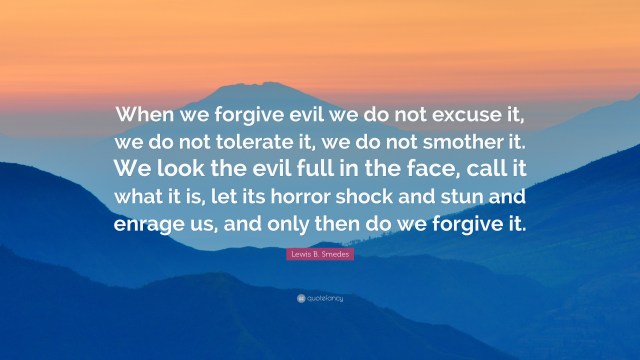
Forgiveness is nothing more, and nothing less, than choosing not to hold another person’s sinful words or actions over their head.

Several years ago, when I was experiencing a major depression, I had trouble doing what were normally simple tasks for me.  I found it hard to focus on reading for any length of time.  It was difficult to get out of bed and even to move, at all.  I don’t even remember some of the terrible things I said to my wife during that awful time – things which she in no way deserved.

To the credit of my wife, she forgave me for such instances of the occasional lashing-out at her.  It took her awhile, but Mary began to understand that it was the depression talking.  She didn’t hold it over me when I was a repeat offender.

Yet, before my wife got to the point of forgiveness, she learned something important.  You can’t forgive someone for being depressed any more than you can forgive someone for getting cancer or for dying young.  You can only forgive words and behaviors which hurt.

lewis smedes 3

Far too often we have expectations for others.  We want them to live-up to our desires for them.  But when they don’t, that’s not in the arena of forgiveness – that’s in the scope of needing to let go of our pre-conceived forecast for their lives.

My lovely wife has A.D.D.  It’s not possible to forgive her for that.  Now, if she has an impatient outburst on her slow-moving husband – that’s something I can say hurt me and for which I need to forgive her.  I have had to learn to let go of my expectations that she will always pay attention and focus well on everything I say and do; that she will never lose her car keys; and, that she will consistently complete tasks on time.

I can’t forgive Mary for any of those things, any more than I could forgive a person with a broken leg for not running in the local community’s 5K race.  I can’t use forgiveness to manipulatively maneuver my way for perfect order.  When we try to forgive someone for their actual personhood, it only breeds resentment on our part.

Being sick and missing work doesn’t need forgiveness.  We don’t need to feel guilty for stuff like that.  God doesn’t jerk us around trying to use the cross of Christ as the way to make us feel bad for being stupid, silly, sanctimonious, or even sinners.  Rather, God forgives us in Jesus Christ because we have all sinned against him with hurtful words and unfeeling actions which have grieved his heart.

“But, what”, you might ask, “do you do with heinous, intentional, and/or egregious evil which one person commits on another?  Do you mean we should forgive Larry Nassar? Because I want to be like the Dad in the courtroom who wanted to beat the ba-jeebers out of him!”

I’m right there with you.  I’ve been a real victim of terrible sin, and I’ve seen loved ones go through awful grief from perpetrators.  I have fantasized more than once about the eye for an eye.

forgiveness lewis smedes

Rather than talk about my own junk (which I’m not really at liberty to do, anyway), let’s think about Jesus.  He did nothing wrong whatsoever.  In fact, he only did good, all the time.  Yet, he was the ultimate victim of both individuals, groups, and an entire Empire.

His only crime was that he did not live up to certain people’s expectations of what Messiah should be.  He is the King of a spiritual kingdom, and that was too threatening to the powers that be.  So, he was betrayed by someone close to him and killed – more than killed – tortured, beaten, spat upon, mocked, and publicly shamed.

And Jesus said, “Father, forgive them, for they don’t know what they’re doing.” (Luke 23:34)

One of the greatest followers of Jesus, Paul, who was beaten more than once and left to die, had no resentment and no bitterness.  Paul took his cues from his Savior:

“Be kind, compassionate, and forgiving to each other, in the same way God forgave you in Christ.” (Ephesians 4:32)

Both Jesus and Paul forgave the persecuting acts and the horrible words, while seeing the personhood behind their perpetrators’ hate.

“But how? I’m not them.” Neither am I.  That doesn’t stop me, however, from dying to myself and striving to live up to their example and teaching.

You can’t forgive someone for failing to live up to what you want them to be.  You can only forgive their bad words or actions.  Jesus and Paul longed for people to connect meaningfully with God.  But when the people didn’t do so, they just kept plugging along without resentment, even when it hurt them deeply.

forgiveness lewis smedes 2

I think we tend to believe that forgiveness has to be immediate, like a one-time event.  It rarely is that.  Forgiveness is much more a process, elongated over time.  And just when you think you’ve licked it and gotten over the hump, a bitter feeling rears its ugly head and bites you in the butt.

The late Christian writer and psychologist, Lewis Smedes, in his insightful book, Forgive & Forget, said:

“Ordinary people forgive best if they go at it in bits and pieces, and for specific acts.  They bog down if they try to forgive people in the grand manner, because wholesale forgiving is almost always fake.  Forgiving anybody is a minor miracle.”

Indeed, it is.  We have enough on our plate trying to forgive another for specific words and actions.  We don’t need to compound it by making it into the full repentance of the other as a prerequisite to our forgiving them.

Luke 14:15-24

            If the gospel of forgiveness in Jesus Christ is such good news, and God is so good, then why aren’t people breaking the door down to get into the church?  Today’s Gospel lesson gives us one reason why:  They just aren’t interested.  The parable Jesus told was of people, when invited to come to the great banquet, kept making one excuse after the other why they couldn’t come.
 
            Jesus was not talking to the sinful outsiders, but the religious insiders – they were the ones making the excuses why they could not participate.  Here’s the deal:  If professing believers in God are not excited about the gospel; if Christians are not enthused over what they possess in the gospel; if we as the church are content to go through the motions of Christianity without a concern to be with Jesus; if we are simply too busy to come and attend God’s banquet of grace; then, why in the world should those persons who don’t profess Christ as Savior break down the door to get in?
 
            Jesus was offering a penetrating warning:  The unresponsive religious insiders will be replaced by the responsive sinful outsiders.  If the insiders take for granted what they possess and have better things to do, then God is going to call people who will hear, listen, and respond to his gracious invitation.
 
            The deeply probing question for every believer today is this:  Are we so familiar with Jesus, and so content with the way things are that when God breaks into our lives in the form of an invitation that we refuse to respond because we are not interested in going to some stupid banquet?  Lord, have mercy.  Christ, have mercy.


            Gracious God, forgive me for wasting time in things that just don’t matter in the scope of eternity.  I choose to go out and compel outsiders to come in, so that your house will be full for the great feast at the end of the age.  Through Jesus, in the power of the Holy Spirit, I pray.  Amen.

Principles of Forgiveness


Since the heart of God’s gospel of grace is the forgiveness of sins we possess through the person and work of Jesus Christ, the church really cannot talk too much about the need for forgiveness.  Christians are not meant to pray a sinner’s prayer, and then move on with their lives without thinking about forgiveness anymore.  Forgiveness is to be a constant dynamic of relationships because we live in a fallen world.  People sin against us.  We sin against others.  Relational pain is a reality this side of heaven.  But revenge and/or passive-aggressive behavior are not biblical ways of handling our hurt.  Let’s keep in mind some principles of what forgiveness is and is not:
 
Forgiveness is hard work. 
 
God did not promise forgiveness would be cheap or easy.  He knows exactly the kind of cost it brings.  Through the blood of Jesus there can be and is forgiveness.  “The blood of bulls and goats and the ashes of a heifer sprinkled on those who are ceremonially unclean sanctify them so that they are outwardly clean.  How much more, then, will the blood of Christ, who through the eternal Spirit offered himself unblemished to God, cleanse our consciences from acts that lead to death, so that we may serve the living God!” (Hebrews 9:13-14).
 
Forgiveness is a process.
 
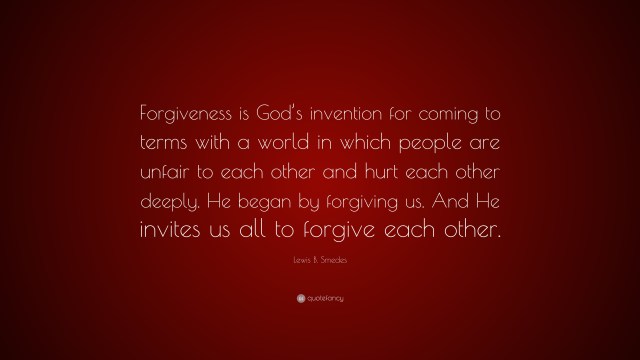
            It is a process of putting off and putting on.  It takes time, and cannot be quickly done.  Forgiveness must be deliberate with no shortcuts to it, otherwise it will not stick.  “Get rid of all bitterness, rage and anger, brawling and slander, along with every form of malice.  Be kind and compassionate to one another, forgiving each other, just as in Christ God forgave you” (Ephesians 4:31-32).
 
Forgiveness does not mean we condone bad behavior.
 
            Forgiveness is not blanket amnesty.  It does not simply give another person a “pass” on their sinful words or actions.  Forgiveness just means we do not hold the offense over the other person’s head.  Dr. Fred Luskin from Stanford University does research in the area of forgiveness, and says this about it:  “Forgiveness is giving up all hope of a better past.”  We cannot undo the past.  But we have control of the present, and can choose to forgive.  True forgiveness calls a spade a spade and names the specific offense in all its ugliness, and lets it go.
 
Forgiveness does not always result in reconciliation.
 
            It takes two to reconcile.  It only takes one to forgive.  I have often been told by individuals that it would do no good to forgive another because it would not change the other person.  That is not the point.  We forgive because it is our responsibility to work through our forgiveness issues and to do it.  We are not in control of whether another person will feel sorry for what they did, or not.  We are in control of our own decision to forgive, no matter what the other person does or does not do, or whether they feel the gravity of their sin, or not.
 
Forgiveness is primarily for our benefit.
 
            If you hold on to bitterness toward another for their offense, you are not hurting anybody but yourself.  Drinking the poison of bitterness will kill you, not the other person.  So, deal with forgiving that other person, and do not have the magical thinking that they are going to come to you all slobbery sorry for what they said or did.  That often does not happen.  When it does, it is a beautiful thing.  But we forgive everyone who sins against us just as God has forgiven us.


            Relational currency in the kingdom of God is forgiveness.  Without it, we can neither operate well together, nor can we enjoy a satisfying life.  But with forgiveness is a demonstration of the practical effects of Christ’s crucifixion in our lives, not to mention a witness to a watching world.