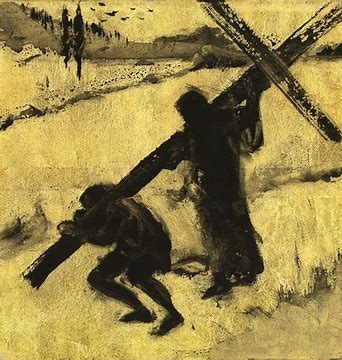
Numbers 27:12-23 – Humble Leadership

Moses Blesses Joshua by Marc Chagall, 1966

One day the Lord said to Moses, “Climb one of the mountains east of the river and look out over the land I have given the people of Israel. After you have seen it, you will die like your brother, Aaron, for you both rebelled against my instructions in the wilderness of Zin. When the people of Israel rebelled, you failed to demonstrate my holiness to them at the waters.” (These are the waters of Meribah at Kadesh in the wilderness of Zin.)

Then Moses said to the Lord, “O Lord, you are the God who gives breath to all creatures. Please appoint a new man as leader for the community. Give them someone who will guide them wherever they go and will lead them into battle, so the community of the Lord will not be like sheep without a shepherd.”

The Lord replied, “Take Joshua son of Nun, who has the Spirit in him, and lay your hands on him. Present him to Eleazar the priest before the whole community, and publicly commission him to lead the people. Transfer some of your authority to him so the whole community of Israel will obey him. When direction from the Lord is needed, Joshua will stand before Eleazar the priest, who will use the Urim—one of the sacred lots cast before the Lord—to determine his will. This is how Joshua and the rest of the community of Israel will determine everything they should do.”

So, Moses did as the Lord commanded. He presented Joshua to Eleazar the priest and the whole community. Moses laid his hands on him and commissioned him to lead the people, just as the Lord had commanded through Moses. (New Living Translation)

Moses was one of the most humble persons who ever lived on this earth (Numbers 12:3). Whereas many people are concerned for their legacy at end of life, Moses, instead, had a deep pastoral concern for his fellow Israelites. He didn’t want them without a capable and godly leader. So, in his humility, Moses was willing to obey God, let go of power, and share his authority so that the people would be well-cared for.

“All streams flow to the ocean because it is lower than they are. Humility gives it its power.”

Lao Tzu (Chinese philosopher, 6th century B.C.E.)

I believe humility is the queen of all virtue, especially that of leadership. Yet, humility is one of the hardest virtues to practice because it requires that we willingly put aside pride, ego, and personal agendas in order to embrace God’s agenda.

Rather than having large statues erected to honor us and our proud accomplishments, or having our names plastered on buildings (and churches!) to recognize our wonderful charity, we really need to orient our energies toward passing the baton to trustworthy people who are capable of faithfully fulfilling the role of servant leader. (2 Timothy 2:2)

Being poor in spirit (Matthew 5:3), becoming like a little child (Matthew 18:3), and thinking of others as better than ourselves (Philippians 2:3) are the cornerstones to becoming open to what God has for us. To be a humble leader means to steadfastly seek God’s will and way in everything. Then, to have the courage in leading others toward God’s direction, despite resistance and opposition from those who want to follow a different path.

Therefore, a leader’s task is to be consumed with seeking God’s direction rather than living purely according to instinct, pragmatic desire, or personal views. We continually need a radical openness to God. So, we must work to develop an ever-deepening awareness of where God is leading us. 

God, in divine mercy, is always up to something good. The Lord has plans for us and for the people we lead.  It’s humility that allows us to listen well to God’s Spirit and gain the direction needed for leadership.

Yet, being open to God is not quite as easy as it sounds. We must recognize that not everyone is open to God.  There are those, maybe even including us, who may be closed to God. 

If our focus is more on creating safety and security or trying to do enough good deeds to be recognized by God and others, or having our institution be what we want it to be, then we have become closed to what God wants.  This comes out in a couple of different ways….

  1. Maintaining tradition, at all costs. Whenever we do everything the way we have always done it, to make us feel safe and secure, then anything that threatens that security angers us. This is where folks practice either fight or flight – they wage either a holy war or just leave. Living with uncertainty and ambiguity is too much for them. But faith is what it takes if we are going to follow God. Like Abraham in the Old Testament, we are called to move and change without always knowing the destination.
  • Getting rid of traditions, at all costs. Sometimes folks who want new or different, desire to create a place of their own making to serve them and their needs. They aren’t really focused on what God is calling them to do. Rather, like Timothy in the New Testament, we are to hold onto the great deposit of doctrine and heritage given to us and not always be looking for the next new thing to turn things around.

So, what to do? Have the humility to ask the question continually and constantly: “What is God’s will?”  We need leadership that is incredibly open to God, allowing decision-making to come from a position of faith, and not fear. This enables us….

  • To let God, flow in and through us, rather than willfully insisting it should be our way or the highway.
  • To practice hope and love, rather than relying on our own strength and desires.
  • To make prayer and discernment the foundation of what we do, always seeking what God wants and then leading others in that direction by inviting them to the same kind of prayerful process.
  • To read our Bibles as if our lives depended on it and pray like there is no tomorrow.

If we have humility and a deep openness to God; a conviction that we are primarily called to follow Jesus Christ; a willingness to let God’s power flow through us; and, a determined readiness to move people lovingly and graciously in God’s direction, then amazing things can happen. 

Let our prayer together be this: I am yours, God, no matter where you call me to go, what you call me to do, and how you call me to be. I will seek your will and way as I lead others to do the same. Amen.

John 1:43-51 – Follow Me

“Follow Me” by Greg Dampier. Jesus calls Peter and Andrew.

The next day Jesus decided to leave for Galilee. Finding Philip, he said to him, “Follow me.”

Philip, like Andrew and Peter, was from the town of Bethsaida. Philip found Nathanael and told him, “We have found the one Moses wrote about in the Law, and about whom the prophets also wrote—Jesus of Nazareth, the son of Joseph.”

“Nazareth! Can anything good come from there?” Nathanael asked.

“Come and see,” said Philip.

When Jesus saw Nathanael approaching, he said of him, “Here truly is an Israelite in whom there is no deceit.”

“How do you know me?” Nathanael asked.

Jesus answered, “I saw you while you were still under the fig tree before Philip called you.”

Then Nathanael declared, “Rabbi, you are the Son of God; you are the king of Israel.”

Jesus said, “You believe because I told you I saw you under the fig tree. You will see greater things than that.” He then added, “Very truly I tell you, you will see ‘heaven open, and the angels of God ascending and descending on’the Son of Man.” (New International Version)

I am a follower of Jesus. I have been for decades. I found, and continue to find, in Jesus Christ a compelling person full of grace, truth, and love.

But my early life was not characterized with knowing Christ. I certainly learned about Jesus, that this ancient guy lived an altruistic life, got tortured and killed on a cross, and that Christians believe in his resurrection from death. However, back then it was more like some strange history lesson. That information made no difference to me.

That is, until I heard a voice – not an audible one that others could hear. Yet, it was just a real as any daily conversation with another person. I heard the call of Jesus. The Ancient of Days showed up. I know with every epistemic fiber in my being that it wasn’t an undigested bit of beef, a blot of mustard, a crumb of cheese, a fragment of an underdone potato. I am sure beyond sure that there was more of an empty grave than gravy about my experience of the risen Christ.

I experienced the call of Jesus to “follow me.” And that is really, at its simplest, the call which continually goes out to all humanity. It is a gracious and merciful call. It isn’t a summons to experience a cataclysmic event of total belief in one fell swoop. Rather, it’s a call to belief that is much more an unfolding awareness of the deep spirituality and connection with the divine within.

“I am the light of the world. If you follow me, you won’t have to walk in darkness, because you will have the light that leads to life.”

Jesus (John 8:12, NLT)

Important to that faith process is another call to “come and see.” Whereas there are some Christian traditions which focus solely on a singular one-time experience of saving faith in Christ, the Gospel of John displays a drama of faith with multiple layers which people move through.

There is no egalitarian zap in which God grants total and immediate understanding. Instead, faith is an ever-increasing process. It is appropriate and biblical to say that our salvation has happened, is happening, and will happen. We follow, we come and see, and we keep following, keep coming, keep seeing more and more.

Like a muscle, our faith grows, develops, stretches, and strengthens over time. To use another metaphor, we ascend a stairway to heaven, one step at a time, day after day, following Jesus.

Methinks this is likely part of what Jesus was getting at with Nathaniel in today’s Gospel lesson. Nathaniel would have quickly picked up on the reference Jesus was making, way back to the first book of Genesis. The Jewish patriarch, Jacob, had an experience of seeing the angels of God on some celestial stairway, ascending and descending. It was an encounter of God’s presence with Jacob, assuring him of divine intervention into the muck of humanity. (Genesis 28:10-17)

Jesus connected that ancient portrait to himself so that Nathaniel would understand, would believe, that God has again broken into this world with a special divine presence. To look at Jesus and follow him, is to see and follow God.

Christ Jesus is the ultimate example and embodiment of God with us. Throughout John’s Gospel, Jesus presents himself as:

  • Living water – connecting to Jacob’s well (John 4:5-14)
  • The Temple of God – the place where the Lord dwells in all divine fullness (John 2:18-22)
  • Bread from heaven – linking the giving of manna to the Israelites in the desert (Exodus 16:4-7; John 6:1-59)
  • The good shepherd – fulfilling divine Old Testament imperatives of caring for people (Ezekiel 34:11-16; John 10:1-30)

In all these ways, and more, Jesus intentionally connects himself as fulfilling God’s ancient promises to people.

In whichever way we need to hear the call to follow, Jesus accommodates to us. For some, Christ comes knocking on the front door. For others, he enters the side door, or slips into the backdoor of our lives.

And, if we will come and see, Jesus will also accommodate us by being the authority over us, the teacher to us, or the friend beside us. The Lord Jesus shall shepherd us and woo us to the flock for guidance and protection.

However, Jesus comes to you, it most likely will be in ways we aren’t expecting. Surely, nothing good can come from Nazareth! Yet, it did. Can anything good come from Calcutta, India, or Juarez, Mexico, or Hoboken, New Jersey, or Milwaukee, Wisconsin, or even from a small rural area that doesn’t show up on a map? Yes, it can. Because with Jesus, God has entered this world, and, as it turns out, the Lord’s presence is everywhere.

Follow me. Come and see. Two of the simplest exhortations ever uttered. Yet, two of the most gracious phrases ever said, with profound implications for us beyond what we can fathom or imagine.

Guide us waking O Lord, and guard us sleeping; that awake we may watch with Christ and asleep we may rest in peace. May the shape of each day be formed by the pedantic following of my Lord; and may I come and see the wonders you have done, are doing, and will do. Almighty and merciful God – Father, Son and Holy Spirit – bless us and keep us. Amen.

Matthew 8:18-22 – The Path of Christian Discipleship

When Jesus saw that a curious crowd was growing by the minute, he told his disciples to get him out of there to the other side of the lake. As they left, a religion scholar asked if he could go along. “I’ll go with you, wherever,” he said.

Jesus was curt: “Are you ready to rough it? We’re not staying in the best inns, you know.”

Another follower said, “Master, excuse me for a couple of days, please. I have my father’s funeral to take care of.”

Jesus refused. “First things first. Your business is life, not death. Follow me. Pursue life.” (The Message)

Count the cost. Realize what it will take. Have some understanding of the time, energy, and resources needed. Discern the kind of commitment which is before you. It’s a matter of life and death, of spiritual survival.

If you had to carry everything you needed in a backpack, what would you put into it?

First off, for me and most people, that means identifying the barest essentials. It would likely take a long time to think simplistically about what is most important for survival. A lot of things would get left behind. And many items would gain greater attention and appreciation.

We would need some small basic tools including: a multi-tool with a knife and pliers; a source of illumination, like a flashlight and extra batteries; duct tape; rope; fishing line; a way of starting fire; a pot, pan, and mug; first-aid kit; emergency poncho; and just a few extra items of clothing.

If we were to live out of a backpack, it would very much change our lifestyle. And that is the point Jesus was trying to get across to some individuals who seemed like they couldn’t do that.

Trying to fit an existing life into a brand new life won’t work. It will not fit into the backpack of Christian discipleship.

Instead, we must adjust to a new reality, a completely different way of being.

When my wife and I were raising our girls, those precocious little females brought lots of life to the dinner table each night. There was never a dull moment with them. Today, however, they are all grown with their own families – which means we are empty-nesters.

It would be weird if my wife and I continued to live as if they were home – making large meals, dirtying lots of dishes, and engaging in mock conversations. Rather, although it took a while to get used to, we eventually came to grips with the new reality that our precious girls were grown and no longer living under our roof. And that meant a complete change of lifestyle for us.

A full-orbed Christian spirituality includes both the comfort of Christ to others, and the rugged responsibility to obey the words and ways of Jesus. In other words, the love of Jesus Christ is both tender and tough, at the same time, all the time.

Hurting and healing are both necessary for the follower of Jesus. Hard teachings and uncompromising commands for discipleship from Christ become the pathways of healing.

So, then, to go all out for Christ will involve much difficulty.

Jesus said to his followers, “If any of you want to be my follower, you must stop thinking about yourself and what you want. You must be willing to carry the cross that is given to you for following me. Any of you who try to save the life you have will lose it. But you who give up your life for me will find true life.”

Matthew 16:24-25, ERV

In today’s New Testament lesson, Jesus rather rudely rejected two would-be followers. When it comes to God’s upside-down kingdom, the eager beavers are turned away, and the half-hearted are called.

Jesus wants us, all of us, and not just our dedication. That is the demand of Christian discipleship. Anyone who believes they can remain the same person and simply fit a bit of Jesus into their lives, does not understand the cost of following Christ. The person who thinks it is Christianity’s lucky day when they decide to follow Jesus has not yet grasped what it means to be a Christian.

Whereas the religious scholar’s head was too big to fit through the narrow hole of Christian discipleship, the man who wanted to bury his father was too fainthearted and timid. He wanted to dip his toe in the water, and really had no intention of taking the all out plunge into the pool.

Nobody needs to do something “first” before following Jesus. Essentially, Jesus was neither invited nor welcome to the funeral. And Christ will have nothing to do with people picking and choosing which areas of their lives he will be invited into. It’s either a wholesale welcome or no welcome, at all.

When Jesus knocks on the door, he wants to be invited into the entire house, not just the foyer.

For Jesus, following him isn’t easy. The world is full of spiritual zombies, the walking dead. This old fallen world needs Christian disciples who will follow Jesus anywhere – into the hard places and rough terrain of engaging the sinful world.

We are meant to wholeheartedly follow Jesus, neither flippantly without counting the cost, nor procrastinating the hard road of Christian discipleship. Christians are to accept and maintain orders of first importance – which means full submission and obedience to Jesus Christ. Anything less is merely a cheap form of following.

When I Survey the Wondrous Cross by Isaac Watts

When I survey the wondrous cross
On which the Prince of glory died
My richest gain I count but loss
And pour contempt on all my pride.

Where every realm of nature mine
My gift was still be far too small
Love so amazing, so divine
Demands my soul, my life, my all.

Lord, you are all-knowing and full of wisdom. Your plan is masterful. Help me as your disciple to follow you in every thought, word, and deed. Give me a heart of obedience and trust so that I do not get wrapped up in my doubt or what I think is the right choice.

Help me to recognize that your good will does not always look the way I think it should, but that doesn’t make it any less good. I desire to be your disciple and follow you all the days of my life. Please give me the strength to do that. Amen.

1 Peter 5:1-5 – Humble Service

To the elders among you, I appeal as a fellow elder and a witness of Christ’s sufferings who also will share in the glory to be revealed: Be shepherds of God’s flock that is under your care, watching over them—not because you must, but because you are willing, as God wants you to be; not pursuing dishonest gain, but eager to serve; not lording it over those entrusted to you, but being examples to the flock. And when the Chief Shepherd appears, you will receive the crown of glory that will never fade away.

In the same way, you who are younger, submit yourselves to your elders. All of you, clothe yourselves with humility toward one another, because “God opposes the proud but shows favor to the humble.”(NIV)

Today’s New Testament lesson addresses two groups of people: Leaders and followers, the older and the younger, shepherds and sheep. Both have their distinct roles and places, yet both are to share together in the virtue of humility. Whether pastor or parishioner, mentor or mentee, humble service is to characterize all.

I spent a good chunk of my ministerial life working with college students and twenty-somethings. One of the reasons I like being around young adults is that they have a very well attuned barometer to hogwash coming from older folks. Unlike children and more mature adults, this group of people live in a nexus between an emerging awareness of the world without having yet been crusted over with bitterness or disillusionment. They can spot a disingenuous person across the room like an eagle eyes the difference between a fish and a rock at five-thousand feet in the air.

All of us have likely had the experience of not being able to explain why, but a certain interaction with a person just seems off – it smacks of being a bit too contrived and manipulative. The other person might talk a good line, yet your instincts tell you different. So, for example, if a church pastor or leader seems to be just going through the motions as if the work is a necessary evil, then there might be something behind it. It is always a good idea to stop and listen to your gut speak.

Difficult for many people is that life is not so much about learning a certain skill set, as if we were in a trade school. The skills approach relies upon learning to say certain things, do certain things, and press certain buttons in others, and then get a solid expected outcome. That kind of approach is where the finely attuned baloney meter goes off in others. They sense that this person talking to them is not bringing anything of themselves to the discussion; they’re just talking without listening; they just go on without a sense of dialogue in which they learn from you or reveal anything of themselves to you.

I genuinely believe humility is the cornerstone of all virtues and the foundation to effective personal interactions and group dynamics. Without humility, there is no sense of the majesty and dignity of the other person – there is only competition and a twisted hierarchy of those with power and those without. If humility is absent, life is a trade school in learning to get what I want on the backs of others.

However, with humility, who we are as people matters. I bring my feelings, my thoughts, my beliefs, my experiences, and my questions into the conversation or situation and seek to, in turn, discover what you think and feel. Then, together, we come to a third way of seeing that honors our collective sharing and consulting of one another with fresh collaboration which blesses the world. This is less a skill set, and more of just being a good human being.

Humility is a posture, not a skill to leverage for what we want. A humble disposition pursues learning, growth, and development. It sits with uncertainty and mystery so that genuine relationship has a real go at happening. Humility sits on the floor at Jesus’ feet and discovers something about self, God, and the interaction between each.

The humble emptying of oneself is necessary in awakening to a new awareness of God’s presence. It may not mean that shepherds and leaders have clear assurances and certain plans, yet it will surely involve living in the awkward in-between of assurance and uncertainty, being loved but not knowing where that love will take you, and following Jesus without a pre-negotiated plan. 

No one can malarkey their way through the Christian life; everyone needs the posture of humility. Jesus will be our Teacher, yet we will need to bring ourselves to the mix because Christianity is not dispassionately taking notes and then forensically regurgitating it all on an exam. Instead, Christianity is a dynamic spiritual encounter between God and self through the person of Jesus. It begins with humility. And the rewards of such living are permanent and eternal.

Jesus, the Good Shepherd of the sheep, give us the humility which realizes its ignorance, admits its mistakes, recognizes its need, welcomes advice, and accepts rebuke. Help us always to praise rather than to criticize, to sympathize rather than to discourage, to build rather than to destroy, and to think of people at their best rather than at their worst. This we ask for your name’s sake. Amen.