Don’t Be Afraid (Matthew 17:1-9)

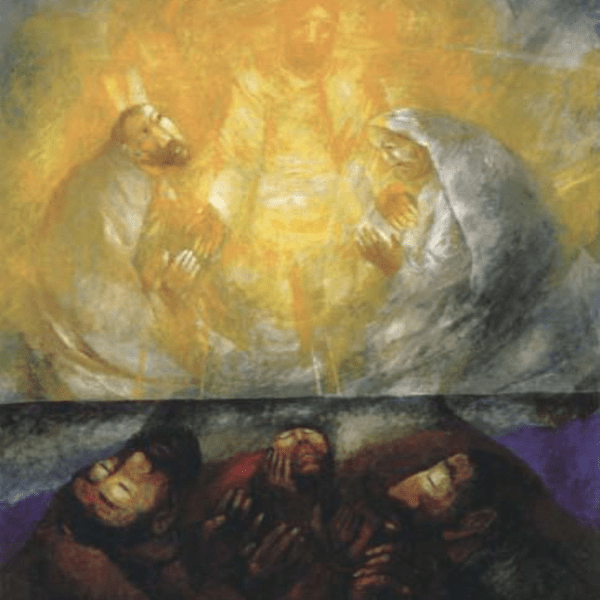
Transfiguration by Sieger Köder (1925-2015)

After six days Jesus took with him Peter, James and John the brother of James, and led them up a high mountain by themselves. There he was transfigured before them. His face shone like the sun, and his clothes became as white as the light. Just then there appeared before them Moses and Elijah, talking with Jesus.

Peter said to Jesus, “Lord, it is good for us to be here. If you wish, I will put up three shelters—one for you, one for Moses and one for Elijah.”

While he was still speaking, a bright cloud covered them, and a voice from the cloud said, “This is my Son, whom I love; with him I am well pleased. Listen to him!”

When the disciples heard this, they fell facedown to the ground, terrified. But Jesus came and touched them. “Get up,” he said. “Don’t be afraid.” When they looked up, they saw no one except Jesus.

As they were coming down the mountain, Jesus instructed them, “Don’t tell anyone what you have seen, until the Son of Man has been raised from the dead.” (New International Version)

Fear is a universal feeling and experience. None of us has to work at being afraid – but we all have to work at being brave and having the courage to face our fears.

Sometimes, we adults teach children not to fear because we assume they are afraid of the dark, high places, and monsters in the closet. But I tend to think a lot of our own adult fear is projected on kids. Why? Because some of the bravest folks I have ever known are children. 

Kids don’t understand near as much as we adults do, yet they conquer their fears every day by facing the world with courage. If you were to go to any children’s hospital today, I believe you would be amazed at the kind of courage you would find amongst kids. We adults have a whole lot to learn about being brave because we have become far too sophisticated in hiding our fears and avoiding courage.

This is why the most repeated exhortation is all of Holy Scripture is to not be afraid. We need courage to live the way God wants. Every day is a fresh opportunity to practice courage.

We need the courage to stand alone

Korah son of Izhar, the son of Kohath, the son of Levi, and certain Reubenites—Dathan and Abiram, sons of Eliab, and On son of Peleth—became insolent,and rose up against Moses. With them were 250 Israelite men, well-known community leaders who had been appointed members of the council. They came as a group to oppose Moses and Aaron and said to them, “You have gone too far! The whole community is holy, every one of them, and the Lord is with them. Why then do you set yourselves above the Lord’s assembly?” (Numbers 16:1-3, NIV)

When Moses heard this, he responded with prayer to God – because he clearly understood that this was all a big power play by Korah, who got others stirred up to take action against him. 

Moses stood alone. Out of the millions of Israelites, not one single person stood with Moses. To be sure, the majority of Israelites did not side with Korah; but neither did they come and stand with Moses. Why? They were too afraid to be involved and took the posture of bystanders. 

God did a miraculous thing, never done before or since, by opening up the ground and having the earth swallow Korah and his followers. The Lord wasn’t only upset with Korah; God was also angry with the people for fearfully standing in the safety of numbers and doing nothing. In fact, God was so mad that he was ready to wipe them all off the face of the earth. But, yet again, Moses, in humility, prayed and pleaded with God to spare them – and God did.

There will always be someone opposing you when you are just trying to obey God and do the right thing. And there will always be a crowd of people who do not want to be involved because they are afraid.

The church everywhere needs to be what Jesus wants it to be, and not what a particular person or group of people want it to be. Courageous people need to stand up to people who want positions of power in order to lead in self-serving ways.

We need the courage to love people

Now while he was in Jerusalem at the Passover Festival, many people saw the signs he was performing and believed in his name. But Jesus would not entrust himself to them, for he knew all people. He did not need any testimony about mankind, for he knew what was in each person. (John 2:23-25, NIV)

Jesus did not get carried away with his own press. Whether people responded to him by the hundreds, or whether they refused him altogether and tried to throw him off a cliff, Jesus was consistently the same. He did not need people’s responsive affirmation in order to do his mission on earth. Christ loved people just because he wanted to, and not because he was trying to get them to love him in return, like insecure and fearful people do.

We need the courage to love the unlovely. And we must understand that perfect love casts out fear.

“We should not only love our brothers and sisters, but also not consider ourselves better than them. Instead, we should show compassion and acceptance to others. We want to have others strictly reprimanded for their offenses, but we will not be reprimanded ourselves. We are inclined to think the other person has too much freedom, but we ourselves will not put up with any restraint to our freedom. There must be rules for everyone else, but we must be given free rein. It is seldom that we consider our neighbor equally with ourselves. If everyone was perfect, what would we have to endure for the love of God?… for we cannot live in this world without adversity. Those who can suffer well will enjoy the most peace, for such persons are brave, courageous, not afraid of pain, have Christ as their friend, and heaven as their reward.”

Thomas à Kempis, The Imitation of Christ, c.1425, C.E.

It is no test of virtue to be on good terms with easy-going people. And, of course, all of us want to live in peace and prefer those who agree with us. Yet, in this mortal life, our peace consists in the humble bearing of suffering and contradictions, not in being free of them.

We need the courage to please God

The devil took him to a very high mountain and showed him all the kingdoms of the world and their splendor. “All this I will give you,” he said, “if you will bow down and worship me.” Jesus said to him, “Away from me, Satan! For it is written: ‘Worship the Lord your God, and serve him only.’” (Matthew 4:8-10, NIV)

Jesus is our model of courage. He sought to please the Father, and not anyone else. Jesus bravely resisted becoming someone other than he was called to be. 

On the Mount of Transfiguration, Jesus courageously refused to remain on the mountain, instead choosing to go into the valley and undertake a new and risky ministry. 

Christ fearlessly came to this earth in the incarnation and resisted the comfort of security. He valiantly confronted sin, overturned the money-changers’ tables, and did his Father’s will, instead of shrinking in fear about what people would think. 

Jesus heroically faced crucifixion, even though he was terribly stressed about it, in order to offer forgiveness in the face of persecution. Jesus gallantly said “No!” to the power of sin by rising from death. And he boldly ascended to heaven and confidently passed the work of ministry to a motley group of people who did not show any promise to carry the mantle of his teaching.

The Son found his identity in relation to the Father. For us to please God, we need the courage to play to an audience of One. 

If we need other people’s acceptance and approval in order to do anything, then we will never have the courage to act for God. 

We must live by conviction, and not by sticking our finger to the wind to see which way popular opinion is blowing.

Conclusion

History is filled with men and women who said “no” to destructive fear and changed the world. But imagine if they had succumbed to the paralyzing effects of fear in their lives. Imagine if…

The Apostle Paul, fearing resistance or rejection, chose to stay home rather than embarking on the missionary journeys that took the message of Christ throughout the known world.

Martin Luther King Jr. gave speeches filled with gentle hints about the evils of segregation, because he feared pushing too hard.

Jackie Robinson refused to enter major league baseball so as to not rock the boat; or Branch Rickey, the owner of the Brooklyn Dodgers, just going with the way baseball had always operated. But neither of them went that way. In the film, “42,” Robinson asks Rickey:

“You want a player that doesn’t have the guts to fight back?” “No. No.” replies Rickey. “I want a player who has the guts not to fight back. People aren’t going to like this. They’re going to do anything to get you to react. Follow a curse with a curse and they’ll hear only yours. Follow a blow with a blow and they’ll say the Negro lost his temper; that the Negro does not belong. Your enemy will be out in force and you cannot meet him on his own low ground. We win with hitting, running, fielding—only that. We win only if the world is convinced of two things: That you are a fine gentleman, and a great ball player. Like our Savior, you’ve got to have the guts to turn the other cheek. Can you do it?”  Robinson replies, “You give me a uniform; you give me a number on my back; and I’ll give you the guts.”

42 (2013 film)

Now imagine yourself, fully aware of the mission and vision God has placed in your heart to advance his gracious and benevolent rule in this world – and yet there is also present all the phobias, irrational worries, and destructive fears of failure, harm, or rejection. So I ask:

If you don’t fulfill the mission God assigned to you, who will?

Luke 8:22-25 – Where Is Your Faith?

One day Jesus said to his disciples, “Let us go over to the other side of the lake.” So, they got into a boat and set out. As they sailed, he fell asleep. A squall came down on the lake, so that the boat was being swamped, and they were in great danger.

The disciples went and woke him, saying, “Master, Master, we’re going to drown!”

He got up and rebuked the wind and the raging waters; the storm subsided, and all was calm. “Where is your faith?” he asked his disciples.

In fear and amazement, they asked one another, “Who is this? He commands even the winds and the water, and they obey him.” (New International Version)

“I’m not afraid of storms, for I’m learning how to sail my ship.”

Louisa May Alcott

The opposite of faith isn’t little to no faith – it’s fear.

Fear, at its core, is being afraid of getting hurt. Fear is an emotion which alerts us to some danger that may break my heart or my body.

Being afraid, in and of itself, is neither good nor bad. It’s more about why fear bubbles up for us.

So, what makes you afraid? Why? How does fear influence your life?

Fear is often at the root of unhealthy behaviors such as:

  • Vilifying another, afraid that others I don’t know or who are different from me might harm me, my family, or my community.
  • Hiding my emotions, afraid my weaknesses or failures will be exposed or exploited.
  • Serving others, afraid that I won’t have worth, meaning, or purpose without helping.
  • Achieving or winning, afraid that I will be irrelevant or unwanted.
  • Smiling and being upbeat, afraid of facing and feeling the deep sadness within me.
  • Procrastinating projects, tasks, or conversations, afraid of being disliked or rejected.

Today’s Gospel story has Jesus at the center of the storm. The wind and the waves, the storm, is not the central element of the story. Jesus is. And that’s an important distinction, because whenever we put outside circumstances as the central elements of our own stories, anxious fear is the inevitable result.

“Fear keeps us focused on the past or worried about the future. If we can acknowledge our fear, we can realize that right now we are okay.”

Thich Nhat Hanh

The disciples were surprised that even the wind and the waves obey him! They were afraid because of the furious storm. Yet, Jesus was sleeping, not the least bit fearful. The disciples woke him, and in shallow breathed words of anxiety stated they all were going to drown because of the extreme conditions.

In my mind’s eye, I imagine Jesus slowly awaking and lazily rising from his slumber, simply rebuking the wind and waves, with neither any anxiety nor any hurry, and then chiding the disciples for their inability to place their faith in him.

Jesus Calms the Storm by the Benedictine Sisters of Turvey Abbey

The disciples’ expectations of and faith in Jesus were way too low! That’s what fear does. It diminishes faith. Like Chicken Little, who thought the sky was falling and all was ruined, we become chickens of little faith.

Many people believe God hears and answers prayer. Yet sometimes, our faith can be so small that, when God answers those prayers in ways far superior to our expectations, we are slack-jawed and astonished by it. Luke’s Gospel records several instances of people being surprised by Jesus: 

Everyone who heard him was amazed at his understanding and his answers. (Luke 2:47, NIV)

They were astounded at his teaching because he spoke with authority. In the synagogue there was a man who had the spirit of an unclean demon, and he cried out with a loud voice, “Leave us alone! What have you to do with us, Jesus of Nazareth? Have you come to destroy us? I know who you are, the Holy One of God.” But Jesus rebuked him, saying, “Be quiet and come out of him!”

Then the demon, throwing the man down before them, came out of him without doing him any harm. They were all astounded and kept saying to one another, “What kind of word is this, that with authority and power he commands the unclean spirits and they come out?” (Luke 4:32-36, NRSV)

I want you to know that the Son of Man has authority on earth to forgive sins.” Then he said to the paralyzed man, “Get up, pick up your stretcher, and go home.”

The man immediately stood up in front of them and picked up the stretcher he had been lying on. Praising God, he went home.

Everyone was amazed and praised God. They were filled with awe and said, “We’ve seen things today we can hardly believe!” (Luke 5:24-26, GW)

Jesus was driving out a demon that could not talk; and when the demon went out, the man began to talk. The crowds were amazed. (Luke 11:14, GNT)

Jesus is more marvelous, wonderful, powerful, and awesome than we know. Jesus will take care of us; he will not let his people be destroyed. And, what’s more, he has the power and authority to heal us.

Whenever we truly grasp who Jesus is, and how much he loves us, there is no room for fear, only faith. 

Even though the disciples’ faith was small, Jesus still responded to it with grace because even small faith is faith. Grace is undeserved help. Our Lord helps anyone who approaches him, whether with little faith or big. Our small faith is no obstacle for Jesus in delivering us from the storms of life.

You might be presently experiencing a violent storm in your life. Please know that Jesus can bring peace.

Perhaps you have a besetting sin that dogs you every day. Jesus can deliver you.

It could be that depression follows you like a lost kitten wherever you go. Jesus can bring new life and fresh joy to your life.

Maybe there is an estranged relationship you have lost hope over. Jesus can restore it.

Perchance you think your neighbor, co-worker, or family member is too far from God to ever know Jesus. By now you know the response….

Ethiopian Orthodox Church depiction of Jesus calming the storm

Our expectations of Jesus are much too small! We can pray big prayers because we serve a big and powerful God who has the authority to command even the wind and the waves!

The Gospel of Mark portrays Jesus as the ultimate authority over everything, including powerful storms. Christ uses that authority to bestow grace, even in the face of the smallest of faith in his followers. Jesus cares about people and seeks to deliver them from the dominion of darkness.  

So, may we participate with Jesus in his agenda for this world.

May we submit to his rule and authority.

May we exhibit the same care, compassion, and concern for people as Jesus does.

May we find our faith, especially amidst the worst of situations.

Lord Jesus, Son of God, I believe all things are possible through you; help my unbelief! Take my small and seemingly insignificant faith and use it to calm the storms in my life and demonstrate your authority even over the wind and the waves. Amen.

John 11:45-57 – Gripped by Worry and Fear

Many of the Jews who had come to visit Mary [the sister of Lazarus] and had seen what Jesus did [raised Lazarus from death] believed in him. But some of them went to the Pharisees and told them what Jesus had done. Then the chief priests and the Pharisees called a meeting of the Sanhedrin.

“What are we accomplishing?” they asked. “Here is this man performing many signs. If we let him go on like this, everyone will believe in him, and then the Romans will come and take away both our temple and our nation.”

Then one of them, named Caiaphas, who was high priest that year, spoke up, “You know nothing at all! You do not realize that it is better for you that one man die for the people than that the whole nation perish.”

He did not say this on his own, but as high priest that year he prophesied that Jesus would die for the Jewish nation, and not only for that nation but also for the scattered children of God, to bring them together and make them one. So, from that day on they plotted to take his life.

Therefore, Jesus no longer moved about publicly among the people of Judea. Instead, he withdrew to a region near the wilderness, to a village called Ephraim, where he stayed with his disciples.

When it was almost time for the Jewish Passover, many went up from the country to Jerusalem for their ceremonial cleansing before the Passover. They kept looking for Jesus, and as they stood in the temple courts they asked one another, “What do you think? Isn’t he coming to the festival at all?” But the chief priests and the Pharisees had given orders that anyone who found out where Jesus was should report it so that they might arrest him. (New International Version)

Helping others, Christian ministry, and compassionate service can be risky business. Just ask Jesus.

The Jewish ruling council (Sanhedrin) was deeply disturbed by all the hubbub Jesus was stirring. Rather than celebrating the healing of many people in both body and soul, the rulers were anxious, worried, and afraid. They feared the worst: All the attention might rile the Roman occupation of the land. Then, they will obliterate both temple and nation.

“Fear is the path to the Dark Side. Fear leads to anger, anger leads to hate, hate leads to suffering.”

Yoda

Wherever you find a group of folks living in continual fear that something awful is going to happen, there you will find a strict code of conformity and no allowances for difference. After all, rocking the boat only draws attention. Fear dictates that if anything, or anyone, deviates from established protocol, the entire religious system and even its people will be destroyed.

Jesus was anything but a conformist to the status quo. He frequently operated outside of established religious norms. Thus, Christ was viewed by many religious leaders as a loose cannon that was making too much noise and needed to be silenced before something terrible happened.

One of the problems with living in the fearful worry of what horrible thing may occur is that we play an ignorant game of prognostication. We simply do not know the future. We can predict. We can become full-time pundits, opining about what’s going to happen. Yet, when all is said and done, the future is not ours to see. Only God is privy to standing above time and space.

Any institution whose chief focus is keeping everyone in line out of a fear of losing influence, power, privilege, money, devotion, buildings, or people will likely experience a self-fulfilled prophecy of doom. Therefore, it is necessary we define our ministries, services, and actions by who we are and not by what we don’t do.

“The enemy is fear. We think it is hate; but it is fear.”

Gandhi

Today’s Gospel lesson chronicles the forward progress of Jesus to his ultimate suffering and death. Within the Gospel of John, there are two streams running parallel to one another. There is a group who observes Jesus, listens to his teaching, sees his miraculous works, and believes in him.  Alongside them is another group who experiences all the same events and hears all the same words of Jesus – yet responds in a different manner by plotting how Jesus might be arrested and killed.

Fear can take such a tight hold within an organization that premeditated murder is executed without any moral misgivings.

Worry can worm its way so deeply into a group that verbal assassinations seem both justified and necessary.

Anxiety can overwhelm an institution to such a degree that rationalizations for unethical behavior are rife. People cease to be looked at as people. They are referred to as threats, demonized as monsters who are trying to take away a way of life.

Caiaphas, the high priest, spoke to his fellow religious leaders, perhaps without even knowing the truth and deep import of his prophetic words: “You know nothing at all.  Nor do you understand that it is better for you that one man should die for the people, not that the whole nation should perish.” Indeed, not only did Jesus die for the nation of Israel, but on behalf of all nations, and all people. 

The implications of Christ’s death are magnanimous. The extent of his atonement for the people includes redemption from the bondage of sin; reconciliation between us and God; satisfaction of God’s wrath against the sin of the world; and victory over demons, death, and hell.

With all this incredible work of restoration and renewal, fear and worry take a back seat. Courage and confidence take the wheel.

Merciful Jesus, you are my guide, the joy of my heart, the author of my hope, and the object of my love. I come seeking refreshment and peace. Show me your mercy, relieve my fears and anxieties, and grant me a quiet mind and an expectant heart, that by the assurance of your presence, I may learn to abide in you, my Lord and my God. Amen.