How You Are Matters (Ruth 4:13-17)

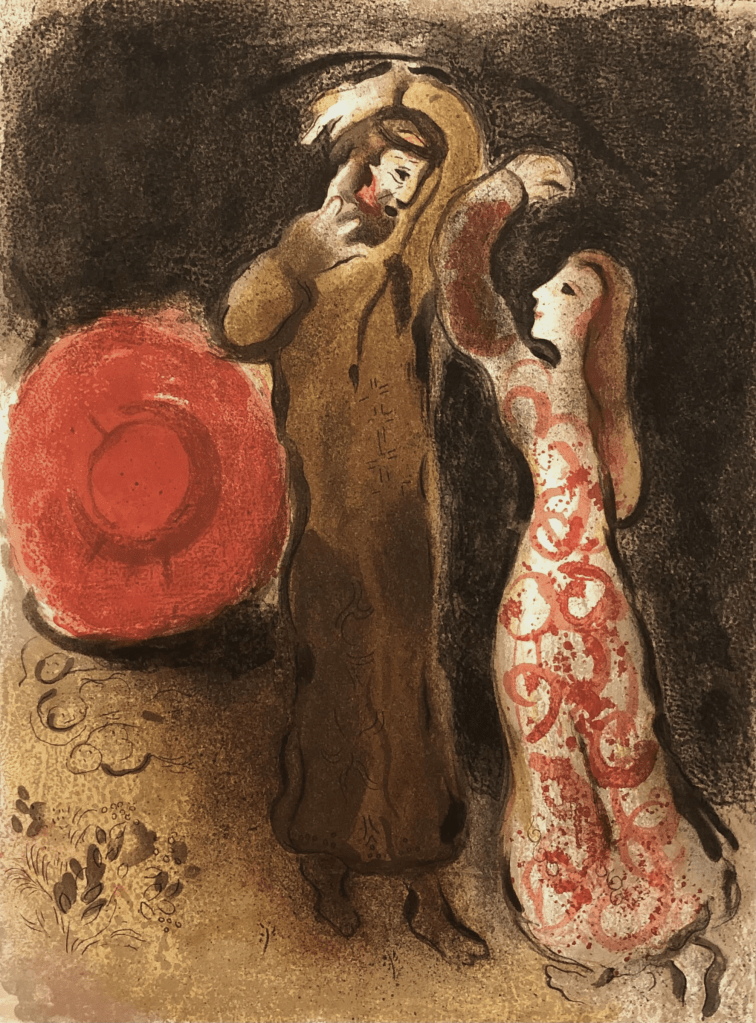
The Meeting of Ruth and Boaz by Marc Chagall, 1960

So Boaz took Ruth home as his wife. The Lord blessed her, and she became pregnant and had a son. The women said to Naomi, “Praise the Lord! He has given you a grandson today to take care of you. May the boy become famous in Israel! Your daughter-in-law loves you and has done more for you than seven sons. And now she has given you a grandson, who will bring new life to you and give you security in your old age.” Naomi took the child, held him close, and took care of him.

The women of the neighborhood named the boy Obed. They told everyone, “A son has been born to Naomi!”

Obed became the father of Jesse, who was the father of David. (Good News Translation)

Your Commitment Matters

Ruth, although not a Jew, committed herself fully to her Jewish mother-in-law and to the Jewish people. Her faithfulness mattered and eventually realized the blessing of family and community.

It wasn’t an easy path for Ruth to enjoy such blessing. She and her mother-in-law, Naomi, came to Bethlehem as two poor widows. Even though Bethlehem today is known around the world, back then there wasn’t much to it – just a small non-descript village in Judah a few miles south of Jerusalem.

Your History Matters

The Bible contains a lot of genealogies. Bible readers often skip over those portions of Holy Scripture to get to the more meaty and interesting stuff. But there’s a lot there.

Genealogies serve to remind us of who we are, where we have come from, and thus, what direction we are headed. Each and every human life has an historical context, a past which informs the present and can help guide for the future.

Naomi had a long history as part of the Jewish community. Ruth was a Moabite. Moab was an ancient kingdom which was located in the present day nation of Jordan. The original ancestor of the Moabites was Moab, a son of Lot. Lot was a nephew of the Jewish patriarch Abraham.

Moabites and Israelites didn’t get along. Moab had their own god, Chemosh, and did not serve Israel’s Yahweh. The person, Moab, was conceived under difficult and dubious circumstances – and it seems this context set the tone for the entire nation of people. (Genesis 19:30-38)

Our genealogical histories can bog us down or they can inspire us. Yet, the unseemly parts of our past family can actually serve to reveal something wonderful.

Your Receiving of Grace Matters

All genealogies are filled with less than stellar characters. But they’re also testaments to grace.

Both Ruth and her husband Boaz were recipients of the Lord’s grace.

Boaz, having a long history of the covenant as a Jew, nonetheless also had a difficult family past. Much like the conception of the ancient character of Moab, one of the ancestors of Boaz, Tamar, and one of the Jewish patriarchs, Judah, had a rather twisted experience. (Genesis 38:1-30)

Both Boaz and Ruth became great grandparents to King David. And they both are listed together in the opening genealogy of Matthew’s Gospel as ancestors to Jesus the Messiah, known as the son of David.

Grace changes history. If Jesus can have a genealogy, much like us, filled with both faithful committed people and dubious characters, then I believe we can give ourselves, and each other, a bit of slack on our shared human condition.

Your Spiritual Family Matters

For the Christian, there is an historical continuity across the millennia with our ancient spiritual forebears. The drama of redemption unveiled throughout the whole of Scripture connects us with Father Abraham, to the deliverance out of Egyptian slavery, to the saving events of Christ’s life, death, resurrection, and ascension, and beyond into the union of Christ and the Church.

A Moabite widow is redeemed into a new community. She marries a Jewish man and conceives a child in grace, born in the humble village of Bethlehem. Centuries later, another woman, Mary, experiences a conception of grace and gives birth to a child in the very same place – Christ the Lord, our Immanuel, God with us.

Jesus was born of David’s genealogical line, from ordinary people, just like Ruth and Boaz. Because it is only from humility that greatness can arise.

Your Faith Matters

Your faith and my faith grows in the context of an ordinary life. We live and move and have our being within the grace and providential care of God. Our faith is rooted in the soil of grace, anchored and moored in the deep of faithful servants who have gone before us.

Like Ruth, we humbly attach ourselves to a larger community and seek to give ourselves for the life of the world. Like Mary, we willingly confess to the angelic messenger:

“I am the Lord’s servant. May your word to me be fulfilled.” (Luke 1:38)

Our Father in heaven, you hold all that you have made within your gracious and merciful hand. Help us in all things to see your loving providence working out a good plan for the earth. Just as Ruth from Moab became one of your people, so you call us by name and hospitably invite us to your Table.

In Jesus Christ, our Redeemer, you meet us in the ordinary routines of our lives. You have graciously taken our pains, fears, sorrows, bitterness, guilt, shame, and sins upon yourself and given us a new life and a new community.Turn our suffering to glory, and our tears into joy.

Holy Spirit, giver of life, you guide us into grace and truth through generous love. As Boaz went out of his way to provide abundance for a poor widow, let us be generous with both our speech and our actions. Teach us to be alert to the needs of others so that everyone may have their daily bread.

Blessed Holy Trinity – Father, Son, and Spirit – the God whom we serve, you are our past, present, and future. We give you praise and commit ourselves to the words and ways of Jesus, in whose name we are bold to pray. Amen.

Are You Ready for Advent? (Matthew 24:36-44)

Advent Starry Night #5 by Virginia Wieringa

Jesus said, “But about that [judgment] day or hour no one knows, not even the angels in heaven, nor the Son, but only the Father. As it was in the days of Noah, so it will be at the coming of the Son of Man. For in the days before the flood, people were eating and drinking, marrying and giving in marriage, up to the day Noah entered the ark; and they knew nothing about what would happen until the flood came and took them all away. That is how it will be at the coming of the Son of Man. Two men will be in the field; one will be taken and the other left. Two women will be grinding with a hand mill; one will be taken and the other left.

“Therefore keep watch because you do not know on what day your Lord will come. But understand this: If the owner of the house had known at what time of night the thief was coming, he would have kept watch and would not have let his house be broken into. So you also must be ready, because the Son of Man will come at an hour when you do not expect him. (New International Version)

The best way of observing the first advent of Christ, his incarnation, is by preparing ourselves for his second advent, his return to the earth.

Just because there is sun today doesn’t mean everyday will be that way. The storm clouds are gathering; the Day of the Lord is at hand. Will you be ready?

Satan once called to him some demons of hell and said he wanted to send one of them to earth to aid women and men in the ruination of their souls. He asked which one would want to go.

One creature came forward and said, “I will go.” Satan said, “If I send you, what will you tell the children of men?” He said, “I will tell the children of men that there is no heaven.” Satan said, “They will not believe you, for there is a bit of heaven in every human heart. In the end everyone knows that right and good must have the victory. You may not go.” 

Then another came forward, darker and fouler than the first. Satan said, “If I send you, what will you tell the children of men?” He said, “I will tell them there is no hell.” Satan looked at him and said, “Oh, no; they will not believe you, for in every human heart there’s a thing called conscience, an inner voice which testifies to the truth that not only will good be triumphant, but that evil will be defeated. You may not go.” 

Then one last creature came forward, this one from the darkest place of all. Satan said to him, “And if I send you, what will you say to women and men to aid them in the destruction of their souls?” He said, “I will tell them there is no hurry.” Satan said, “Go!” (C.S. Lewis, The Screwtape Letters)

Most people’s crime in not some gross sin, but indifference, without much thought to a coming judgment. It seems we are all spiritual procrastinators. Why do today what we can put off till tomorrow? 

But the spiritually indifferent won’t know what hit them. 

So we need to be deeply concerned for the coming Day of the Lord, which may be very soon. 

The question for us is not, “When will Christ return?” Rather, the question is, “Are you ready for Christ’s return?” We must:

  • Keep watch, stay alert, and be ready, like a watchman on an ancient city wall scanning the horizon for an advancing army.
  • Remain vigilant and not forget that Jesus is coming again. 
  • Live every moment of our lives in light of the promise of Christ’s return. 
  • Be busy (not busybodies) because we don’t know the day of Christ’s second advent.

What does it mean to keep watch, be ready, and stay alert? 

In between these two advents of Christ, believers are to bear witness to a world going about their merry way unaware of the judgment that is about to overtake them. Like Noah, we actively build the ark of the church instead of living as if Jesus weren’t coming.

Noah was a preacher of righteousness in both word and deed, building an ark in a place and around a people who had never seen rain. What’s more, constructing the massive ark took a solid one-hundred years. This was no easy feat.

Like Noah, we must plug away and be faithful stewards, doing the tedious and patient work given to us. We aren’t supposed to be like the irresponsible teenager who, when given the responsibility of watching over the house while the parents are gone for the weekend, throws a big party and trashes the place. The parents will come home at a time that the teenager does not expect, and then there will certainly be weeping and gnashing of teeth. 

When the Lord returns, we don’t know who will be taken and who will be left. Two different people might look the same on the outside, doing the same work, but each of those persons working side by side can really be very different on the inside. So, let us be patient as we await the coming of Christ and avoid losing sight of what is truly important.

One day a man named Denis Waitley was trying to catch a flight but running late. So he literally ran through the airport terminal and got to the gate the split second the flight attendant closed the door. Denis explained his situation, that he had a speaking engagement and needed to be on that flight, but the attendant didn’t budge. 

Denis stormed out of the boarding area and back to the ticket counter to register a complaint and reschedule his flight. His anger intensified as he waited for more than twenty minutes in a line that barely moved. Just before he got to the counter an announcement over the intercom changed his life. 

The plane he missed getting on, Flight 191 from Chicago to Los Angeles, crashed on takeoff and killed every person on board the plane. Denis Waitley never registered his complaint. In fact, he never returned his invalidated ticket.

He took the ticket home and pinned it on a bulletin board in his office to remind him whenever he got frustrated or upset that life is more than day to day impatience and worry and complaints. It’s about serving a lost world destined to slide away from God apart from the grace that can turn judgment into blessing.

It could be today. Every day we must live with the reality that Christ’s return is imminent. Until that happens, we are to be faithful servants of God by serving a world that is tremendous need of getting on the ark and being saved from the judgment that will come. 

Almighty God, give us grace to cast away the works of darkness, and put on the armor of light, now in the time of this mortal life in which your Son Jesus Christ came to visit us in great humility; that in the last day, when he shall come again in his glorious majesty to judge both the living and the dead, we may rise to the life immortal; through him who lives and reigns with you and the Holy Spirit, one God, now and forever. Amen.

A Parable about Faithfulness (Luke 19:11-27)

Parable of the Ten Minas, by Dutch painter Willem de Poorter (1608-1668)

The crowd was listening to everything Jesus said. And because he was nearing Jerusalem, he told them a story to correct the impression that the Kingdom of God would begin right away. 

He said, “A nobleman was called away to a distant empire to be crowned king and then return. Before he left, he called together ten of his servants and divided among them ten pounds of silver, saying, ‘Invest this for me while I am gone.’ But his people hated him and sent a delegation after him to say, ‘We do not want him to be our king.’

“After he was crowned king, he returned and called in the servants to whom he had given the money. He wanted to find out what their profits were. The first servant reported, ‘Master, I invested your money and made ten times the original amount!’

“‘Well done!’ the king exclaimed. ‘You are a good servant. You have been faithful with the little I entrusted to you, so you will be governor of ten cities as your reward.’

“The next servant reported, ‘Master, I invested your money and made five times the original amount.’

“‘Well done!’ the king said. ‘You will be governor over five cities.’

“But the third servant brought back only the original amount of money and said, ‘Master, I hid your money and kept it safe. I was afraid because you are a hard man to deal with, taking what isn’t yours and harvesting crops you didn’t plant.’

“‘You wicked servant!’ the king roared. ‘Your own words condemn you. If you knew that I’m a hard man who takes what isn’t mine and harvests crops I didn’t plant, why didn’t you deposit my money in the bank? At least I could have gotten some interest on it.’

“Then, turning to the others standing nearby, the king ordered, ‘Take the money from this servant, and give it to the one who has ten pounds.’

“‘But, master,’ they said, ‘he already has ten pounds!’

“‘Yes,’ the king replied, ‘and to those who use well what they are given, even more will be given. But from those who do nothing, even what little they have will be taken away. And as for these enemies of mine who didn’t want me to be their king—bring them in and execute them right here in front of me.’” (New Living Translation)

The great humanitarian issues of this world are not only individual concerns but are also systemic problems.

And the majority of those troubles are us climbing the wrong ladder. It’s a booger to get to the top and find out all that energy was expended for a worthless chamber pot full of $%&!.

So, whenever we examine Holy Scripture, especially the words of Jesus, it’s necessary to pay attention and hear both the responsibility of individuals and the accountability which human culture has to ensure a just society and equitable structural systems.

In other words, evil resides in both the individual human heart and in the world’s operating system. Corporations, communities, and churches not only have sinful persons within them; sin also resides in the very ways we about business, interactions, even worship.

Westerners tend to read a story, like today’s Gospel parable from Jesus, with individualist eyes. Yes, it is about individual servants; and it’s also about community and culture – and ultimately about the kingdom of God.

The cost of Christian discipleship is high, demanding both personal and communal faithfulness to Jesus Christ.

Christianity is concerned for all of life – not just the religious parts but all the parts – both body and soul, personal and communal, church and workplace, individual minds and institutional education, healthy emotional selves and healthy public discourse. It all matters to God.

Whoever’s in charge makes a big difference as to whether right and just systems are followed, or whether corrupt and oppressive operations are the chief mode of ruling.

To illustrate the contrast, Jesus told a parable about systemic evil and whether one will be faithful to that or some other way of operating.

In the parable, the nobleman becoming the king is a reference to an earthly ruler, not Jesus. Before this worldly prince takes off to obtain more authority, he summons ten of his servants and gives them each ten pounds, or coins.

As the sort of person who rules in standard worldly ways, the nobleman fully expects the servants to operate just as he himself would: collect unfair taxes, squeeze the poor of what little they have, and generally do whatever it takes to make a profit. This, of course, is why the story tells us that the general populace hate the guy in charge.

Parable of the Ten Minas, by Unknown 16th century artist

This is not a parable about rejecting the Messiah or God; it is about authority and government, economics and politics, systemic oppression and structural evil. It’s about where our faith and commitment is truly placed.

The ruler is quite pleased when the first and second servants faithfully invest in the politics and economics of his worldly kingdom. So, the servants are rewarded for abiding by the system.

However, if you buck the system, like the third servant did, you’ll get condemned. That servant knew the sort of ruler he was dealing with and the kind of cutthroat system which was in place. And he wanted nothing to do with it.

The third servant in the parable is unfaithful to the unjust ruler and oppressive system because he is faithful to another lord with a different kind of system. This servant was prepared to accept the consequences of his convictions and his inaction. In a way, he was practicing civil disobedience.

As servants under God’s rule and reign, we are not to play along with worldly systems of injustice and oppression. If we want to be faithful Christian disciples, then we must live into the words and ways of Jesus; we must be prepared to pay the price for our commitment to an alternative kingdom.

Everyone has faith. It’s just a matter of whom and what we place that faith in.

Perhaps Jesus had the words of his mother, Mary, in his mind when he told the story. She was willing to accept whatever happens in a complete commitment and faith in God:

“Here am I, the servant of the Lord; let it be with me according to your word.” (Luke 1:38, NRSV)

Jesus was unlike any earthly ruler. Christ operated very differently than any worldly government. He and his teaching were in stark contrast to others:

God will bless you people
who are poor.
    His kingdom belongs to you!

God will bless
    you hungry people.
You will have plenty
    to eat!
God will bless you people
who are now crying.
    You will laugh!

God will bless you when others hate you and won’t have anything to do with you. God will bless you when people insult you and say cruel things about you, all because you are a follower of the Son of Man…. So when this happens to you, be happy and jump for joy! You will have a great reward in heaven.

But you rich people
    are in for trouble.
You have already had
    an easy life!

You well-fed people
are in for trouble.
    You will go hungry!
You people
who are laughing now
    are in for trouble.
You are going to cry
    and weep!

You are in for trouble when everyone says good things about you. (Luke 6:20-26, CEV)

In order to embrace Christian ethics, worldly practices have got to be jettisoned. To make room for the good, the just, and the right, we must let go of any and all ways contrary to our Christian commitment of following Jesus.

Are you willing to be the third servant?

Gracious and sovereign Lord God of all, in your mercy, hear our prayers:

Help us to be understanding and forgiving of all those we encounter.

Show us how to serve one another, to offer love, care and support.

Guide all those who are called to lead and advocate in the world.

Inspire our leaders, teachers, doctors, social workers and counsellors to be bringers of hope in all situations.

Protect all those who carry peace to other nations. Bless the food, care and shelter they provide.

Comfort those who live with grief. Help them see the light of heaven.

Heal all the broken-hearted and those with broken bodies and spirits.

Embrace those in pain and physical suffering. May they feel your abiding and close presence.

Watch over all who feel isolated and alone. Calm their fears and lead them into peace and freedom.

Strengthen and encourage all those who seek to serve and protect the vulnerable.

Lead us to be generous with our time, possessions and money.

Lord, in your mercy, hear our prayers, and answer them according to your good grace and in your good time. Amen.

All Saints Day (Psalm 149)

All Saints Day I, Wassily Kandinsky, 1911

Praise the Lord!

Sing a new song to the Lord;
    sing his praise in the meeting of his people.

Let the Israelites be happy because of God, their Maker.
    Let the people of Jerusalem rejoice because of their King.
They should praise him with dancing.
    They should sing praises to him with tambourines and harps.
The Lord is pleased with his people;
    he saves the humble.
Let those who worship him rejoice in his glory.
    Let them sing for joy even in bed!

Let them shout his praise
    with their two-edged swords in their hands.
They will punish the nations
    and defeat the people.
They will put those kings in chains
    and those important men in iron bands.
They will punish them as God has written.
    God is honored by all who worship him.

Praise the Lord! (New Century Version)

Most of us are aware and in touch with how imperfect we are. Sometimes we view our imperfections as failure, weakness, or sin. But how does God see us? In what way does the eternally perfect, infinitely strong, and sovereign Lord feel about us?

The Lord is happy with his people, he is pleased with us. And because God is delighted with people, the Lord saves the humble in heart, beautifies the unlovely, and turns the sinner into a saint.

Throughout the ages, the faithful have experienced the love of God. Even now, they are rejoicing, singing for joy, and celebrating the ways God changed them to make the world a better place.

On the Christian Calendar, November 1 is the day each year to remember the saints who have gone before us, to acknowledge that God has always taken pleasure in using imperfect broken people to impact the world.  

Today is meant to be a day of remembrance – a way of not forgetting the people, friends, and family, as well as the long-dead historical saints, who have made a significant difference in our spiritual lives.

All Saints Day is more than simply acknowledging extraordinary persons; today also highlights the work of ordinary Christians who faithfully lived their lives and persevered to the end. We give thanks for the gift of how they daily lived their faith.

We remember today that:

  • Christians everywhere and throughout time are united and connected to one another.
  • God’s good pleasure saves and redeems all sorts of people.
  • Underprivileged and underserved people are noticed by God and God’s saints.
  • Influential people in our lives, now in the presence of the Lord, can be honored through emulating their faith and perseverance.

“Remember your leaders, who spoke the word of God to you.  Consider the outcome of their way of life and imitate their faith.” (Hebrews 13:7, NIV)

The saints of the past are an inspiration to us in the present. They serve us as a model of faithfulness in persevering in our Christian lives. Through biblical stories of very human persons being used of God, as well as reading biographies of godly people who were dedicated to God in service, we gain motivation and patience until Jesus returns.

All Saints Day II, by Kandinsky, 1911

Who went out of their way to communicate God’s love to you with both words and actions? 

Who wrestled in prayer for you so that you and others might know God? 

If any of those persons are still around, and you know where they are, remember them. Drop them a note. Express to them a simple thank you for their influence in your life. You will not only encourage that person – it will help you remember and re-engage with something in your life you may have forgotten or have just taken for granted for too long.

We truly stand on the shoulders of faithful and wise people those who have gone before us. We will continue to persevere and thrive in faith by remembering them; and also by allowing people now, presently with us, to join us in our journey along the road of faith.

It is sage to recall events of rescue and pull them forward into the present so that all God’s worshipers can taste and see that the Lord is good.

Like newborn babies, crave pure spiritual milk, so that by it you may grow up in your salvation, now that you have tasted that the Lord is good. As you come to him, the living Stone—rejected by humans but chosen by God and precious to him—you also, like living stones, are being built into a spiritual house to be a holy priesthood, offering spiritual sacrifices acceptable to God through Jesus Christ. (1 Peter 2:2-5, NIV)

God uses symbols as a means of revelation and remembrance. We need both special days and ordinary events;  shared meals and silent fasting, tangible signs and necessary endings, active rituals and passive observances, iconic images and iconoclastic nonconformity.

We need both words and sacraments – to have days set apart for gathering together and expressing our verbal gratitude and love for each other, as well as giving our nonverbal gifts of food, fun, and friendship.

Our shared spiritual history connects us to God, to one another, and to all of God’s people who have gone before us. We remember that history by energizing our time together with words and symbols of care and redemption.

Christ told the disciples about his upcoming death and provided symbols which reinforced the words: 

“Take and eat – this is my body…. Take this cup – drink from it, all of you.” (Luke 22:7-20)

The taste of real bread reminds us of the physical incarnation of Christ, and Christ’s humiliation and death. Drinking from the tangible cup reminds us of the bodily sacrifice of Christ, the drops of blood which Jesus sweat in Gethsemane, and the beatings, floggings, nails, and crown of thorns that caused the bleeding. Tasting the bread and cup when celebrating communion reminds us that our sins are forgiven, we are united to Christ, and we are united together. 

There are past historical events which are now presently forgotten. Yet, there are also past actions that ripple and linger with continuing results into the present. The incarnation, life, death, resurrection, ascension, and glorification of the Lord Jesus are past redemptive events which continually exert powerful force into the here and now.

The saints throughout church history moved the message of Christ along and demonstrated for us that the past is alive in the person of Jesus Christ. Along with them, we proclaim:

Christ has died, Christ has risen, Christ is coming again.

And God has something planned for those who have gone before us, along with us, so that together we will experience the perfect righteousness of Christ forever. (Hebrews 11:39-40)

Remember and celebrate, eat and drink, taste and see, that the Lord is good.

May we remember the Lord’s people and never forget their example of godly living.

Our spiritual ancestors in faith continue to praise the Lord, to proclaim that God is our refuge and strength, our ever-present help. Let us follow in their footsteps.

Almighty God, you have knit together your elect in one communion and fellowship in the mystical Body of your Son: Give us grace to emulate your saints by living virtuous and godly lives so that we may share the joy you have prepared for those who truly love you, through Jesus Christ our Lord, who with you and the Holy Spirit lives and reigns as one God, in glory everlasting. Amen.