The Blessing (Genesis 17:15-22)

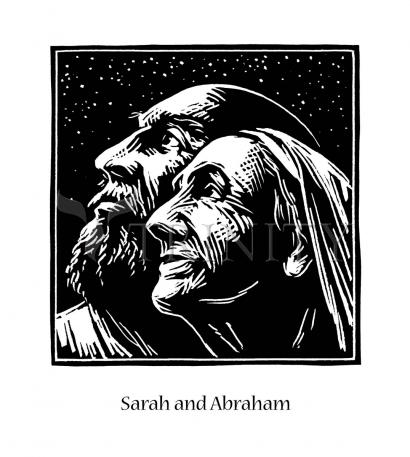
By American artist Julie Lonneman

God said to Abraham, “Don’t call your wife by the name Sarai anymore. Instead, her name is Sarah [Princess]. I will bless her, and I will also give you a son by her. I will bless her, and she will become a mother of nations, and kings will come from her.” Immediately, Abraham bowed with his face touching the ground. He laughed as he thought to himself, “Can a son be born to a hundred-year-old man? Can Sarah, a ninety-year-old woman, have a child?” Then Abraham said to God, “Why not let Ishmael be my heir?”

God replied, “No! Your wife Sarah will give you a son, and you will name him Isaac [He Laughs]. I will make an everlasting promise to him and his descendants. I have heard your request about Ishmael. Yes, I will bless him, make him fertile, and increase the number of his descendants. He will be the father of 12 princes, and I will make him a great nation. But I will make my promise to Isaac. Sarah will give birth to him at this time next year.” When God finished speaking with Abraham, he left him. (God’s Word Translation)

Life can only be lived with faith. We all believe in something, in someone. It’s just a matter of what or whom we place our faith in. Whomever we direct our faith, that is where we give our allegiance and obedience.

As for Abraham and his wife Sarah, they had their faith in the God who called them from Ur of the Chaldees. They demonstrated their belief by doing exactly what the Lord said to do – they went West to the land God would show them. (Genesis 12:1-5)

Abraham and Sarah listened to God and acted accordingly.

I don’t want to cross over into TMI territory (Too Much Information) yet I want us to consider what had to take place when the Lord tells the old couple they will have a baby next year. Here’s where the faith and action comes in: It is highly unlikely that a 100-year-old man and a 90-year-old woman were sexually active. But the Lord essentially told them to get going on conceiving a child. So, they did!

I can’t speak for Abraham and Sarah, but I know as a grandfather that I am really glad I don’t have to raise kids anymore. It makes me exhausted just thinking about it, at my age, so I’ve got to believe it crossed their minds, too. Maybe that’s why Abraham sort of pleaded with God to let Ishmael be the son of promise; the reality of being responsible for a newborn was maybe the last thing on old Abe’s mind.

But faith they had, as the New Testament attests:

Even when Sarah was too old to have children, she had faith that God would do what he had promised, and she had a son. Her husband Abraham was almost dead, but he became the ancestor of many people. In fact, there are as many of them as there are stars in the sky or grains of sand along the seashore. (Hebrews 11:11-12, CEV)

Genuine belief results in decisive action. At Abraham and Sarah’s age, sex may likely have seemed a safety hazard. Yet, they were submissive to God’s plan that divine promises would come through Isaac – who was indeed born the next year, just as the Lord said.

Abraham and Sarah by Marc Chagall, 1956

All this is consistent with the names “Abraham” and “Sarah.” Names were (and still are in most of the world) important identifiers of personal character – particularly toward what sort of person one would become.

God made a name change for the old couple. “Abram,” meaning “exalted father,” was changed to “Abraham,” “father of many nations.” “Sarai” was altered to “Sarah,” yet both names have the same meaning: “Princess.” (Genesis 17:3-8, 15-16)

The change of names was meant to communicate the promise of divine blessing from God for the future. All the world will be blessed through the covenant made with Abraham. Sarah’s alteration of name, though only in form and not substance, brought to the fore that Sarah, too, had a special purpose along with her husband in blessing the world.

Today, this blessing is still unfolding. Throughout all history, since the time of Abraham and Sarah over four millennia ago (c.2100 B.C.E.), the divine ripples of God’s covenant with them have moved across the earth.

Their progeny, through Isaac, the son of the promise, the Jewish people, continue to exist as arguably the most resilient group on the planet. We, especially Christians and Muslims, owe a great debt to the Jews for persevering in faith for such a long stretch of time. They have much to teach us, if we have ears to hear and hearts receptive.

Since the time of Christ, the blessing has extended well beyond the physical descendants of Abraham and Sarah:

Is this blessedness only for the circumcised [Jews] or also for the uncircumcised [Gentiles]? We have been saying that Abraham’s faith was credited to him as righteousness. Under what circumstances was it credited? Was it after he was circumcised, or before? It was not after, but before! And he received circumcision as a sign, a seal of the righteousness that he had by faith while he was still uncircumcised. 

So then, Abraham is the father of all who believe but have not been circumcised, in order that righteousness might be credited to them. And he is then also the father of the circumcised who not only are circumcised but who also follow in the footsteps of the faith that our father Abraham had before he was circumcised….

Therefore, the promise comes by faith, so that it may be by grace and may be guaranteed to all Abraham’s offspring—not only to those who are of the law but also to those who have the faith of Abraham. He is the father of us all. As it is written: “I have made you a father of many nations.” He is our father in the sight of God, in whom he believed—the God who gives life to the dead and calls into being things that were not.

Against all hope, Abraham in hope believed and so became the father of many nations, just as it had been said to him, “So shall your offspring be.” Without weakening in his faith, he faced the fact that his body was as good as dead—since he was about a hundred years old—and that Sarah’s womb was also dead. 

Yet he did not waver through unbelief regarding the promise of God but was strengthened in his faith and gave glory to God, being fully persuaded that God had power to do what he had promised. This is why “it was credited to him as righteousness.” The words “it was credited to him” were written not for him alone, but also for us, to whom God will credit righteousness—for us who believe in him who raised Jesus our Lord from the dead. He was delivered over to death for our sins and was raised to life for our justification. (Romans 4:9-12, 16-25, NIV)

May you know the depth and breadth of your faith, that it stretches far beyond this time and place. And may the blessing of God almighty – Father, Son, and Spirit – be upon you and remain with you, now and forever. Amen.

A Testimony of Faith (John 3:31-36)

The one who comes from above is above all; the one who is of the earth belongs to the earth and speaks about earthly things. The one who comes from heaven is above all. He testifies to what he has seen and heard, yet no one accepts his testimony. Whoever has accepted his testimony has certified this, that God is true. He whom God has sent speaks the words of God, for he gives the Spirit without measure. The Father loves the Son and has placed all things in his hands. Whoever believes in the Son has eternal life; whoever disobeys the Son will not see life but must endure God’s wrath. (New Revised Standard Version)

I, personally, have found Jesus to be precisely whom he claims to be. 

I was raised in the church. But it didn’t stick. The most boring hour of every week for me was having to endure the Sunday morning worship service. It seemed like a major waste of my time. I could be reading the funnies (the comic strips in the Sunday morning newspaper), watching TV, or playing outside. I get a weekend off from school and I have to do this! Sheesh.

There is, I eventually discovered, often a difference between what we humans do in our lives and our institutions, and Jesus. That’s not necessarily a knock on the church. It’s just the observation that we sinful folk very often fall short of the glory of God – which is why we need Jesus in the first place.

We as people know how to love, yet we love imperfectly. We understand that kindness and compassion are needed, but we tend to withhold it from so many of our fellow humans. Jesus, on the other hand, as the divine/human figure who straddles between both heaven and earth, always loves consistently and perfectly; and demonstrates compassionate kindness in ways which connect deeply with us.

It took me a while to see this, but by God’s grace, I mercifully came to experience the love of God in Christ and the powerful enablement of God’s Spirit.

I have come to accept Christ’s enduring testimony as gracious, truthful, and life-giving. I have wholeheartedly embraced the New Testament Gospel accounts of his birth, life, teaching, death, resurrection, and ascension. This belief came neither quickly nor easily for me – it resulted from an honest straightforward reading of the Bible; and the patient wooing of the Holy Spirit.

Oh, I certainly could get quite cerebral and offer a Christian apologetic of the faith that gets down to the nitty gritty of theology, both historical and contemporary. But the older I get, the more I experience that when I get down, I can’t get back up again. There’s much more to Christianity than ideas and philosophical arguments.

Truth is, it really isn’t my job to convince you of Jesus Christ’s authenticity and trustworthiness. That’s the work of the Holy Spirit. Instead, it is my task to bear witness of the things I have seen and heard concerning Jesus. 

My life has been thoroughly turned upside-down because of Jesus. With Jesus, I have been invited into the very life of God. By the wounds of Jesus, I have experienced healing of damaged emotions and recovery from spiritual hurts inflicted by others. Through union with Christ, I have grace and forgiveness of things I have done and left undone. With Jesus as my Friend, I enjoy loving attention and am never dismissed by him, nor do I ever have my experiences and feelings invalidated by him.

For those who have not read the Gospel accounts and refuse Christ, then, for honesty’s sake, please have the integrity to give Jesus a hearing before you dismiss him with a slight of hand. It’s one thing to genuinely not know much about Jesus, and it is quite another thing to ignore him when you have knowledge about how to find out about him.

For those of us who have read the New Testament Gospels and accept the testimony of Jesus, we come back again and again to his life-giving words and seek continually to follow him in his way of mercy, purity, and peace. We bear witness to how Jesus has changed our lives and offers a life worth living.

Everyone with faith in Jesus has a life-giving connection with God. Those who don’t, don’t. If you disagree with this, then contend with Jesus himself. Give him a hearing. Watch him in action. Observe how he deals with people. See if he lives up to his words. Then, bear witness to what you have seen and heard.

In the power of the Spirit and in union with Christ, I pray to you, the God and Father of all:

For empowerment by the Spirit, that I may be a faithful witness

For those who wait on You, that they may find renewal

For all people, that they may acknowledge the kingdom of the ascended Christ

For all who are struggling with broken relationships

I commend myself and all for whom I pray, to Your mercy and protection through Jesus Christ, my Lord and Savior. Amen.

Messages of Hope (Zechariah 8:1-17)

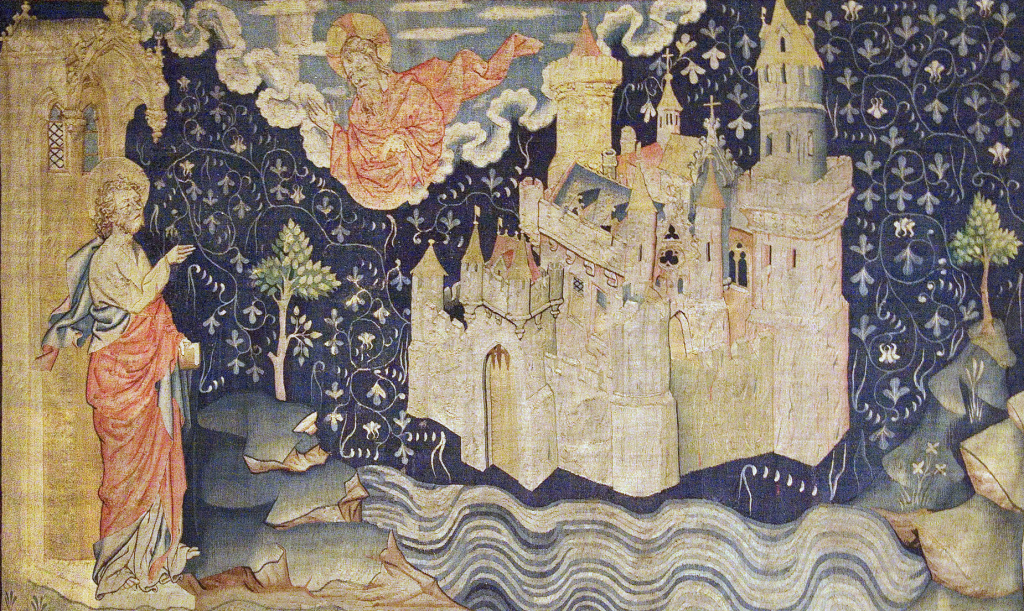
A 14th century tapestry of the Apostle John’s vision of the New Jerusalem

The word of the Lord Almighty came to me.

This is what the Lord Almighty says: “I am very jealous for Zion; I am burning with jealousy for her.”

This is what the Lord says: “I will return to Zion and dwell in Jerusalem. Then Jerusalem will be called the Faithful City, and the mountain of the Lord Almighty will be called the Holy Mountain.”

This is what the Lord Almighty says: “Once again men and women of ripe old age will sit in the streets of Jerusalem, each of them with cane in hand because of their age. The city streets will be filled with boys and girls playing there.”

This is what the Lord Almighty says: “It may seem marvelous to the remnant of this people at that time, but will it seem marvelous to me?” declares the Lord Almighty.

This is what the Lord Almighty says: “I will save my people from the countries of the east and the west. I will bring them back to live in Jerusalem; they will be my people, and I will be faithful and righteous to them as their God.”

This is what the Lord Almighty says: “Now hear these words, ‘Let your hands be strong so that the temple may be built.’ This is also what the prophets said who were present when the foundation was laid for the house of the Lord Almighty. Before that time there were no wages for people or hire for animals. No one could go about their business safely because of their enemies since I had turned everyone against their neighbor. But now I will not deal with the remnant of this people as I did in the past,” declares the Lord Almighty.

“The seed will grow well, the vine will yield its fruit, the ground will produce its crops, and the heavens will drop their dew. I will give all these things as an inheritance to the remnant of this people. Just as you, Judah and Israel, have been a curse among the nations, so I will save you, and you will be a blessing. Do not be afraid, but let your hands be strong.”

This is what the Lord Almighty says: “Just as I had determined to bring disaster on you and showed no pity when your ancestors angered me,” says the Lord Almighty, “so now I have determined to do good again to Jerusalem and Judah. Do not be afraid. These are the things you are to do: Speak the truth to each other and render true and sound judgment in your courts; do not plot evil against each other, and do not love to swear falsely. I hate all this,” declares the Lord. (New International Version)

The name “Zechariah” means “Yahweh remembers.” The Lord indeed remembers the divine covenant which was established. And God will fulfill all promises made.

The Lord is determined to do good – not really because people so much deserve it but because it is God’s character to be good, and thus, do good, even when there is little goodness on the earth to be found.

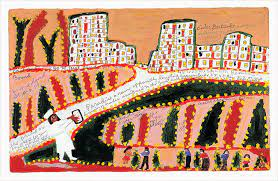
New Jerusalem by Sister Gertrude Morgan (1900-1980)

God’s judgment is but for a moment; but the Lord’s promise, salvation, and peace shall endure forever. God’s wrath is quite real and certain, yet it is a brief extension of the Lord’s steadfast love. Rebellion and judgment are never the last words; forgiveness and grace are:

Many times he [Yahweh] delivered them [the Israelites],
    but they were rebellious in their purposes
    and were brought low through their iniquity.
Nevertheless, he regarded their distress
    when he heard their cry.
For their sake he remembered his covenant
    and showed compassion according to the abundance of his steadfast love.
He caused them to be pitied
    by all who held them captive. (Psalm 106:43-46, NRSV)

All of the Old Testament prophets end their message of impending judgment with the final note of hope. That is, it won’t always be this way. There are better days ahead. The Lord’s coming is not all wrath; it’s mercy and hope. Notice the five brief messages of hope which Zechariah gives the people:

1. Yahweh burns with jealousy for Zion

Throughout the Bible, God likens the relationship to the Israelites much like a lover – as if the Lord were married to them. God’s covenant relationship with people is at the heart of understanding the whole of Scripture. Whenever they stray from divine promises, Yahweh is offended and hurt. 

God is an emotional Being, which is why we have emotions as people created in his image. Early humanity strayed so far from God that it hurt:

The Lord saw that humanity had become thoroughly evil on the earth and that every idea their minds thought up was always completely evil. The Lord regretted making human beings on the earth, and he was heartbroken. (Genesis 6:5-6, CEB)

Yet, God was gracious, sparing Noah and his family. The Lord took a group of Noah’s descendants, Abraham’s family, and set godly covenant affection on them. Through the Israelites, God hoped to lead the entire world to right relations. Yet, they, too, came to fail the gracious covenant made and set their affections on others.

Like a jilted lover, God longed for Israel to remain faithful, and, at the same time, was hurt and angry. Just as the prophet Hosea did not give up on his wife, even though she was brazenly unfaithful, so God looked at Israel as a spouse and could not bear to give her up.

2. Yahweh returns to Zion  

Jerusalem will be known as a faithful city and a holy mountain. The presence of God is what makes that happen. Because even though people can be fickle, inconsistent, complacent, and unfaithful, Yahweh remains true to the divine character of steadfast and immovable love for people.

You will never again be called ‘The People God Left.’
    Your land will never again be called ‘The Land God Destroyed.’
You will be called ‘The People God Loves.’
    Your land will be called ‘God’s Bride,’
because the Lord loves you,
    and your land will be his. (Isaiah 62:4, ERV)

3. The streets of Jerusalem will be full of children playing

The elderly will be sitting there watching the kids play, full of delight at the scene. Much too often we Westerners measure both the significance and success of our cities by its industry, businesses, buildings, wealth, and culture.

Methinks we may be misguided with such measurements. Instead, I suggest, along with the prophet, that we gage our cities by their effect on both the old and the young – because long life and children are signs of blessing from God.

4. Nothing is impossible with Yahweh

Is anything too hard for God? That, my friends, is a rhetorical question. If the Lord can cause old women to bear children (Genesis 18:10-14) and large armies to evaporate (Judges 7:1-25) then there is nothing more preposterous than to always view everything from our puny human perspective. Mary gained such a vantage and believed. We, too, have such an Advent hope within us.

“You will conceive and give birth to a son, and you are to call him Jesus. He will be great and will be called the Son of the Most High. The Lord God will give him the throne of his father David, and he will reign over Jacob’s descendants forever; his kingdom will never end.”

“How will this be,” Mary asked the angel, “since I am a virgin?”

The angel answered, “The Holy Spirit will come on you, and the power of the Most High will overshadow you. So the holy one to be born will be called the Son of God. Even Elizabeth your relative is going to have a child in her old age, and she who was said to be unable to conceive is in her sixth month. For no word from God will ever fail.”

“I am the Lord’s servant,” Mary answered. “May your word to me be fulfilled.” (Luke 1:31-38, NIV)

5. Yahweh renews and restores

Separation, diaspora, and disconnection will become a thing of the past. The Lord sets all things right again, brings people together, and heals, so that everything exists as it is meant to exist.

Deliverance from sin, death, and hell is the means of bringing renewal to the earth and its people. Salvation belongs to God. Righteousness and justice will characterize the future.

For the word of the Lord is upright,
    and all his work is done in faithfulness.
He loves righteousness and justice;
    the earth is full of the steadfast love of the Lord. (Psalm 33:4-5, NRSV)

Hope is fully realized when people put their trust in God and do their part by having strong hands and faithful hearts. We must be truthful and gracious whenever we speak. The Lord expects us to do the right thing by one another, both personally and publicly. We are to never cook up plans to take unfair advantage of others. Instead, we need to keep our lives simple and honest.

The promise of blessing is assured by God. However, the timing of that blessing is conditioned by our response. And there is no better time than the Christian season of Advent to recall what the Lord will do, as well as what God wants us to do.

May we be people of hope and let hope live in our hearts now and always, to the glory of God. Amen.

How You Are Matters (Ruth 4:13-17)

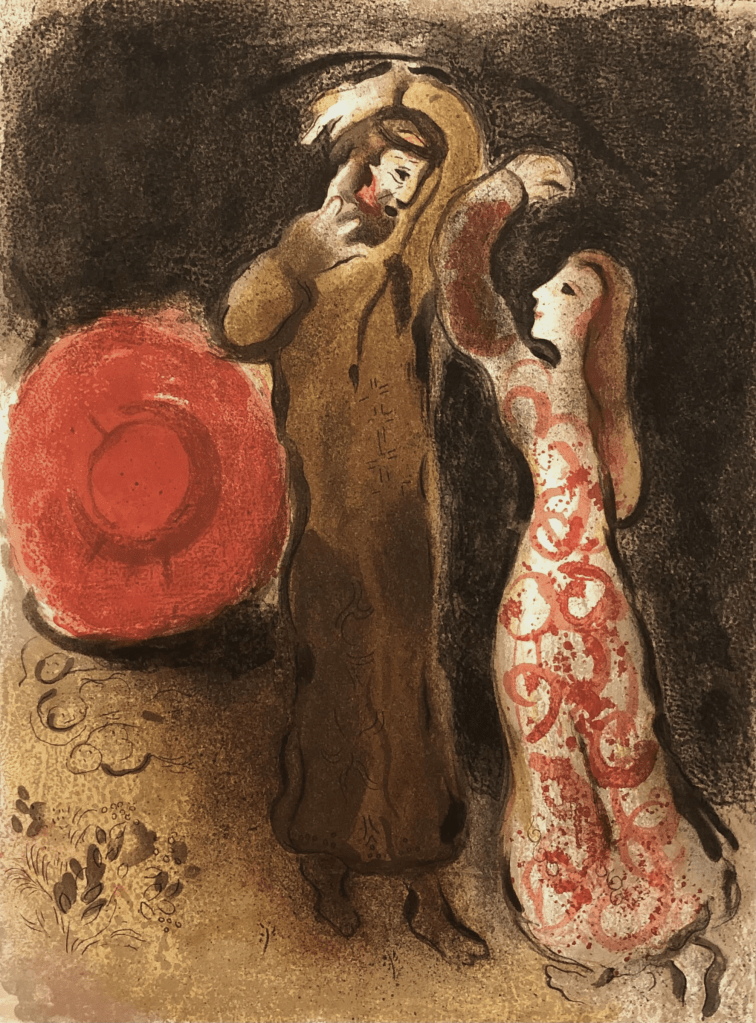
The Meeting of Ruth and Boaz by Marc Chagall, 1960

So Boaz took Ruth home as his wife. The Lord blessed her, and she became pregnant and had a son. The women said to Naomi, “Praise the Lord! He has given you a grandson today to take care of you. May the boy become famous in Israel! Your daughter-in-law loves you and has done more for you than seven sons. And now she has given you a grandson, who will bring new life to you and give you security in your old age.” Naomi took the child, held him close, and took care of him.

The women of the neighborhood named the boy Obed. They told everyone, “A son has been born to Naomi!”

Obed became the father of Jesse, who was the father of David. (Good News Translation)

Your Commitment Matters

Ruth, although not a Jew, committed herself fully to her Jewish mother-in-law and to the Jewish people. Her faithfulness mattered and eventually realized the blessing of family and community.

It wasn’t an easy path for Ruth to enjoy such blessing. She and her mother-in-law, Naomi, came to Bethlehem as two poor widows. Even though Bethlehem today is known around the world, back then there wasn’t much to it – just a small non-descript village in Judah a few miles south of Jerusalem.

Your History Matters

The Bible contains a lot of genealogies. Bible readers often skip over those portions of Holy Scripture to get to the more meaty and interesting stuff. But there’s a lot there.

Genealogies serve to remind us of who we are, where we have come from, and thus, what direction we are headed. Each and every human life has an historical context, a past which informs the present and can help guide for the future.

Naomi had a long history as part of the Jewish community. Ruth was a Moabite. Moab was an ancient kingdom which was located in the present day nation of Jordan. The original ancestor of the Moabites was Moab, a son of Lot. Lot was a nephew of the Jewish patriarch Abraham.

Moabites and Israelites didn’t get along. Moab had their own god, Chemosh, and did not serve Israel’s Yahweh. The person, Moab, was conceived under difficult and dubious circumstances – and it seems this context set the tone for the entire nation of people. (Genesis 19:30-38)

Our genealogical histories can bog us down or they can inspire us. Yet, the unseemly parts of our past family can actually serve to reveal something wonderful.

Your Receiving of Grace Matters

All genealogies are filled with less than stellar characters. But they’re also testaments to grace.

Both Ruth and her husband Boaz were recipients of the Lord’s grace.

Boaz, having a long history of the covenant as a Jew, nonetheless also had a difficult family past. Much like the conception of the ancient character of Moab, one of the ancestors of Boaz, Tamar, and one of the Jewish patriarchs, Judah, had a rather twisted experience. (Genesis 38:1-30)

Both Boaz and Ruth became great grandparents to King David. And they both are listed together in the opening genealogy of Matthew’s Gospel as ancestors to Jesus the Messiah, known as the son of David.

Grace changes history. If Jesus can have a genealogy, much like us, filled with both faithful committed people and dubious characters, then I believe we can give ourselves, and each other, a bit of slack on our shared human condition.

Your Spiritual Family Matters

For the Christian, there is an historical continuity across the millennia with our ancient spiritual forebears. The drama of redemption unveiled throughout the whole of Scripture connects us with Father Abraham, to the deliverance out of Egyptian slavery, to the saving events of Christ’s life, death, resurrection, and ascension, and beyond into the union of Christ and the Church.

A Moabite widow is redeemed into a new community. She marries a Jewish man and conceives a child in grace, born in the humble village of Bethlehem. Centuries later, another woman, Mary, experiences a conception of grace and gives birth to a child in the very same place – Christ the Lord, our Immanuel, God with us.

Jesus was born of David’s genealogical line, from ordinary people, just like Ruth and Boaz. Because it is only from humility that greatness can arise.

Your Faith Matters

Your faith and my faith grows in the context of an ordinary life. We live and move and have our being within the grace and providential care of God. Our faith is rooted in the soil of grace, anchored and moored in the deep of faithful servants who have gone before us.

Like Ruth, we humbly attach ourselves to a larger community and seek to give ourselves for the life of the world. Like Mary, we willingly confess to the angelic messenger:

“I am the Lord’s servant. May your word to me be fulfilled.” (Luke 1:38)

Our Father in heaven, you hold all that you have made within your gracious and merciful hand. Help us in all things to see your loving providence working out a good plan for the earth. Just as Ruth from Moab became one of your people, so you call us by name and hospitably invite us to your Table.

In Jesus Christ, our Redeemer, you meet us in the ordinary routines of our lives. You have graciously taken our pains, fears, sorrows, bitterness, guilt, shame, and sins upon yourself and given us a new life and a new community.Turn our suffering to glory, and our tears into joy.

Holy Spirit, giver of life, you guide us into grace and truth through generous love. As Boaz went out of his way to provide abundance for a poor widow, let us be generous with both our speech and our actions. Teach us to be alert to the needs of others so that everyone may have their daily bread.

Blessed Holy Trinity – Father, Son, and Spirit – the God whom we serve, you are our past, present, and future. We give you praise and commit ourselves to the words and ways of Jesus, in whose name we are bold to pray. Amen.