Faith Is More than a Feeling

“Isn’t it obvious that God-talk without God-acts is outrageous nonsense?” 
(James 2:17, The Message)


I recently bought a shirt.  The first time I put it on, a button fell off.  You know, when I buy a shirt, I expect it to hold up under normal conditions of wear and tear.  But if I wear it once and it tears, or I wash it the first time and it falls apart in the washer, that shirt did not stand up to the test of being an active shirt.  We have reasonable expectations that things will hold up to real life conditions.  If I have a new car that breaks down after a few hundred miles, then I call that car a lemon because it did not stand up well to normal driving conditions.  In the case of a shirt or a car or any other product, if it does not accomplish its intended purpose, I get another one.
 
            When it comes to our “faith,” if it continually does not stand up to the normal rigors of living the Christian life, then I need a new life because my faith is not active.  A strong robust faith in Jesus Christ does not just come by looking good in the store or at the car lot; genuine faith is active and can stand the muster of adversity.
 
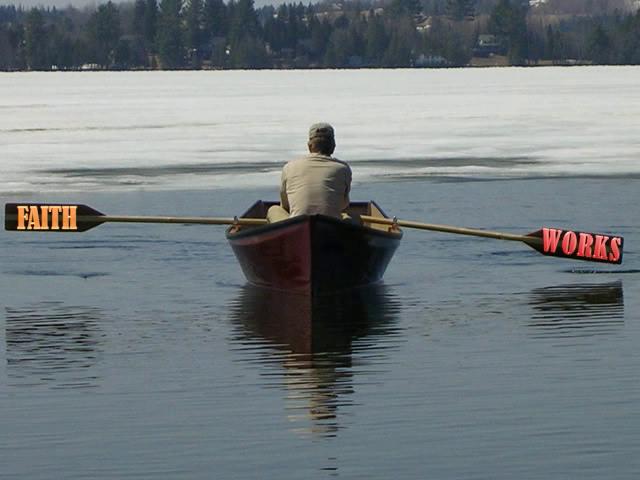
            Real faith is not just a matter of words and feelings; it is a matter of deeds and actions.  “What good is it if a person claims to have faith but has no deeds?” the Apostle James asked the church.  This is meant to wake up his readers so that they will realize that true faith is always active.  “Can such faith save him?”  (James 2:14-17).  No, it cannot.  That is the point.  A faith that is not active is not really faith at all.  But, you might wonder, I thought works did not save us.  No, they do not.  The Apostle Paul typically talked about the relationship between faith and works before a person has a conversion to Christ, whereas James talks about the role of works to faith afterwe have professed faith in Christ.  Paul said that works cannot bring us to Christ; James said that once we come to Christ, works are a necessity.  In fact, Paul put it all together in Ephesians 2:8-10 – “For it is by grace you have been saved, through faith – and this not from yourselves, it is the gift of God – not by works, so that no one can boast.  For we are God’s workmanship, created in Christ Jesus to do good works, which God prepared in advance for us to do.”
 
            James is not discussing how to become a believer in Jesus, but how a believer in Jesus ought to live.  And he does this by giving an illustration of the relationship between faith and works.  If someone is in need and expresses a sentimental feeling, even if that feeling is sincere, without backing it up with action – that expression is only that – it does not help.  I once came home after a long day at work on Valentine’s Day.  I picked up some flowers at a drive through flower shop.  I walked into the door and handed my wife the flowers with an “I love you.”  Then, I sat down in a heap and turned on the TV.  What was her response, you ask?  It was not very favorable toward me.  But I felt real feelings for her, and gave her some flowers, even though they were not very good looking ones.  What was the problem?  I did not really put any thought or action behind Valentine’s Day, and she knew it.  My words of “I love you” just did not sync well with my actions. 
 
            If we want to be people of faith in Jesus, our actions will perfectly sync with our words.  For example, when we say “I will pray for you” it needs to be much more than an expression of concern – we need to actually spend the time and commitment it takes in praying for them.
 
            Faith is more than feelings.  Faith cannot exist or survive without deeds.  Works are not an added extra to faith any more than breathing is an added extra to the body.  We need them both in order to live the Christian life. 
 
–If we say worship of God is important, what will our actions be like? 
–If we say the Bible is important, what will our actions be like? 
–If we say that everyone needs the good news of Jesus Christ, what will our actions be like? 
–If we say that family is important, what will our actions be like? 
–If we say that our youth are a priority to the church, what will our actions look like?


            Christianity is much more than a sentimental religion.  Real faith in Jesus is always expressed through both loving words and loving actions.  What is the Holy Spirit saying to you?  Is there a potential action he wants you to do?  Will you do it?  How will you do it?  When will you do it?  Real faith stands up when it is tested.

Galatians 3:23-29

            Ever since the fall of humanity those many millennia ago, people have had the predilection to organize themselves in groups that keep them distinct from other groups.  Whether it is high school peer groups or office politics; whether it is class warfare or church cliques; there has always been this tendency to think better about the groups we identify with, and to look down and believe the worst about those we don’t understand or just don’t plain like.
 
            But Jesus is the person that changes it all.  “Faith in Christ Jesus is what makes each of you equal with each other, whether you are a Jew or a Greek, a slave or a free person, a man or a woman.”  I’m not sure the English translations of Paul’s phrasing here can truly capture his emphatic pathos about this issue.  For Paul, Christ’s cross has done so much more than bring personal salvation; it has completely eradicated prejudice, discrimination, and division.  The church is to be the one place on earth where divisions do not exist anymore.  It is to be a foretaste of heaven. 
 
            Since the ground is level at the cross, we are to live into Christian unity with an attitude of humility and meekness, and with actions of gusto.  One way of doing this is to simply walk across the room and meet a new person and engage them in some meaningful dialogue.  Walk across the street and talk with a neighbor for whom you think you have little in common with. 


            Gracious God, you have abolished barriers through the redemption of Christ.  Prevent me from erecting walls that would divide and use me to be a bridge so that others may experience equality in Jesus.  Amen.

Poverty, Plenty, and Paradox


The brother in humble circumstances ought to take pride in his high position.  But the one who is rich should take pride in his low position because he will pass away like a wild flower (James 1:9-10).
 
            Webster defines a paradox as “a statement that is seemingly contradictory or opposed to common sense and yet is true.”  The Bible contains a lot of paradoxes, telling us that the ones who give receive, the weak are strong, the empty are full, the slave is free, the cursed are blessed, and that death brings life – all statements which first strike the ear as contradictory, but when we think about them we realize they are true.  The pithy Englishman G.K. Chesterton once gave this insightful definition of a paradox:  “A paradox is truth standing on its head shouting for attention.”  Paradox can be a powerful vehicle for truth, because it makes us think.
 
The poor person is rich.
 
            The Christian in humble circumstances, the lowly poor person actually has a high position because:  poverty enables him to be open to God; and, the pressures of poverty lead him to rely on God’s enablement and provision.  Whenever you find yourself with few material possessions; when you work hard but struggle to keep food on the table; and, find it difficult to pay the bills – then, you are stripped of the illusion of independence and are left vulnerable before God.  And it is in this state of humility that the believer in Jesus cries out to God, recognizing his dependence.  Trust is no option, but absolutely necessary for survival.
 
            What God deems important is a broken, humble, and contrite heart.  God cares about our poverty of spirit.  A person can be economically disadvantaged, but, at the same time, be spiritually advantaged.  We are loved by God not because of either wealth or poverty, but because we realize we desperately need to trust in him.
 
            The Scripture’s use of paradox calls us to make a choice:  Will we pour our lives into things, or into people?  Will we look for ingenuity and technical solutions in order to make our personal and church budgets budge, or will we come to God?  Will we define success in family and church as worldly wealth, or will we define success as acting justly, loving mercy, and walking humbly with our God?
 
The rich person is poor.
 
            It is difficult for wealthy people to trust in God and not in their riches.  Anyone who trusts in things is the truly underprivileged person.  A sirocco wind is a weather name given to hot and humid southeast to southwest winds originating as hot, dry desert-air over North Africa, blowing northward into the southern Mediterranean basin.  The early believers all knew about these winds that could unpredictably come through their area and wither perfectly good and apparently strong plants.  But those plants could not stand a sirocco wind.  Trusting in our resources rather than God will not stand in the judgment.


            The real issue is one of trust – locating and placing faith in the person and work of Jesus, and not in wealth with the influence and security it brings to life.  We live in a time when many church leaders are nearly obsessed with the ability to measure everything from numbers to quantifying spiritual growth and development.  Incredible amounts of money go into budgets, buildings, and programs.  The book of James in the New Testament gives a pushback on our compulsion with money and measurement.  Perhaps declining churches are in a humble state to recognize God; maybe growing churches are in need of better listening skills in order to hear God.  Before making new plans or just maintaining the old status quo in the church, several slow and careful readings of James just might give us some guidance and wisdom of where our real efforts in ministry need to be directed.

Rejoice in Hard Circumstances


“Consider it pure joy, my brothers and sisters, whenever you face trials of many kinds because you know that the testing of your faith develops perseverance.” (James 1:2-3)
 
The book of James in the New Testament of the Bible was written to a group of Christians struggling to make their way far from their land of origin in an alien country.  If you put yourself in the position of these Jewish Christian refugees, leading off with this kind of an exhortation seems a bit over the top.  Telling them to consider their situation as pure joy is a really hard pill to swallow.  I am not sure what the believers were thinking when they first heard this from James, but they must have thought the guy was crazy.  These are people who have experienced not only hard things, but have felt the brunt of living in a broken and fallen world.  To tell hungry families with no wealth or status who were wondering where their next meal is coming from that they ought to consider their situation as pure joy may seem strange, even calloused. 
 
            But James was looking to fortify the believers with some important truth.  When we get a cut or a laceration, the first thing that needs to happen is to apply peroxide to the wound so that there will be no infection that results from the injury.  It might seem insensitive because to get peroxide in an open wound stings like nothing else.  But it has to happen.  It is a necessary part of the coping and healing.  James actually cared enough about the people to tell them what they absolutely needed to hear right up front.  Without a positive, godly, and wise perspective on their situation, they would not make it.  Infection would set in and destroy the fledgling church.
 
            Suffering in the form of spiritual peroxide is absolutely necessary.  To just say what itching ears want to hear helps no one.  Suffering is a significant part of the Christian life.  God never promised anywhere in the Bible that life would be and should be all bunnies and unicorns.  In fact, he promised just the opposite – that everyone who wants to live for Jesus in this present broken world will have a hard time.  It is not a matter if you will face the testing of your faith; it is a matter of wheneveryou face trials.
 
            But the good news is that through the adversity God is producing in his people patient endurance, which is necessary to the development of our faith.  We can only become mature Christians through adversity, by having our faith tested in the crucible of hard circumstances.
 
            Faith is not a neutral or static thing.  Faith is an active dynamic thing that is always either developing or degenerating.  Without spiritual peroxide, faith will degenerate and become putrid.  Eventually, gangrene will set in and something will have to be amputated.  If you do not want to experience that, then we will need to learn how to experience joy in the middle of hard things.
 
            It seems to me that one of the tragedy of today’s American church is that we can live a trivial, blasé, and superficial existence as believers in Jesus Christ and get away with it because we have the ability to be independent, self-sufficient, and hold our own.  We don’t really need the church.  We say we need God, but then turn around and live our lives as if he isn’t even there.  The peroxide that we need in our lives for this day and for this time is that we are doing everything but exercising spiritual disciplines that would put us in touch with Jesus.  Church is optional.  Reading our Bibles is not a matter of life and death.  Prayer only happens if I want or need something, and is not a means of connecting with Jesus.  Giving and service happens if I have any discretionary time and money. 


            The Christian life was not meant to be easy!  It is challenging, it is hard; and, in the middle of that it can be invigorating and joyful.  Yes, joyful.  This is where our brothers and sisters throughout the world who undergo adversity to their faith every day can teach us.  Americans might have the money, but others have a unique spiritual depth of faith forged in the fires of resistance to governments and cultures that actively put them to the test.  And, despite their hardship, many know the joy of living for Jesus, while far too many in the West live dull depressed lives devoid of real faith.  Let us pray boldly for one another so that together we can realize a genuine faith in Christ that glorifies God and edifies his church.