
Exodus 10:21-29 – From Darkness to Light

Darkness

Then the Lord said to Moses, “Stretch out your hand toward the sky so that darkness spreads over Egypt—darkness that can be felt.” So, Moses stretched out his hand toward the sky, and total darkness covered all Egypt for three days. No one could see anyone else or move about for three days. Yet all the Israelites had light in the places where they lived.

Then Pharaoh summoned Moses and said, “Go, worship the Lord. Even your women and children may go with you; only leave your flocks and herds behind.”

But Moses said, “You must allow us to have sacrifices and burnt offerings to present to the Lord our God. Our livestock too must go with us; not a hoof is to be left behind. We have to use some of them in worshiping the Lord our God, and until we get there, we will not know what we are to use to worship the Lord.”

But the Lord hardened Pharaoh’s heart, and he was not willing to let them go. Pharaoh said to Moses, “Get out of my sight! Make sure you do not appear before me again! The day you see my face you will die.”

“Just as you say,” Moses replied. “I will never appear before you again.” (NIV)

The ancient Israelites were in bondage to the mighty Egyptian empire. After four-hundred years of bondage, God called Moses to lead them out from Egypt to the Promised Land. The only kink was the Egyptian Pharaoh’s outright reluctance. As the most powerful human on the planet at the time, Pharaoh was used to getting his way on everything. God knew it would be a process of deliverance, and not just a sudden event.

So, a series of ten wonders or miracles occurred that struck at the heart of Egyptian power and religion. A discernible pattern quickly developed in which Pharaoh refused cooperation; God sent an incredible devastation on the land; Pharaoh relented with a half-repentance; God lifted the devastation; and, with things “back to normal” Pharaoh’s heart was hardened and he would not let God’s people go. Rinse and repeat a lot more times.

Today’s Old Testament lesson recounts the ninth wonder done by God, using Moses. Although the miracle of complete and total darkness lasted a full three twenty-four-hour long days without harming any human or animal, the sheer fear and terror it brought to the Egyptians left them in a three-day state of suspense. Living on the edge in anxious apprehension is psychologically overwhelming. At least with the other plagues, you could see what you were up against.

Fear in the dark

In the land known as the “eternally rising sun,” the uncertainty of the perpetual darkness was meant to humble Egypt and put it in its place. Yet, with nine strong and full wonders from God, Pharaoh remained intransigent and stubborn. He was not going to let all that slave labor walk away while he was in charge.

I “wonder” what it takes for most of us to make a major change in our lifestyle – what we need to go through before we cry “uncle” and let go. The more power and control we have, the harder it is to do so. Humans are creatures of habit, and wherever there are long standing routines there you will find great difficulty in changing those practices.

No one simply wakes up in the morning and decides to be a jerk. Instead, it is likely that one day a person will arise, look in the mirror, and not recognize who is looking back at them. A series of choices and habits over a long stretch of time eventually formed the undistinguished blockhead. The Apostle James once described the pathology behind the person in the mirror:

You are tempted by the evil things you want. Your own desire leads you away and traps you. Your desire grows inside you until it results in sin. Then the sin grows bigger and bigger and finally ends in death. (James 1:14-15, ERV)

By reading today’s story Christologically we have a clue as to the remedy and reformation needed to form newer and better habits. Just as all Egypt was in three days of darkness due to sin, so Jesus was three days in the dark grave because of the world’s sin. And just as the ancient Israelites were delivered from their cruel bondage from Egypt and entered the Promised Land, so in Jesus Christ humanity is liberated from their power-hungry, money-grubbing, control-obsessing ways of being insensitive dolts to forming new habits of humility, justice, and love. The Apostle Peter said:

You are a chosen race, a royal priesthood, a holy nation, God’s own people, in order that you may proclaim the mighty acts of him who called you out of darkness into his marvelous light. (1 Peter 2:9, NRSV)

It is the aim of the Christian to look out at the world and bring love where love is not; to discover it is more blessed to give than to receive; and, to have a deep sense of justice which works for egalitarian ways and the equity of all people, not just people of privilege.

So, may we gain a proper perspective of ourselves, others, and the world. And, may we resist the Pharaoh’s among us, while championing the needs of the downtrodden of this old fallen world. May we be like Christ and see Jesus in each person we encounter.

God, you have given all peoples one common origin. It is your will that they be gathered as one family in yourself. Fill the hearts of humanity with the fire of your love and with the desire to ensure justice for all. By sharing the good you give us, may we secure an equality for all our brothers and sisters throughout the world. May there be an end to division, strife, and war. May there be a dawning of a truly human society built on love and peace. We ask this in the name of Jesus, our Lord, through the might of the Holy Spirit. Amen.

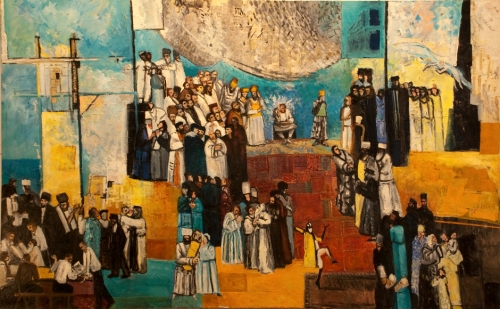
Exodus 3:16-25 – A Great Reversal

Moses and the Children of Israel by Richard McBee
“Moses and the Children of Israel” by Richard McBee

“Go, assemble the elders of Israel and say to them, ‘The Lord, the God of your fathers—the God of Abraham, Isaac and Jacob—appeared to me and said: I have watched over you and have seen what has been done to you in Egypt. And I have promised to bring you up out of your misery in Egypt into the land of the Canaanites, Hittites, Amorites, Perizzites, Hivites and Jebusites—a land flowing with milk and honey.’ 

“The elders of Israel will listen to you. Then you and the elders are to go to the king of Egypt and say to him, ‘The Lord, the God of the Hebrews, has met with us. Let us take a three-day journey into the wilderness to offer sacrifices to the Lord our God.’ But I know that the king of Egypt will not let you go unless a mighty hand compels him. So, I will stretch out my hand and strike the Egyptians with all the wonders that I will perform among them. After that, he will let you go. 

“And I will make the Egyptians favorably disposed toward this people, so that when you leave you will not go empty-handed. Every woman is to ask her neighbor and any woman living in her house for articles of silver and gold and for clothing, which you will put on your sons and daughters. And so, you will plunder the Egyptians.” (NIV) 

Moses spent forty years in the back side of the desert tending sheep. The first forty years were lived in the most powerful place on earth at the time, Egypt. Although Moses had a privileged position, he forsook his place to be in solidarity with the enslaved Israelites. With a skewed sense of timing and method, he slew a cruel Egyptian, and was forced to flee into the desert. 

The time eventually became ripe, and God was on the move. At eighty years old, God called Moses out of the desert and back to Egypt. The deliverance was going to be accomplished according to God’s designs and purposes, and not from the impetuous actions of a younger Moses. God knew exactly what he was doing and put Moses on a course which would strike at the heart of imperial Egypt and bring freedom to millions of slaves. 

Today’s story is laced thick with divine promises. After all, it is the promises of God which give people hope and a future. Referring to himself as the God of Abraham, Isaac, and Jacob, the Lord connects the generations-long covenant promise to the Israelites and reminded them they are not forgotten. God’s covenant has neither disappeared nor changed; it still exists. While the Jews were languishing in slavery, God was not aloof but watching – carefully inspecting, caring, and paying close attention. 

The inheritance of the Promised Land was coming, and it would be realized. God affirmed the covenant, knowing the plans he has for them – plans to give them abundance and joy. And God knew full well that dislodging the Israelites from Egypt would take some work, since Pharaoh relied so heavily on slave labor to support his massive imperial state. 

You, like me, have likely noticed that God tends to move rather slow by our standards. We might question and wonder about so much injustice going unabated for so long. Yet, that is our perspective of things, not God’s. Whereas we often have our own self-interest at mind, the Lord has the concern of an entire world. God is patient and long-suffering, providing full opportunity for both individual and national repentance. The Lord is on the lookout for people to amend their errant ways and return to their true purpose for living. He only judges at the proper time. 

And when that time comes, look out! Nothing can stand in the way of God’s good plans for the earth. The ancient Egyptians had built an empire on the backs of slavery, and everything went into supporting the power and wealth of the state. God was not okay with this situation. As he had done many times before, the Lord would thoroughly dismantle and destroy the powerful system of oppression. God is the expert at flip-flopping the status of people – the slaves become free, and the free are bound; the hated become favored, and those who enjoyed all the perks of power and privilege become the despised. 

Embracing God’s upside-down kingdom means advocating for justice, righteousness, and holiness for all people, not just a select few whom I like. Jesus, over 1,500 years after Moses and the exodus from Egypt, had this to say: 

“Those who are last now will someday be first, and those who are first now will someday be last.” (Matthew 20:16, NCV) 

“Blessed are you who are poor, 
    for yours is the kingdom of God. 
“Blessed are you who are hungry now, 
    for you will be filled. 
“Blessed are you who weep now, 
    for you will laugh. 

“Blessed are you when people hate you, and when they exclude you, revile you, and defame you on account of the Son of Man. Rejoice in that day and leap for joy, for surely your reward is great in heaven; for that is what their ancestors did to the prophets. 

“But woe to you who are rich, 
    for you have received your consolation. 
“Woe to you who are full now, 
    for you will be hungry. 
“Woe to you who are laughing now, 
    for you will mourn and weep. 

“Woe to you when all speak well of you, for that is what their ancestors did to the false prophets. (Luke 6:20-26, NRSV) 

And the Apostle Paul said to the Church: 

“For our present troubles are small and won’t last very long. Yet they produce for us a glory that vastly outweighs them and will last forever!” (2 Corinthians 4:17, NLT) 

The New Testament references are not meant to sanitize or put a positive spin on the very real suffering that so many people have endured both past and present. It is, however, meant to lift-up the reality that we have a sure and certain hope. Our trust in the promises and presence of God will eventually be realized and gives shape to how we live today in persistent prayers with patience and perseverance. 

So, may the Lord of all creation bless and protect you. May the Lord show you mercy and kindness in your affliction. And, may the Lord be good to you and give you peace. Amen. 

Exodus 2:11-15 – Time Out

A Time for Everything

In the course of time Moses grew up. Then he went to see his own people and watched them suffering under forced labor. He saw a Hebrew, one of his own people, being beaten by an Egyptian. He looked all around, and when he didn’t see anyone, he beat the Egyptian to death and hid the body in the sand.

When Moses went there the next day, he saw two Hebrew men fighting. He asked the one who started the fight, “Why are you beating another Hebrew?”

The man asked, “Who made you our ruler and judge? Are you going to kill me as you killed the Egyptian?” Then Moses was afraid and thought that everyone knew what he had done.

When Pharaoh heard what Moses had done, he tried to have him killed. But Moses fled from Pharaoh and settled in the land of Midian. (GW)

Faith is not a static phenomenon that one possesses, or not. Rather, faith is a dynamic movement which is continually either being strengthened or weakened through our life choices.  Moses needed to learn how to make healthy decisions of faith, just as much or more than the rest of us.  The fact that he was eighty years old before he became the human agent of God’s deliverance of the Israelites from the Egyptians, after a forty year stint in the backside of the desert, tells us that it took him awhile to mature.  Even though Moses may have had a sense that the Israelites needed freedom from slavery and acted on that sense by killing a ruthless Egyptian, his method and sense of timing were off.

There is a time for everything, said the writer of Ecclesiastes.  Wisdom, which is the ability to apply faith to concrete situations with appropriate forms, is often in the timing of things.  To know when to speak and when to listen, when to act and when to wait, is an important facet of faith.  The ancient Israelites were slaves in Egypt for a long time.  Moses knew they were suffering, and he acted in “good faith.” Yet, it was not yet time and it was a rash movement.  Eventually, the Jewish cry of suffering arose to God, and God heard them, remembering his covenant with them.  Why God did not act sooner, or use Moses earlier, is information that is only privy within God himself.

If we are to develop a strong and wise faith with an opportune sense of timing, we will need to rely on God.  Trusting in ourselves, our own efforts, and our own gauge of how things ought to proceed will usually not end well.  We may, like Moses, find ourselves taking a “time out” from God in obscurity until we learn to wait on him.

In the fullness of time, Paul said to the Galatians, Jesus came, born of a woman, born under law, to redeem those under the law (Galatians 4:4-5).  God knows what he is doing, even though it might seem like he is sometimes slow to act.  God sees.  God delivers.  And he does it in his timing – not ours.

Redeeming God, you control all things, including the clock.  Give me wisdom so that my sense of timing might reflect your will and your way, through Jesus Christ, your Son, who with you and the Holy Spirit reign supremely as one God, now and forever.  Amen.

Exodus 19:16-25 – An Awesome God

Mount Sinai

On the morning of the third day, thunder roared, and lightning flashed, and a dense cloud came down on the mountain. There was a long, loud blast from a ram’s horn, and all the people trembled. Moses led them out from the camp to meet with God, and they stood at the foot of the mountain.  All of Mount Sinai was covered with smoke because the Lord had descended on it in the form of fire. The smoke billowed into the sky like smoke from a brick kiln, and the whole mountain shook violently. As the blast of the ram’s horn grew louder and louder, Moses spoke, and God thundered his reply. The Lord came down on the top of Mount Sinai and called Moses to the top of the mountain. So, Moses climbed the mountain.

Then the Lord told Moses, “Go back down and warn the people not to break through the boundaries to see the Lord, or they will die. Even the priests who regularly come near to the Lord must purify themselves so that the Lord does not break out and destroy them.”

“But Lord,” Moses protested, “the people cannot come up to Mount Sinai. You already warned us. You told me, ‘Mark off a boundary all around the mountain to set it apart as holy.’”

But the Lord said, “Go down and bring Aaron back up with you. In the meantime, do not let the priests or the people break through to approach the Lord, or he will break out and destroy them.”

So, Moses went down to the people and told them what the Lord had said. (NLT)

As Christians await the Day of Pentecost and the giving of the Spirit, the Revised Common Lectionary reminds us of another great anticipation from the Old Testament. The ancient Israelites were amazingly delivered from Egyptian slavery, miraculously walked through the Red Sea, and traveled with wondrous anticipation to Mount Sinai. Now, in today’s reading, they are about to meet with God!

The scene of this meeting is not exactly the romantic highland encounter of the Man from Snowy River (my wife’s all-time favorite movie). The landscape is much more akin to the dark and volcanic Mount Doom from The Lord of the Rings. The picture appears more foreboding than loving. The thing about mountain top experiences is that they are not all monolithic one-size-fits-all encounters with bright rainbows and happy skipping unicorns.

Holy Scripture is replete with mountain experiences. Mountains serve as symbols for significant encounters with a mighty God. Whether it is Christ’s transfiguration on a mountain; or, the giving of the law on a mountain; the awesome mountain serves as a tangible symbol of divine majesty, strength, and sovereignty. And, I might add, conversely, valleys in Scripture are symbolic of difficulty and suffering.  Our God is a God of both mountain and valley. That is, the God of the Bible is both transcendent and immanent; he rules with power and might high above us on his holy mountain; yet, he also comes near to us in the valley of the shadow of death.

Leading up to the giving of the Ten Words (Commandments) in Exodus 20, Exodus 19 portrays an awesome scene of God in his transcendent holiness and power. In fact, the experience was so otherworldly that the people were afraid to even come near the mountain. The Israelites needed limits placed on themselves because of God’s holy presence. Just like coming too near the immense power of the sun will destroy us, so getting near God can ruin us if we do not respect his holiness.

Respecting God’s power and transcendence brings the reality of his immanence into greater appreciation. God has gone to extreme lengths to reveal himself to his people. For the Christian, it all culminates through the incarnation of Christ, the sending of the Son. In Jesus, the transcendence and immanence of God meet perfectly to bridge the chasm between humanity and the divine.  Because of Jesus, the awesome sounds of thunder and trumpet do not lead to fear; they announce grace to those who approach God by faith.

You have not come to a mountain that can be touched and that is burning with fire; to darkness, gloom and storm; to a trumpet blast or to such a voice speaking words that those who heard it begged that no further word be spoken to them, because they could not bear what was commanded: “If even an animal touches the mountain, it must be stoned to death.” The sight was so terrifying that Moses said, “I am trembling with fear.” But you have come to Mount Zion, to the city of the living God, the heavenly Jerusalem. You have come to thousands upon thousands of angels in joyful assembly, to the church of the firstborn, whose names are written in heaven. You have come to God, the Judge of all, to the spirits of the righteous made perfect, to Jesus the mediator of a new covenant….

See to it that you do not refuse him who speaks. If they did not escape when they refused him who warned them on earth, how much less will we, if we turn away from him who warns us from heaven? At that time, his voice shook the earth, but now he has promised, “Once more I will shake not only the earth but also the heavens.” The words “once more” indicate the removing of what can be shaken—that is, created things—so that what cannot be shaken may remain.

Therefore, since we are receiving a kingdom that cannot be shaken, let us be thankful, and so worship God acceptably with reverence and awe, for our “God is a consuming fire.” (Hebrews 12:18-29, NIV)

Our God is an awesome God. As Christians anticipate Pentecost, we connect the consuming fire of Mount Sinai with the fire of the Spirit. The divine drama of both experiences has provided God’s people with spiritual power. Both the deliverance of the Israelites from Egyptian slavery by God and the deliverance secured on Mount Zion from spiritual slavery by Jesus are meant to free us to do the will of God. With God’s Word and God’s Spirit given to us, we are emancipated from an empty way of life to experience the fullness of Christ.

May the Spirit who hovered over the waters at creation breathe life into your spirit.

May the Spirit whose presence on the mountain was a consuming fire grant you a revived spirit.

May the Spirit who overshadowed the virgin Mary at the conception of our Lord overwhelm your spirit with joy.

May the Spirit who set the Church afire on Pentecost aflame every spirit on earth with the love of Christ.

And, may the Spirit who exhorts, encourages, helps, and comforts be your blessing and your life today and always. Amen.